
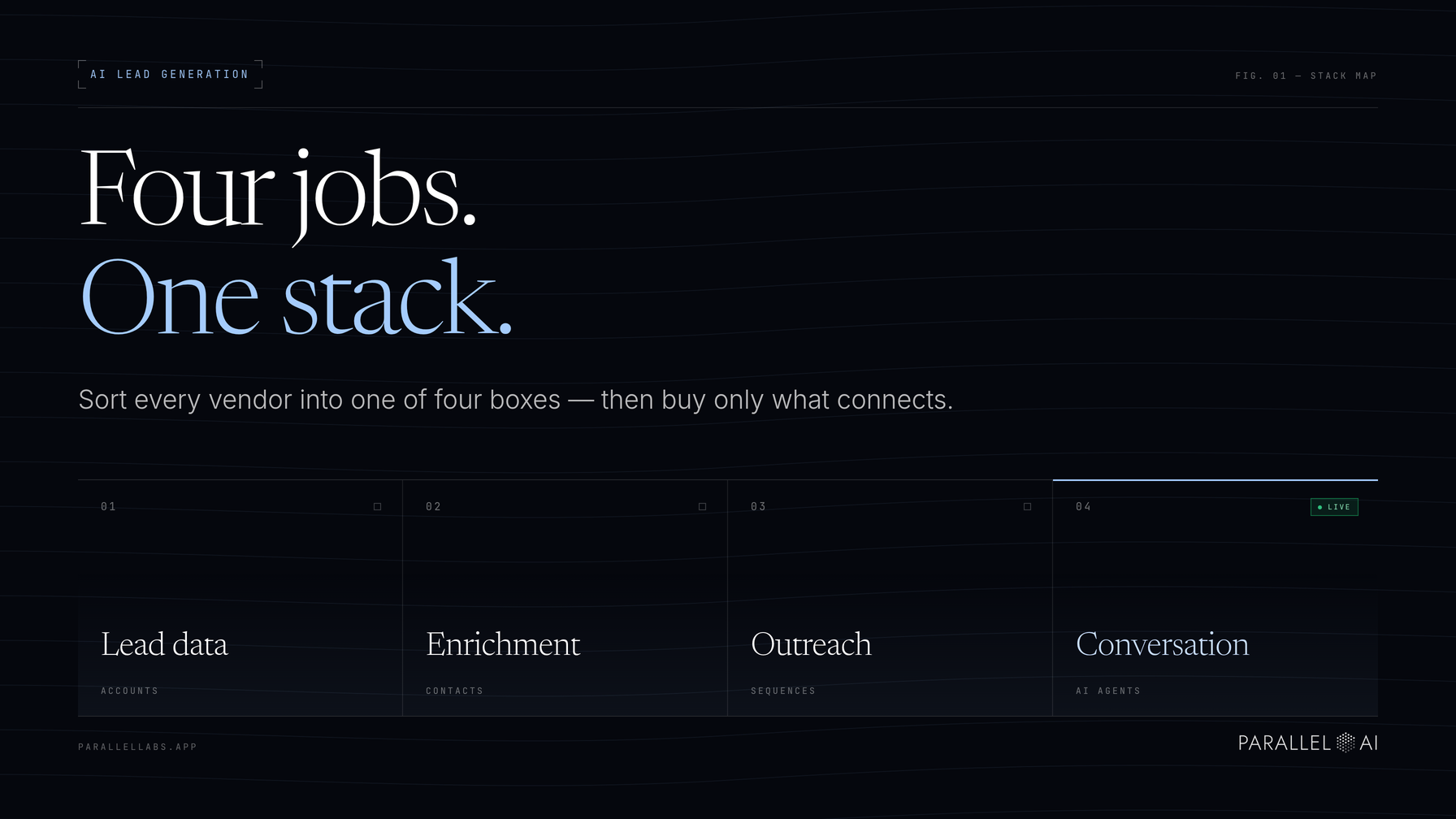
AI lead generation tools do one of four jobs. They find prospects, complete contact records, run outreach, or hold conversations for you. Sort any vendor into one of those boxes and choosing a stack stops being overwhelming. It becomes a sequence of practical decisions: what to buy first, how the pieces connect, and whether you need separate tools at all.
This guide maps the market into those four categories and walks through assembling a stack that holds together. It also compares point tools against all-in-one platforms on what matters to a lean team: cost, integration overhead, data consistency, and management burden. It's written for owner-led agencies that need prospecting to run steadily without a dedicated sales team or a dozen disconnected subscriptions.
The core trade-off looks like this:
| Consideration | Point tools | All-in-one platform |
|---|---|---|
| Cost structure | Several subscriptions, each priced and renewed separately | One subscription covering data, enrichment, outreach, and agents |
| Integration overhead | You build and maintain the connections between tools | Connections between functions are built in |
| Data consistency | Contact records duplicated across systems, drifting apart | One contact record shared by every function |
| Management burden | Multiple logins, vendors, and admin surfaces | One place to manage and train the AI |
| Best fit | Teams with an ops function or unusual specialist needs | Lean teams that need prospecting running without new hires |
The Four Categories of AI Lead Generation Tools
The market for AI lead generation tools is hard to compare. Vendors describe themselves in overlapping language: "AI-powered," "revenue intelligence," "growth platform." Function is a better lens than marketing copy. Map any vendor to the job it performs, and the market collapses into four categories.
Lead data and discovery
These tools answer the first question in any pipeline: who should we talk to? They build target lists from filters like industry, location, and headcount, then hand you a pool of accounts to work from. When you evaluate one, check two things. First, does it cover your market? A tool with strong national coverage may be weak on the local businesses many agencies sell to. Second, do its filters match how you define an ideal client?
Contact enrichment
Discovery tells you which accounts matter. Enrichment tells you who inside them to contact. These tools fill in decision-maker names, titles, email addresses, and phone numbers. When you evaluate one, ask about accuracy and how often records refresh. The bigger question is where the data ends up. Good tools write enriched records straight back into your outreach tool. Weak ones leave them in a spreadsheet until someone moves them by hand.
Outreach automation
These tools run the sequences: timed emails, follow-ups, and multi-touch outreach across channels. Personalization comes from the data layer. Check whether the tool supports the channels your prospects use. Look at how it handles replies, and whether a person can review drafts before anything sends. For an agency, brand voice is an asset. Automation should carry it, not flatten it.
Chat and voice agents
Chat and voice agents are the newest category. They sit on your website or phone line, answer questions, qualify inbound interest, and book meetings. They matter because speed of response often decides whether an inbound inquiry becomes a conversation. Check where the agent's knowledge comes from and what it's allowed to say. Most importantly, check how and when it hands a qualified conversation to a human.
How Do You Build a Stack That Holds Together?
Order matters more than brand names. Buy in the order the work flows: data first, then enrichment, then outreach, then conversational capture.
What to buy first
Start with lead data, because nothing downstream works without it. You can't enrich or sequence contacts you never found. Add enrichment second, since sequences built on incomplete records fail at the worst moment. Outreach automation comes third, once it has clean contacts to work with. Chat and voice agents come last in the buying order. Even so, they often deliver the fastest visible results, because they convert traffic you already have.
How the tools should connect
The spine of any stack is the contact record. Every function should read from and write to the same record. Enrichment updates it, sequences log against it, chat transcripts attach to it, and content created for that account references it. The second connector is a knowledge base: your approved service descriptions, pricing logic, and positioning. Whatever tool is speaking, it draws on the same source of truth.
Where the handoffs break
Fragmented stacks break at the handoffs between tools, not inside the tools themselves. The usual failure points:
- Enrichment updates never sync back, so sequences run on stale data.
- Replies land in one inbox while tasks and notes live in another.
- Content is drafted in a separate system, so outreach and marketing drift apart in message.
- Each tool keeps its own AI context, so none of them knows what the others learned about the account.
- Qualified inbound interest waits for someone to notice it.
If any of those describe your setup, the damage is coming from the gaps between your tools.
Point Tools vs. All-in-One Platforms: Which Fits a Lean Agency?
Point tools win when you need unusual depth, like a specialist data source for a narrow industry. They also win when someone on your team owns integration maintenance. If you already run a mature stack that works, replacing it carries its own cost.
For most owner-led agencies, the arithmetic points the other way. On cost, separate subscriptions for data, enrichment, outreach, chat, and content stack up fast. That's before you count the integration time between them. On data consistency, separate tools mean duplicate records and conflicting statuses. A unified platform means one record that everything touches. On management, every additional tool is another login, another admin surface, another place to train AI on your positioning. None of that bills to a client.
The honest test is whether you'd rather spend your week choosing and connecting tools, or running outreach with them.
What a Unified Platform Looks Like in Practice
Parallel AI is a useful example of where consolidation ends up. Its founder built Salesforce Marketing Cloud and the user growth platform at TikTok. The platform reflects that background: it was designed as one system rather than an assembly of parts. Lead data, contact enrichment, outreach sequences, chat and voice agents, and a content engine all share one contact record. They draw from one knowledge base too. You also get access to multiple frontier models (OpenAI, Anthropic, Gemini, Grok, DeepSeek) through a single subscription.
In practice, that shared structure changes how the stack behaves:
- An AI employee researches a prospect, and the enrichment it finds is already on the record the sequence will use.
- A chat agent qualifies an inbound inquiry and books the meeting. The transcript attaches to the same account the outreach history lives on.
- The content engine drafts the SEO post, LinkedIn update, or campaign asset from your approved positioning. Outreach and marketing end up saying the same thing.
- Your service information, processes, and messaging live in one knowledge base that every function draws from. You never re-train three separate tools to say the same thing.
For agencies exploring client-facing delivery, white-label capability lets you package the same platform as a service under your own brand. The stack you build for yourself can become a product you sell.
Build for the Handoffs, Not the Feature List
- Every AI lead generation tool performs one of four functions: lead data, enrichment, outreach automation, or chat and voice agents.
- Buy in the order work flows: data, then enrichment, then outreach, then conversational capture.
- Stacks fail at the handoffs more than at any individual tool: stale enrichment, orphaned replies, disconnected content.
- Point tools suit specialist needs and teams with ops capacity. All-in-one platforms suit lean teams that need prospecting running without new hires.
The simplest way to consolidate the whole stack is to try Parallel AI. It puts lead data, enrichment, sequences, chat and voice agents, and content on one shared contact record and knowledge base. Human review and brand voice stay under your control the whole time. Start there. And if you're weighing white-label delivery for clients, ask about the White-Label AI Services Launch Kit. It's a custom document plus a white-label demo built for your agency at no charge.