
If you’re a growth-stage B2B team, you know the drill. You’re juggling a CRM, an email sequencer, a lead database, an AI writer, a chatbot, a social scheduler, a voice dialer, and an analytics tool. All those separate subscriptions, sometimes eight or even seventeen. Data stays siloed, integrations go haywire every week, and the team spends more time filling out spreadsheets than actually selling. This tool sprawl is not just a headache; it’s draining your revenue. A smarter way has emerged for 2026: a single AI platform that handles prospecting, enrichment, scoring, and qualification on its own. It replaces that jumble of point solutions and can cut your total lead generation costs by half.
Let’s walk through the top tools, techniques, and automation strategies redefining AI lead generation today. We’ll break down how AI transforms raw data into a pipeline of sales-ready conversations, compare the leading platforms, and show you how to calculate the real ROI of consolidation.
Core Capabilities: Prospecting, Enrichment, Scoring, Qualification
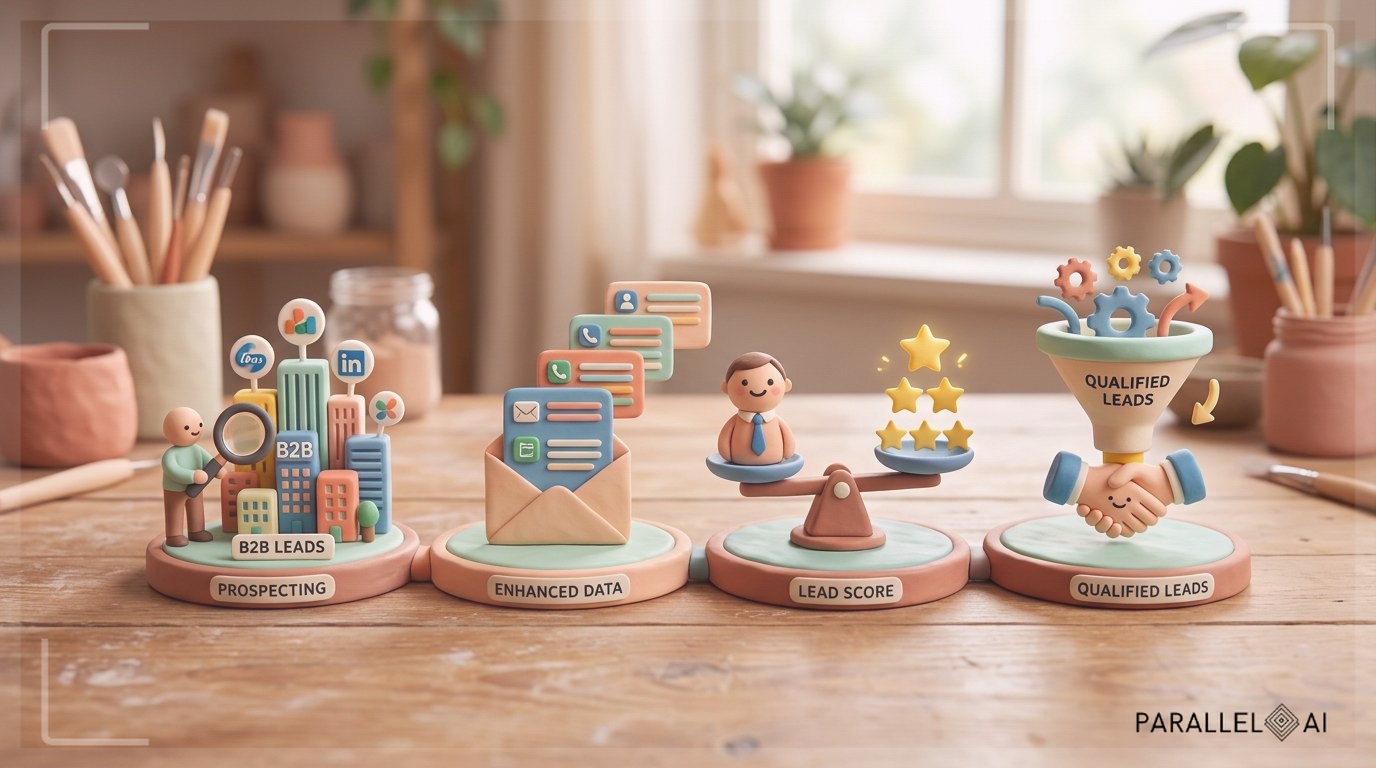
Traditional lead generation is a manual, multi-step slog. AI makes it a smooth, continuous workflow:
- Prospecting: AI scours company databases, intent signals, and social platforms to build targeted lists of ideal-fit accounts and contacts. No more manual CSV exports.
- Enrichment: Beyond basic firmographics, AI appends technographics, recent news, hiring trends, and buyer intent data. This turns a name and email into a multidimensional profile.
- Scoring: Machine learning models analyze historical conversion data and behavioral signals to assign a predictive score, pointing you to the leads most likely to close.
- Qualification: AI-driven questions, chatbot interactions, and automated email sequences engage prospects, capturing BANT (Budget, Authority, Need, Timing) information easily. The system then segments leads into hot, warm, or nurture buckets without an SDR lifting a finger.
How AI Lead Generation Actually Works in 2026
Here’s how it works under the hood. The AI taps into a constantly refreshed B2B contact database with millions of verified records. You describe your ideal customer profile with a simple prompt, like “SaaS companies in the US, 50–200 employees, hiring for sales roles.” The AI then builds a smart list, enriches each entry with over 50 data points, and applies a scoring model you can adjust. Qualified leads get automatically added to multi-channel sequences (email, voice, SMS, LinkedIn) that tailor messaging based on how each prospect behaves. All of this happens in one interface, and your CRM updates in real time.
Head-to-Head: Best AI Lead Generation Tools Compared
Not all AI tools are equal. The market splits between specialists and all-in-one platforms. Here’s how the top contenders stack up:
| Tool | Core Focus | Lead Enrichment | Automated Scoring | Multi-Channel Outreach | White-Label / Agency Features | Starting Price (per month) |
|---|---|---|---|---|---|---|
| Parallel AI | Single GTM platform (prospecting, enrichment, scoring, sequences, content, voice, chat) | Deep enrichment with 50+ data points, technographics, intent | Custom predictive scoring with AI models | Email, voice, SMS, sequences, social, chat | Yes, full rebranding and resale options | $297 (Business plan) |
| Clay | Data enrichment and waterfalling | Extensive, with 50+ providers | Basic scoring through integrations | None (relies on integrations) | No | Free tier; paid plans from $149 |
| Apollo.io | Lead database and sequences | Firmographics, buying signals | Lead scoring based on engagement | Email, calls, sequences | No | Free plan; paid from $49/user |
| Outreach | Sales engagement and sequences | Limited, through integrations | Limited built-in | Advanced sequences, voice, reporting | No | Custom pricing (starts ~$100/user) |
| Jasper | AI content creation only | None | None | None | No | $49/seat (Creator) |
Data as of mid-2026; pricing may vary.
How All-in-One Platforms Cut Cost and Complexity
When you use a patchwork of tools, you pay multiple subscription fees and the hidden “integration tax” (the hours your team spends moving data between systems, fixing sync errors, and learning each tool). An all-in-one platform like Parallel AI collapses the stack into one interface. That means:
- Costs drop by at least half. Replacing just five tools can save thousands a month.
- Data silos vanish. Contact, conversation, and behavioral data flow automatically from prospecting straight into your CRM.
- New reps ramp up faster. They only have to learn one system, not six.
- Your brand stays consistent. Email, voice, and chat all use the same on-brand AI voices and messaging.
Case Study: Parallel AI’s Smart Lists and AI SDR in Action
Take a Series A B2B SaaS company with 40 employees. They were using HubSpot, Outreach, ZoomInfo, ChatGPT, and a standalone chatbot. Total monthly spend was nearly $2,500. After moving to Parallel AI, the team used Smart Lists to prospect 2,000 target accounts in under an hour. The AI SDR enriched each lead with technographics, recent funding news, and hiring signals. Scoring surfaced 340 high-intent prospects. Then multi-channel sequences (email and AI voice calls) engaged those leads automatically. Within 30 days, their pipeline grew by 60%, and the platform cost fell to $297 a month. That’s $2,200 in savings every month, and they got back 15 hours a week that used to go toward managing tools.
Workflow Automation: From Lead Capture to CRM Update
AI lead generation does more than find leads; it moves them through the funnel without manual handoffs. Here’s how a typical automated sequence works in Parallel AI:
- Lead capture: A prospect fills out a form or interacts with the chat/voice bot on your site. The AI checks the database and appends full contact data at the same time.
- Enrichment & scoring: The lead is enriched with firmographics, tech stack, and intent signals. A score is assigned based on your model.
- Qualifying questions: If the score meets the threshold, the AI SDR sends a personalized email or voice message asking one or two BANT questions.
- CRM sync: All responses, engagement data, and lead status update in Salesforce/HubSpot in real time. No spreadsheets, no copy-paste.
- Hot lead handoff: When a lead is sales-ready, the assigned rep receives a Slack alert with a summary and suggested talk tracks.
Step-by-Step Lead Qualification with AI
Automated lead qualification is where AI truly shines. Here’s how it goes:
- Define ideal customer profile (ICP): Use natural language to describe your best customers. Industry, size, growth signals, pain points.
- Configure scoring criteria: Assign weights to data points like job title, intent keywords, technology used, and engagement (email opens, site visits).
- Engage automatically: AI chat or email asks qualifying questions (e.g., “Is your team actively evaluating solutions?”). Responses are parsed by NLP.
- Classify the lead: Based on answers and profile data, AI moves the lead to MQL, SQL, or nurture lists.
- Escalate to sales: Only truly qualified leads make it to a rep’s queue, so nobody wastes time on junk contacts.
ROI Analysis: Cost per Qualified Lead with AI vs. Manual
Here’s a cost comparison for a mid-market B2B team that generates 100 qualified leads each month:
- The old manual way: two full-time SDRs (about $10k/month loaded), plus ZoomInfo ($500/mo), SalesLoft ($300/mo), ChatGPT ($60/mo), and other tools ($200/mo). Total: around $11,060 a month, or $110 per qualified lead.
- With AI automation (Parallel AI): one SDR managing the platform ($5k/month), the platform costs $297/month, and you ditch the extra tools. Total: $5,297 a month. That’s $52.97 per qualified lead, a 52% drop.
And AI scales without extra effort. The same platform can handle 500 leads at almost no additional cost, while manual teams need more people.
Can AI Lead Generation Replace Manual Prospecting Entirely?
Not entirely, but it can replace about 80% of the repetitive work. AI is unmatched at data gathering, initial outreach, and lead scoring. Human SDRs are still vital for complex negotiations, relationship building, and creative personalization. The winning model in 2026 is “AI-augmented” teams: AI handles the volume and triage, while humans focus on high-value conversations. That hybrid approach raises conversion rates and cuts burnout.
Conclusion: The Future of AI-Driven Pipeline Generation
The fragmentation era is over. In 2026, the smartest GTM teams are trading their stack of point solutions for a single AI engine that can prospect, enrich, score, qualify, and engage, all from one seat. The payoff: big cost savings, faster pipelines, and a sales team that sells instead of pushing paper.
If you’re tired of paying for 17 tools and a spreadsheet nobody updates, it’s time to experience a single platform that does it all. The future of lead generation isn’t about more tools; it’s about smarter automation and consolidation.
Want to see what AI can do for your pipeline? Start your free trial of Parallel AI today and build your first Smart List in under an hour.
Related reading
- The Essential AI Resource Toolkit: 12 Free and Premium Tools Every Solo Consultant Needs in Their Stack
- AI Lead Generation in 2026: Tools, Strategies, and Best Practices
- AI Content Generation for Marketing Agencies: Trends & Strategies
- AI for Small Business: Affordable Automation Tools to Compete with Big Brands