
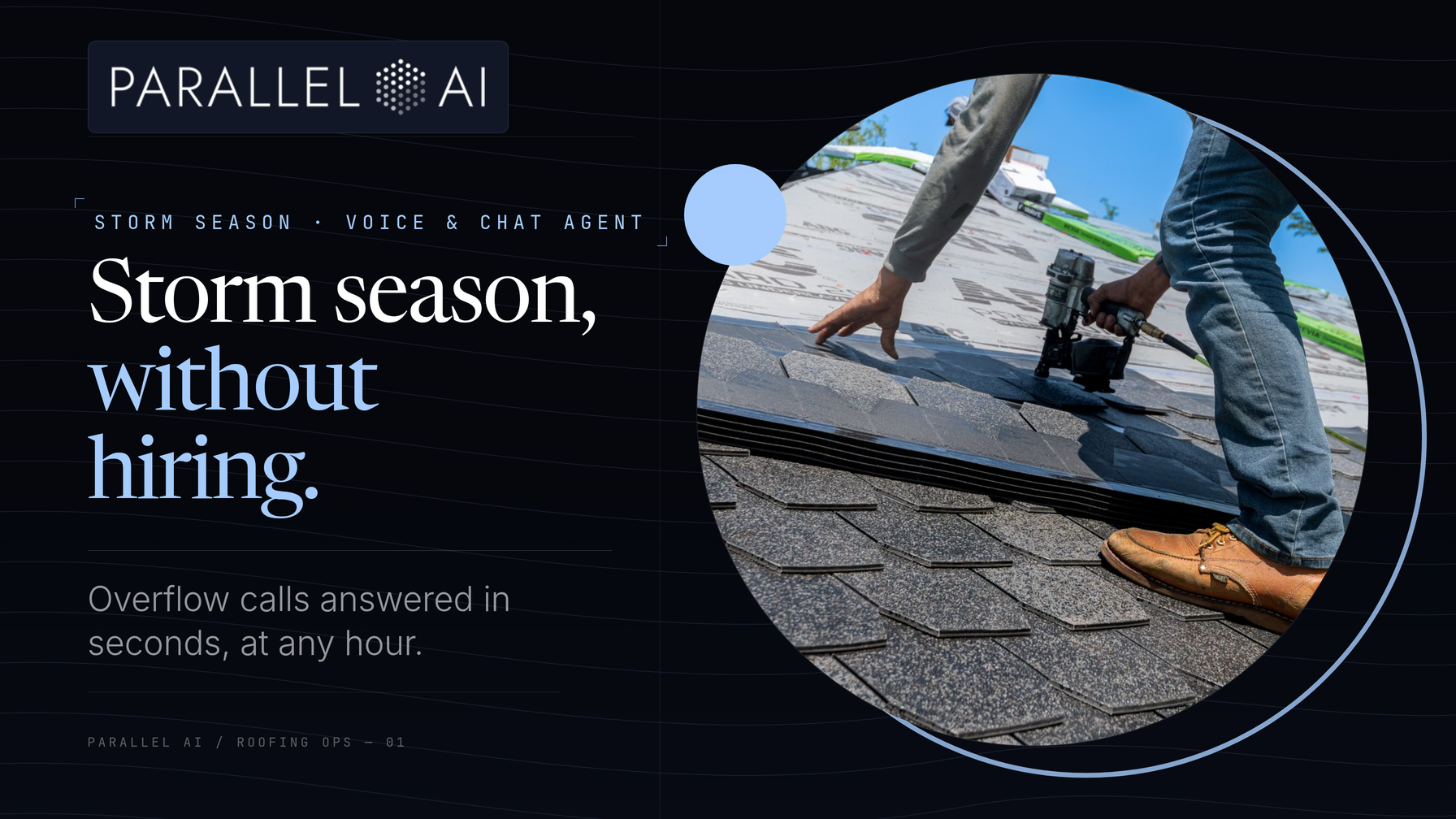
Yes, roofing companies are using AI to absorb storm-season call volume, qualify and follow up on leads, and keep local marketing consistent, all without adding headcount. AI for roofing companies works because it removes the speed bottleneck that storms create: the sudden pile of calls, forms, and quote requests that a lean office simply cannot answer fast enough. If you run an owner- or partner-led roofing business, you know the cycle. Quiet stretches where the phone barely rings. Then a hailstorm hits your service area and everything piles up at once. Miss those calls and you miss the jobs that fund the rest of your year.
This post covers the practical ways roofing contractors use AI today: a voice and chat agent answering overflow calls after a storm, smart lead lists built around storm-affected neighborhoods, automated follow-up on unsent estimates, and a content engine that keeps your site ranking for local storm searches. We'll close with setup steps and the guardrails that keep a human in charge of every customer-facing message.
Why Storm Season Breaks Manual Roofing Operations
Storm season exposes the weak points in a lean roofing operation. The problem isn't effort. It's that everything funnels through the same few people at exactly the moment capacity matters most.
Consider a typical week after a hail event. Calls spike, but your estimators are already on roofs. Voicemails go unanswered past business hours, and a homeowner who called three companies books with whoever called back first. Website form submissions sit in an inbox until someone has time to sort through them. Estimates promised on Monday get pushed to Thursday because crews are slammed. By then the homeowner has signed elsewhere.
Each missed touchpoint is a job lost. Not because your work wasn't good, but because your response wasn't fast. Referrals and local reputation get you into consideration. Speed and consistency close the deal. AI matters here precisely because it removes the speed bottleneck without removing you from the conversation.
How an AI Voice and Chat Agent Handles Overflow Calls
An AI voice and chat agent answers the calls and website inquiries your team can't get to during a surge. Immediately, at any hour, with consistent answers.
Here's how it works in practice. A homeowner calls at 7:40 p.m. after spotting a leak. Instead of voicemail, the AI receptionist picks up. It captures the caller's name, address, damage description, and insurance situation, then books an inspection directly onto your estimator's calendar. It can answer common questions too: whether you work with their carrier, what a tarp-over costs, how soon you can get someone out. All of it comes from an approved knowledge base you control.
The guardrail matters more than the automation. Anything outside the script escalates. Total losses, active leaks flooding a living room, anything requiring a judgment call gets routed to a human right away, with the full context attached so nobody repeats intake questions.
The result is a triage layer. Your people spend their hours on roofs and closings instead of repeated intake calls, and no lead sits overnight unanswered.
Finding Property Owners in Storm-Affected Areas
After a storm, the fastest-moving roofing companies don't wait for inbound calls. They build lists of the property owners most likely to need them and reach out first.
With an AI platform, you can build a smart lead list around a storm footprint: neighborhoods by zip code or radius, filtered by property type and owner role. The system enriches those contacts and runs segmented outreach. That might be email sequences and LinkedIn messages tailored to the situation, whether that's a hail damage assessment offer for residential owners in Oakview or a roof-condition pitch for commercial property managers.
The practical workflow after a storm event looks like this:
- Define the affected geography and property profile.
- Build and enrich the contact list.
- Launch a short, relevant sequence: assessment offer, timeline, insurance guidance.
- Have your team follow up by phone on the prospects who engage, where permitted.
The point isn't volume. It's relevance. You reach the right property owners while the damage is fresh and the decision is live, instead of relying on whoever happens to drive past your truck.
Following Up on Estimates Before They Go Cold
Unsent and unanswered estimates are the most expensive leak in most roofing businesses, and the easiest one to fix with automation.
Set up a follow-up sequence that triggers when an estimate is created but not signed. Over a few weeks, the prospect receives a series of touchpoints: the estimate recap, answers to common objections like insurance timeline and financing options, a relevant FAQ, and a final nudge with a clear next step such as booking the crew before the season's calendar fills.
Every message draws from your approved knowledge base, so pricing logic and policy answers stay consistent across the team. And because it's a sequence rather than a sticky note on a monitor, no estimate falls through when your office manager is out or your estimator is buried.
For relationship-driven bids, think commercial reroofs, HOA work, multi-property contracts, AI handles the reminders and materials while you handle the conversations. Extended consideration cycles get the repeated, relevant touchpoints they need without demanding repeated manual effort from you.
Publishing Local Storm-Season Content That Ranks
Roofing customers search locally and seasonally: "hail damage roof repair [city]," "does insurance cover wind damage," "how long does a roof replacement take." A content engine keeps you ranking for those searches without a marketing hire.
Instead of staring at a blank page each month, you define the topics. Storm-season checklists, insurance claim walkthroughs, material comparisons, answers to the questions your estimators already field daily. The AI drafts posts and FAQs built around your service area and service lines. You review for accuracy, because you're the expert, and publish on a schedule that compounds.
This does two things. It feeds local SEO so homeowners in your footprint find you when they search, and it becomes the source material your AI agent uses to answer inquiries. A well-maintained knowledge base and a strong content library reinforce each other. Every accurate answer on your site is one your agent can give on the phone.
For multi-location or multi-brand operators, the same engine keeps messaging consistent across offices: same storm policies, same warranty language, same intake questions, without someone manually reconciling pages.
Setting Up AI for Roofing Companies Without Losing the Human Touch
Adoption works best when it starts narrow and expands only after the workflow proves itself. A realistic sequence for an owner-led roofing operation:
Week 1: Stand up the AI receptionist. Load your approved knowledge base: service areas, insurance carriers you work with, inspection process, typical timelines. Route escalations to a designated person.
Weeks 2–3: Add estimate follow-up sequences. Map your unsent-estimate flow, then build the touchpoint series. Have a human approve the first batch of messages before they run unattended.
Weeks 3–4: Launch one content stream and one prospecting campaign. Pick your highest-value service line, storm repair is usually it, and publish around that. Build one list around one storm event or service area, not ten.
Ongoing: Review and expand. Each week, review what the agent handled, what escalated, and what content performed. Add service lines once the pattern is stable.
Insist on a few guardrails from day one: human approval of outgoing outreach before sequences run, clear escalation paths for sensitive or urgent inquiries, and a knowledge base only you can update. Homeowners are trusting you with their biggest asset. The technology should speed up your response, never replace your judgment.
One Platform Instead of Five Subscriptions
Most roofing companies that adopt AI piecemeal end up with a chatbot from one vendor, an email tool from another, a content subscription from a third, and no shared record of the customer. A homeowner who called Monday gets an email Tuesday that doesn't know they called.
A unified platform fixes that. Parallel AI consolidates voice, chat, email, LinkedIn outreach, and content generation into one system: one contact record per prospect, one knowledge base powering every channel, and one credit balance instead of five subscriptions. You see the whole journey in one place, from the storm-week call to the unsent estimate to the follow-up sequence to the signed job.
That's the fit for an owner-led operation. Enough automation to absorb storm-season spikes, enough oversight that your name still stands behind every interaction.
Start With Your Next Storm, Not a Big Bang
AI for roofing companies isn't a future concept. It's how lean operations already handle the surge that used to require hiring. The pattern is consistent: answer every call instantly, follow up on every estimate, reach the right property owners first, and publish the local content that keeps you findable.
Parallel AI makes that pattern manageable for a roofing business without a marketing department. Start your 7-day free trial and set up your AI receptionist and first follow-up sequence this week, before the next storm rolls in and the phone starts ringing off the hook.