
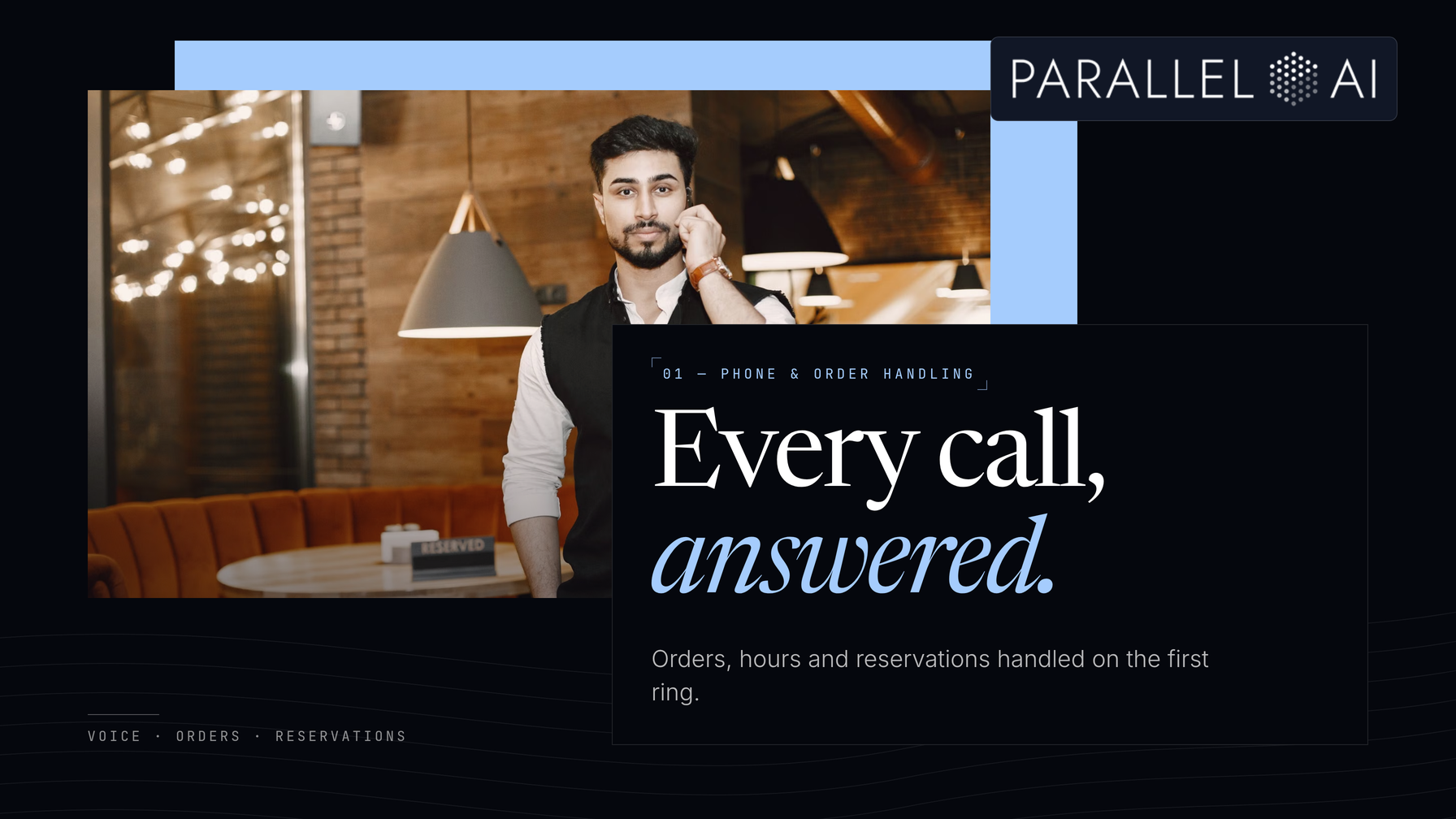
AI for restaurants is already answering phones, taking orders, booking tables, and running marketing for independent and multi-location operators. The restaurants doing this well aren't the ones with big tech budgets. They're the ones that started with a focused problem, like missed calls during Friday dinner rush, and expanded from there. This guide covers the four areas where AI is delivering real value right now: phone and order handling, marketing content and local SEO, review and social management, and outreach for catering and events. Each section includes steps you can follow without a technical team.
How do AI phone agents take orders and handle reservations?
An AI voice agent answers your restaurant's phone, takes carryout and delivery orders, fields questions about hours and menu items, and books reservations. No person has to pick up the line. On a busy Friday night, that means every caller gets an answer on the first ring instead of a busy signal or a hold queue.
What a phone agent can actually handle
Most independent restaurants underestimate how much of their call volume is routine:
- Order taking for carryout and delivery, read back and confirmed
- Menu questions like "Do you have gluten-free options?" or "What's in the special?"
- Hours, address, parking, and dress-code questions
- Reservation booking and confirmation
- Routing complex calls, such as catering or private-event inquiries, to a manager
How to set one up
- Write your call script the way you train a new host. What do you say when you answer? Which questions do you always ask? What should never be said?
- Upload your menu and policies. A knowledge base lets the agent answer accurately instead of guessing. If an item runs out, update it in one place.
- Decide on escalation rules. Which calls always go to a human? Complaints, large-group bookings, press. Set those rules explicitly so nothing sensitive gets mishandled.
- Test during slow hours first. Run the agent alongside your normal answering for a week, review the transcripts, and correct mistakes.
- Roll out to peak hours. Once accuracy is where you want it, let the agent handle the rush.
The common mistake is trying to automate everything on day one. Restaurants that start with order-taking and simple questions see the fastest payoff, because those calls eat the most staff time and callers need them answered fast.
Can AI handle your restaurant's marketing content and local SEO?
Yes. AI for restaurants can draft website copy, blog posts, menu descriptions, event pages, and Google Business Profile updates, and it can do it consistently across locations. Consistency is where most restaurants struggle. One owner posts when there's time, the website hasn't been updated in two years, and each location's pages tell a slightly different story.
What to generate and where it goes
A content engine can produce:
- Location pages optimized for "[cuisine] restaurant in [city]" searches
- Seasonal and event landing pages for holidays, Restaurant Week, and local festivals
- Blog posts answering the questions diners actually search, like "best patio dining in [area]" or "where to book a group dinner near [landmark]"
- Menu descriptions that sell, not just list
- Email campaigns announcing new items, seasonal menus, and promotions
A repeatable monthly workflow
- Pick four to eight topics tied to what you want to sell more of. Group dining, weekday lunch, catering.
- Generate drafts with your brand voice, service details, and local context loaded into the platform.
- Review for accuracy: prices, hours, ingredients. A human should always approve anything customer-facing.
- Publish across your website, Google Business Profile, and email list.
- Track which pages drive calls and reservations, and double down on those.
For multi-location operators the win is bigger. One workflow publishes to every location's pages and profiles, with location-specific details filled in automatically.
What about review responses and social posting?
AI can draft responses to every review, positive and negative, and keep your social calendar full while you keep the final say on what goes out. Reviews are one of the biggest local ranking and conversion factors for restaurants. They're also the first thing that gets neglected when service gets busy.
Review response that protects your reputation
- Draft replies to every review within 24 hours, in a tone you approve
- Flag reviews that need a manager's personal attention, like food-safety complaints or staff issues, instead of auto-responding
- Keep responses consistent with how your best manager would reply in person
Social posting without the blank page
A good workflow: batch-generate a month of posts at once, schedule them, and review comments weekly. Posts about specials, staff, behind-the-scenes prep, and local partnerships perform well. AI can draft them from a few bullet points you provide.
One guardrail worth repeating: never let review responses or public posts go out without human review in sensitive situations. A drafted reply to a food-safety complaint should always be read by a person before it posts.
How does AI help restaurants win catering and group bookings?
AI can build prospect lists, run outreach sequences, and follow up on catering and event inquiries automatically. This is where most restaurants leave money on the table. A quote request that goes unanswered for three days is usually a lost booking, and catering leads come in through forms, email, phone, and walk-ins all at once.
A simple outreach system
- Build your list. Identify the businesses, offices, schools, and venues within your delivery radius that order catering. Sort by industry, size, and location.
- Write a segmented sequence. An office manager booking monthly team lunch needs different messaging than a wedding venue needs for event catering. Tailor by buyer, not just by account.
- Follow up on inbound inquiries promptly. Every form submission and voicemail triggers a response within hours, with the details sent to whoever handles catering.
- Track touchpoints. Relationship-driven catering sales often take five or more relevant touches. A sequence keeps that from depending on someone's memory.
Handling the awkward parts
Phone and SMS follow-up works for catering outreach, but consent matters. Use it for people who've given you their contact information, and honor opt-outs immediately. The same rules that apply to your guest list apply to your prospect list.
How Parallel AI brings AI for restaurants together in one platform
Most restaurants that try AI end up with a phone agent from one vendor, a social tool from another, a content subscription from a third, and a stack of logins nobody fully owns. Parallel AI consolidates all of it: voice and chat agents for orders and inquiries, a content engine for website and local SEO material, smart lead lists and outreach sequences for catering and events, and review and social automation. All of it sits under one login, with human review at every step.
A few things worth knowing:
- AI employees do the routine work. Agents handle order-taking, hours questions, and reservation booking, and escalate anything sensitive to your team.
- Your knowledge base keeps answers accurate. Menus, policies, and service details live in one place, so every agent and piece of content uses the same facts.
- Outreach runs across email, LinkedIn, phone, and SMS with sequences you set up once and review as leads respond.
- Content goes through human review before it publishes, because your reputation is worth more than any time savings.
- If you work with an agency, Parallel AI is available white-label, so your agency can deliver the whole capability under its own brand.
Start with one use case and grow from there
The restaurants getting real results from AI aren't overhauling everything at once. They pick one problem, whether that's missed calls, stale website content, or slow catering follow-up, solve it, measure it, and expand. Here's how to begin:
- Choose the most expensive routine problem you have. For most, it's missed calls during peak hours or unanswered quote requests.
- Set it up narrowly. One agent, one workflow, one measure of success.
- Review the output for a few weeks. Read transcripts, check drafts, correct mistakes.
- Expand only when the first use case is running smoothly.
If you run a single location, start with a phone agent and one location page. If you operate multiple locations or brands, start where visibility is weakest and use that location as the template.
Where to go next
Parallel AI brings your restaurant's orders, inquiries, content, and outreach into one platform, so you keep the personal touch your guests expect while AI handles the routine work pulling your team away from the dining room. Start a Parallel AI trial today. Pick one use case, whether that's orders, local SEO, or catering outreach, and see what a unified platform does for your restaurant's revenue before committing to anything bigger.