
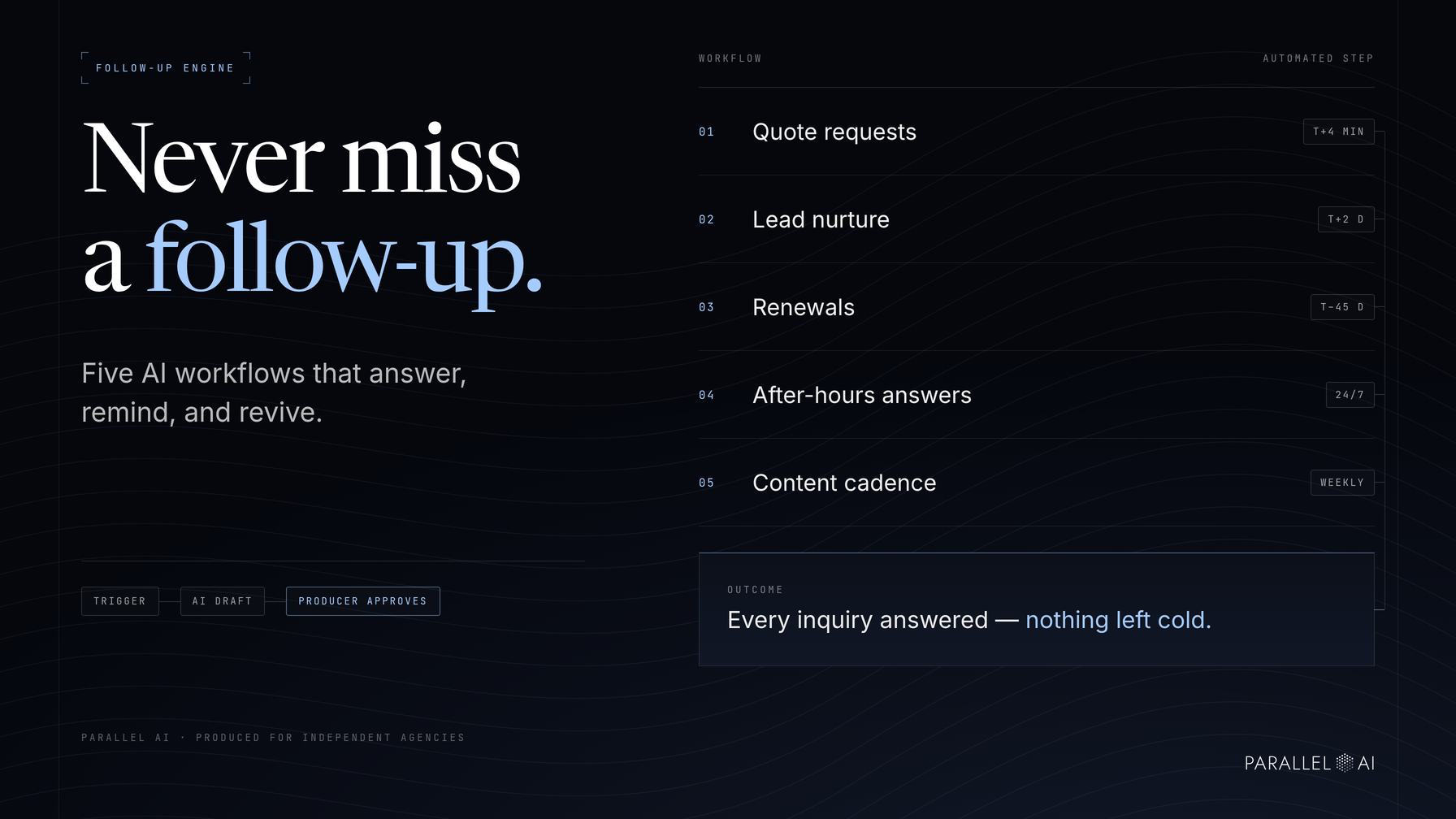
AI for insurance agents pays off fastest in one place: follow-up. Agencies getting results aren't using AI to replace producers. They're using it to make sure no quote request, renewal, or client question sits unanswered. That means instant acknowledgments when a quote request lands, renewal reminders prepared weeks ahead, steady touchpoints between first contact and bind, after-hours answers to routine questions, and useful content that keeps the agency visible between conversations.
For an independent agency where producers spend most of the day servicing accounts and nobody owns marketing full-time, that combination converts more of the interest you already generate. This post covers five follow-up workflows worth automating, how they fit together in Parallel AI, the review steps that keep communications accurate, and what to verify before adopting any platform.
Which follow-up tasks should AI handle at an insurance agency?
The highest-return AI tasks share two traits: a clear trigger and a defined next step. A quote request triggers follow-up. An expiration date triggers a renewal review. A client question triggers an answer or an escalation. Five workflows fit that description at almost every independent agency.
1. Quote requests that never go cold
A commercial-lines quote request arrives through your website form at 4:47 on a Friday afternoon. The producer is out with a client. By Monday, the prospect has already talked to two other agencies. Speed decides a surprising share of commercial business, and speed is exactly what a busy office struggles to deliver consistently.
An AI workflow closes that gap. The system acknowledges the request within minutes, asks the clarifying questions a producer would ask (operations, payroll, vehicle count, property details), and drafts a response for review. If the quote goes unanswered, a personalized email sequence revives it: a recap of coverage highlights on day two, an industry-specific question on day five, and an invitation to compare options side by side on day ten. The producer approves every message. AI handles the timing.
2. Nurturing leads between first contact and bind
Business insurance decisions often take weeks, and silence during those weeks loses deals that were yours to win. AI keeps a steady, relevant cadence going without adding work for producers: a check-in after the first meeting, a plain-English explanation of the difference between a BOP and a package policy, a reminder ahead of the prospect's renewal date with their current carrier.
A prospect comparing general liability options might receive a two-week sequence answering the questions they were going to search for anyway, with each message drafted by AI and reviewed by the producer before it sends. The prospect hears from your agency consistently. Your producers spend their time on conversations instead of remembering who to email.
3. Renewals that stay on schedule
Renewals are the easiest revenue to protect and the easiest to lose to inattention. Scheduled AI tasks prepare renewal work weeks in advance rather than leaving it to whoever notices the expiration date first.
Here's a typical structure. Sixty days out, the system assembles current coverage details and flags changes worth discussing. Forty-five days out, it drafts a renewal review email for the account manager to approve. Thirty days out, it creates a phone follow-up task if the client hasn't responded. The account manager keeps the judgment and the relationship; the AI makes sure the calendar never slips.
4. Routine client-service questions, answered on first contact
Most inbound client questions are routine: billing inquiries, certificate-of-insurance requests, "does my policy cover a rented trailer?" A chat agent trained on your agency's approved knowledge base answers those instantly, including after hours, when clients and prospects are most likely to fill out your contact form. Voice agents can capture detailed messages from callers and route each request to the right person.
The boundary matters as much as the capability. Anything involving a claim, a coverage dispute, or a question requiring licensed judgment escalates to a person right away. The AI absorbs the routine so your team can focus on the conversations that need them.
5. Staying visible between conversations
Follow-up isn't only direct replies. Prospects who aren't ready today need to keep finding your agency when they search. AI content workflows produce service-specific local articles, like workers' compensation basics for roofing contractors, what a certificate covers for property managers, and cyber liability questions for small medical practices. These answer what your ideal clients type into a search bar.
Each article is drafted by the content engine and reviewed by someone at the agency before publishing, so the information is accurate and the voice is yours. Published consistently, these pieces do quiet follow-up work for years. They feed local search visibility and give producers something genuinely useful to send.
How do these AI for insurance agents workflows come together in Parallel AI?
Parallel AI organizes all of this as AI employees. Each agent has a defined role, a knowledge base, and clear boundaries, and they all run on one platform instead of a stack of disconnected subscriptions.
Each AI employee takes on a specific job. A quote follow-up agent handles new inquiries. A renewal coordinator runs the renewal calendar. A service-desk chat agent answers inbound questions from your website, with voice agents covering the phone side. Because every employee draws on the same approved knowledge base, clients get consistent answers whether they email, call, or chat.
Behind the front-line agents, Smart Lists build researched prospect lists by industry, role, and location. Sequences run personalized multi-channel outreach across email and LinkedIn, with phone or SMS follow-up where it's appropriate and permitted. The content engine drafts the local SEO articles and email pieces those sequences send. Everything routes through review steps, so nothing reaches a client without a person approving it.
The platform's background shapes how it's built. Parallel AI's founder built Salesforce Marketing Cloud and the user growth platform at TikTok, and the product reflects that: growth infrastructure a lean agency can actually operate, not a generic AI wrapper. That distinction matters in a market crowded with tools that demo well and overburden small teams.
How do you keep AI accurate and on-brand in insurance?
Accuracy comes from structure: an approved knowledge base, drafts instead of auto-sends, and escalation rules that route anything sensitive to a licensed person.
Start with the knowledge base. Load your service descriptions, answers to the questions clients ask most, your processes, and notes on tone. Every AI employee works only from that material, which keeps answers consistent across producers, offices, and channels.
Then require human approval on anything outbound. AI drafts the quote follow-up, the renewal reminder, and the LinkedIn message; a producer or account manager reviews and sends. That single step prevents the generic, off-key outreach that damages a trusted local brand. And reviewing a draft usually takes less time than writing the message from scratch.
Finally, set explicit escalation rules. Claims, coverage disputes, complaints, and anything requiring a coverage opinion go straight to a person. The AI's job is to make routine work invisible so human judgment gets full attention.
What should a lean team check before adopting an AI platform?
Judge any platform on whether it connects to a workflow you can name, such as quote follow-up, renewals, or inbound inquiries, and whether a team without a marketing department can run it. Five checks cover most of it:
- Specific workflow fit. Can the platform handle quote follow-up at an agency like yours, rather than "AI" in the abstract?
- Line-of-business separation. Commercial and personal lines need different messaging. Does the platform segment audiences and tailor content, or send one generic version?
- Review and escalation controls. Are approvals and hand-offs to licensed staff built in?
- Setup weight. Can an office manager get a working workflow running in days, without a marketing-operations hire?
- Pricing that earns its keep. The subscription should prove itself on the first use case before you expand.
Setup in Parallel AI follows the same logic. Pick one workflow; quote follow-up is the most common starting point because results show up fast. Build the knowledge base. Configure the AI employee and its approval steps. Run it on a handful of real quotes and watch response times and reply rates. Only then add renewals, the service desk, or content.
Start With One Workflow, Then Expand When It Proves Itself
The pattern across every workflow here is the same. AI handles timing, drafts, and routine answers, while licensed people keep the judgment and the client relationships. Quote requests get answered in minutes instead of days. Renewals run on a calendar instead of on memory. Leads hear from your agency consistently between first contact and bind. Routine questions get answers after hours, and sensitive ones reach a person immediately.
The next step is to see this applied to your agency specifically. Parallel AI will build an AI Receptionist demo and a Local Growth Plan, a custom document plus a white-label demo configured for your agency, at no charge, so you can watch the follow-up workflow run before changing anything about how you operate. Start with the one use case that costs you the most business today, and expand only once the value is clear.