
The business development scene just shifted in ways most solopreneurs haven’t caught onto yet. While everyone’s talking about AI replacing jobs, a quieter revolution is playing out: solo consultants and micro-agencies are closing enterprise partnerships that used to require full BDR teams. They’re doing it without six-figure salaries, without complex CRM infrastructures, and without losing the personal touch that wins high-value deals.
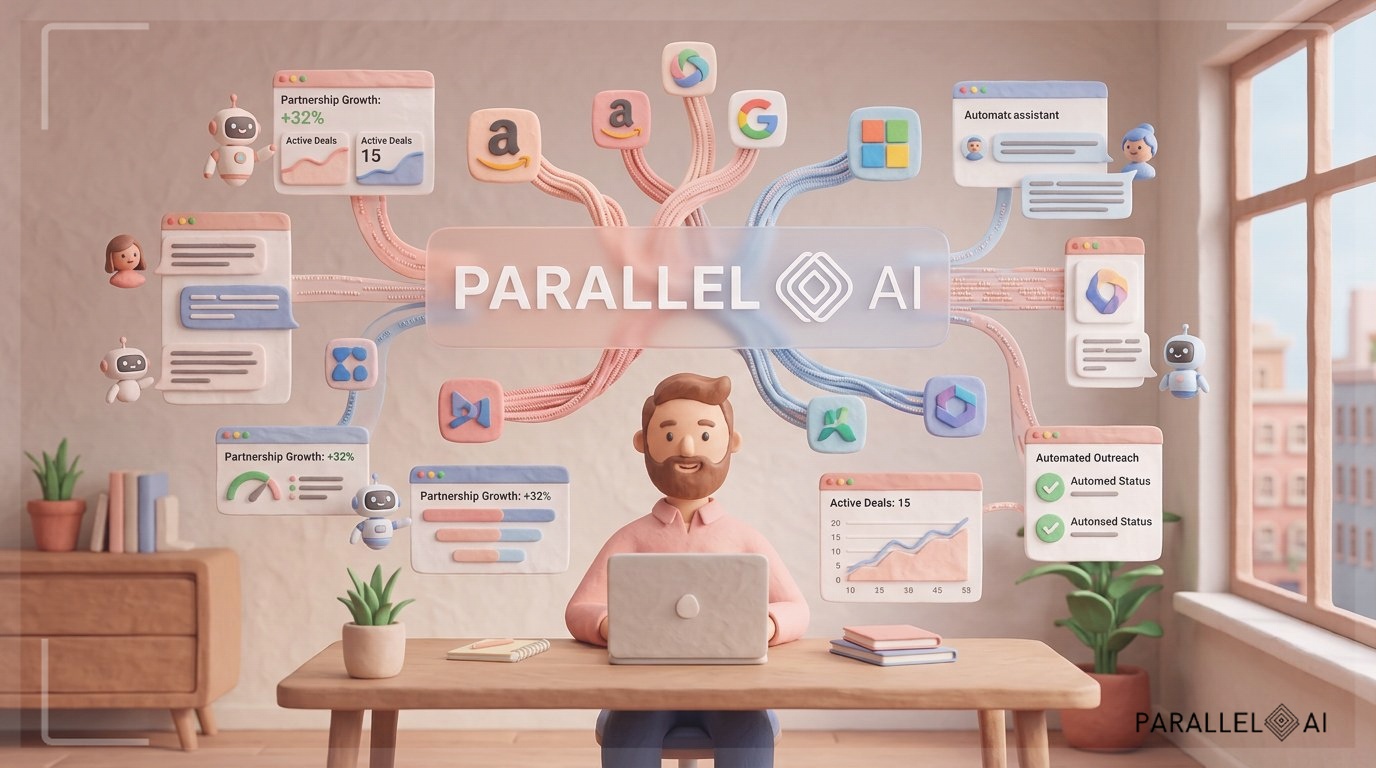
The secret? Sophisticated AI BDR systems built on unified platforms like Parallel AI that consolidate what used to require five separate tools, three subscriptions, and a technical team to manage.
Here’s what changed in 2026, and why solopreneurs who understand this shift are winning deals that used to go to agencies ten times their size.
The 2026 AI BDR Reality: Why 81% Adoption Meets 50-70% Churn
Recent data reveals a fascinating contradiction in the AI sales development space. According to industry analysis, 81% of sales teams now use AI in some capacity. That’s near-universal adoption. Yet AI SDR and BDR tools experience annual churn rates between 50-70%.
What’s happening?
Most solopreneurs are drowning in fragmented AI tools. They’re paying for ChatGPT Plus ($20/month), a dedicated AI writing tool ($49/month), a separate prospecting platform ($99/month), and maybe a conversation intelligence tool ($79/month). Each tool requires separate logins, separate context setting, and separate workflows. The cognitive overhead becomes unsustainable.
The platforms that survive aren’t the ones with the flashiest AI models. They’re the ones that solve the consolidation problem, giving solopreneurs everything they need in one unified system.
What AI BDR Actually Means (And Why It’s Different from AI SDR)
Confusing AI SDR and AI BDR agents costs solopreneurs real opportunities. Here’s the critical distinction:
AI SDR (Sales Development Representative) agents focus on inbound lead qualification and initial outreach to warm prospects. They handle the volume game, qualifying leads from your website, responding to inquiries, and booking discovery calls with people already interested in what you offer.
AI BDR (Business Development Representative) agents handle outbound prospecting and partnership development. They identify cold prospects, research decision-makers, craft personalized outreach across multiple channels, and nurture relationships over longer sales cycles. BDRs are hunters; SDRs are qualifiers.
For solopreneurs targeting enterprise clients or strategic partnerships, AI BDR capabilities matter more. You’re not drowning in inbound leads. You’re strategically pursuing high-value relationships that could transform your business.
The problem? Traditional BDR work is exactly what solopreneurs struggle with most. It requires consistent outreach across email, LinkedIn, phone, and other channels. It demands personalization at scale. It needs multi-touch sequences that adapt based on prospect behavior. And it requires the kind of research depth that used to justify a $95K salary.
Until now.
The Parallel AI Advantage: Building AI BDR Agents That Actually Work
Parallel AI approaches AI BDR differently than fragmented point solutions. Instead of forcing solopreneurs to cobble together separate tools for prospecting, outreach, and follow-up, it provides an integrated system where AI BDR agents access everything they need in one place.
Here’s how solopreneurs are deploying sophisticated AI BDR systems on Parallel AI:
Smart Lists: The Foundation of Intelligent Prospecting
Traditional lead lists are static. You export contacts from a database and hope they’re still relevant. Parallel AI’s Smart Lists are dynamic, pulling from multiple sources and automatically updating based on signals like job changes, company funding, or engagement patterns.
A solo business strategist used Smart Lists to identify 300+ qualified enterprise prospects in industries facing digital transformation pressure. Instead of manually researching companies and tracking changes, the AI BDR agent monitored relevant signals and prioritized outreach based on timing indicators.
Response rates jumped 40% because outreach happened when prospects were actively seeking solutions.
Knowledge Base Integration: Personalization That Scales
Generic outreach dies in enterprise inboxes. Decision-makers spot templated messages instantly. The AI BDR agents that succeed demonstrate genuine understanding of the prospect’s business context.
Parallel AI connects with Google Drive, Notion, and Confluence, wherever you store your research, case studies, and industry insights. When your AI BDR agent crafts outreach, it pulls specific details from your knowledge base: relevant case studies, industry trends, competitive insights.
One solo consultant integrated their entire client success library, 40+ case studies across different industries. Their AI BDR agent automatically matched prospects with the most relevant success stories, crafting personalized opening messages that referenced similar challenges the prospect’s industry faced.
Conversion to first meeting jumped from 8% to 23%.
Multi-Channel Sequences: The Omni-Channel Advantage
Enterprise prospects don’t respond to single-channel outreach. They need touchpoints across email, LinkedIn, phone, and sometimes direct mail or events. Coordinating these channels manually is where most solopreneurs break down.
Parallel AI’s Sequences feature orchestrates multi-channel campaigns with context awareness across every touchpoint. Your AI BDR agent knows that the prospect opened your email but didn’t click, then visited your LinkedIn profile two days later. The next touchpoint adapts accordingly.
A solo sales consultant built a seven-touch sequence:
– Day 1: Personalized email referencing specific company news
– Day 3: LinkedIn connection request with custom note
– Day 5: Value-add content share (no ask)
– Day 8: Follow-up email with case study
– Day 12: LinkedIn message referencing previous email
– Day 15: Phone call with AI-generated talking points
– Day 20: Final email with clear call-to-action
The AI BDR agent managed 200+ prospects simultaneously through this sequence, adapting based on engagement. The consultant spent 4 hours weekly reviewing high-priority opportunities instead of 30+ hours managing outreach manually.
Large Context Windows: Understanding Complex Sales Cycles
Enterprise BDR work involves complex account research. You need to understand organizational structure, recent initiatives, competitive positioning, budget cycles, and decision-making processes. That context often spans thousands of words across multiple documents.
Parallel AI provides access to AI models with context windows reaching one million tokens, enough to process extensive account research, entire conversation histories, and detailed company information at the same time.
One solopreneur targeting Fortune 500 accounts fed their AI BDR agent:
– Complete company annual reports
– Recent earnings call transcripts
– News articles about digital transformation initiatives
– LinkedIn profiles of key decision-makers
– Notes from previous networking interactions
The AI BDR agent synthesized this information to craft outreach that demonstrated executive-level understanding of the prospect’s business challenges. Response rates from C-suite executives increased 3x compared to generic outreach.
Real Implementation: The 30-Day AI BDR Deployment Blueprint
Theory doesn’t close deals. Here’s how solopreneurs are actually deploying sophisticated AI BDR systems on Parallel AI:
Week 1: Foundation and Research
– Define your ideal customer profile with specific firmographic and behavioral criteria
– Build your initial Smart List of 100-300 high-fit prospects
– Upload your knowledge base content (case studies, industry research, value propositions)
– Create your first AI BDR agent and train it on your positioning and messaging approach
Week 2: Sequence Development
– Design your multi-channel outreach sequence (typically 5-8 touchpoints over 20-30 days)
– Write template frameworks that your AI BDR agent will personalize for each prospect
– Set up integration with your existing tools (email, LinkedIn, CRM)
– Test sequences with 10-20 prospects to refine messaging
Week 3: Scaled Deployment
– Deploy your AI BDR agent to your full prospect list
– Monitor engagement metrics and response patterns
– Refine messaging based on what’s generating responses
– Handle inbound responses and book qualified meetings
Week 4: Optimization and Expansion
– Analyze which message variants and touchpoints drive the highest engagement
– A/B test different value propositions and call-to-action approaches
– Build additional Smart Lists for different prospect segments
– Scale successful sequences to larger prospect volumes
A solo marketing strategist followed this blueprint and generated 47 qualified meetings in the first 60 days, more than they’d booked in the previous six months of manual outreach.
The Cost Reality: $95K BDR Salary vs. Unified AI Platform
Let’s get specific about what AI BDR systems actually cost compared to traditional approaches.
Traditional Human BDR:
– Base salary: $75,000-$95,000
– Benefits and taxes: $18,000-$24,000
– Tools and software: $3,600-$6,000
– Training and onboarding: $5,000-$8,000
– Management overhead: 5-10 hours weekly
– Total first-year cost: $101,600-$133,000
Fragmented AI Tool Approach:
– AI writing tool: $588/year
– Prospecting platform: $1,188/year
– Email automation: $948/year
– Conversation intelligence: $948/year
– CRM with AI features: $1,200/year
– Integration tools: $600/year
– Total annual cost: $5,472
– Hidden cost: 15+ hours monthly managing disconnected tools
Parallel AI Unified Platform:
– Complete AI BDR capabilities: $99-$297/month
– All features integrated (Smart Lists, Sequences, Knowledge Base, Multi-Model Access)
– Total annual cost: $1,188-$3,564
– Time investment: 4-6 hours weekly managing high-priority opportunities
The consolidation savings are real, but the bigger win is time. Solopreneurs using Parallel AI spend 60% less time on BDR infrastructure and 60% more time on strategic relationship building.
White-Label Opportunity: Offering AI BDR as a Service
Smart solopreneurs aren’t just using AI BDR for their own business development. They’re offering it as a service to clients.
Parallel AI’s white-label capabilities let consultants and micro-agencies deploy branded AI BDR solutions for clients without building proprietary technology. You become the strategic advisor who provides enterprise-grade business development capabilities to companies that can’t justify hiring full BDR teams.
A solo B2B consultant built a sophisticated AI BDR service offering:
– Setup package: $3,500 one-time (includes strategy, Smart List building, sequence development)
– Monthly management: $1,500/month (includes optimization, reporting, and strategic guidance)
– Cost to deliver: $297/month Parallel AI subscription + 8-12 hours of strategic work
They’re serving six clients at once, generating $12,500 monthly revenue with tool costs under $300. Previously, offering this level of BDR support would have required hiring a team.
Security and Privacy: Enterprise-Grade Protection
Enterprise prospects ask about data security. Solopreneurs need credible answers.
Parallel AI provides:
– AES-256 encryption for data at rest and in transit
– TLS protocols for all communications
– Privacy-first commitment: Your data is never used to train AI models
– On-premise deployment options for enterprise clients
– Single sign-on (SSO) capabilities
When a solo consultant pitched a Fortune 100 prospect, security questions came up immediately. Because they built their AI BDR system on Parallel AI, they could confidently address enterprise security requirements, something that would have been impossible with consumer-grade AI tools.
Measuring Success: Metrics That Matter
Revenue matters, but smart solopreneurs track leading indicators:
Outreach Efficiency:
– Prospects contacted per week
– Response rate by channel and message variant
– Time from first touch to meeting booked
Engagement Quality:
– Percentage of responses showing genuine interest vs. polite declines
– Meeting show rates
– Conversations advancing to proposal stage
Resource Optimization:
– Hours spent on BDR activities weekly
– Cost per qualified meeting
– Return on platform investment
One solopreneur tracked these metrics consistently:
– Before AI BDR: 40 prospects contacted weekly, 6% response rate, 2-3 meetings booked monthly, 25 hours weekly on outreach
– After AI BDR (90 days): 200+ prospects contacted weekly, 11% response rate, 12-15 meetings booked monthly, 6 hours weekly on outreach
The time savings alone justified the investment. The revenue impact made it transformative.
The 2026 Competitive Reality
Here’s the uncomfortable truth: your competitors are deploying sophisticated AI BDR systems right now. The solopreneurs who understand this shift are closing enterprise deals that used to be impossible without full sales teams.
The gap between AI-powered and traditional business development is widening every day. In 2026, the question isn’t whether to adopt AI BDR. It’s whether you can afford not to.
Your choice is stark:
Option A: Continue manual outreach, limited by your personal capacity, competing against AI-powered competitors who can personalize at scale, missing opportunities because you can’t maintain consistent multi-channel presence.
Option B: Build sophisticated AI BDR systems on unified platforms like Parallel AI that consolidate prospecting, outreach, and relationship nurturing into scalable workflows that grow your business without growing your team.
The solopreneurs winning enterprise deals in 2026 chose Option B months ago.
Getting Started: Your First AI BDR Agent
The barrier to entry is lower than you think. Parallel AI offers free access to start building and testing AI BDR agents before committing to paid plans.
Start with one high-value prospect segment. Build a Smart List of 50-100 ideal prospects. Create a simple 5-touch sequence. Train your AI BDR agent on your best case studies and positioning. Deploy and measure.
You’ll see results within 30 days, or you’ll identify exactly what needs refinement. Either way, you’re building the sophisticated business development capability that will compound over time.
The enterprises you’re pursuing aren’t waiting for you to figure this out. They’re evaluating consultants and agencies right now. The ones demonstrating enterprise-grade capabilities, even as solopreneurs, are winning the conversations.
Your AI BDR system is how you compete. Parallel AI is how you build it without the complexity, cost, or technical barriers that used to make this impossible. The 2026 business development scene rewards solopreneurs who can demonstrate enterprise capabilities at scale. AI BDR systems are no longer optional. They’re table stakes.
The question is whether you’ll build yours before your next big opportunity slips to a better-equipped competitor. Start your free Parallel AI account today and deploy your first AI BDR agent this week.