
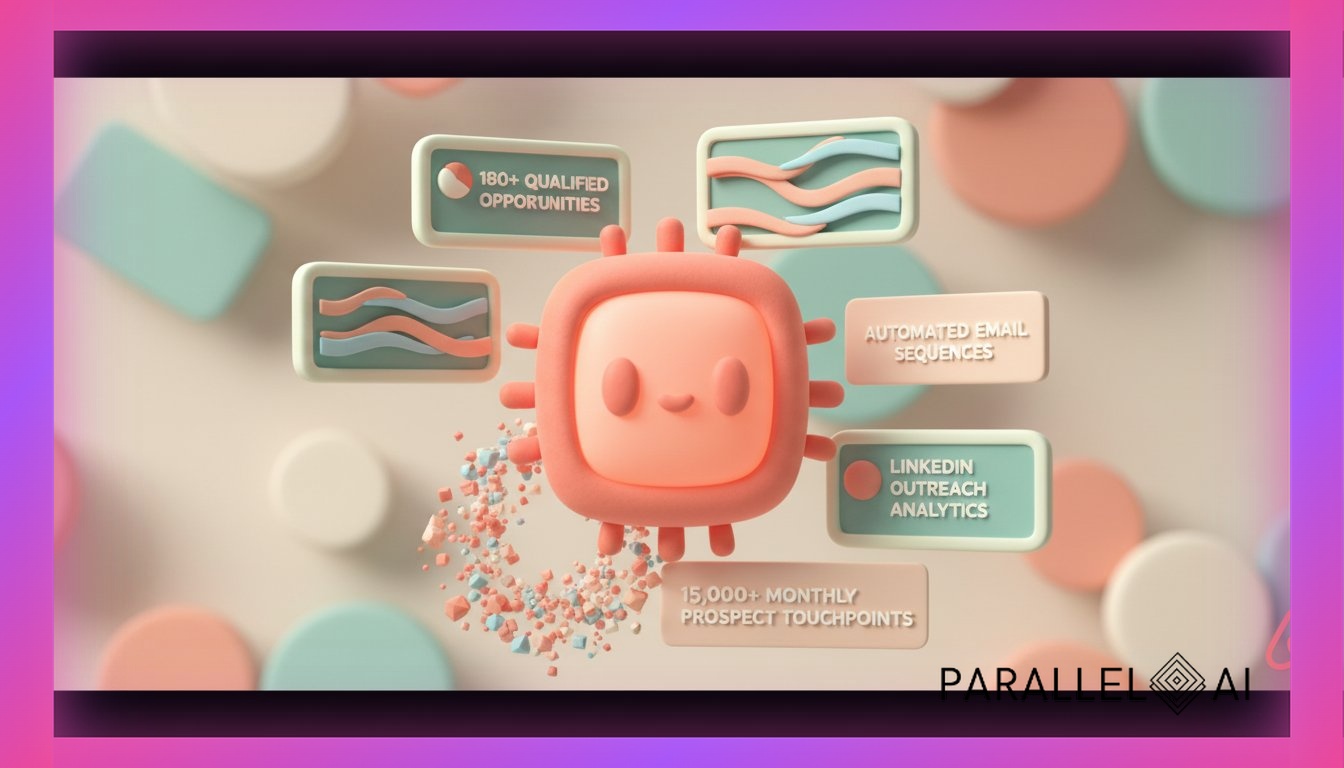
The business development landscape changed forever in early 2026. While most solopreneurs still believe they need a six-figure BDR salary to scale their pipeline, a quiet revolution is happening. Forward-thinking entrepreneurs are deploying AI BDR agents that handle 15,000+ monthly prospect engagements, generate $500K+ annual pipeline, and work 24/7—all for the cost of a decent dinner out each month.
The math is brutal: Traditional BDRs cost $120K annually in salary, benefits, and training, require 3-6 months to reach productivity, and burn out after 18 months on average. AI BDR agents? They’re operational in 48 hours, never sleep, never quit, and cost 97% less. This isn’t future speculation—it’s happening right now, and the solopreneurs who adapt first are capturing market share at unprecedented rates.
The competitive gap is widening every day. While you’re manually researching prospects and crafting one-off emails, your AI-enabled competitors are executing 500+ personalized touchpoints daily across email, LinkedIn, SMS, and voice. The question isn’t whether to implement AI BDR—it’s how quickly you can deploy before your market position erodes.
The 2026 AI BDR Market Reality: What Actually Changed and Why It Matters
The AI BDR market isn’t just growing—it’s exploding. Recent market analysis reveals that AI sales automation platforms are experiencing unprecedented adoption rates, with businesses reporting 30-60% increases in meetings per dollar spent and 3-5x increases in email volume capacity.
What’s driving this surge? Three converging forces have made AI BDR accessible to solopreneurs for the first time. First, the democratization of advanced AI models means you’re no longer locked into expensive enterprise platforms. Second, the consolidation of sales tools into unified platforms eliminates the fragmentation that previously made AI implementation too complex for small teams. Third, the proven ROI data is now overwhelming—businesses implementing AI BDR solutions are seeing 20-40% improvement in email reply rates and 15-25% recovery in cold conversations that would have otherwise died.
The cost-benefit equation has fundamentally shifted. Where AI BDR once required six-figure enterprise investments, today’s platforms deliver the same capabilities for $200-300 monthly. That’s a 97% cost reduction compared to human BDRs, with performance metrics that often exceed human capabilities in volume, consistency, and response time.
The Multi-Channel Imperative Nobody’s Talking About
Here’s what the AI BDR platforms won’t tell you: Single-channel automation is already obsolete. Email-only AI BDR delivers 30-40% of the results that multi-channel approaches achieve. Your prospects aren’t just checking email—they’re active on LinkedIn, responsive to SMS for urgent matters, and increasingly expect instant chat responses on your website.
The winning AI BDR strategy in 2026 requires orchestrated outreach across at least four channels: email for detailed value propositions, LinkedIn for social proof and relationship building, SMS for time-sensitive follow-ups, and voice for high-value prospect engagement. Platforms that can’t coordinate context across these channels create disjointed experiences that hurt conversion rates instead of helping them.
The data is clear: Businesses deploying multi-channel AI BDR agents report 70% higher conversion rates than those using single-channel automation. The reason is simple—you’re meeting prospects where they are, with context that carries across every interaction, creating a seamless experience that feels personalized rather than automated.
What Is an AI BDR Agent? (And Why Most Definitions Miss the Point)
Let’s cut through the marketing hype. An AI BDR agent isn’t just email automation with a fancy name. It’s an autonomous system that replicates the entire business development workflow: prospecting, research, personalized outreach, qualification, objection handling, and opportunity routing.
The critical difference between AI BDR and traditional sales automation comes down to intelligence and autonomy. Old-school automation follows rigid if-then rules. AI BDR agents learn from interactions, adapt messaging based on prospect behavior, and make qualification decisions without human intervention. They don’t just send emails on a schedule—they analyze response patterns, adjust timing and messaging, and prioritize follow-ups based on engagement signals.
Here’s what a fully-functional AI BDR agent actually does: It monitors your target market for buying signals, researches prospect backgrounds and pain points, crafts personalized outreach that references specific company challenges, engages in back-and-forth conversations across multiple channels, qualifies prospects using frameworks like BANT (Budget, Authority, Need, Timeline), and routes qualified opportunities directly to your calendar with full context.
Beyond the Hype: Real AI BDR Capabilities in 2026
The capabilities gap between AI BDR platforms is massive, and most solopreneurs don’t realize what they’re missing. Basic platforms offer templated email sequences with variable insertion—hardly revolutionary. Advanced platforms like Parallel AI deliver context-aware conversations powered by multiple AI models, with context windows reaching one million tokens.
What does that actually mean for your business? It means your AI BDR can reference your entire knowledge base, past client interactions, product documentation, and market research in every conversation. It means personalization that goes far beyond “Hi [First Name]”—your agent can discuss specific challenges facing the prospect’s industry, reference recent company news, and tailor solutions to their unique situation.
The technical architecture matters more than most realize. Platforms offering access to multiple AI models (OpenAI, Anthropic, Gemini, Grok, DeepSeek) allow you to optimize for different tasks—using one model for research, another for creative messaging, and another for qualification logic. Single-model platforms lock you into one approach, limiting your effectiveness.
The Real Cost of NOT Implementing AI BDR in 2026
Let’s talk about the cost everyone ignores: opportunity cost. Every day without AI BDR means missed conversations, lost pipeline, and competitive disadvantage that compounds over time.
Here’s the brutal math: If a human BDR can handle 50-75 quality prospect interactions daily, an AI BDR agent handles 500+. That’s 425 missed opportunities every single day you delay implementation. Over a month, that’s 12,750 potential prospect engagements you’re leaving on the table. Even with conservative conversion rates of 2%, that’s 255 lost opportunities monthly.
The competitive dynamics are equally stark. Your competitors using AI BDR are reaching prospects first, with more personalized messaging, and following up more consistently. In markets where speed-to-lead determines winners, being hours slower means losing deals. Research shows that response time impacts conversion by up to 400%—the first company to respond has an overwhelming advantage.
The Time Investment Trap
Most solopreneurs drastically underestimate the time they spend on business development tasks. Let’s break down the real numbers. Manual prospect research: 15-20 minutes per prospect. Crafting personalized outreach: 10-15 minutes per email. Follow-up management: 5-10 minutes per interaction. If you’re targeting 20 prospects daily, that’s 10-15 hours of work.
AI BDR agents reduce this to near-zero. Your time investment shifts from execution to strategy—defining ideal customer profiles, refining messaging frameworks, and analyzing results. The productivity multiplication is staggering: One solopreneur with AI BDR can match the output of a 5-person BDR team.
The ROI timeline is faster than most expect. Businesses implementing AI BDR solutions report positive ROI within 30-90 days, with the primary variable being how quickly they optimize their targeting and messaging. Compare that to hiring a human BDR, which takes 3-6 months to reach productivity and requires ongoing management overhead.
How to Build Your AI BDR Agent with Parallel AI (The Complete Implementation Blueprint)
Let’s get practical. Building an effective AI BDR agent requires more than signing up for a platform—it requires strategic thinking about your sales process, clear qualification criteria, and systematic implementation.
Phase 1: Strategic Foundation (Days 1-7)
Start by defining your ideal customer profile with precision. Vague targeting produces mediocre results. Identify specific firmographics (company size, industry, revenue range), technographics (tools they use, tech stack), and behavioral signals (recent funding, hiring, expansion). The more specific your ICP, the better your AI BDR performs.
Map your buyer’s journey from awareness to decision. What questions do prospects ask at each stage? What objections emerge? What information moves them forward? Your AI BDR needs this context to engage effectively. Document the typical path from first contact to qualified opportunity, including average timeline and key decision criteria.
Set clear pipeline goals and KPIs. How many qualified opportunities do you need monthly to hit revenue targets? What conversion rates are you targeting at each stage? What engagement metrics indicate quality conversations? These benchmarks guide your optimization efforts and help you measure success objectively.
Phase 2: Knowledge Base Configuration (Days 8-14)
Your AI BDR is only as smart as the knowledge you provide. This is where Parallel AI’s integration capabilities become crucial. Connect your Google Drive, Notion, or Confluence to give your agent access to all sales collateral, case studies, product documentation, and market research.
Upload your best-performing sales content—the emails that get responses, the case studies that resonate, the value propositions that convert. Your AI BDR will learn from these examples, adapting the language and approach while maintaining your brand voice. Include objection-handling frameworks, competitive positioning, and pricing guidance.
Configure brand voice parameters to ensure consistency. Define your tone (authoritative vs. friendly, formal vs. casual), vocabulary preferences, and communication style. Parallel AI’s large context windows mean your agent can reference all this context in every interaction, ensuring brand-consistent conversations at scale.
Phase 3: Multi-Channel Sequence Design (Days 15-21)
This is where most solopreneurs stumble—they try to replicate human sequences instead of leveraging AI capabilities. Don’t just automate your existing process; redesign it for AI strengths.
Email sequences should focus on value delivery, not just volume. Design 7-10 touch campaigns that educate, provide insights, and build credibility. Use Parallel AI’s IMAP, Gmail, and Office 365 integrations to send from your actual business email, maintaining deliverability and authenticity.
LinkedIn outreach requires a different cadence and tone. Connection requests should feel personal and reference specific mutual interests or shared challenges. Follow-up messages should add value through insights, content, or introductions. Coordinate LinkedIn activity with email timing to reinforce messaging without overwhelming prospects.
SMS integration handles time-sensitive follow-ups and meeting confirmations. Use sparingly but strategically—SMS has 98% open rates but feels intrusive if overused. Reserve for high-intent prospects who’ve engaged across other channels. Voice capabilities enable your AI BDR to handle inbound inquiries and schedule meetings, extending your availability beyond business hours.
Phase 4: Qualification and Routing Logic (Days 22-28)
Effective qualification separates high-performing AI BDR agents from glorified email senders. Implement BANT framework (Budget, Authority, Need, Timeline) as your baseline, but customize based on your sales process.
Define clear qualification criteria for each stage. What indicates a prospect has budget? It might be company size, recent funding, or stated priorities. How do you identify decision-makers? Title analysis, organizational charts, or direct questions during conversations. What signals demonstrate need? Pain points mentioned, current solutions discussed, or specific challenges raised.
Build lead scoring automation that weighs multiple signals. Engagement level (email opens, link clicks, responses) indicates interest. Firmographic fit (ICP match) indicates potential value. Behavioral signals (website visits, content downloads) show active research. Combine these into a composite score that prioritizes your pipeline.
Set routing rules for high-intent prospects. When a prospect meets your qualification criteria and demonstrates buying signals, your AI BDR should automatically schedule a meeting on your calendar with full context. No manual handoffs, no information loss, no delays. Include escalation triggers for situations requiring human intervention—complex objections, enterprise deals, or executive-level conversations.
Phase 5: Deployment and Continuous Optimization (Days 29-30+)
Launch pilot campaigns with 50-100 prospects to test your sequences, messaging, and qualification logic. Monitor engagement metrics obsessively—open rates, response rates, conversation quality, and qualification accuracy. The data will reveal what’s working and what needs adjustment.
A/B test everything: subject lines, email length, call-to-action placement, send timing, personalization depth. Parallel AI’s multiple model access lets you test different AI approaches—compare OpenAI’s conversational style against Anthropic’s analytical approach, or Gemini’s creative messaging against DeepSeek’s concise communication.
Refine qualification parameters based on results. Are you routing too many unqualified leads? Tighten criteria. Missing opportunities? Broaden your definition of qualified. The goal is precision—sending only genuinely qualified prospects to your sales conversations.
Scale systematically once performance metrics stabilize. Expand from pilot to full prospect database, monitor deliverability and engagement, and adjust volume based on your capacity to handle qualified opportunities. The beauty of AI BDR is scalability—you can 10x your outreach volume without proportionally increasing costs or complexity.
Real-World AI BDR Results: What Solopreneurs Are Actually Achieving
Theory is interesting, but results matter. Let’s examine real performance metrics from businesses deploying AI BDR agents with Parallel AI.
Case Study: Marketing Consultant Transforms Pipeline Generation
Background: Solo marketing consultant struggling to balance client delivery with business development. Spending 15+ hours weekly on outreach, generating 10-15 qualified opportunities monthly, hitting capacity limits.
Implementation: Built AI BDR agent using Parallel AI with multi-channel sequences targeting mid-market B2B companies. Integrated Google Drive knowledge base with case studies, testimonials, and methodology frameworks. Configured qualification logic based on company size, marketing budget, and current challenges.
Results: 180 qualified opportunities monthly (12x increase), $500K annual pipeline generated (4x previous), 20 hours per week reclaimed for client work and strategy, 45% improvement in email response rates, 70% of opportunities coming from multi-channel engagement.
The transformation wasn’t just quantitative—the quality of conversations improved. AI BDR handled initial education and qualification, meaning sales conversations focused on strategic fit and solution design rather than basic discovery.
Case Study: Tech Consultant Eliminates Six-Figure Hiring Need
Challenge: Growing technology consulting firm needed BDR capacity to support expansion but couldn’t justify $120K+ salary for uncertain ROI. Considered offshore alternatives but wanted to maintain quality and brand consistency.
Solution: Deployed AI BDR agent with Parallel AI, integrating existing CRM data, technical documentation, and industry research. Built sophisticated qualification logic identifying companies undergoing digital transformation, cloud migration, or technology modernization.
Outcome: 15,000 monthly prospect engagements across email, LinkedIn, and SMS, 220 qualified opportunities quarterly, 70% improvement in conversion rates vs. manual outreach, $200 monthly cost vs. $120K+ for human BDR, 48-hour implementation vs. 3-6 month BDR ramp time.
The cost differential was staggering—97% reduction in BDR costs with superior performance metrics. The firm reinvested savings into product development and client success, accelerating growth without expanding headcount.
Common Success Patterns Across Implementations
Analyzing dozens of successful AI BDR deployments reveals consistent patterns. Multi-channel approaches outperform single-channel by 3-5x. Businesses using email, LinkedIn, SMS, and voice integration report 70% higher conversion rates than email-only automation.
Personalization depth drives response rates. Generic AI messages get 1-2% response rates. Messages referencing specific company challenges, recent news, or industry trends get 5-8% responses. Deep personalization powered by large context windows and comprehensive knowledge bases makes the difference.
Twenty-four-seven availability captures international prospects and different time zones. Businesses deploying AI BDR report 25% of qualified opportunities coming from off-hours engagement that would have been missed with human-only approaches.
Knowledge base integration ensures brand consistency and quality. AI BDR agents connected to comprehensive documentation maintain voice, messaging, and positioning across thousands of conversations—something impossible with multiple human BDRs or freelancers.
Overcoming AI BDR Implementation Challenges (What Actually Works)
Let’s address the obstacles that derail AI BDR implementations and how to avoid them.
Challenge 1: Achieving Genuine Personalization at Scale
The Problem: Generic AI-generated messages feel robotic and get ignored. Prospects can spot templated outreach instantly, reducing response rates and damaging brand perception.
The Root Cause: Most AI BDR platforms have limited context windows and can’t reference enough information to personalize meaningfully. They fall back on superficial variable insertion—name, company, industry—which feels automated.
The Solution: Large context windows change everything. Parallel AI’s one-million-token context capacity means your agent can reference your entire knowledge base, prospect research, industry trends, and conversation history in every message. This enables genuine personalization that discusses specific challenges, references relevant case studies, and tailors solutions to unique situations.
Practical Implementation: Build comprehensive prospect profiles that include recent company news, technology stack, organizational structure, and known challenges. Train your AI BDR to reference this context naturally in conversations. The difference between “I see you work in healthcare” and “I noticed your recent expansion into telehealth—many of our clients faced integration challenges during similar transitions” is the difference between ignored and engaged.
Challenge 2: Coordinating Multi-Channel Outreach Without Fragmentation
The Problem: Using separate tools for email, LinkedIn, SMS, and voice creates disjointed experiences. Prospects receive disconnected messages that don’t reference previous interactions, creating confusion and reducing trust.
The Root Cause: Tool fragmentation means no single system has complete context. Your email platform doesn’t know about LinkedIn conversations, your SMS tool doesn’t reference email engagement, and nothing ties together comprehensively.
The Solution: Unified platforms that manage all channels with shared context. Parallel AI integrates email (IMAP/Gmail/Office 365), LinkedIn, SMS, voice, and chat in one system, ensuring every interaction references previous touchpoints across all channels.
Practical Implementation: Design multi-channel sequences where each touchpoint builds on previous interactions. If a prospect opens your email but doesn’t respond, your LinkedIn message might reference the content they engaged with. If they respond positively on LinkedIn, your email follow-up acknowledges that conversation and advances it. This creates cohesive experiences that feel thoughtfully orchestrated rather than randomly automated.
Challenge 3: Maintaining Qualification Accuracy
The Problem: AI BDR agents sending unqualified leads to sales conversations wastes time, damages credibility, and reduces ROI. Too loose qualification floods your calendar with poor fits; too strict misses genuine opportunities.
The Root Cause: Simplistic qualification logic that relies on single signals or rigid criteria. Real qualification requires weighing multiple factors and understanding nuanced signals.
The Solution: Multi-factor qualification frameworks that combine firmographic fit, behavioral signals, stated needs, and engagement level. Build logic that requires multiple qualification indicators before routing to sales.
Practical Implementation: Define primary and secondary qualification criteria. Primary might be company size, industry, and stated budget. Secondary includes engagement level, timeline urgency, and decision-maker involvement. Require prospects to meet all primary criteria plus 2-3 secondary indicators before qualifying. This ensures quality while maintaining flexibility for different buyer journeys.
Challenge 4: Data Security and Privacy Protection
The Problem: Solopreneurs handle sensitive client information and prospect data. Using AI platforms that train models on your data or have weak security creates compliance risks and competitive vulnerabilities.
The Root Cause: Many AI platforms use customer data to improve their models, meaning your competitive intelligence and client information contributes to training that benefits competitors. Unclear data policies and insufficient encryption expose sensitive information.
The Solution: Enterprise-grade security with explicit data protection commitments. Parallel AI implements AES-256 encryption, commits to never using customer data for model training, and maintains SOC 2 compliance standards.
Practical Implementation: Audit your AI BDR platform’s data policies before implementation. Verify encryption standards, data usage policies, and compliance certifications. Establish internal data handling procedures that specify what information gets stored in AI systems and what remains in secured environments. This protects both your business and your clients while enabling AI capabilities.
AI BDR vs. Human BDR: The Honest 2026 Comparison
Let’s cut through the hype and examine where AI BDR excels, where humans still matter, and how smart solopreneurs combine both.
Where AI BDR Dominates
Volume capacity isn’t close. AI BDR agents handle 15,000+ monthly engagements; human BDRs max out at 500-1,000. This 15-30x advantage means reaching more prospects, testing more messaging, and filling pipeline faster.
Consistency is guaranteed. AI BDR agents maintain quality and approach across every interaction. No bad days, no burnout, no variation in effort. Human BDRs have performance fluctuations based on motivation, energy, and circumstances.
Cost efficiency is overwhelming. AI BDR costs $200-300 monthly; human BDRs cost $120K+ annually including salary, benefits, training, and tools. That’s 97% cost reduction with superior volume and consistency.
Speed and availability create competitive advantages. AI BDR agents respond instantly, work 24/7, and never need vacation or sick days. They engage international prospects across time zones and capture after-hours inquiries that would otherwise be lost.
Scalability is frictionless. Adding prospect volume to AI BDR requires no additional headcount, training, or management overhead. Human BDR scaling means recruiting, onboarding, and ongoing supervision—each new hire adds complexity and cost.
Where Human BDR Still Adds Value
Complex enterprise sales with 9-12 month cycles and multiple stakeholders benefit from human relationship building. The strategic navigation of organizational politics and coalition building plays to human strengths.
High-touch relationship development for strategic accounts justifies human involvement. When deals exceed $500K or require executive-level engagement, human BDRs build deeper connections than AI currently achieves.
Nuanced negotiation handling objections that require creative problem-solving or custom solution design benefits from human flexibility and empathy. AI BDR handles standard objections effectively but struggles with novel situations.
Strategic account planning for named account targeting and relationship mapping leverages human strategic thinking and pattern recognition in ways that current AI doesn’t replicate.
The Hybrid Model: Optimal Strategy for 2026
Smart solopreneurs don’t choose between AI and human—they leverage AI BDR for volume and qualification while focusing human effort on high-value relationships and strategic accounts.
The winning approach: AI BDR handles prospecting, initial outreach, qualification, and opportunity routing. Humans focus on qualified conversations, relationship deepening, negotiation, and account strategy. This division of labor maximizes strengths and eliminates weaknesses.
Implementation framework: Deploy AI BDR for all new outbound prospecting and inbound lead qualification. Route qualified opportunities to human sales conversations. Assign strategic accounts to human BDR or founder for relationship building while AI BDR handles research, meeting scheduling, and follow-up coordination.
The productivity multiplication is staggering. One founder with AI BDR support achieves the pipeline generation of a 5-person BDR team, at 5% of the cost, while maintaining personal involvement where it matters most.
The Future of AI BDR: What’s Coming and How to Prepare
The AI BDR landscape is evolving rapidly. Understanding emerging trends helps you position for sustained competitive advantage.
Agentic AI: The Next Evolution
Current AI BDR follows sequences and rules with some adaptive capability. Agentic AI makes autonomous decisions about strategy, not just tactics. It will analyze market conditions, identify emerging opportunities, and adjust targeting without human intervention.
Predictive pipeline forecasting will become standard. AI BDR agents will analyze historical patterns, current engagement levels, and external signals to forecast pipeline generation with increasing accuracy. This enables better resource planning and revenue predictability.
Self-optimizing sequences that adjust based on performance data will eliminate manual A/B testing. Your AI BDR will automatically test variations, identify winners, and implement improvements continuously.
What this means for solopreneurs: Focus on strategic direction and qualification criteria while AI handles optimization and execution. Your competitive advantage shifts from execution speed to strategic positioning and unique value proposition.
Integration with Physical AI and Robotics
The convergence of digital and physical AI is coming faster than most expect. AI BDR capabilities will extend to trade shows, conferences, and in-person events through integrated robotics and augmented reality systems.
Imagine AI-powered avatars representing your business at virtual events, engaging prospects in real-time with full context from your knowledge base. Or robotic systems at physical trade shows that qualify attendees and schedule meetings based on sophisticated AI analysis.
For solopreneurs, this means extending reach beyond digital channels while maintaining the cost efficiency and scalability of AI automation.
Governance, Ethics, and Transparency
Regulatory frameworks around AI in sales are emerging. Expect requirements for transparency about AI involvement in sales conversations, data usage disclosure, and consent mechanisms for AI-driven outreach.
Proactive governance positions you ahead of regulation. Implement clear disclosure policies, respect opt-out preferences rigorously, and maintain data protection standards that exceed current requirements.
The competitive advantage will shift to trusted brands that use AI responsibly rather than those that push ethical boundaries for short-term gains.
The Skills Gap and Continuous Learning Imperative
AI literacy is becoming a competitive necessity. Solopreneurs who understand AI capabilities, limitations, and optimization strategies will outperform those who treat it as a black box.
Invest in continuous learning about AI developments, sales automation best practices, and integration strategies. Join communities of AI-forward entrepreneurs, participate in platform-specific user groups, and experiment with new capabilities as they emerge.
The winners in 2026 and beyond will be those who combine domain expertise with AI fluency, using technology as a force multiplier rather than a replacement for strategic thinking.
Platform Selection: Why Consolidation Wins for Solopreneurs
The average solopreneur uses 5-8 different AI subscriptions, spending $200-500 monthly across platforms. This fragmentation creates hidden costs that erode the value of each tool.
The Fragmentation Tax
Tool switching wastes 5-10 hours weekly. Every time you move between platforms, you lose context, re-input information, and recreate parameters. Multiply this across dozens of daily tasks and the time cost becomes overwhelming.
Context loss between platforms reduces effectiveness. Your email AI doesn’t know about LinkedIn conversations. Your content AI doesn’t reference your CRM data. Your chat AI can’t access your knowledge base. Each tool operates in isolation, missing opportunities for integration and intelligence.
Integration complexity requires technical expertise most solopreneurs lack. Connecting disparate tools through APIs, webhooks, or middleware platforms adds technical debt and maintenance burden. Every integration is a potential point of failure.
Subscription costs compound quickly. ChatGPT Plus ($20), Jasper ($49+), Copy.ai ($49+), sales automation ($99+), CRM ($29+), LinkedIn automation ($99+) adds up to $345+ monthly—and that’s without premium tiers or additional seats.
Parallel AI’s Consolidated Approach
Replace 5+ subscriptions with one unified platform. Parallel AI consolidates content generation, sales automation, knowledge management, multi-channel outreach, and AI model access in a single system.
Uncapped access to multiple AI models (OpenAI, Anthropic, Gemini, Grok, DeepSeek) eliminates usage limits and token counting. Generate unlimited content, conversations, and automations without per-use billing or surprise overages.
White-label capabilities turn AI BDR from cost center to revenue stream. Offer AI-powered business development as a service to clients, branded as your own solution. This transforms your AI investment into an income-generating asset.
Integrated knowledge base connects Google Drive, Notion, Confluence, and other platforms, ensuring all your AI capabilities access the same comprehensive context. No more recreating information across tools or losing institutional knowledge in fragmented systems.
Affordable scaling from free starter plans to enterprise solutions means you pay for what you need, when you need it. No forced upgrades or feature gating that holds capabilities hostage.
Getting Started: Your AI BDR Quick-Start Checklist
Theory is worthless without action. Here’s your concrete implementation checklist for the first 30 days.
Week 1: Foundation and Strategy
- Sign up for Parallel AI (start with free plan to test capabilities)
- Define your ideal customer profile with specific firmographics, technographics, and behavioral criteria
- Document your current sales process from first contact to closed deal
- Gather existing sales collateral, case studies, and high-performing content
- Set clear pipeline goals: qualified opportunities needed monthly, conversion rate targets, revenue objectives
- Identify your top 3-5 prospect pain points and how your solution addresses each
- Map your buyer’s journey and typical timeline from awareness to decision
Week 2: Configuration and Integration
- Integrate knowledge base (Google Drive, Notion, Confluence) with all sales content
- Upload case studies, testimonials, product documentation, and competitive positioning
- Configure brand voice parameters: tone, vocabulary, communication style
- Set up CRM integration for prospect data and interaction tracking
- Build email templates for each stage of your buyer’s journey
- Design LinkedIn outreach sequences with connection requests and follow-up messages
- Configure SMS and voice parameters for high-intent prospect engagement
- Create qualification frameworks defining what constitutes a qualified opportunity
Week 3: Testing and Refinement
- Launch pilot campaign with 50-100 prospects matching your ICP
- Monitor engagement metrics: open rates, response rates, conversation quality
- Test different AI models for various tasks (research, messaging, qualification)
- A/B test subject lines, email length, personalization depth, and send timing
- Refine messaging based on prospect responses and feedback
- Adjust qualification logic based on opportunity quality routed to sales
- Identify and fix any technical issues with integrations or automation
- Document what’s working and what needs improvement
Week 4: Scaling and Optimization
- Expand from pilot to full prospect database based on performance metrics
- Implement white-label configuration if offering AI BDR to clients
- Set up advanced automation workflows for complex sequences
- Establish ongoing optimization cadence: weekly metric reviews, monthly strategy adjustments
- Build reporting dashboards tracking pipeline generation, qualification accuracy, and ROI
- Create documentation for your AI BDR processes and configurations
- Plan expansion into additional channels or market segments
- Schedule quarterly reviews to assess performance and adjust strategy
The Competitive Imperative: Adapt Now or Get Replaced
We’ve covered the what, why, and how of AI BDR implementation. Now let’s address the elephant in the room: urgency.
The competitive landscape is shifting faster than most realize. Your competitors are deploying AI BDR right now. Every week you delay means more prospects reached first by AI-enabled competitors, more opportunities lost to faster response times, and more market share captured by businesses that adapted earlier.
The first-mover advantage in your market is still available, but the window is closing. In 12-18 months, AI BDR will be table stakes—everyone will have it, eliminating competitive differentiation. The solopreneurs winning today are those who implement while it’s still an advantage rather than waiting until it becomes a requirement.
The implementation barrier is lower than you think. You don’t need technical expertise, large budgets, or dedicated staff. You need strategic thinking about your sales process and 30 days of focused implementation. The return on that investment is 10x your pipeline generation capacity and 20+ hours weekly reclaimed from manual outreach.
The risk of waiting exceeds the risk of implementing. What’s the downside of trying AI BDR with Parallel AI’s free plan? A few hours of setup time. What’s the downside of not trying? Competitive obsolescence, missed revenue, and the compounding disadvantage of falling behind while others advance.
Take Action: Start Building Your AI BDR Today
The AI BDR revolution isn’t coming—it’s here. Solopreneurs are generating $500K+ annual pipeline without six-figure salaries, enterprise sales infrastructure, or complex technical implementations. They’re using platforms like Parallel AI to deploy multi-channel agents that work 24/7, handling 15,000+ monthly engagements at 97% lower cost than human BDRs.
You’ve seen the data, the case studies, and the implementation framework. You understand the competitive dynamics and the urgency of action. The only question remaining is: when will you start?
Parallel AI makes it risk-free to begin. Start with the free plan to test capabilities, explore the platform, and build your first AI BDR agent. No credit card required, no complex contracts, no pressure. Just hands-on experience with the platform that’s democratizing business development for solopreneurs.
Once you’ve validated the approach, scale with plans starting at $99 monthly—replacing $200-500 in fragmented AI subscriptions while adding capabilities none of those tools deliver individually. Access OpenAI, Anthropic, Gemini, Grok, and DeepSeek models without usage limits. Integrate your knowledge base for context-aware conversations. Deploy multi-channel sequences across email, LinkedIn, SMS, and voice. Build the AI BDR agent that transforms your pipeline generation while you focus on closing deals and serving clients.
The solopreneurs who thrive in 2026 and beyond will be those who recognized that AI BDR isn’t about replacing human expertise—it’s about multiplying it. Your knowledge, positioning, and client relationships remain your competitive advantages. AI BDR simply ensures those advantages reach more prospects, faster, more consistently, and more cost-effectively than ever before possible.
Start building your AI BDR agent today at parallellabs.app. Your future pipeline is waiting.