
The business development landscape just hit an inflection point that most solopreneurs and micro-agencies haven’t fully grasped yet. While you’re debating whether to hire your first BDR at $70,000-$88,000 annually, a quiet revolution is unfolding: autonomous AI BDR agents are now generating seven-figure pipeline revenue, operating 24/7 across multiple channels, and costing 83% less than their human counterparts.
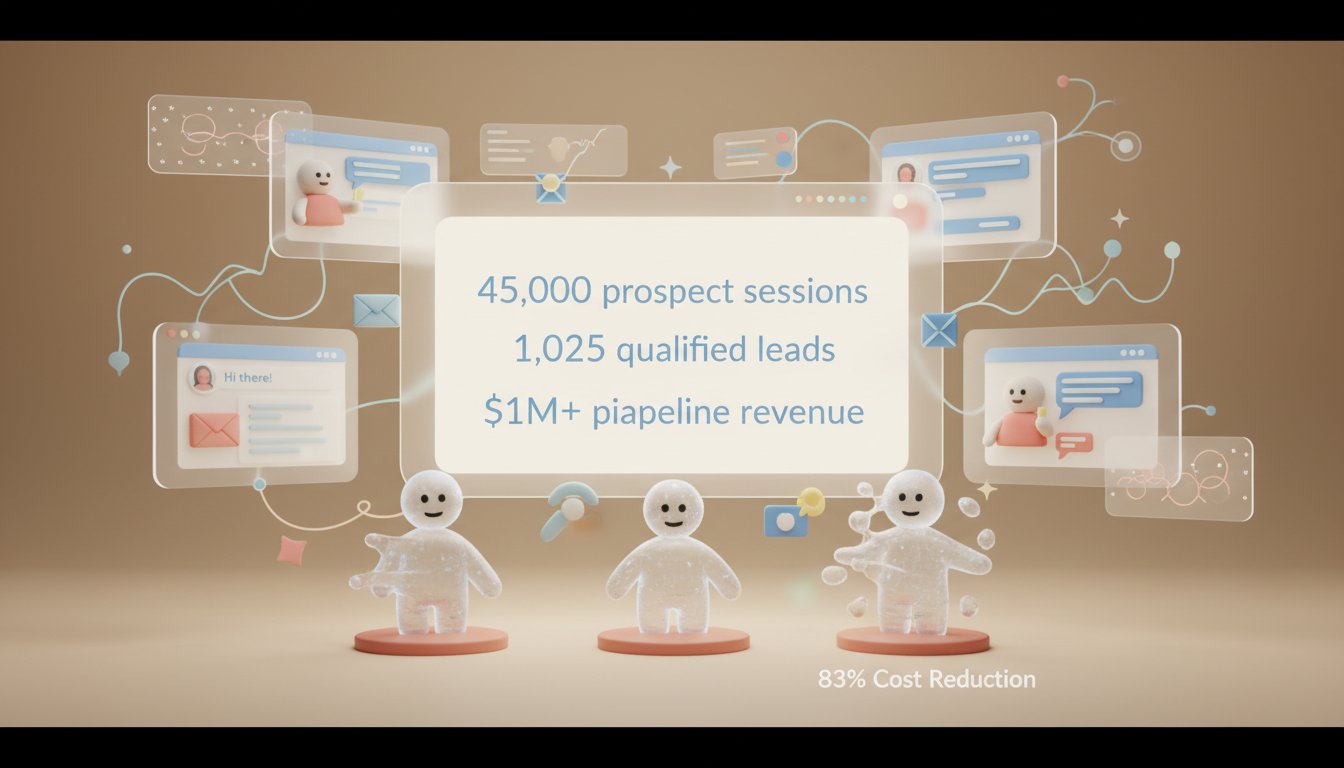
This isn’t theoretical. One AI BDR agent recently handled over 45,000 prospect sessions, qualified 1,025 high-intent leads, booked 91 meetings, and generated over $1 million in attributed revenue—all within a few months of deployment. The mathematics are brutal for traditional approaches: while a human BDR spends 30-45 minutes researching and engaging each prospect, AI BDR agents complete the same process in under two minutes, maintaining perfect consistency without fatigue, salary negotiations, or turnover risk.
For solopreneurs and micro-agencies caught in the growth paradox—needing to scale business development capacity without scaling headcount—AI BDR technology represents the most significant competitive advantage available in 2026. The question is no longer whether to adopt AI BDR agents, but whether you can afford to delay while competitors build unstoppable pipeline generation machines. Here’s exactly how the smartest independent professionals are deploying AI BDR agents that punch far above their weight class, and why the window for early-adopter advantage is closing faster than most realize.
The AI BDR Revolution: What Changed in the Last 12 Months
The AI BDR landscape transformed dramatically between 2025 and 2026, evolving from assistive chatbots to fully autonomous business development agents capable of executing complete sales motions without human intervention. This shift represents a fundamental change in how small businesses can approach pipeline generation.
From Assistive to Autonomous
Early AI sales tools simply helped human BDRs work faster—suggesting email templates, scheduling meetings, or scoring leads. Today’s AI BDR agents operate autonomously from initial prospect research through qualification and meeting booking. They don’t assist your business development process; they execute it independently while you focus on high-value client delivery and strategic relationships.
The technical capabilities driving this transformation include advanced natural language processing that generates genuinely human-grade outreach, multi-channel orchestration that coordinates email, social media, SMS, and voice touchpoints seamlessly, and real-time personalization engines that adapt messaging based on prospect behavior and engagement signals. These aren’t incremental improvements—they represent a category-level shift in what’s possible for resource-constrained businesses.
The Market Validation Nobody’s Talking About
Here’s the data point that should make every solopreneur pay attention: 36% of B2B companies reduced their sales development staff in 2025, according to recent SaaStr analysis. This isn’t a temporary cost-cutting measure during economic uncertainty—it’s a permanent structural shift driven by AI automation efficiency. Companies that deployed AI BDR agents discovered they could maintain or increase pipeline generation while dramatically reducing headcount costs.
For solopreneurs, this trend creates an unprecedented opportunity. You’re now competing on equal technological footing with mid-market companies that previously had 5-10 person BDR teams. The playing field just leveled in a way that favors lean, AI-augmented operations over traditional headcount-heavy approaches.
The Performance Gap Is Widening
The performance differential between AI BDR agents and traditional approaches continues expanding. While human BDRs typically work 40 hours weekly and handle 20-30 meaningful prospect interactions daily, AI BDR agents operate continuously across time zones, managing hundreds of personalized conversations simultaneously without quality degradation.
Recent performance benchmarks reveal AI BDR agents reduce cost-per-meeting by up to 60% while simultaneously improving lead qualification quality. The consistency advantage alone is transformative—AI agents maintain perfect adherence to your qualification criteria, never have bad days, and apply the same strategic approach to prospect 1 and prospect 10,000.
Building Your AI BDR Agent: The Parallel AI Advantage
Deploying an effective AI BDR agent requires more than access to language models—you need a complete automation platform that handles data integration, multi-channel orchestration, personalization at scale, and continuous optimization. This is precisely where Parallel AI transforms the equation for solopreneurs and micro-agencies.
The All-in-One AI BDR Infrastructure
Parallel AI consolidates the entire AI BDR technology stack into a single platform, eliminating the complexity and cost of integrating multiple point solutions. Instead of stitching together separate tools for prospect research, email automation, CRM integration, conversation intelligence, and performance analytics, you access everything through one unified system.
The platform integrates leading AI models including OpenAI, Anthropic, Gemini, Grok, and DeepSeek, giving you access to the most advanced language capabilities for generating human-grade outreach at scale. With context windows reaching up to one million tokens, your AI BDR agents maintain conversation continuity across extended prospect interactions, remembering every touchpoint and adapting their approach based on cumulative engagement data.
Multi-Channel Orchestration Without the Complexity
Effective business development in 2026 requires coordinated outreach across email, LinkedIn, SMS, chat, and voice channels. Prospects expect to engage on their preferred platforms, and single-channel approaches suffer dramatically reduced response rates. Parallel AI’s Smart Lists and Sequences enable you to build sophisticated multi-channel campaigns that feel personalized and contextual rather than automated and generic.
The platform’s sequence automation handles the complex orchestration logic—if a prospect opens your email but doesn’t respond, the system automatically triggers a LinkedIn connection request with personalized messaging. When they accept, it initiates a value-focused conversation thread. If they engage on LinkedIn but don’t book a meeting, the sequence introduces an SMS touchpoint with a different value proposition. This level of sophisticated, conditional workflow automation previously required enterprise marketing automation platforms costing $30,000+ annually.
Knowledge Base Integration: The Secret Weapon
The difference between mediocre AI BDR agents and exceptional ones often comes down to contextual knowledge. Generic AI models lack specific understanding of your industry, ideal customer profile, value proposition nuances, and competitive positioning. Parallel AI’s knowledge base integration solves this by connecting directly with Google Drive, Confluence, Notion, and other platforms where your expertise and documentation live.
This means your AI BDR agent can reference your case studies when a prospect asks about results, cite specific methodology details when differentiating your approach, and adapt messaging based on the prospect’s industry challenges documented in your research repository. The agent becomes an extension of your expertise rather than a generic automation sending templated messages.
White-Label Capabilities: Turn AI BDR Into Your Service Offering
Here’s where the business model transformation gets interesting for agencies and consultants: Parallel AI’s white-label functionality allows you to brand the entire platform as your proprietary technology. You can offer AI BDR services to clients under your brand, creating a high-margin recurring revenue stream without the development costs of building proprietary AI infrastructure.
Multiple agencies are already deploying this model—they position themselves as AI-powered business development consultancies, charge clients $3,000-$7,000 monthly for AI BDR services, and deliver results using Parallel AI’s white-labeled platform. The economics are compelling: your platform costs are a fraction of client fees, and you can scale to dozens of clients without proportionally increasing your time investment.
Deployment Strategies: From Setup to Seven-Figure Pipeline
Building an effective AI BDR agent requires strategic thinking beyond simply automating your current process. The most successful deployments follow a proven implementation framework that maximizes performance while minimizing setup complexity.
Phase 1: Foundation Setup (Days 1-3)
Begin by integrating your core business development assets into Parallel AI. Connect your CRM to ensure seamless lead tracking and meeting scheduling. Upload your ideal customer profile documentation, case studies, value proposition frameworks, and competitive intelligence to the knowledge base. Configure your primary communication channels—typically email and LinkedIn as starting points.
Define your qualification criteria precisely. What characteristics indicate a high-fit prospect? What questions must be answered before booking a meeting? What disqualification signals should trigger removing prospects from active sequences? Your AI BDR agent will apply these criteria consistently, so invest time making them comprehensive and accurate.
Build your initial prospect list using Parallel AI’s Smart Lists functionality. The system can compile targeted prospect lists based on firmographic criteria, technographic signals, and engagement indicators. Start with a manageable list of 200-500 high-fit prospects rather than attempting to reach thousands immediately—you want to validate your messaging and qualification approach before scaling volume.
Phase 2: Messaging Development and Personalization (Days 4-7)
This is where many AI BDR deployments succeed or fail. Generic, obviously automated outreach generates poor response rates and damages your brand. Your messaging must feel genuinely personalized and value-focused while remaining systematically deliverable at scale.
Leverage Parallel AI’s content generation capabilities to develop multiple messaging variations for different prospect segments, company sizes, and pain point scenarios. The platform’s AI can generate dozens of email variants that maintain your brand voice while adapting to specific contexts. Test different value propositions, calls-to-action, and personalization approaches.
Implement dynamic personalization tokens that reference prospect-specific data points—recent company news, published content, mutual connections, or relevant case study examples. Parallel AI’s knowledge base integration enables sophisticated personalization that goes far beyond inserting the prospect’s first name and company into a template.
Phase 3: Sequence Architecture and Multi-Channel Workflows (Days 8-14)
Design your outreach sequences with conditional logic that adapts based on prospect behavior. A basic sequence might include an initial personalized email, a 3-day follow-up if unopened, a LinkedIn connection request if opened but not responded to, a 7-day re-engagement email with different value proposition, and a final value-add touchpoint before pausing the sequence.
Parallel AI’s sequence builder enables you to create sophisticated workflows without technical complexity. You define the timing, channels, and conditional triggers visually, and the platform handles execution. The system tracks every interaction, automatically updates prospect status in your CRM, and surfaces high-engagement prospects for immediate follow-up.
Incorporate multiple channels strategically rather than bombarding prospects everywhere simultaneously. Email remains the primary channel for initial outreach and detailed value communication. LinkedIn works effectively for relationship building and social proof. SMS and chat excel for time-sensitive offers and meeting confirmations. Voice outreach, either through AI voice agents or human calls triggered by high engagement, provides the high-touch option for premium prospects.
Phase 4: Optimization and Scaling (Ongoing)
Once your AI BDR agent is actively engaging prospects, shift focus to continuous optimization based on performance data. Parallel AI provides comprehensive analytics on email open rates, response rates, meeting booking conversion, and qualification accuracy. Use this data to refine messaging, adjust targeting, and improve conversion at each funnel stage.
Test systematically rather than making random changes. Run A/B tests on subject lines, email length, value proposition framing, and call-to-action language. When you identify winning variations, implement them as your new baseline and continue testing incremental improvements.
Scale gradually as you validate performance. If your initial 500-prospect campaign generates strong response rates and qualified meetings, expand to larger prospect lists. If performance is mediocre, refine your approach before adding volume—more prospects with poor messaging just accelerates brand damage.
The Economics: Why AI BDR Agents Make Sense for Solopreneurs
The financial case for AI BDR agents becomes overwhelming when you compare total costs and performance metrics against traditional approaches. For solopreneurs and micro-agencies, this isn’t just about cost savings—it’s about accessing capabilities that were previously impossible at your business scale.
The True Cost of Traditional BDR Approaches
Hiring a human BDR costs $70,000-$88,000 annually when you factor in salary, benefits, payroll taxes, and overhead. Training takes 2-3 months before they’re productive. Turnover averages 18-24 months in BDR roles, creating constant recruitment and training costs. Performance varies based on individual motivation, experience, and countless external factors.
Many solopreneurs avoid hiring entirely, attempting to handle business development themselves. This creates the classic founder bottleneck—every hour spent on prospecting and qualification is an hour not spent on client delivery, product development, or strategic planning. Your effective hourly cost for BDR activities becomes your fully-loaded founder rate, often $150-300+ per hour.
Outsourcing to BDR agencies seems like a middle ground, but costs typically run $3,000-$8,000 monthly with mixed results. You sacrifice control over messaging and prospect experience while paying premium rates for services of variable quality.
The AI BDR Cost Structure
Parallel AI’s pricing ranges from free introductory access to enterprise packages, with most solopreneurs and micro-agencies operating effectively on plans costing $99-$297 monthly. This represents 96-98% cost reduction compared to hiring a human BDR, with performance metrics that often exceed human benchmarks.
The platform eliminates the fragmented subscription costs that plague AI-augmented sales approaches. Instead of paying separately for CRM enrichment ($99/month), email automation ($149/month), conversation intelligence ($99/month), AI writing assistance ($49/month), and LinkedIn automation ($79/month)—totaling $475+ monthly—you access all capabilities through Parallel AI’s unified platform.
Scaling costs remain minimal because AI BDR agents don’t require proportional cost increases as you expand outreach volume. Whether you’re engaging 500 prospects or 5,000 prospects monthly, your platform costs remain largely fixed while human BDR costs scale linearly with volume.
ROI Calculation: The Numbers That Matter
Consider a realistic scenario for a solopreneur consultant: You deploy an AI BDR agent through Parallel AI at $197 monthly. The agent engages 1,000 prospects monthly across email and LinkedIn, generating 3% response rate (30 conversations) and 1% meeting booking rate (10 qualified meetings). If your typical close rate from qualified meetings is 20% and average project value is $15,000, you generate $30,000 in monthly revenue from AI BDR activities.
Your customer acquisition cost per closed deal is $98.50 ($197 monthly cost / 2 deals), compared to $3,500-$4,400 if you hired a human BDR generating similar results. The AI agent paid for itself with the first deal and delivered pure profit thereafter.
These aren’t hypothetical projections—they’re conservative estimates based on documented AI BDR performance. Remember the case study mentioned earlier: 45,000 sessions, 1,025 qualified prospects, 91 meetings, over $1 million in attributed revenue. That level of pipeline generation would require a BDR team of 8-10 people costing $600,000+ annually, versus an AI solution costing a fraction of that investment.
Competitive Advantage: The Window Is Closing
Early adopters of AI BDR technology are building sustainable competitive advantages that will be difficult for late movers to overcome. Understanding why this advantage exists and how long the opportunity window remains open should inform your urgency around implementation.
The First-Mover Advantage in Your Market
Most industries and niches haven’t yet seen widespread AI BDR adoption. If you’re the first consultant, agency, or service provider in your space deploying sophisticated AI BDR agents, you gain several compounding advantages. You can engage prospects before competitors reach them, establishing early relationships that preempt competitive outreach. Your consistent, high-quality touchpoints across multiple channels create strong brand awareness while competitors remain silent or sporadic in their outreach.
The learning curve and optimization time required to build effective AI BDR agents means early starters accumulate months or years of performance data and refinement while others are just beginning. Your messaging improves, your qualification accuracy increases, and your conversion rates optimize through continuous iteration. By the time competitors deploy AI BDR agents, you’ve already captured significant market share and established relationships that insulate you from competitive pressure.
The Perception Gap Creates Opportunity
Many of your competitors still view AI BDR technology with skepticism or consider it too complex for small business implementation. This perception gap creates extraordinary opportunity for those who recognize the reality: AI BDR deployment through platforms like Parallel AI is accessible, affordable, and delivers measurable results within weeks.
While competitors debate whether AI BDR is viable or wait for the technology to “mature,” you’re actively generating pipeline, booking meetings, and closing deals. The perception gap won’t last—as more success stories emerge and AI BDR becomes obviously effective, adoption will accelerate rapidly. The opportunity is being early enough to establish position before the market recognizes what’s possible.
The Scalability Moat
Once you’ve built effective AI BDR agents and validated your approach, scaling becomes remarkably straightforward. You can expand to adjacent markets, additional buyer personas, or complementary service offerings without proportionally increasing your business development costs or time investment. This creates a widening capability gap between your AI-augmented operation and competitors still constrained by manual or human-dependent business development.
A solopreneur with well-deployed AI BDR agents can maintain business development activities that match or exceed what a 10-person company achieves with traditional approaches. This isn’t theoretical positioning—it’s mathematical reality based on the volume and consistency advantages AI agents deliver.
Common Implementation Mistakes (And How to Avoid Them)
Even with accessible platforms like Parallel AI, certain implementation mistakes can undermine AI BDR performance. Learning from others’ missteps accelerates your path to effective deployment.
Mistake 1: Automating Bad Process
The most common error is simply automating your current business development approach without rethinking what’s possible with AI capabilities. If your existing outreach is generic, poorly targeted, or value-light, automating it just scales mediocrity faster. AI BDR agents amplify your strategy—they don’t fix fundamental positioning or messaging problems.
Before automating, audit your business development approach honestly. Does your outreach clearly articulate differentiated value? Are you targeting precisely defined ideal customer profiles? Do your messages focus on prospect challenges rather than your capabilities? Fix strategic issues before scaling tactical execution.
Mistake 2: Over-Automation and Brand Damage
AI BDR agents can engage thousands of prospects monthly, but that doesn’t mean you should immediately maximize volume. Aggressive automation with insufficient personalization damages your brand reputation and generates spam complaints that harm deliverability. Start conservatively, validate that your messaging resonates and feels appropriately personalized, then scale gradually.
Parallel AI’s multi-model access enables you to use more sophisticated AI for personalization and message generation, but you still need quality input data and clear guidelines. The platform makes it easy to generate hundreds of outreach variations—use that capability to increase relevance, not just volume.
Mistake 3: Neglecting the Human Handoff
AI BDR agents excel at prospect research, initial outreach, follow-up sequences, and qualification conversations. But most prospects still expect to speak with a human before making purchase decisions. The transition from AI engagement to human conversation must be smooth and contextual.
Configure your AI BDR agent to surface high-engagement prospects for immediate human follow-up rather than keeping them in automated sequences indefinitely. When prospects ask complex questions or express strong buying intent, route them to you promptly. Parallel AI’s omni-channel conversation tracking ensures you have complete context when taking over conversations, but you need to monitor engagement signals and respond appropriately.
Mistake 4: Insufficient Testing and Optimization
AI BDR deployment isn’t a set-it-and-forget-it implementation. The highest-performing agents undergo continuous testing and refinement based on performance data. If you’re not systematically testing messaging variations, trying different outreach sequences, and analyzing what drives response and conversion, you’re leaving significant performance gains on the table.
Parallel AI provides comprehensive analytics, but you need to actually review the data and implement changes based on insights. Schedule weekly optimization reviews where you analyze performance metrics, identify underperforming elements, and implement tests to improve results.
The Future Is Already Here (Just Unevenly Distributed)
The solopreneurs and micro-agencies generating seven-figure pipelines with AI BDR agents aren’t using secret technology unavailable to others. They’re simply implementing accessible platforms like Parallel AI with strategic intent and consistent execution. The competitive advantage isn’t technical—it’s decisional.
Every week you delay AI BDR deployment, competitors gain ground. They’re building prospect relationships in your target market, refining their messaging through real engagement data, and establishing brand presence that makes your eventual outreach less effective. The 36% of B2B companies that reduced sales development staff in 2025 didn’t make that decision lightly—they recognized that AI BDR agents deliver superior results at a fraction of traditional costs.
The mathematics are unforgiving: $70,000+ annually for a human BDR who manages 20-30 daily prospect interactions versus $99-$297 monthly for an AI BDR agent that handles hundreds of simultaneous conversations with higher consistency and no turnover risk. Cost-per-meeting reductions of 60%. Revenue attribution exceeding $1 million from individual AI BDR deployments. These aren’t projections—they’re documented results from businesses that made the transition.
For solopreneurs caught in the growth paradox—knowing you need to scale business development but lacking resources to hire a team—AI BDR technology eliminates the constraint. You can now compete on equal footing with mid-market companies while maintaining the lean, efficient operation that gives you strategic flexibility. The question isn’t whether AI BDR agents work (the data conclusively demonstrates they do), but whether you’ll be an early adopter capturing market share or a late follower competing for scraps.
Parallel AI makes the implementation straightforward: unified platform consolidating all necessary capabilities, integration with your existing tools and knowledge bases, multi-channel orchestration across email, LinkedIn, SMS, and voice, sophisticated personalization at scale, and white-label options if you want to offer AI BDR services to clients. You’re not building custom AI infrastructure or integrating fragmented point solutions—you’re deploying a proven system designed specifically for resource-constrained businesses.
The window for early-adopter advantage is measurable in months, not years. As AI BDR success stories proliferate and adoption accelerates, the competitive differentiation diminishes. Being the first in your market to deploy sophisticated AI BDR agents creates compounding advantages through relationship establishment, brand awareness, and optimization time. Being the tenth or twentieth means competing against established players who’ve already captured attention and built pipeline.
Your move. The AI BDR agents are ready to deploy. The platform is accessible. The performance data is validated. The only question remaining is whether you’ll act while the advantage is available, or watch from the sidelines as competitors build unstoppable pipeline generation machines. Schedule a demo with Parallel AI at https://meetquick.app/schedule/parallel-ai/agency-demo and see exactly how quickly you can deploy an AI BDR agent that generates qualified meetings while you focus on closing deals and delivering exceptional client results. The future of business development isn’t coming—it’s already here, and it’s time to claim your position.