
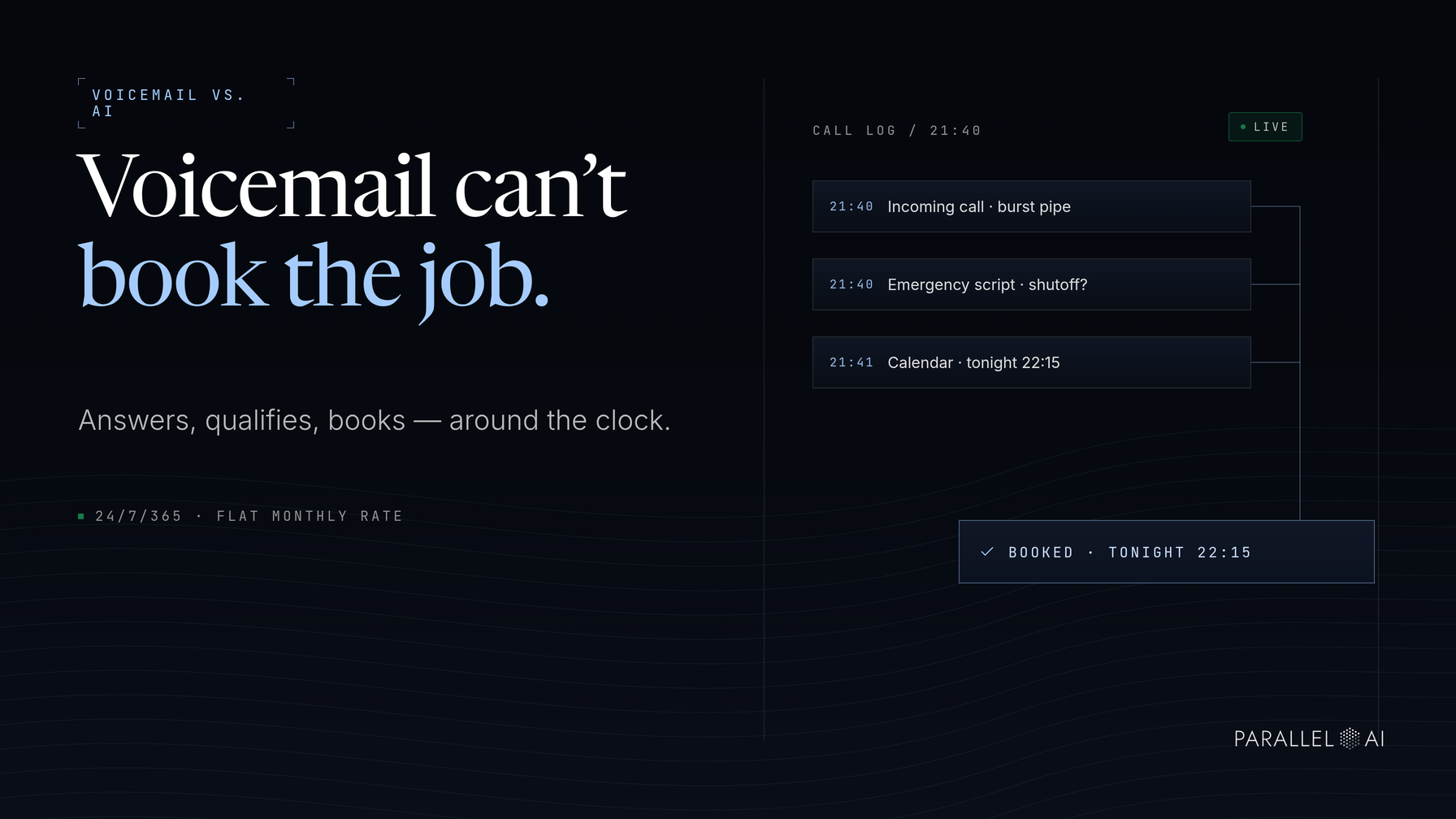
Yes, an AI answering service for small business can reliably answer your calls, take messages, qualify leads, and book appointments around the clock, without a receptionist on payroll. Most owners already suspect that, though. The real question is whether it should replace your traditional answering service, back it up, or just replace the voicemail box that's quietly costing you customers.
This matters most if you run a plumbing company, a salon, a small law office, a clinic, or a real estate team. In those businesses the phone rings while your hands are already full. This post compares the two options side by side, walks through exactly what happens on a call, and shows a setup you can finish in an afternoon.
AI Answering Service for Small Business vs. a Traditional Answering Service: Which Should You Choose?
Neither option wins across the board. A traditional answering service and an AI answering service for small business each handle different parts of the missed-call problem, so the right choice depends on which jobs matter most to you:
| What you need | Traditional answering service | AI answering service |
|---|---|---|
| Message taking | A live agent writes down the message and relays it | Every call transcribed instantly, with details texted or emailed to you |
| After-hours coverage | Usually offered, often on higher-priced tiers | On by default, 24/7/365 |
| Lead qualification | Agents follow a script, but depth varies by agent | Asks your qualifying questions on every call, every time |
| Appointment booking | Usually takes a message for you to call back | Checks real-time availability and books while the caller is on the line |
| Cost structure | Billed per call or per minute, so costs rise with volume | Flat monthly subscription, so costs stay predictable |
| Consistency | Varies by agent, shift, and familiarity with your account | Follows your exact script on every call, and updates take effect immediately |
Where a traditional answering service still wins
A human agent brings judgment. When a caller is upset, confused, or dealing with a genuinely complicated situation, a person can read the moment and improvise in ways a script can't. If your callers frequently demand a real person, or your conversations routinely go off-script, a human voice has real value.
Where an AI answering service pulls ahead
Consistency and availability. An AI answering service never sleeps, never has a bad shift, and never forgets the policy you updated on Monday. Three examples make this concrete:
- The plumber with the 9:40 p.m. burst-pipe call. The AI answers on the first ring and works through your emergency script ("Is water still flowing? Have you found the main shutoff valve?"). It texts the caller's details to your on-call phone and tells them a plumber will call back within minutes.
- The salon owner mid-appointment. A client calls to reschedule while you're mid-color. The AI checks your calendar, moves the booking, answers "how much for highlights?" from your price FAQ, and sends a confirmation text. You find out afterward.
- The law office at 7 p.m. A caller asks about a court date next week. The AI explains that no one can give legal advice tonight, because you scripted it that way. It collects the name, contact info, matter type, and deadline, then files a structured summary with the full transcript for your attorney to review in the morning.
The booking gap matters most here. Traditional services typically take a message and wait for you to call back, and that's exactly where small businesses lose callers to whoever answers first. AI books into your live calendar while the caller is still on the line.
The mix most small businesses land on
AI takes the first line: after-hours, weekends, and overflow when you're already on a call. You or a small human service handles escalations. That combination covers every hour of the week without paying anyone to sit idle overnight.
Whichever mix you choose, it helps to understand what actually happens between the ring and the booked appointment.
How Does the AI Actually Handle a Call?
An AI answering service moves a call through five stages. Each one takes seconds.
- It picks up instantly. No rings rolling into voicemail. The caller hears your greeting right away.
- It listens and transcribes. The caller's words are converted to text in real time, which is what makes the transcript and summary possible later.
- It understands what the caller wants. The AI matches what it hears against your call script, your FAQ, and your knowledge base. Those are the same answers you'd give yourself.
- It acts. It answers the question, asks your qualifying questions, checks your availability, and either books the appointment or captures a detailed message.
- It hands off when needed. If the caller asks for a person, gets upset, or raises something outside the script, the AI routes the conversation to your team with full context, so nobody has to repeat themselves.
Parallel AI is built around exactly this model. Its AI employees include voice and chat agents that answer the phone, SMS, WhatsApp, web chat, and email around the clock. They qualify leads, book meetings, and hand complex issues to your team with the complete conversation attached. And because the call lives in the same platform as your customer records, every conversation becomes data you can act on instead of a message slip on a desk.
That raises a practical question. How hard is this to set up?
Can You Set One Up Without Technical Skills?
Yes. If you can write an email and forward a call, you can set up an AI answering service. Plan on an afternoon, in this order:
Step 1: Define what happens when the phone rings
Decide when the AI answers. After-hours only? Overflow when you're busy? Every call? Also settle what the greeting says and what the AI handles versus escalates. A plumber might want emergencies texted to the on-call line immediately, while everything else gets booked for the next business day.
Step 2: Write your call script and FAQ
Start with your greeting, the ten questions callers actually ask (hours, location, service area, parking, pricing basics), your qualifying questions, and the keywords that count as an emergency. The fastest shortcut is to copy your existing FAQ page and borrow the phrasing from whoever answers your phones best today.
Step 3: Connect your phone number
Forward your existing business number to the AI agent, or give the agent its own number for a specific purpose, like an after-hours line or a "book now" line. No new hardware and no carrier change. You can keep answering some calls yourself.
Step 4: Set your handoff rules
Decide when a human takes over. Triggers include the caller asking for a person, the conversation turning emotional, the question falling outside the script, or high stakes. Then choose how: a warm transfer with full context, or a captured message texted to your team instantly.
Step 5: Test before going live
Call the number from your own cell phone. Play the emergency caller, the rambler, the price shopper, and the person who asks, "Is this a machine?" Refine the script and call again. When it handles all four comfortably, turn it on for after-hours first and expand once you trust it.
What to Do Once Your Calls Are Covered
Call answering is usually the first job an AI platform takes over, not the last. Once the phones are handled, the same system can pick up the follow-on work:
- Lead data. Every call becomes a structured record: name, number, what they needed, the full transcript. No more voicemails you half-remember.
- Outreach. Callers who didn't book, like the quote shopper or the "let me think about it" caller, can flow into a follow-up sequence that nudges them by email or SMS a day or two later.
- Content. The same content engine can draft your follow-up emails, review requests, and the FAQ answers you feed back into your call scripts.
- White-label for agencies. If you serve small businesses as an agency, Parallel AI's white-label option lets you offer AI answering under your own brand. Most of your clients need it whether they've asked for it or not.
A Missed Call Doesn't Have to Be a Lost Customer
An AI answering service for small business answers calls 24/7, takes messages, qualifies leads, and books appointments. No receptionist, no technical skills required. Traditional answering services still win on judgment-heavy, emotional, or highly complex conversations, so most small businesses get the best results from a mix: AI for after-hours and overflow, people for escalations. Setup is an afternoon's work. You write the script, connect your number, set handoff rules, and make a test call from your own phone.
The fastest way to know whether it fits your business is to hear it yourself. Start Parallel AI's 7-day free trial, connect your number, write a greeting, and call it from your cell phone before a single customer does. If it doesn't sound like the front desk you'd want, you've spent an afternoon, not a customer.