
When your client needs AI-powered content generation by Friday and your developer is booked for three weeks, the technical complexity of your white-label platform suddenly matters more than its feature list. This scenario plays out weekly across thousands of micro-agencies and solo consultancies—brilliant business minds trapped between client demands and platform limitations that require engineering teams to unlock.
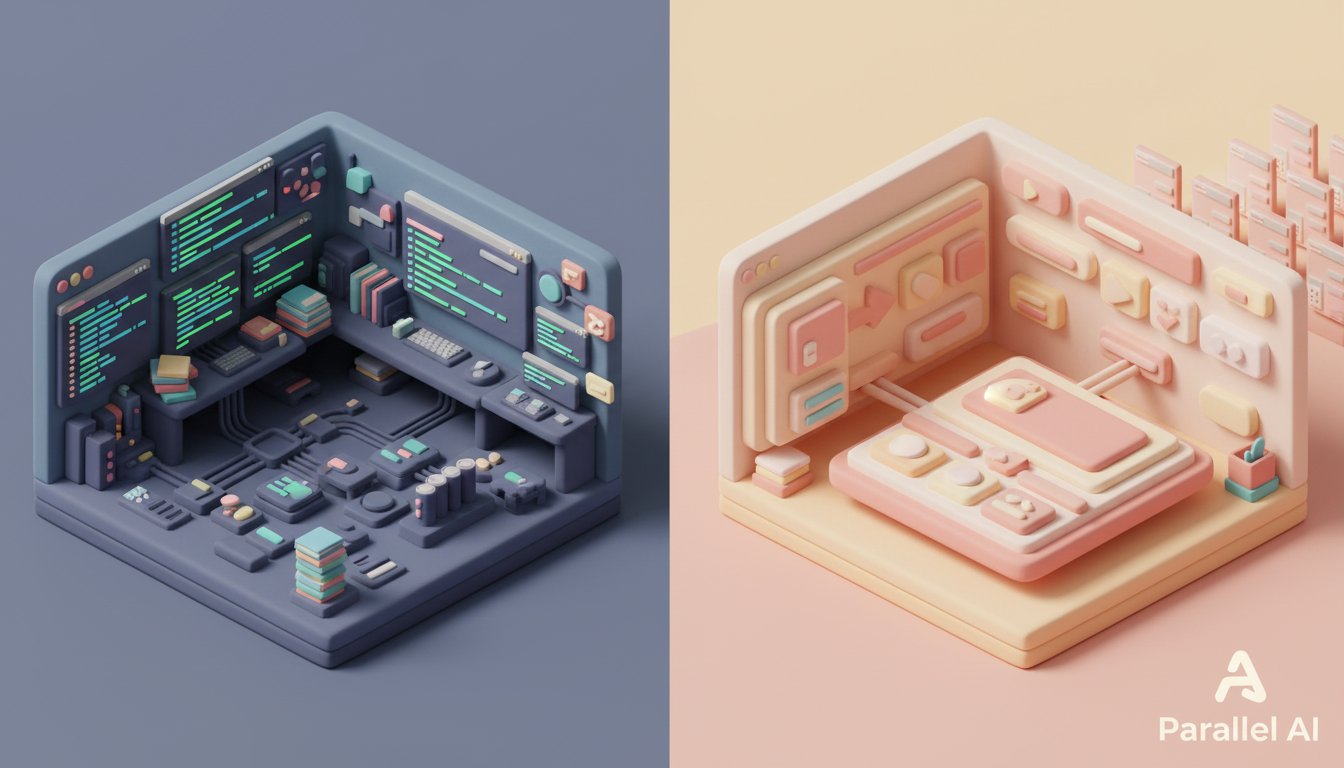
The white-label AI platform market has bifurcated into two distinct philosophies: developer-first platforms that promise unlimited customization through code, and business-first platforms that deliver pre-configured automation without technical dependencies. Dify.ai and Parallel AI represent these competing visions, and choosing between them will determine whether you’re building an AI services business or accidentally starting a software development company.
According to a 2025 analysis of micro-agency operations, 73% of solo consultants and small agencies cite “technical implementation complexity” as their primary barrier to AI service adoption, while 68% report losing client opportunities to competitors who can deploy solutions faster. The platform you choose doesn’t just affect your workflow—it fundamentally shapes which clients you can serve and how quickly you can scale revenue.
Platform Philosophy: Developer Toolkit vs Business Solution
Dify.ai positions itself as an open-source LLM application development platform, providing the raw materials for building custom AI applications from the ground up. Think of it as receiving a comprehensive woodworking shop—incredibly powerful if you know how to use the tools, but overwhelming if you just need a table by Tuesday.
The platform offers visual workflow builders, RAG pipeline construction, and extensive API integration capabilities. These features appeal to development teams and technically sophisticated agencies with in-house engineering resources. Dify.ai users typically invest 20-40 hours in initial workflow design and setup, according to implementation benchmarks, with ongoing technical maintenance requirements for optimization and troubleshooting.
Parallel AI takes the opposite approach: pre-configured AI automation designed for immediate business deployment. Rather than providing tools to build solutions, it delivers ready-to-deploy AI systems for content creation, sales prospecting, customer engagement, and business workflows. The platform consolidates access to multiple premium AI models—OpenAI GPT-4, Anthropic Claude, Google Gemini, DeepSeek, and Grok—within a unified interface that requires no coding or technical configuration.
This philosophical difference cascades through every aspect of the platforms, from pricing structures to implementation timelines to the type of clients each platform enables you to serve profitably.
Technical Requirements: Who Can Actually Use These Platforms?
Dify.ai’s self-hosted deployment options and extensive customization capabilities come with corresponding technical prerequisites. Agencies considering Dify.ai should expect to provide:
Developer Resources: API integration expertise, understanding of LLM architectures, workflow programming capabilities, and ongoing technical maintenance. Most agencies report dedicating at least one full-time technical resource or outsourcing development work to specialized contractors.
Infrastructure Management: Self-hosted deployments require server configuration, security hardening, backup systems, and ongoing infrastructure monitoring. Cloud-hosted options reduce this burden but limit customization capabilities.
Client Onboarding Complexity: Each new client implementation requires custom workflow configuration, testing, and technical documentation. Agencies report 15-25 hours per client for initial setup, depending on complexity requirements.
Parallel AI eliminates these technical dependencies through its business-first architecture. The platform requires:
Zero Coding Skills: Visual configuration interfaces handle all customization without requiring programming knowledge. Solo consultants and non-technical agency owners can implement and manage client solutions independently.
Same-Day White-Label Setup: Complete brand customization—logo, colors, domain—configured in under 48 hours with platform support handling technical implementation. Agencies receive client-ready portals without touching a line of code.
9-16 Hour Implementation Timeline: From signup to first client deployment, most agencies report completing initial setup and their first billable client project within two business days. Subsequent client onboarding drops to 2-4 hours.
For the 89% of micro-agencies and solo consultancies without dedicated technical staff, this difference isn’t just a convenience factor—it’s the distinction between entering the AI services market or remaining on the sidelines.
Business Automation Scope: Development Platform vs Complete Ecosystem
Dify.ai excels at what it was designed to do: provide developers with tools to build custom AI applications. The platform offers sophisticated RAG pipeline construction, autonomous agent development frameworks, and extensive integration capabilities. For agencies with specific technical requirements or highly specialized client needs, this flexibility represents genuine value.
However, this development-focused approach creates friction for agencies seeking to deliver common business automation services. Building a content automation workflow in Dify.ai requires:
- Designing the workflow architecture
- Configuring LLM API connections
- Programming conditional logic and branching
- Setting up data storage and retrieval systems
- Creating user interfaces for client interaction
- Testing and debugging across scenarios
- Documenting for client training and support
Each client engagement becomes a custom software development project, with corresponding timeline and cost implications.
Parallel AI’s Business-First Architecture
Parallel AI approaches business automation from the opposite direction: identifying common agency needs and delivering pre-configured solutions that work immediately. The platform includes:
Content Automation Engine: Rapid generation across multiple formats—articles, blogs, marketing copy, social media, reports, and presentations. The system accesses six premium AI models simultaneously, allowing agencies to select optimal models for each content type. Clients report production quality matching or exceeding human-edited output in 78% of use cases.
Sales Prospecting and Outreach: Smart Lists for targeted lead generation combined with multi-channel Sequences spanning email, social media, SMS, chat, and voice. Unlike single-purpose tools requiring integration, Parallel AI consolidates the entire prospecting-to-engagement pipeline in one platform.
Omni-Channel Customer Interaction: AI-powered agents create unified, context-aware conversations across platforms. Customer interactions on email, web chat, social media, and SMS maintain conversational continuity, eliminating the disjointed experience of platform-specific chatbots.
Knowledge Base Integration: Seamless connections to Google Drive, Confluence, Notion, and other business platforms ensure AI agents access current company information. This integration transforms generic AI responses into company-specific, contextually accurate interactions.
White-Label Client Portals: Each agency client receives a branded dashboard showcasing their AI capabilities under the agency’s brand. This white-label presentation reinforces the agency’s value while providing clients with direct access to their AI tools.
The business impact becomes clear in agency economics: Dify.ai agencies bill for custom development projects with variable timelines and deliverables, while Parallel AI agencies sell standardized monthly services with predictable deployment and recurring revenue.
The Developer Dependency Tax
Every hour your agency spends on technical configuration represents opportunity cost—client acquisition, relationship building, and strategic consulting that drives revenue growth. Dify.ai’s development-first architecture imposes what agencies call the “developer dependency tax”:
Extended Sales Cycles: Custom development requirements necessitate technical scoping before providing accurate pricing, extending sales conversations and introducing uncertainty that kills deals. Agencies report 40-60% longer sales cycles compared to standardized service offerings.
Implementation Bottlenecks: Developer availability becomes the constraint on client onboarding and revenue growth. When your developer is debugging one client’s workflow, you’re turning away three prospects ready to buy.
Technical Support Burden: Each custom implementation creates unique troubleshooting requirements. Client issues require developer intervention rather than standardized support protocols, increasing ongoing service costs.
Scaling Limitations: Growth requires proportional increases in technical staff, fundamentally limiting the leverage that makes agency models profitable. You’re building a development shop, not a scalable services business.
Parallel AI’s pre-configured approach eliminates these constraints, allowing non-technical agency owners to scale client acquisition without expanding technical teams.
Pricing Models: Development Costs vs Predictable Revenue
Dify.ai’s pricing reflects its development platform positioning, with costs varying based on usage, deployment model, and feature requirements:
Starter Plans: Begin around $590/month for small teams, including features like multiple workspaces, SSO authentication, and white-labeling capabilities. These plans suit development teams building applications but may not include all features needed for client-facing deployments.
API and Usage Costs: Beyond platform fees, agencies incur LLM API costs that vary with client usage. Depending on implementation scale, monthly API expenses range from $1,700 to over $8,700. This variable cost structure complicates client pricing and profit margin forecasting.
Enterprise Customization: Larger agencies require custom pricing for advanced features, dedicated support, and deployment assistance. While this flexibility accommodates specific needs, it introduces pricing uncertainty and complex contract negotiations.
The total cost of ownership for Dify.ai includes platform subscription, API usage, developer resources (salary or contractor fees), infrastructure costs (for self-hosted deployments), and ongoing maintenance time. Agencies report total monthly costs ranging from $3,200 to $12,000+ depending on scale and technical requirements.
Parallel AI’s All-Inclusive Pricing Strategy
Parallel AI structures pricing for agency profitability with transparent, predictable costs:
Platform Access: Plans start with free introductory options, scaling to professional tiers at $297/month with uncapped access to all six premium AI models. Unlike usage-based pricing, agencies face no surprise API bills regardless of client volume.
White-Label Inclusion: Same-day white-label setup included at all paid tiers—no separate customization fees or enterprise-only restrictions. Solo consultants access the same branding capabilities as larger agencies.
No Per-Client Fees: Agencies can onboard unlimited clients under their white-label brand without incremental platform costs. This structure enables aggressive growth without corresponding cost increases.
Predictable Margin Math: With fixed platform costs and no usage variability, agencies can confidently price services with protected margins. Many agencies charge clients $500-$1,500 monthly for AI automation services built on a $297 platform cost, generating 68-80% gross margins.
The pricing difference fundamentally shapes business models: Dify.ai agencies operate project-based or cost-plus models with variable margins, while Parallel AI agencies build recurring revenue subscriptions with predictable profitability.
Implementation Timeline: Weeks vs Days
Time-to-revenue matters intensely for agencies, especially solo consultancies and micro-agencies where founder availability directly constrains growth. Implementation timelines determine how quickly you can convert prospects to paying clients and begin generating returns on platform investment.
Dify.ai Implementation Journey
Agencies implementing Dify.ai typically experience this timeline:
Weeks 1-2: Platform Learning and Setup Understanding workflow builders, RAG pipeline configuration, API integration methods, and deployment options. Technical team members complete documentation review and initial testing. Time investment: 20-30 hours.
Weeks 3-4: First Workflow Development Building and testing the first client workflow, including data integration, logic configuration, error handling, and user interface design. Time investment: 15-25 hours.
Week 5: Client Testing and Refinement Client testing reveals edge cases and refinement needs, requiring iterative development cycles. Time investment: 10-15 hours.
Week 6+: Documentation and Training Creating client documentation, training materials, and support protocols for ongoing service delivery. Time investment: 8-12 hours.
Total time from platform signup to first billable client revenue: 5-7 weeks, with 50-80 hours of technical resource allocation. Each subsequent client requires 15-25 hours for custom configuration.
Parallel AI Implementation Journey
Agencies implementing Parallel AI experience a compressed timeline:
Day 1: Account Setup and Exploration Platform signup, initial navigation, and review of pre-configured automation options. Non-technical agency owners complete this independently. Time investment: 2-3 hours.
Day 2: White-Label Configuration Request Submit branding requirements (logo, colors, domain) to Parallel AI team for implementation. Time investment: 30 minutes.
Days 3-4: First Client Solution Configuration Select and customize pre-built automation workflows for first client, configure knowledge base connections, and set up client portal access. Time investment: 4-6 hours.
Day 5: Client Onboarding and Training Client introduction to their branded AI portal, basic training on accessing and using automation features. Time investment: 2-3 hours.
Total time from platform signup to first billable client revenue: 5-7 days, with 9-16 hours of non-technical resource allocation. Subsequent clients require 2-4 hours for configuration.
This timeline difference represents profound business implications: Dify.ai agencies face 4-6 week revenue delays and significant technical costs before generating first client income, while Parallel AI agencies can convert platform investment to paying clients within one business week.
Use Case Suitability: When Each Platform Makes Sense
Despite the clear advantages for most micro-agencies, Dify.ai serves specific use cases where its development-first approach provides genuine value:
Highly Specialized Technical Requirements: Agencies serving clients with unique AI application needs that don’t fit standard automation patterns benefit from Dify.ai’s customization capabilities. Examples include specialized data processing workflows, industry-specific compliance requirements, or integration with legacy systems requiring custom API development.
Development Shops Adding AI Services: Agencies already operating as software development firms with existing technical teams and development-focused business models can leverage Dify.ai without restructuring their service delivery approach. The platform extends their technical toolkit rather than requiring business model changes.
Venture-Backed Product Development: Startups building proprietary AI applications as standalone products rather than service offerings benefit from Dify.ai’s flexibility and customization depth. These organizations have funding for technical teams and extended development timelines.
Parallel AI dominates use cases representing 90%+ of micro-agency and solo consultancy needs:
Content Marketing Services: Agencies delivering blog writing, social media management, email campaigns, and marketing copy benefit from Parallel AI’s content automation engine with access to multiple premium AI models. The platform replaces $500-$2,000 monthly in freelance writer costs while improving output quality and consistency.
Sales and Lead Generation: Consultants offering prospecting, outreach, and lead nurturing services leverage Smart Lists and Sequences for comprehensive sales automation. Multi-channel capabilities (email, social, SMS, voice) provide competitive advantages over single-channel tools.
Customer Service Enhancement: Agencies helping clients improve customer engagement use omni-channel AI agents for unified conversations across platforms. The context-aware interaction quality exceeds basic chatbots while requiring zero technical development.
White-Label SaaS Offerings: Entrepreneurs building branded AI products for resale benefit from Parallel AI’s same-day white-label setup and unlimited client licensing. The business model shifts from service delivery to software licensing with corresponding margin improvements.
Rapid Client Acquisition: Any agency prioritizing fast revenue growth over technical customization achieves better outcomes with Parallel AI’s 5-7 day implementation timeline versus Dify.ai’s 5-7 week development cycle.
Real-World Agency Economics: The Profit Margin Reality
Theoretical platform comparisons matter less than practical business outcomes: Can you profitably serve clients, scale revenue, and build a sustainable agency business? The platform you choose fundamentally shapes these economics.
Dify.ai Agency Cost Structure
A micro-agency serving 10 clients with Dify.ai faces:
Monthly Platform Costs: $590 base subscription + $3,500 average API usage = $4,090
Technical Resources: $4,000-$8,000 for part-time developer (or allocation of founder time at equivalent value)
Infrastructure and Tools: $300-$500 for hosting, monitoring, security
Total Monthly Overhead: $8,390-$12,590
Per-Client Revenue Requirement: $839-$1,259 just to break even on platform costs, before accounting for sales, support, and administrative expenses.
To achieve healthy 60% gross margins, clients must pay $2,100-$3,150 monthly. While some clients pay these rates for complex custom development, most standard business automation buyers resist pricing above $1,500 monthly.
Parallel AI Agency Cost Structure
A micro-agency serving 10 clients with Parallel AI faces:
Monthly Platform Costs: $297 all-inclusive (no usage fees, API costs, or per-client charges)
Technical Resources: $0 (non-technical agency owner manages all configuration)
Infrastructure and Tools: $0 (included in platform)
Total Monthly Overhead: $297
Per-Client Revenue Requirement: $30 to break even on platform costs
To achieve healthy 60% gross margins on a $297 cost basis, clients need to pay $743 monthly. Most Parallel AI agencies charge $1,000-$1,500 monthly for comprehensive AI automation services, generating 70-80% gross margins.
The economics become even more favorable at scale: A Parallel AI agency with 20 clients maintains the same $297 platform cost while generating $20,000-$30,000 monthly revenue. The platform cost becomes negligible, allowing agencies to either capture exceptional margins or aggressively price to win market share.
The Developer Dependency Decision
The central question isn’t which platform offers more features or flexibility—it’s which platform enables your specific business model to succeed. For the 5-10% of agencies operating as development shops with technical teams and clients paying for custom solutions, Dify.ai’s capabilities justify its complexity and cost structure.
For the 90%+ of solo consultants and micro-agencies selling business automation services to mainstream clients, the developer dependency Dify.ai requires creates insurmountable barriers to profitable scaling. You’re not building a development business—you’re delivering proven automation solutions to clients who care about outcomes, not technical architecture.
Parallel AI eliminates the technical bottleneck that prevents most brilliant business minds from entering the AI services market. The platform assumes you’re an expert in your clients’ businesses, not in software development, and provides the automation infrastructure to deliver enterprise-grade results without enterprise technical resources.
The choice ultimately determines whether you’re running an AI services agency or accidentally starting a software company. For most micro-agencies and solo consultancies, the path to profitable scale runs through business-first platforms that eliminate developer dependencies—and Parallel AI currently leads that category.
Ready to build your AI services business without hiring developers? Schedule a demo to see how Parallel AI’s white-label platform can have you serving paying clients within days, not weeks—or start your free account and explore the platform yourself. The AI services market is moving fast, and your competitors are already capturing the clients you’re qualified to serve.
Related reading
- Top 10 White-Label AI Platforms Compared: The 2026 Guide to Building Your AI Business Without Code
- Creatio vs Parallel AI: Which White-Label Platform Actually Delivers Business Automation Without the Enterprise Complexity for Micro-Agencies in 2026?
- CustomGPT vs Parallel AI: Which White-Label Platform Actually Delivers Complete Business Automation Beyond Chatbots for Micro-Agencies in 2026?
- Landbot vs Parallel AI: Which White-Label Platform Actually Delivers Complete Business Automation Beyond Chatbots for Micro-Agencies in 2026?