
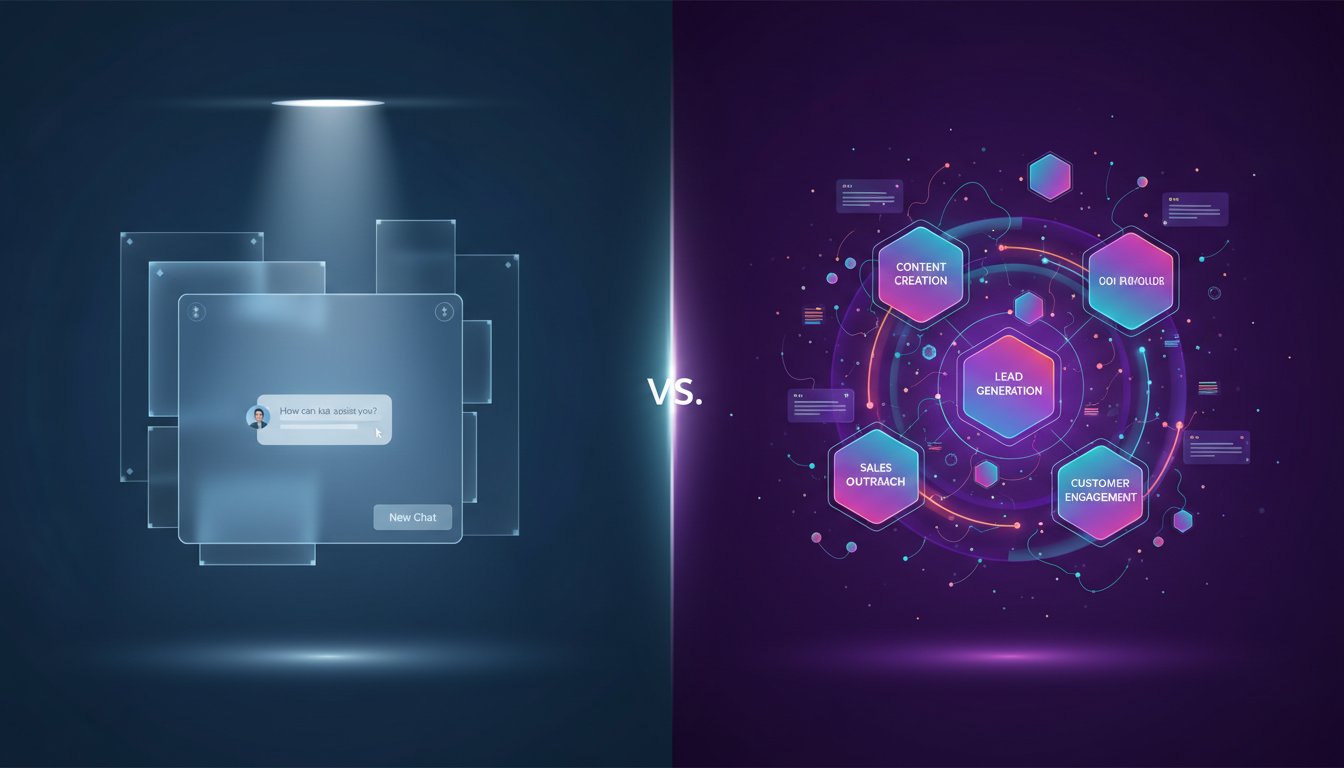
The white-label AI platform market has reached a critical inflection point. Micro-agencies and solo consultants face a fundamental strategic choice that will shape their competitive positioning for years: invest in specialized chatbot platforms that excel at one function, or embrace comprehensive automation ecosystems that consolidate content creation, lead generation, sales outreach, and customer engagement into a single brandable solution.
This decision carries implications far beyond feature comparisons. According to recent market analysis, micro-agencies launching AI automation services with initial investments of $2,000-$5,000 are scaling to $5,000-$50,000 monthly revenue within their first year—but only when they choose platforms that eliminate the need for multiple tool subscriptions and technical development resources.
The challenge isn’t finding AI capabilities. It’s finding a white-label platform that transforms you from a service provider into a technology company without requiring venture capital, development teams, or years of platform building. CustomGPT and Parallel AI represent two distinctly different approaches to solving this problem, and understanding their fundamental architectural differences will determine whether you’re selling chatbot access or building a scalable AI services business.
This comprehensive analysis examines both platforms through the lens that matters most to micro-agencies: profit margins, deployment speed, client retention mechanics, and the hidden operational costs that only emerge after you’ve committed to the wrong infrastructure.
The Core Architectural Difference That Determines Everything Else
Before comparing features, pricing, or integration capabilities, you need to understand the fundamental philosophical difference between these platforms—because this architectural decision cascades into every aspect of your business model.
CustomGPT: The Specialized Chatbot Deployment Model
CustomGPT was purpose-built as a no-code chatbot creation platform. Its core value proposition centers on rapid deployment of branded AI chat agents that can be embedded on websites, integrated with existing workflows, and customized with your logo and branding elements. The platform excels at one specific use case: creating conversational AI interfaces trained on your content sources.
This specialization delivers genuine advantages. The no-code interface enables chatbot deployment “within minutes” according to their marketing materials, with straightforward customization options for businesses needing quick conversational AI solutions. Their white-label capabilities allow agencies to brand these chatbots as their own technology.
But here’s the strategic limitation: CustomGPT is fundamentally a chatbot platform, not a comprehensive business automation ecosystem. When your clients need content generation at scale, multi-channel sales prospecting, automated lead qualification sequences, or workflow automation beyond conversational interfaces, you’ll still need separate tools—each with its own subscription cost, learning curve, and integration challenges.
Parallel AI: The Consolidated Automation Ecosystem Model
Parallel AI was architected from the ground up to solve a different problem: consolidating the six-plus AI tools that agencies typically pay $2,000+ monthly for into a single white-label platform. Rather than specializing in one function, it provides an integrated ecosystem covering chat, content automation, knowledge management, lead generation, sales sequences, workflow automation, and omnichannel customer engagement.
This architectural approach fundamentally changes your business model. Instead of reselling chatbot access while paying for separate tools to handle content creation (Jasper), lead generation (HubSpot), sales automation (Outreach), and workflow automation (Zapier), you’re offering a complete AI operations platform under your brand.
The platform integrates six premium AI models—OpenAI GPT-4, Anthropic Claude 3, Google Gemini, Grok, DeepSeek, and others—allowing clients to switch models based on task requirements rather than being locked into a single AI engine. Context windows extend up to one million tokens, enabling complex business processes that chatbot platforms simply can’t support.
For micro-agencies, this difference translates directly to profit margins and client retention. When clients get chatbot-only solutions, they view you as a vendor providing a single tool. When they get comprehensive automation that replaces multiple subscriptions and measurably increases their operational capacity, you become infrastructure—which means dramatically lower churn and higher lifetime value.
White-Label Capabilities: Branding vs. Business Infrastructure
Both platforms offer white-label options, but the depth and business implications differ substantially.
CustomGPT’s White-Label Approach
CustomGPT provides customization options that allow businesses to personalize AI agents with logos, backgrounds, and branding elements. Higher pricing tiers unlock more extensive customization capabilities, and the platform positions itself as suitable for agencies wanting to offer branded chatbot solutions.
The white-label functionality focuses primarily on visual branding—making the chatbot interface appear as your technology. This works well if your business model centers exclusively on deploying conversational AI solutions.
However, the platform doesn’t provide the infrastructure for running a complete white-label AI services business. You won’t find built-in client billing management through your own Stripe account, granular feature toggle controls per client, or the ability to create custom pricing tiers that your clients subscribe to directly through your branded portal.
Parallel AI’s Complete White-Label Business Infrastructure
Parallel AI provides white-label capabilities designed specifically for agencies building recurring revenue businesses. The difference extends far beyond logo customization.
You get complete control over client billing through your own Stripe integration. Your clients pay you directly, subscription revenue flows to your business account, and you manage pricing, packaging, and payment terms. Parallel AI operates on a transparent revenue share model where you keep 30% of subscription revenue plus unlimited markup potential, with base costs starting at $69/month for entrepreneur-level packages.
The platform includes granular client management tools: create custom pricing tiers, toggle features on/off for different package levels, manage multiple client accounts from a single dashboard, set your own markup and profit margins, and customize the entire client experience with your branding, domain, terms of service, and privacy policies.
Setup time averages 2-3 hours from signup to first client onboarded, with the fastest recorded time being 2.5 hours. Compare this to the months or years required to build proprietary AI infrastructure, and the strategic advantage becomes clear.
For micro-agencies, this infrastructure difference determines whether you’re reselling access to someone else’s chatbot tool or operating your own AI services company. The former caps your margins and positions you as easily replaceable. The latter creates defensible recurring revenue with 30-70% profit margins.
Feature Ecosystem: Single Function vs. Complete Automation
The feature comparison reveals fundamentally different visions of what agencies need to scale profitably.
CustomGPT’s Chatbot-Centric Feature Set
CustomGPT focuses its development resources on making chatbot deployment as frictionless as possible:
Core Capabilities:
– No-code chatbot creation and deployment
– Content ingestion from various sources to train AI agents
– Integration with business workflows
– Customizable conversational interfaces
– Multi-format support (increasing with higher pricing tiers)
The platform excels at its core mission. If your business model centers exclusively on deploying branded chatbots for client websites, customer support automation, or internal knowledge bases, CustomGPT provides purpose-built tools for this use case.
The Limitation for Micro-Agencies:
When clients need comprehensive AI capabilities, you’ll need to integrate or purchase:
– Separate content automation tools for blog posts, marketing copy, and reports
– Different platforms for multi-channel sales prospecting and outreach
– Additional workflow automation tools beyond conversational interfaces
– Standalone knowledge management systems
– Other lead generation and qualification tools
Each additional tool means another subscription cost (eating into your margins), another integration to maintain (increasing technical complexity), and another potential point of failure (risking client satisfaction).
Parallel AI’s Integrated Automation Ecosystem
Parallel AI consolidates the tools micro-agencies need into a single platform:
Multi-Model AI Chat:
Access to six premium AI models (GPT-4, Claude 3, Gemini, Grok, DeepSeek, and more) with up to 1M token context windows. Clients can switch models per task for optimal results rather than being locked into a single AI engine.
Enterprise Knowledge Base:
Persistent memory across conversations, integration with Google Drive, Confluence, and Notion, and the ability to train AI on client brand guidelines, voice, and proprietary data. This transforms generic AI into specialized business intelligence that understands your client’s specific context.
Content Automation Engine:
Rapid generation of diverse content formats—articles, blogs, marketing copy, reports, social media posts, email sequences, and more. This capability alone replaces tools like Jasper or Copy.ai that many agencies pay $50-200+ monthly for.
Sales Prospecting and Outreach:
Smart Lists for targeted lead generation and multi-channel Sequences that orchestrate outreach across email, social media, SMS, chat, and voice. This consolidates functionality that would otherwise require separate subscriptions to platforms like HubSpot, Outreach, or Apollo.
AI Employees and External Agents:
Customizable AI agents that handle specific business functions autonomously—lead qualification, customer support, content scheduling, data analysis, and more. These agents work 24/7 without the overhead of human hiring.
Workflow Automation:
Custom workflow builder with included n8n instance and MCP servers to connect virtually any tool. This eliminates the need for separate Zapier or Make subscriptions while providing more powerful automation capabilities.
Omnichannel Customer Interaction:
Multi-platform AI-powered agents that create unified, context-aware conversations across channels. Whether customers engage via email, chat, social media, or phone, they receive consistent, coherent responses informed by complete interaction history.
For micro-agencies, this ecosystem approach fundamentally changes the economics. Instead of paying for six-plus separate tools and trying to integrate them, you’re offering clients a consolidated platform that replaces their fragmented tool stack—which justifies higher pricing and creates stickier client relationships.
Pricing Models and Profit Margin Reality
Pricing structures reveal each platform’s target market and expected use cases.
CustomGPT Pricing Tiers
CustomGPT offers three primary pricing tiers:
Standard Plan: $99/month (billed annually) or $99/month (billed monthly)
– Suitable for small to medium businesses
– Basic AI functionality and customization
– Limited capacity for chatbot deployments
Premium Plan: $499/month (billed annually) or $499/month (billed monthly)
– Advanced features and increased capacity
– Enhanced customization options
– Higher usage limits
Enterprise Plan: Custom pricing
– Tailored for large organizations
– Extensive integrations and support
– Bespoke solutions and dedicated account management
Additional packages include Proof of Concept (POC) options and custom enterprise plans available upon contact.
Margin Analysis for Agencies:
If you’re reselling CustomGPT with typical 1.5-2x markup:
– Standard tier: Cost $99, Charge $149-199, Profit $50-100/client/month
– Premium tier: Cost $499, Charge $749-999, Profit $250-500/client/month
These margins work if chatbot deployment is your entire business model. But remember—you’re still paying separately for content tools, lead generation platforms, sales automation, and workflow tools. Those costs (typically $2,000+ monthly for a small agency) dramatically reduce your actual profitability.
Parallel AI Pricing and Margin Structure
Parallel AI operates on a transparent revenue share model with base platform costs:
Base Platform Costs (What You Pay):
– $69/month (annual): Entrepreneur package – 1 company, 1 seat, 2K credits
– $181/month (annual): Growth package – 1 company, 6 seats, 6K credits
– $209/month (annual): Business package – 3 companies, 9 seats, 9K credits
– Custom: Enterprise packages with unlimited seats and custom credits
Typical Client Pricing and Your Margins:
– Entrepreneur base: Charge $497-697/month → Profit $428-628/month per client
– Growth base: Charge $697-997/month → Profit $516-816/month per client
– Business base: Charge $1,800-2,400/month → Profit $1,591-2,191/month per client
Real-World Profit Examples:
Solo Consultant:
– 3 clients × $697/month = $2,091/month revenue
– Your cost: $299/month (annual pricing)
– Profit: $1,704/month ($20,448/year)
Small Agency:
– 10 clients × $997/month = $9,970/month revenue
– Your cost: ~$1,200/month (base plus extra seats)
– Profit: $8,770/month ($105,240/year)
Agency with Service Packages:
– 15 clients × $897/month platform = $13,455/month
– Setup fees: 3 new clients × $2,500 = $7,500 one-time
– Monthly consulting: 10 hours × $200 = $2,000/month
– Total Monthly: $15,455 plus variable consulting
The critical difference: these margins include all the functionality that would normally require separate subscriptions to content tools, lead generation platforms, sales automation, and workflow tools. You’re not just making higher margins—you’re eliminating the tool stack costs that would otherwise consume your profits.
Additional Revenue Opportunities:
Parallel AI white-labelers keep 100% of revenue from professional services:
– Training sessions: $200-500/session
– Professional onboarding: $1,500-5,000 one-time
– Custom AI employee setup: $500-2,000 per employee
– Knowledge base integration: $750-2,500
– Workflow automation consulting: $150-300/hour
– Monthly optimization retainer: $500-2,000
This hybrid model—platform subscriptions plus professional services—creates multiple revenue streams from each client relationship, dramatically increasing lifetime value.
Integration Ecosystems and Technical Flexibility
How platforms connect with existing business tools determines implementation complexity and long-term scalability.
CustomGPT Integration Approach
CustomGPT provides APIs and integration capabilities designed primarily to connect chatbots with existing workflows. The platform supports content ingestion from various sources to train AI agents and can be embedded into websites and business applications.
For agencies, this means you can deploy chatbot solutions that connect with client systems, but you’re responsible for architecting how those chatbots interact with the rest of your client’s tool stack. If clients need comprehensive automation beyond conversational interfaces, you’ll need to build custom integrations or add other platforms.
Parallel AI Integration Ecosystem
Parallel AI includes native integrations with the tools micro-agencies and their clients actually use:
Knowledge Base Integration:
– Google Drive (documents, spreadsheets, presentations)
– Confluence (team wikis and documentation)
– Notion (databases and project management)
– Direct file uploads and URL ingestion
Workflow Automation:
– Included n8n instance for custom workflow automation
– MCP (Model Context Protocol) servers for connecting virtually any tool
– API access for custom integrations
– Webhook support for real-time triggers
Communication Channels:
– Email (SMTP integration)
– SMS and voice (carrier integrations)
– Social media platforms (LinkedIn, Twitter, Facebook)
– Chat interfaces (website embed, Slack, Teams)
Business Tools:
– CRM systems (via n8n and API)
– Payment processors (Stripe for white-label billing)
– Analytics platforms
– Marketing automation tools
The included n8n instance is particularly significant. Rather than paying for separate Zapier or Make subscriptions ($29-99+ monthly), you get enterprise-grade workflow automation included in your white-label package. This means you can build sophisticated automations connecting Parallel AI with any tool your clients use—without ongoing integration costs.
For micro-agencies, this comprehensive integration ecosystem eliminates a major operational burden. You’re not constantly troubleshooting how to connect chatbots with content tools, then connecting content tools with lead generation platforms, then connecting lead platforms with sales automation. Everything works within a unified system designed for end-to-end business automation.
Deployment Speed and Time-to-Revenue
How quickly you can launch and start generating revenue directly impacts cash flow and client acquisition velocity.
CustomGPT Deployment Timeline
CustomGPT emphasizes rapid chatbot deployment, marketing the ability to create and launch conversational AI “within minutes.” For agencies focused exclusively on chatbot services, this speed delivers real value.
The no-code interface minimizes technical barriers. Upload content sources, configure basic settings, customize branding elements, and deploy. If your service offering begins and ends with chatbot creation, CustomGPT’s streamlined approach gets clients up and running quickly.
However, if clients need comprehensive AI capabilities, your deployment timeline extends significantly. You’ll need to:
1. Deploy the CustomGPT chatbot
2. Set up separate content automation tools
3. Configure lead generation platforms
4. Integrate sales automation systems
5. Build workflow connections between all these tools
6. Train clients on multiple platforms
This multi-tool deployment can stretch from days to weeks, delaying revenue and increasing implementation risk.
Parallel AI White-Label Launch Timeline
Parallel AI’s white-label setup averages 2-3 hours total from signup to first client onboarded:
Phase 1: Sign Up & Initial Setup (15 minutes)
– Create white-label account
– Connect your Stripe account for direct billing
– Choose base subscription tier
Phase 2: Brand Customization (30 minutes)
– Upload logo and set brand colors
– Configure custom domain (e.g., ai.youragency.com)
– Customize email notifications and sender details
– Add your terms of service and privacy policy
Phase 3: Package Configuration (45 minutes)
– Create pricing tiers (Starter, Pro, Enterprise, etc.)
– Toggle features on/off for each package level
– Set markup and profit margins
– Write package descriptions and benefits
Phase 4: Testing & Quality Check (30 minutes)
– Create test client account
– Verify branding appears correctly throughout
– Test client login experience
– Preview all features from client perspective
– Confirm billing flow works properly
Phase 5: Launch & First Client (1-2 hours)
– Onboard first real client
– Send branded login credentials
– Begin generating revenue immediately
– Schedule onboarding/training call
The fastest recorded setup time is 2.5 hours from signup to first paying client. Many agencies set up their white-label platform in the morning and have their first paying client by end of day.
This speed-to-revenue advantage compounds over time. While competitors are spending weeks implementing multi-tool stacks, you’re already generating subscription revenue and moving on to your next client.
Target Market Fit and Ideal Use Cases
Understanding where each platform excels helps determine the right choice for your specific business model.
When CustomGPT Makes Strategic Sense
CustomGPT is purpose-built for specific scenarios:
Chatbot-Focused Agencies:
If your entire service offering centers on deploying conversational AI for customer support, website engagement, or internal knowledge bases, CustomGPT’s specialized focus delivers exactly what you need without unnecessary features.
Single-Function AI Solutions:
Businesses wanting to add AI chat capabilities to existing services benefit from CustomGPT’s streamlined, no-code deployment. If you’re not trying to build a comprehensive AI services business, the chatbot specialization is an advantage rather than a limitation.
Technical Simplicity Over Ecosystem Breadth:
For agencies or consultants who prefer mastering one tool exceptionally well rather than managing multiple capabilities, CustomGPT’s narrow focus reduces complexity.
The Strategic Limitation:
CustomGPT positions you as a chatbot vendor rather than a comprehensive AI automation partner. When clients need capabilities beyond conversational interfaces—and most growing businesses inevitably do—you’ll either lose the expanded business or scramble to integrate additional tools, eroding your margins and increasing operational complexity.
When Parallel AI Delivers Strategic Advantage
Parallel AI was designed specifically for micro-agencies and solo consultants facing the challenges outlined in your ideal customer profile:
Solopreneurs and Micro-Agencies (1-10 Employees):
You need to scale impact without scaling headcount. Parallel AI provides the technological infrastructure to deliver enterprise-grade results with a small team, essentially allowing you to “run your business in parallel rather than sequentially.”
Agencies Replacing Multiple Tool Subscriptions:
If you’re currently paying for separate tools for content creation, lead generation, sales automation, workflow automation, and customer engagement (typically $2,000+ monthly), consolidating into a single white-label platform transforms these costs into profit centers.
Consultants Building Recurring Revenue Models:
The white-label infrastructure supports subscription-based business models with 30-70% margins, creating predictable recurring revenue rather than project-based income.
Service Providers Competing Against Larger Agencies:
When you can offer the same comprehensive AI capabilities as firms with 50+ employees, you eliminate their primary advantage while maintaining the personalized service that makes small agencies valuable.
Businesses Seeking Demonstrable ROI:
Because Parallel AI consolidates multiple functions, the ROI calculation is straightforward: clients replace $2,000+ in separate subscriptions plus countless hours of manual work with a single platform at $697-1,997 monthly. The value proposition sells itself.
The Strategic Advantage:
Parallel AI positions you as infrastructure rather than a vendor. When clients depend on your platform for content creation, lead generation, sales automation, customer engagement, and workflow automation—all branded as your technology—switching costs become prohibitively high. This creates the sticky client relationships that drive long-term profitability.
Security, Compliance, and Enterprise Readiness
As you scale your white-label business, enterprise-grade security becomes a competitive requirement rather than a nice-to-have feature.
CustomGPT Security Approach
CustomGPT provides security features appropriate for chatbot deployments, with higher pricing tiers including enhanced security measures. The Premium and Enterprise plans offer SOC2 compliance, demonstrating commitment to enterprise security standards.
For agencies serving small to medium businesses primarily interested in chatbot functionality, these security measures generally suffice.
Parallel AI Enterprise Security
Parallel AI includes enterprise-grade security features across all white-label packages:
Data Protection:
– AES-256 encryption for data at rest
– TLS protocols for data in transit
– Commitment to never use client data for model training
– Complete data sovereignty and privacy controls
Access Management:
– Single sign-on (SSO) capabilities
– Granular permission controls per user and per client
– Multi-factor authentication support
– API access with secure authentication
Infrastructure:
– 99.9% uptime SLA
– Regular platform maintenance and security updates
– On-premise deployment options for enterprise clients
– Compliance with major data protection regulations
For White-Label Agencies:
– You control your own terms of service and privacy policies
– Client data remains completely separate between your customers
– Full audit logs and usage analytics
– White-glove enterprise support on higher tiers
These enterprise-grade features matter when competing for larger clients. When prospects compare your white-label platform against established SaaS companies, matching their security and compliance standards removes objections and enables upmarket expansion.
The Hidden Costs That Only Emerge After Implementation
The most important comparison factors often aren’t visible in feature lists or pricing pages—they only become apparent after you’ve committed to a platform and built your business around it.
The Multi-Tool Tax of Specialized Platforms
When you choose CustomGPT’s chatbot-focused approach, you’re implicitly accepting the ongoing cost and complexity of maintaining a multi-tool ecosystem:
Direct Financial Costs:
– Content automation tool: $50-200/month (Jasper, Copy.ai)
– Lead generation platform: $50-300/month (Apollo, ZoomInfo)
– Sales automation: $100-500/month (Outreach, SalesLoft)
– Workflow automation: $29-99/month (Zapier, Make)
– CRM and customer engagement: $50-200/month (HubSpot, ActiveCampaign)
– Total: $279-1,299+ monthly in additional tools
These costs directly reduce your profit margins on every client. If you’re making $250-500/month profit per client reselling CustomGPT but paying $279-1,299 monthly for the other tools you need, your actual profitability is far lower than the pricing suggests.
Hidden Operational Costs:
– Time spent learning and maintaining multiple platforms
– Integration complexity and breakage troubleshooting
– Client confusion from using multiple separate tools
– Increased support burden across fragmented systems
– Higher churn risk when clients perceive you as tool reseller rather than strategic partner
These operational costs don’t appear on invoices, but they consume the hours you could otherwise spend acquiring new clients or developing higher-value services.
The Consolidated Platform Advantage
Parallel AI eliminates the multi-tool tax entirely:
Consolidated Costs:
Everything you need is included in base pricing starting at $69/month. You’re not paying separately for content tools, lead generation, sales automation, workflow automation, or customer engagement platforms.
Simplified Operations:
One platform to learn, one system to maintain, one integration ecosystem to manage. Your operational complexity decreases while your capabilities increase.
Unified Client Experience:
Clients log into one branded platform for all their AI automation needs. This consolidation increases perceived value while reducing the support burden of managing multiple tool relationships.
Higher Perceived Value:
When you offer comprehensive automation that replaces clients’ fragmented tool stacks, you’re positioned as strategic infrastructure rather than a chatbot vendor. This justifies premium pricing and creates stickier client relationships.
The math is straightforward: if you’re saving $279-1,299 monthly in tool subscriptions while charging clients premium prices for comprehensive automation, your actual profit margins can reach 50-70% rather than the 30-50% typical of tool reselling.
Support, Training, and Long-Term Partnership Considerations
Your relationship with the platform provider determines your ability to support clients and scale your business.
CustomGPT Support Model
CustomGPT provides support appropriate to pricing tiers, with Premium and Enterprise plans receiving priority support. The platform includes a help center with documentation for chatbot deployment and configuration.
For agencies, this support structure works well if you’re handling straightforward chatbot deployments for clients who primarily need conversational AI.
Parallel AI Partner Ecosystem
Parallel AI positions white-label agencies as partners rather than customers:
Onboarding and Training:
– Pre-built landing pages and training documentation to help you get started
– White-label page templates for marketing your platform
– Security and roadmap pages you can customize for clients
– Training documentation center you can brand as your own
Ongoing Platform Development:
– New AI models added within days of release
– Regular feature updates included at no additional cost
– Platform maintenance and security handled by Parallel AI
– API access for custom integrations and extensions
White-Glove Enterprise Support:
Higher-tier white-label packages include dedicated support for you and your clients, ensuring rapid resolution of issues that could otherwise damage client relationships.
Community and Resources:
Access to the partner ecosystem, complementary tools and resources, growth planning workshops, and exclusive resources for Parallel AI white-labelers.
This partner-focused approach recognizes that your success directly drives platform growth. When Parallel AI invests in your success through training, resources, and responsive support, you’re better positioned to acquire and retain clients—which benefits both parties.
Making the Strategic Choice for Your Business Model
The decision between CustomGPT and Parallel AI isn’t primarily about features—it’s about aligning platform capabilities with your business strategy and growth objectives.
Choose CustomGPT If:
Your business model is laser-focused on chatbot deployment and you have no plans to expand into comprehensive AI automation services. You prefer mastering one specialized function exceptionally well rather than managing broader capabilities. You’re comfortable maintaining separate subscriptions for content tools, lead generation, sales automation, and workflow automation, and you can justify these costs within your pricing structure.
Your clients specifically request chatbot-only solutions and don’t need the broader automation capabilities that comprehensive platforms provide. You have the technical resources to build and maintain integrations between specialized tools, and you’re confident this multi-tool approach won’t create operational bottlenecks as you scale.
Choose Parallel AI If:
You’re building a white-label AI services business designed for scalable recurring revenue with high profit margins. You want to consolidate the $2,000+ monthly tool stack into a single platform that you can brand as your own technology. You need to compete against larger agencies by delivering enterprise-grade capabilities with a small team.
Your clients need comprehensive automation spanning content creation, lead generation, sales outreach, customer engagement, and workflow automation—and you want to provide all these capabilities under your brand rather than cobbling together separate tools. You prioritize rapid deployment speed to maximize time-to-revenue and client acquisition velocity.
You recognize that positioning yourself as infrastructure rather than a vendor creates stickier client relationships and higher lifetime value. The 30-70% profit margins on subscription revenue, combined with 100% retention of professional services revenue, align with your financial objectives.
The Real-World Implementation Path
Theory matters less than execution. Here’s what implementation actually looks like for each platform.
CustomGPT Implementation Reality
Week 1:
– Sign up for CustomGPT account
– Learn the chatbot creation interface
– Create your first test chatbot
– Customize branding elements
– Deploy for first client
Weeks 2-4:
– Client requests content creation capabilities → Subscribe to Jasper or Copy.ai
– Client needs lead generation → Add Apollo or ZoomInfo subscription
– Client wants sales automation → Integrate Outreach or similar platform
– Spend time learning these additional tools
– Build integrations between platforms
– Train client on multiple separate systems
Month 2-3:
– Troubleshoot integration issues between tools
– Manage support requests across fragmented systems
– Pay for multiple tool subscriptions, reducing margins
– Realize the chatbot alone isn’t creating enough value for premium pricing
– Consider either raising prices (risking client loss) or accepting lower margins
Parallel AI Implementation Reality
Day 1, Morning (2-3 hours):
– Sign up for white-label account
– Connect Stripe for direct client billing
– Customize branding (logo, colors, domain)
– Create pricing tiers and configure packages
– Test client experience
– Launch branded platform
Day 1, Afternoon:
– Onboard first client to your branded platform
– Client gets immediate access to:
– Multi-model AI chat
– Content automation engine
– Lead generation tools
– Sales sequences
– Workflow automation
– Knowledge base integration
– Start generating subscription revenue
– Schedule client training call
Week 1:
– Onboard additional clients using the same streamlined process
– Revenue scales linearly with client acquisition
– No additional tool subscriptions needed
– All client support happens within unified platform
Month 1:
– First subscription revenue hits your Stripe account
– Profit margins of 30-70% on platform subscriptions
– Additional revenue from onboarding and professional services
– Client retention high because they’re dependent on comprehensive automation
– Time to focus on client acquisition rather than technical troubleshooting
The implementation path reveals the strategic difference. CustomGPT starts simple but becomes increasingly complex as you layer on the additional tools clients inevitably need. Parallel AI starts with slightly more initial setup (2-3 hours) but simplifies dramatically as you scale because everything stays within a unified ecosystem.
Beyond Features: The Business Model Transformation
The most significant difference between these platforms isn’t what they do—it’s how they transform your business model and competitive positioning.
The Vendor Trap of Specialized Tools
When you resell specialized tools like chatbot platforms, you’re positioned as a vendor in your clients’ minds. Vendors are:
– Easily replaceable with alternatives
– Evaluated primarily on price
– Treated as costs to minimize
– Subject to constant comparison shopping
– Vulnerable to direct-to-consumer offerings
This positioning creates constant pressure on margins and high churn risk. Even if you provide excellent service, you’re competing in a commoditized market where clients can switch to alternatives without major disruption.
The Infrastructure Advantage of Comprehensive Platforms
When you provide comprehensive automation that replaces multiple tools and becomes deeply embedded in clients’ operations, you’re positioned as infrastructure. Infrastructure is:
– Difficult and expensive to replace
– Evaluated on total value rather than individual features
– Treated as essential investment rather than discretionary cost
– Protected by high switching costs
– Defended against direct alternatives because of deep integration
This positioning creates pricing power and dramatically reduces churn. Clients don’t comparison shop for infrastructure the way they do for individual tools because the replacement cost is prohibitively high.
Parallel AI was specifically designed to position micro-agencies as infrastructure providers rather than vendors. When your clients depend on your platform for content creation AND lead generation AND sales automation AND customer engagement AND workflow automation—all under your brand—the cumulative switching cost becomes so high that churn drops to minimal levels.
The Decision Framework: Beyond Features to Strategic Fit
Rather than choosing based on feature checklists, evaluate these platforms against your actual business objectives:
Question 1: What business are you actually building?
– Specialized chatbot deployment service → CustomGPT may fit
– Comprehensive AI automation platform → Parallel AI aligns better
Question 2: What profit margins do you need to be sustainable?
– 30-50% margins with ongoing tool subscription costs → CustomGPT economics
– 50-70% margins with consolidated platform costs → Parallel AI economics
Question 3: How quickly do you need to generate revenue?
– Willing to spend weeks implementing multi-tool stacks → Either platform
– Need to start generating revenue within days → Parallel AI advantage
Question 4: How do you want clients to perceive you?
– Chatbot vendor selling access to someone else’s tool → CustomGPT positioning
– Technology infrastructure partner → Parallel AI positioning
Question 5: What’s your operational capacity?
– Comfortable managing multiple tool subscriptions and integrations → CustomGPT workable
– Need to minimize operational complexity to focus on growth → Parallel AI simplifies
Question 6: Where do you see your business in 12-24 months?
– Still focused exclusively on chatbot services → CustomGPT specialization works
– Scaling to comprehensive AI services business → Parallel AI provides infrastructure
Your answers to these questions matter more than any individual feature comparison because they determine whether a platform supports or constrains your growth trajectory.
The platforms compared in this analysis represent genuinely different strategic approaches to white-label AI services. CustomGPT excels at specialized chatbot deployment for agencies focused exclusively on conversational AI. Parallel AI provides comprehensive automation infrastructure for micro-agencies building scalable, high-margin AI services businesses.
For the solopreneurs and micro-agencies described in your ideal customer profile—facing limited resources, competing against larger agencies, seeking to scale without hiring, and needing demonstrable ROI—the consolidated ecosystem approach delivers strategic advantages that extend far beyond feature counts.
The choice ultimately comes down to business model alignment. If you’re building a chatbot-focused service, CustomGPT’s specialization serves you well. If you’re building the kind of scalable AI automation business that transforms solo consultants into technology companies and micro-agencies into competitive threats to firms ten times their size, Parallel AI was architected specifically for that transformation.
The white-label AI platform market will continue evolving rapidly. But the fundamental strategic question remains constant: are you selling access to specialized tools, or are you providing comprehensive infrastructure that becomes essential to your clients’ operations? Your answer to that question should drive your platform decision—because the wrong choice doesn’t just limit your features, it caps your growth trajectory and profit potential for years to come.
Ready to transform your consulting practice from service provider to technology infrastructure? Schedule a demo with Parallel AI to see how micro-agencies are building 50-70% margin businesses by consolidating their entire AI tool stack into a single white-label platform. Or sign up now to launch your branded AI platform in the next 2-3 hours.
Related reading
- Top 10 White-Label AI Platforms Compared: The 2026 Guide to Building Your AI Business Without Code
- Landbot vs Parallel AI: Which White-Label Platform Actually Delivers Complete Business Automation Beyond Chatbots for Micro-Agencies in 2026?
- Voiceflow vs Parallel AI: Which White-Label Platform Actually Delivers Complete Business Automation Beyond Chatbots for Micro-Agencies in 2026?
- Botsonic vs Parallel AI: Which White-Label Platform Delivers Complete Business Automation Beyond Chatbots for Agencies in 2025?
- Retool vs Parallel AI: Which White-Label Platform Actually Delivers Complete Business Automation for Micro-Agencies Without the DevOps Nightmare?
- Zapier Chatbots vs Parallel AI: Which Platform Actually Delivers Complete White-Label Business Automation for Agencies in 2025?
- CustomGPT.ai vs Parallel AI: Which Platform Delivers Complete Business Automation Beyond Chatbots for Agencies in 2025?