
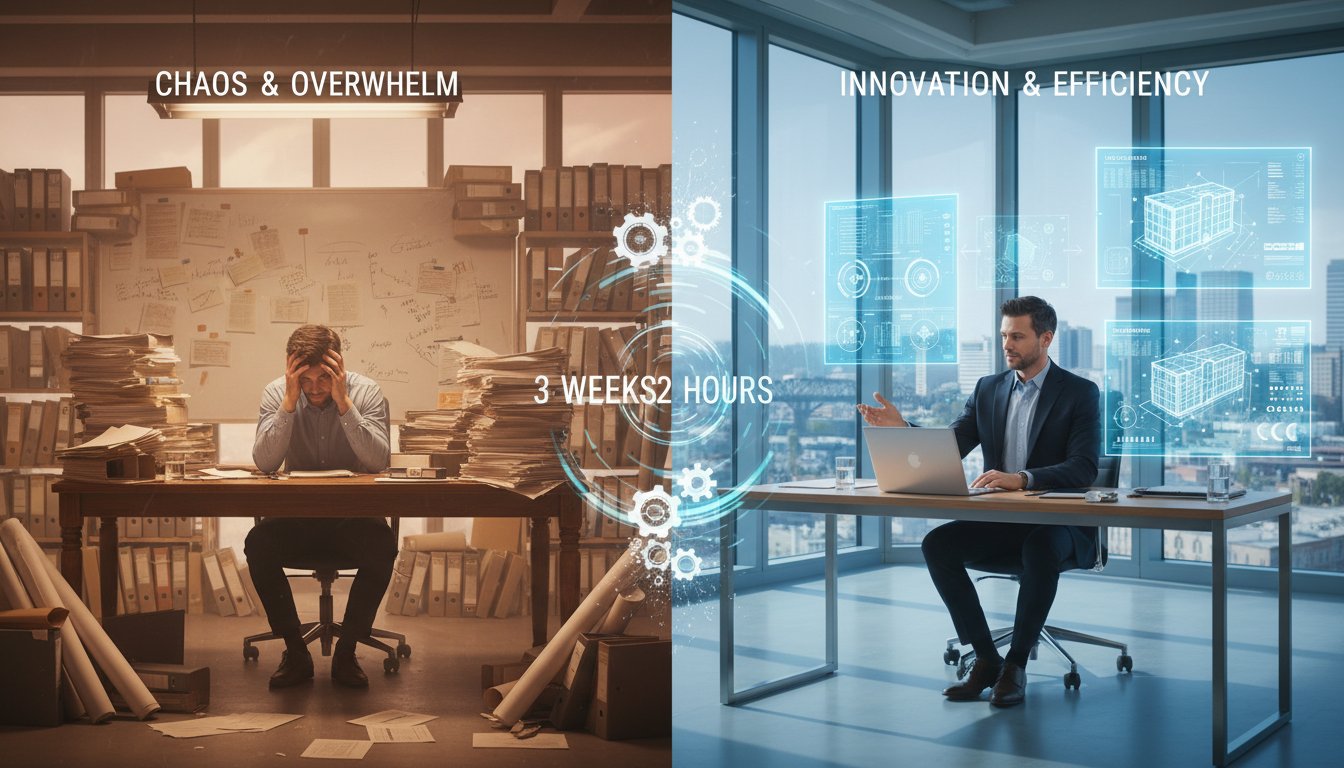
Maya Rodriguez had just received what should have been the opportunity of a lifetime: an RFP for a $4.2 million sustainable mixed-use development in Portland. The catch? She had eight days to submit a comprehensive proposal that would compete against firms with teams of 15+ architects. As a solo architecture consultant specializing in climate-adaptive design, she knew her technical expertise could win the project. What she didn’t have was three weeks and a staff of junior architects to compile specifications, generate presentation materials, and craft the 47-page proposal the client expected.
This scenario plays out thousands of times each year across the architecture industry. Solo practitioners and boutique firms face an impossible equation: respond to high-value RFPs with enterprise-level proposals while managing existing client projects, business development, and the relentless administrative burden that consumes over 50% of working hours according to the American Institute of Architects. The result? Talented architects either decline lucrative opportunities or burn themselves out attempting to do the work of entire teams.
The architecture consulting landscape is shifting dramatically in 2026. While talent acquisition challenges and economic uncertainty plague larger firms, solo practitioners and boutique architecture consultancies are discovering a competitive advantage that doesn’t require hiring: white-label AI automation platforms that handle the documentation, research, and administrative workflows that traditionally required multiple team members. This isn’t about replacing the creative vision and technical expertise that define great architecture—it’s about eliminating the 20-30 hours of administrative work that prevents solo consultants from focusing on what actually wins projects: innovative, sustainable design solutions tailored to specific client contexts.
The Hidden Time Tax Destroying Architecture Consulting Profitability
The architecture industry operates on a brutal efficiency paradox. Firms aim for utilization rates of 81-83%, meaning architects should spend roughly four out of five working hours on billable activities. The reality tells a different story, particularly for solo practitioners and boutique consultancies managing every aspect of their practice.
Consider the typical RFP response process for a commercial or institutional project. Industry data reveals that architecture firms invest 3-6 weeks responding to a single request for proposal, with approximately 24 hours dedicated solely to drafting and customizing the submission. This timeline includes reviewing project requirements, preparing qualification statements, compiling past project case studies, developing conceptual approaches, creating presentation materials, and coordinating all elements into a cohesive proposal package.
For a solo architecture consultant, this 24-hour drafting investment represents three full billable days—time that must be carved from existing client work, project administration, or personal time. And that’s just the writing. Add research on local building codes, sustainability standards analysis, preliminary structural considerations, specification compilation, and client communication, and the real investment approaches 40-50 hours per major RFP response.
The mathematics become even more challenging when you examine what architects spend time on beyond proposals. Construction administration—the approval processes and documentation required during building—accounts for approximately 20% of total architectural fees, yet firms consistently underestimate the time investment required. Documentation and specifications consume another 10-15% of total project time. When you factor in billing, project tracking, client correspondence, and regulatory compliance, administrative tasks can consume 50% or more of a solo practitioner’s working hours.
This creates a devastating opportunity cost. Every hour spent formatting specification documents, compiling building code research, or generating standard client communication is an hour not spent on high-value design work, strategic client relationships, or business development that generates new projects. For solo consultants charging $150-250 per hour for architectural services, administrative work effectively cuts their earning potential in half while simultaneously limiting the number of projects they can pursue.
The competitive implications extend beyond individual profitability. When boutique firms decline RFP opportunities because they lack bandwidth to respond, they’re not just losing individual projects—they’re becoming invisible to high-value clients who distribute future work based on established relationships. The proposal process serves dual purposes: winning the immediate project and demonstrating capabilities for future opportunities. Solo practitioners who can’t consistently respond to RFPs with enterprise-quality submissions find themselves trapped serving smaller residential clients while watching larger, more prestigious projects go to bigger firms.
The Proposal Quality Gap That Prevents Solo Consultants From Competing
Client expectations for architectural proposals have escalated dramatically, even as project budgets have tightened. A competitive RFP response for a commercial project now typically includes detailed qualification statements, minimum three comparable project case studies with visual documentation, preliminary conceptual approaches, sustainability analysis, team credentials, fee structures, project timelines, risk assessments, and often preliminary building code compliance reviews.
Large firms distribute this work across specialized roles: business development staff handle qualification statements, project managers compile case studies, senior architects develop conceptual approaches, sustainability specialists perform environmental analysis, and marketing teams create polished presentations. A solo consultant must personally execute every component while maintaining quality standards that match firms with dedicated support staff.
The visual presentation standards alone create significant barriers. Clients expect professionally formatted documents with consistent branding, high-quality renderings of past projects, clear infographics explaining design approaches, and polished layouts that communicate sophistication and attention to detail. For architects trained in design but not graphic design or marketing, creating these materials consumes hours that could be spent on actual architectural work.
Research and analysis requirements compound the challenge. A thorough RFP response for a sustainable building project requires reviewing current energy codes, researching applicable green building certifications (LEED, Living Building Challenge, Passive House), analyzing local climate data, investigating available sustainable materials, and identifying relevant precedent projects. This research is essential for credible proposals but represents 10-15 hours of work before a single word of the actual proposal is written.
White-Label AI Automation: The Force Multiplier for Architecture Consultancies
The emergence of white-label AI automation platforms specifically designed for professional service providers is fundamentally changing what solo architecture consultants can accomplish without hiring staff. Unlike generic AI tools that require constant prompt engineering and produce inconsistent results, white-label platforms allow consultants to build custom AI workflows that match their specific practice area, design philosophy, and client communication style.
The white-label component proves particularly valuable for architecture consultants building a branded consulting practice. Rather than telling clients “I used ChatGPT to write this,” consultants deploy AI capabilities under their own firm branding, maintaining the premium positioning that commands $200+ hourly rates. Clients see a sophisticated, efficient architecture consultancy leveraging advanced technology—not a solo practitioner relying on consumer AI tools.
For architecture-specific applications, this translates into custom AI agents trained on the consultant’s past project documentation, design approach, sustainability methodologies, and preferred specification language. When an RFP arrives for a net-zero energy office building, the consultant doesn’t start from scratch—their AI system already understands their approach to passive solar design, preferred sustainable materials, typical construction details, and how they communicate complex technical concepts to non-architect clients.
RFP Response Automation: From 3 Weeks to 72 Hours
The most immediate impact of white-label AI automation appears in RFP response workflows, where architecture consultants are compressing multi-week processes into 2-3 day turnarounds without sacrificing proposal quality or strategic positioning.
The transformation begins with qualification statement generation. Traditional approaches require consultants to manually review the RFP requirements, identify relevant past projects, draft descriptions of firm capabilities, and format everything into client-specified structures. An AI agent trained on the consultant’s portfolio and practice areas can analyze the RFP, identify the most relevant qualifications, and generate initial drafts in minutes rather than hours.
For a solo architecture consultant with 15 years of experience across 40+ projects, manually selecting the three most relevant case studies for a specific RFP involves reviewing project files, assessing technical similarities, evaluating visual appeal, and considering geographic or programmatic relevance. This decision-making process alone can consume 3-4 hours. An AI system trained on the consultant’s complete project database can perform this analysis in seconds, ranking projects by relevance and automatically pulling together project descriptions, technical specifications, sustainability achievements, and client testimonials.
Case study compilation represents another major time savings. Each case study in an architectural proposal typically includes project background, site analysis, design approach, technical solutions, sustainability strategies, materials and systems, construction challenges and solutions, photography, and results. Manually compiling this information from project documentation, formatting it consistently, and creating compelling narratives requires 4-6 hours per case study. AI automation can generate initial drafts by analyzing project files, CAD metadata, specification documents, and previous presentations, reducing consultant time to 30-45 minutes of review and refinement per case study.
Preliminary conceptual approaches—the section where consultants demonstrate how they would approach the proposed project—benefit enormously from AI-powered research and synthesis. Rather than spending 6-8 hours researching building codes, sustainability standards, site conditions, and precedent projects, consultants can deploy AI agents that gather this information, synthesize key findings, and suggest design considerations based on the consultant’s established design philosophy. The architect focuses on the creative synthesis and strategic positioning while AI handles the research legwork.
The cumulative impact is dramatic. What traditionally required 40-50 hours of consultant time—with significant portions dedicated to administrative formatting, research compilation, and document generation—can be compressed to 12-15 hours focused on strategic decision-making, creative conceptual development, and final quality review. This isn’t about producing lower-quality proposals faster; it’s about eliminating the administrative friction that prevents solo consultants from competing on proposal quality with larger firms.
Project Documentation and Specification Automation
Beyond proposals, white-label AI platforms transform the ongoing documentation burden that consumes 10-15% of total project time and creates significant administrative overhead for solo practitioners.
Architectural specifications—the detailed written requirements for materials, installation methods, and quality standards—represent one of the most time-intensive yet least creative aspects of architectural practice. A comprehensive specification package for a commercial project might include 300-500 pages covering everything from concrete mixes to lighting fixtures to door hardware. While much of this content is standardized, it must be customized for each project’s specific requirements, local building codes, and sustainability goals.
Traditional specification writing involves selecting relevant MasterFormat sections, customizing standard language for project requirements, coordinating with engineering consultants, reviewing manufacturer data, and ensuring code compliance. For solo consultants, this process can consume 20-30 hours per project—time that’s necessary but generates minimal client value compared to design development or construction problem-solving.
AI automation platforms trained on architectural specifications can generate initial specification packages based on project parameters, automatically incorporating relevant building codes, sustainability standards, and the consultant’s preferred products and installation methods. Rather than manually compiling specifications from scratch, consultants review and refine AI-generated documents, reducing time investment by 60-70% while maintaining quality and customization.
Construction administration documentation follows similar patterns. Site observation reports, request for information (RFI) responses, submittal reviews, and change order documentation all require consistent formatting, technical accuracy, and clear communication—but rarely require deep creative thinking. AI agents can draft initial responses to contractor RFIs based on project drawings and specifications, generate site observation report templates pre-populated with project information, and even flag potential conflicts between submitted shop drawings and design intent.
The time savings prove substantial. AIA data shows that construction administration accounts for approximately 20% of architectural fees, yet firms consistently underestimate time requirements. For a solo consultant managing five active construction projects, automating documentation workflows can recover 5-10 hours weekly—time that can be redirected to business development, design work, or simply reducing the 60+ hour weeks that characterize many solo practices.
Client Communication and Project Management Workflows
Architecture consulting success depends heavily on clear, consistent client communication throughout long project timelines. Solo practitioners must manage client expectations, coordinate with engineers and contractors, communicate design decisions, explain technical requirements, and maintain visibility into project progress—all without dedicated project management staff.
White-label AI platforms enable consultants to automate routine client communications while maintaining the personalized touch that differentiates boutique practices from larger firms. Custom AI agents trained on the consultant’s communication style can generate project update emails, meeting summaries, design decision documentation, and responses to standard client questions, maintaining consistent tone and technical accuracy.
For client meetings, AI-powered meeting preparation proves particularly valuable. Rather than manually reviewing project files, previous meeting notes, outstanding action items, and upcoming milestones, consultants can deploy AI agents that compile this information into briefing documents, suggest discussion topics, and even generate presentation materials based on recent project developments. A task that might consume 90 minutes becomes a 15-minute review.
Project timeline management and milestone tracking represent another area where solo consultants struggle against larger competitors. Enterprise firms use sophisticated project management software with dedicated staff monitoring progress, identifying delays, and coordinating complex multi-party timelines. Solo consultants often track projects through a combination of spreadsheets, calendar reminders, and mental tracking—an approach that works until project complexity or quantity increases.
AI-powered project management workflows can automatically track project milestones, monitor deadlines, identify potential scheduling conflicts, and generate status reports without manual data entry. Integration with the consultant’s knowledge base—containing typical project timelines, consultant availability, and coordination requirements—enables the system to proactively flag risks and suggest scheduling adjustments.
The business impact extends beyond time savings to client perception. Clients receiving consistently professional communications, timely updates, and well-organized project documentation perceive higher value and sophistication, supporting premium pricing and generating referrals. The solo consultant who communicates like a well-staffed firm commands respect and rates comparable to larger competitors.
Building Your Architecture-Specific AI Automation Practice
Successfully implementing white-label AI automation in an architecture consulting practice requires strategic planning that goes beyond simply subscribing to a platform. The consultants achieving 60-70% time savings and winning larger projects follow structured approaches to building custom AI capabilities that genuinely enhance their practice.
Knowledge Base Development: Training AI on Your Architectural Expertise
The foundation of effective AI automation is a comprehensive knowledge base containing the consultant’s accumulated architectural expertise, project experience, and practice methodologies. Unlike generic AI tools that provide general architectural information, a properly trained white-label AI system understands your specific design philosophy, preferred technical approaches, communication style, and past project solutions.
Begin by compiling your project portfolio documentation. This includes completed project descriptions, technical specifications, design narratives, sustainability analyses, case studies, client testimonials, and visual documentation. For a consultant with 10-15 years of practice, this might represent 30-50 projects across various building types, scales, and technical approaches.
Next, document your standard processes and methodologies. How do you approach site analysis for sustainable design? What’s your typical design development sequence? What are your preferred construction details for common conditions? What technical questions do clients frequently ask, and how do you explain complex architectural concepts in accessible language? This process knowledge enables AI agents to not just retrieve information but apply your methodologies to new situations.
Integration with existing documentation systems proves crucial. Architecture consultants already maintain project files in various formats—CAD drawings, specification documents, email correspondence, meeting notes, photography, and presentation materials. White-label AI platforms that integrate with Google Drive, Notion, Confluence, or other documentation systems can access this information without requiring manual uploads or duplicate file management.
Platforms like Parallel AI specifically design knowledge base capabilities for professional service providers, offering integrations with standard documentation platforms and the ability to train AI agents on firm-specific content. The white-label aspect ensures that when these AI capabilities are deployed in client-facing situations, they appear as sophisticated tools of your architecture consultancy rather than generic third-party AI.
Custom AI Agent Development for Architecture Workflows
With knowledge bases established, the next phase involves building custom AI agents optimized for specific architecture consulting workflows. Rather than using a single general-purpose AI assistant, effective implementations deploy specialized agents for different practice areas.
An RFP response agent might be trained specifically on your qualification statements, project case studies, standard fee structures, typical project timelines, and proposal writing approach. When a new RFP arrives, this agent analyzes requirements, selects relevant past projects, generates initial qualification narratives, and structures the response according to client specifications—all while maintaining your established tone and positioning.
A specification writing agent would be trained on your preferred specification language, standard products and systems, sustainability requirements you typically incorporate, and local building code provisions relevant to your practice area. This agent doesn’t replace your technical judgment but handles the administrative work of compiling standard specification sections, inserting project-specific information, and formatting documents consistently.
A client communication agent learns from your past client emails, meeting notes, project updates, and design presentations to generate communications that match your style and technical depth. This proves particularly valuable for routine project updates, meeting summaries, and responses to standard questions, freeing your time for complex technical discussions and strategic client relationship building.
The key is creating agents with clear, specific purposes rather than expecting a single AI system to handle everything. Architecture consulting involves diverse activities requiring different knowledge sets, communication styles, and levels of technical depth. Specialized agents deliver better results than general-purpose tools.
Implementation Strategies That Don’t Disrupt Active Projects
The consultants who successfully implement AI automation do so incrementally, testing workflows on non-critical tasks before deploying them in high-stakes client situations. This approach minimizes risk while building confidence in AI capabilities.
Start with internal documentation and administrative tasks that don’t directly face clients. Use AI agents to generate meeting notes from your recordings, compile project status summaries from various information sources, or draft internal checklists for upcoming project phases. These low-risk applications let you assess output quality, refine agent training, and develop comfort with AI-generated content before client-facing deployment.
Next, implement AI automation in proposal and business development workflows where you have time to review and refine outputs before submission. Use RFP response agents to generate initial drafts, then apply your expertise to strategic refinement, technical verification, and quality assurance. This approach delivers immediate time savings—even 50% reduction in drafting time is significant—while maintaining complete control over final deliverables.
As confidence builds, expand to client communication workflows with appropriate review processes. Generate initial drafts of project updates, meeting summaries, or routine client questions, but review everything before sending. Over time, you’ll identify which types of communications AI handles reliably and which require more significant human intervention.
The goal isn’t to remove architects from the process but to shift time allocation from administrative documentation to strategic thinking, creative design, technical problem-solving, and relationship building—the activities that actually differentiate your consultancy and justify premium fees.
The Competitive Positioning Advantage of White-Label AI Capabilities
Beyond operational efficiency, white-label AI automation creates powerful competitive positioning opportunities for architecture consultancies competing against both larger firms and other solo practitioners.
When solo consultants can respond to RFPs with 72-hour turnarounds that would take competitors three weeks, they signal operational sophistication and responsiveness that clients value highly. The consultant who returns a comprehensive, polished proposal while competitors are still assembling their teams demonstrates a level of efficiency that translates directly to client perception of project execution capability.
The ability to manage larger, more complex projects without hiring expands the consultant’s addressable market. Projects that previously seemed too administratively complex—multi-building campuses, phased developments, design-build collaborations—become feasible when AI automation handles coordination, documentation, and communication workflows that would otherwise require additional staff.
Client communication consistency, enabled by AI-powered project management and communication workflows, positions solo consultants as more organized and professional than their actual firm size might suggest. Clients receiving weekly project updates, comprehensive meeting summaries, and timely responses to questions perceive a well-staffed operation even when working with a solo practitioner.
The white-label aspect proves crucial for maintaining premium positioning. Clients who know you’re using consumer AI tools may question your pricing or technical expertise. Clients who see sophisticated, branded AI capabilities integrated seamlessly into your practice perceive innovation and technological sophistication—attributes that support higher fees and attract forward-thinking clients.
For architecture consultants positioning themselves as sustainability specialists, technology innovators, or efficiency experts, demonstrating AI integration in their own practice provides powerful proof of concept. The consultant advocating for smart building systems and data-driven design while using AI to optimize their own operations presents a credible, consistent brand story.
Pricing Premium Justification Through Technology Integration
Architecture consultants face constant pricing pressure, particularly from clients who perceive solo practitioners as lower overhead alternatives to established firms. The challenge is justifying $200-250 hourly rates or premium fixed fees when competing against consultants charging $125-150.
White-label AI capabilities provide tangible value propositions that support premium pricing. The consultant who can deliver comprehensive RFP responses in 3 days instead of 3 weeks provides measurable time-to-value that clients appreciate. The consultant who provides weekly project updates, comprehensive documentation, and instant responses to routine questions delivers client service levels that larger firms struggle to match.
More fundamentally, AI automation enables consultants to focus more time on high-value activities—design innovation, technical problem-solving, sustainability optimization, code compliance creativity—that directly impact project outcomes. When 60-70% of administrative burden is automated, the consultant spending 80% of billable hours on actual architectural thinking rather than 50% delivers genuinely higher value per dollar.
For consultants offering white-label AI capabilities to clients—particularly developers, institutional clients, or design-build contractors who might benefit from similar tools—the architecture practice becomes a demonstration case. “The same AI systems I use to optimize my practice can help you streamline property management, automate tenant communications, or improve construction coordination” positions the consultant as a technology partner beyond traditional architectural services.
This expanded service offering creates additional revenue streams and deeper client relationships. The architecture consultant who provides not just building designs but also AI-powered operational tools becomes a strategic partner rather than a project-based service provider, supporting recurring revenue and reducing the feast-famine cycles common in solo practice.
Real-World Implementation: Transforming a Sustainable Architecture Practice
To understand how these capabilities translate to practice transformation, consider the case of a solo architecture consultant specializing in net-zero energy commercial buildings—a practice area requiring deep technical expertise, extensive sustainability research, complex energy modeling, and sophisticated client education.
Before implementing white-label AI automation, this consultant managed 3-4 active projects simultaneously, declined approximately 60% of RFP opportunities due to bandwidth limitations, spent 25-30 hours weekly on administrative tasks and documentation, and worked 55-60 hour weeks to maintain client service quality.
The implementation began with knowledge base development, compiling 12 years of project documentation including 28 completed net-zero and near-zero energy projects, sustainability analysis methodologies, energy modeling approaches, preferred mechanical systems, envelope details, renewable energy integration strategies, and client communication materials explaining complex energy concepts.
Custom AI agents were developed for specific workflows: an RFP response agent trained on past proposals and qualification statements, a sustainability research agent that could quickly analyze climate data and building code energy requirements, a specification agent focused on high-performance building assemblies, and a client communication agent that could explain technical concepts in accessible language.
The transformation appeared across multiple dimensions. RFP response time dropped from an average of 42 hours to 14 hours, enabling the consultant to pursue 3-4 additional proposals monthly. Project documentation time decreased by approximately 65%, recovering 8-10 hours weekly. Client communication became more consistent and comprehensive without additional time investment, improving client satisfaction scores and generating more referrals.
Within eight months, the practice had expanded from 3-4 simultaneous projects to 6-7 active projects, increased proposal win rate from 32% to 51% (attributed partly to faster response times and partly to more comprehensive proposals), reduced average weekly hours from 57 to 48 while increasing revenue by 40%, and launched white-label AI consulting services for developer clients seeking to optimize property operations.
The competitive positioning shifted noticeably. Where the consultant had previously positioned primarily on sustainability expertise, the practice now emphasizes “technology-enabled sustainable design”—appealing to forward-thinking clients who value both environmental performance and operational innovation. The ability to respond to complex RFPs within days rather than weeks created a reputation for responsiveness that generated direct referrals from clients impressed by the service experience.
Perhaps most significantly, the consultant reported substantially improved work-life balance and professional satisfaction. The elimination of late nights formatting specification documents and weekends compiling proposal materials created space for continuing education, industry involvement, and personal time—investments that further enhanced the practice’s expertise and positioning.
Getting Started: Your 30-Day Implementation Roadmap
For architecture consultants ready to implement white-label AI automation, a structured 30-day approach minimizes disruption while building capabilities systematically.
Week 1: Knowledge Base Compilation
Gather your existing project documentation, including completed project descriptions, case studies, technical specifications, sustainability analyses, client testimonials, proposal examples, and any standardized content you regularly reuse. Organize this content by project type, technical approach, or other relevant categories. Identify gaps where documentation exists but isn’t in accessible digital format—these become lower priorities for initial implementation.
Week 2: Platform Selection and Agent Configuration
Evaluate white-label AI automation platforms based on architecture-specific needs: knowledge base integration with your existing documentation systems (Google Drive, Dropbox, etc.), ability to create custom agents for different workflows, white-label branding capabilities, security and confidentiality protections for client information, and pricing structures that align with your practice size.
Parallel AI’s white-label solutions specifically address professional service providers, offering the content automation engine, knowledge base integration, and custom agent development capabilities architecture consultants require, along with white-label options that maintain your practice branding.
Begin with one or two specific agents focused on high-impact, lower-risk workflows—perhaps an RFP response agent and a project documentation agent.
Week 3: Testing and Refinement
Deploy your initial AI agents on non-critical tasks or past projects where you can evaluate output quality without client-facing risk. Generate a practice RFP response for a past proposal, comparing AI-generated content against what you actually submitted. Create project documentation for a completed project, assessing accuracy and completeness. Identify areas where agent training needs refinement, output quality varies, or human review is essential.
Week 4: Production Deployment with Review Processes
Begin using AI agents on actual client work with appropriate review workflows. Generate initial proposal drafts, then apply your expertise for strategic refinement. Create documentation templates, then customize for specific project requirements. Establish clear review standards: what types of content can be used with minimal review, what requires moderate refinement, and what needs substantial human input.
Track time savings quantitatively—how long would this task have taken previously versus time invested in reviewing and refining AI output. This data demonstrates ROI and identifies which workflows deliver greatest value.
Beyond 30 days, continue expanding AI capabilities incrementally. Add agents for additional workflows, refine existing agents based on output quality, integrate new project documentation into knowledge bases, and explore client-facing applications where white-label capabilities provide competitive differentiation.
The Future of Solo Architecture Consulting Is Already Here
The architecture industry stands at an inflection point. Economic uncertainty, talent shortages, and rising client expectations are pressuring traditional firm structures, while AI automation capabilities are democratizing tools and capabilities that previously required large teams. Solo practitioners and boutique consultancies willing to embrace these technologies are discovering they can compete effectively against firms 10-20 times their size—not by working harder, but by working fundamentally differently.
The consultants thriving in this environment aren’t the ones with the most prestigious project portfolios or the largest networks, though those advantages certainly help. They’re the practitioners who recognize that their value lies in architectural expertise, design innovation, technical problem-solving, and client relationship building—not in manually formatting specification documents or spending 40 hours compiling RFP responses.
White-label AI automation doesn’t replace the architect. It eliminates the administrative friction that prevents talented architects from focusing on architecture. It enables the solo consultant to deliver enterprise-quality proposals, documentation, and client service without enterprise overhead. It transforms the growth equation from “how many people can I hire” to “how effectively can I leverage technology to multiply my own capabilities.”
For architecture consultants currently declining high-value RFP opportunities, working 60-hour weeks to maintain service quality, or watching larger firms win projects despite having comparable technical expertise, the path forward is increasingly clear. The question isn’t whether to implement AI automation—it’s whether you’ll adopt these capabilities before your competitors do.
The solo architecture consultant who can respond to a complex commercial RFP in 72 hours with a comprehensive, polished proposal, manage seven active projects with consistent client communication, and still maintain a 45-hour work week isn’t working for some hypothetical future firm. They’re operating today, using white-label AI platforms designed specifically for professional service providers who recognize that their competitive advantage lies in expertise, not administrative capacity.
The sustainable architecture practice you’ve been building—the one that delivers net-zero energy buildings, climate-adaptive design, and innovative technical solutions—can now operate at the scale and sophistication level you’ve always envisioned. The only limitation that remains is whether you’re ready to embrace the tools that make it possible. Explore how white-label AI solutions from Parallel AI can transform your architecture consulting practice from administratively constrained to strategically competitive, or schedule a personalized demo to see exactly how these capabilities would work in your specific practice area. The next high-value RFP that arrives in your inbox doesn’t have to be an opportunity you decline—it can be the project that demonstrates what your practice is truly capable of delivering.
Related reading
- How Construction Consultants Are Using AI to Scale Project Management Services and Build Seven-Figure Independent Practices
- How Solo Architecture Consultants Are Delivering 35-Hour Code Compliance Reports in 4 Hours Using White-Label AI (Without Hiring Additional Staff)
- How Solo Architects Are Delivering 32-Hour Design Proposals in 4 Hours Using White-Label AI (Without Hiring a Documentation Team)
- How Solo Construction Consultants Are Completing 22-Hour Bid Proposals in 3 Hours Using White-Label AI (Without Hiring a Single Estimator)