
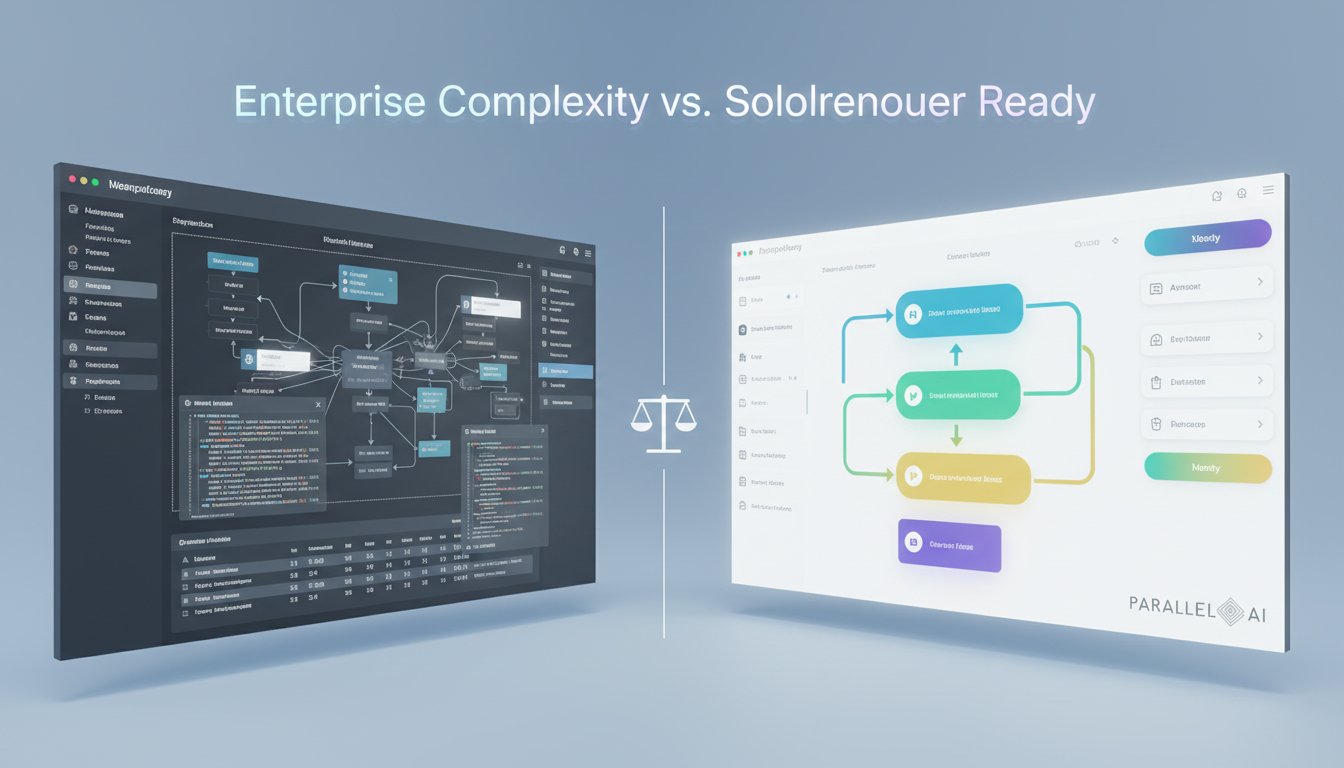
The promise sounds identical: build AI agents, automate workflows, white-label the platform, and scale your consulting business. Both Relevance AI and Parallel AI market themselves as comprehensive automation platforms with white-label capabilities. Yet after the sales demos end and implementation begins, one critical difference emerges—the gap between “enterprise-flexible” and “solopreneur-ready” can mean the difference between launching your AI service in days versus struggling for months.
This isn’t about which platform has more features on a spec sheet. It’s about which platform actually helps a solo consultant or micro-agency generate revenue faster, with less technical overhead, and without requiring a development team to maintain. For solopreneurs juggling client delivery, business development, and operations, the platform that promises “ultimate flexibility” often becomes the platform that demands the most time you don’t have.
Let’s cut through the marketing language and examine what these platforms actually deliver when a one-person consultancy needs to launch a white-labeled AI service, onboard paying clients, and maintain profitability without hiring engineers. The answer will determine whether you’re building a scalable business asset or inheriting a technical maintenance burden.
The White-Label Reality Check: What Solopreneurs Actually Need
White-label capability appears on both feature lists, but the implementation reality differs dramatically. For a solopreneur, white-labeling isn’t just about removing a vendor logo—it’s about creating a professional, branded experience that clients perceive as your proprietary technology while requiring minimal technical setup.
Relevance AI’s White-Label Approach
Relevance AI offers white-label capabilities primarily through its Business ($599/month) and Enterprise (custom pricing) tiers. The platform provides flexibility to customize workflows and agent behaviors, but the branding customization itself requires navigating their API and potentially working with their team for implementation. For enterprise customers with technical resources, this flexibility enables deep customization. For solopreneurs, it means delayed launches and potential consulting fees.
The platform’s strength lies in building highly customized AI agent systems with complex multi-agent workflows. However, this same flexibility creates a steeper learning curve. You’re not just configuring settings—you’re architecting systems. Their free plan offers 100 credits daily with 10MB knowledge capacity and supports only one user, making it suitable for testing but not for client delivery. Scaling to the Team plan ($199/month for 100,000 credits and 10 users) provides more capacity, but white-label branding remains locked behind higher tiers.
Parallel AI’s Deployment-First Philosophy
Parallel AI structures its white-label offering around rapid deployment, claiming 3-5 day launches with full customization including your logo, colors, and custom domain. Clients interact exclusively with your brand—never seeing “Parallel AI” in their experience. The platform handles billing through your Stripe account, with recommended markup strategies of 1.5-2x (for example, charging clients $697/month on a $387/month base cost, generating $310/month profit per client).
This approach removes technical barriers to monetization. You’re not building a platform; you’re deploying one that already works. The emphasis on “launch in days, not months” directly addresses the solopreneur’s primary constraint: time to revenue. While this reduces customization flexibility compared to building from scratch, it accelerates the path from concept to paying clients—the metric that matters most when you’re competing against your own runway.
AI Model Access: Breadth vs. Depth
Both platforms integrate multiple AI models, but their approaches to model access reveal different philosophies about how solopreneurs should deploy AI.
Relevance AI’s Integration Ecosystem
Relevance AI supports integration with major language models including OpenAI, Claude, and Gemini. The platform emphasizes flexibility in building multi-agent systems where different agents can leverage different models for specialized tasks. This creates powerful possibilities for complex workflows—imagine one agent handling initial customer inquiries using a cost-effective model, escalating to a more sophisticated model for complex analysis, then routing to a specialized agent for industry-specific responses.
However, implementing these sophisticated workflows requires understanding the strengths and limitations of each model, architecting the routing logic, and testing extensively. For solopreneurs with technical backgrounds, this represents an opportunity. For those focused on client delivery rather than system architecture, it represents overhead.
The credit-based pricing model adds complexity to cost prediction. Different models consume credits at different rates, and complex multi-agent workflows can quickly deplete credit allocations. This variability makes it challenging to predict your actual monthly costs when serving multiple clients with varying usage patterns.
Parallel AI’s Unified Model Access
Parallel AI provides access to six premium AI models—OpenAI GPT-4 and GPT-4 Turbo, Anthropic Claude 3 Opus and Sonnet, Google Gemini Pro, Grok (X.AI), and DeepSeek—with the ability to switch models per task for optimal results. This breadth covers virtually every commercial use case a solopreneur might encounter, from content generation to data analysis to customer interaction.
The key difference lies in implementation simplicity. Rather than architecting complex routing systems, you select the appropriate model for each task or template. Need maximum reasoning capability for strategic analysis? Use Claude Opus. Optimizing for speed and cost on routine content? Switch to GPT-4 Turbo. The platform handles the technical integration; you focus on application.
For solopreneurs, this approach reduces the technical overhead of maintaining model expertise. You’re not monitoring API changes across six different providers, managing separate billing relationships, or troubleshooting integration issues. The platform consolidates this complexity, letting you focus on client outcomes rather than infrastructure maintenance.
Knowledge Base Integration: Data as Competitive Advantage
For service businesses, the ability to train AI systems on client-specific information transforms generic tools into competitive advantages. Both platforms offer knowledge base capabilities, but implementation complexity and capacity limits create different practical realities.
Relevance AI’s Knowledge Approach
Relevance AI’s knowledge capacity scales with pricing tiers: 10MB on the free plan, 100MB on Pro ($19/month), 1GB on Team ($199/month), and 5GB on Business ($599/month). These limits sound abstract until you consider practical applications. A comprehensive client onboarding package including brand guidelines, previous campaign examples, product documentation, and competitive analysis can easily exceed 100MB, pushing solo consultants toward higher-tier plans even with modest client loads.
The platform supports building custom knowledge bases that agents can reference, enabling sophisticated applications like client-specific advisory systems. However, implementing these systems requires understanding how to structure data for optimal retrieval, how to connect knowledge bases to specific agents, and how to troubleshoot when agents don’t access the right information. For technically-oriented consultants, this control enables precision. For those focused on rapid client delivery, it adds implementation time.
Parallel AI’s Enterprise Knowledge Architecture
Parallel AI offers persistent memory across conversations with integration to Google Drive, Confluence, and Notion, supporting context windows up to one million tokens. This massive context capacity means you can load comprehensive client information—brand guidelines, historical data, industry research, competitive intelligence—and have AI systems reference it naturally without complex data structuring.
The integrations with existing collaboration platforms eliminate data migration overhead. If your client’s information already lives in Google Drive or Notion, you’re connecting rather than rebuilding. This architectural decision reflects an understanding of how solopreneurs actually work: leveraging existing client systems rather than requiring clients to adapt to new platforms.
For practical applications like generating client-specific content, creating personalized outreach sequences, or delivering strategic recommendations that reference a client’s specific context, this knowledge capacity and easy integration removes a significant implementation barrier.
Pricing Reality: Total Cost of Implementation
Published pricing tells part of the story. Total cost of implementation—including the learning curve, setup time, and ongoing maintenance—tells the rest. For solopreneurs, time is the ultimate cost.
Relevance AI’s Tiered Economics
Relevance AI’s pricing structure serves different market segments:
- Free Plan: 100 credits/day, 1 user, 10MB knowledge—suitable for testing, not client delivery
- Pro ($19/month): 10,000 credits, 1 user, 100MB knowledge—entry-level for solo use
- Team ($199/month): 100,000 credits, 10 users, 1GB knowledge—multi-client capacity
- Business ($599/month): 300,000 credits, unlimited users, 5GB knowledge, white-label capabilities
- Enterprise (custom): Advanced features, SLAs, multi-region support
White-label capabilities require Business tier minimum ($599/month), meaning your platform cost before serving a single client is $7,188 annually. To achieve profitability, you need sufficient client volume to cover this fixed cost plus your implementation and support time.
The credit-based consumption model adds unpredictability. Complex workflows consume more credits, and usage varies by client. Estimating your actual monthly costs requires monitoring consumption patterns and potentially upgrading tiers as client usage grows. This variability complicates pricing strategy—you need margin cushion to protect against usage spikes.
Parallel AI’s Margin-First Structure
Parallel AI structures pricing around agency profitability, with a base cost (referenced as $387/month in their white-label documentation) and recommended client pricing of $697/month, generating $310/month profit per client. This transparent margin calculation simplifies business planning.
The platform emphasizes multiple monetization models:
- Direct Platform Subscriptions: Clients pay you directly through your branded portal via your Stripe account
- Bundled Service Packages: Include platform access in monthly retainers ($3,000+/month) with setup fees ($1,500-$5,000 one-time)
- Hybrid Model: Combine platform subscriptions at your markup with professional services for implementation and optimization
This pricing philosophy prioritizes your business model over the vendor’s. Rather than maximizing their per-seat revenue, they’re structuring economics that allow you to build a sustainable service business. The predictable base cost enables confident client pricing, and the markup flexibility allows positioning from value entry-point to premium service.
Implementation Timeline: Theory vs. Reality
Marketing claims about “quick setup” require translation into operational reality. For solopreneurs, implementation time directly impacts revenue timing and opportunity cost.
Relevance AI’s Learning Curve
Relevance AI’s flexibility creates a corresponding learning investment. Understanding how to build effective multi-agent systems, structure knowledge bases for optimal retrieval, configure workflows, and troubleshoot issues requires time. The platform’s documentation and community resources support this learning, but the knowledge transfer happens on your timeline.
For consultants with technical backgrounds or those planning to invest time upfront to build highly customized systems, this learning curve represents capability building. For those needing to launch quickly to meet client commitments or validate market demand, it represents delayed revenue.
The platform’s strength in enterprise applications suggests its architecture optimizes for power users willing to invest learning time to unlock advanced capabilities. This makes sense for organizations with dedicated technical resources but creates friction for solo operators juggling multiple business responsibilities.
Parallel AI’s Time-to-Revenue Focus
Parallel AI’s “3-5 day launch” claim targets the solopreneur’s critical constraint: speed to market. The platform provides pre-configured templates, established integrations, and deployment processes designed to minimize setup complexity. You’re implementing proven configurations rather than architecting custom systems.
This approach trades ultimate flexibility for rapid deployment. You’re working within the platform’s established patterns rather than building from scratch. For most solopreneur applications—content generation, customer engagement, lead qualification, strategic analysis—these patterns cover the use cases that generate revenue.
The platform’s case studies reference specific outcomes: HighLevel agencies automating client content generation, reducing onboarding from 8 hours to 45 minutes, and creating “Premium Social Management” services at $600-900/month with $50-75/month platform costs. These concrete applications help solopreneurs visualize implementation rather than starting with blank architecture.
The Automation Architecture Question
Both platforms enable workflow automation, but their approaches to building and maintaining automations create different operational realities for solopreneurs.
Relevance AI’s Custom Workflow Engine
Relevance AI emphasizes customizable workflows where you can build sophisticated automation sequences with multiple agents handling different workflow stages. This enables powerful applications: imagine a content creation workflow where one agent researches topics, another generates outlines, a third produces drafts, a fourth optimizes for SEO, and a fifth formats for different platforms.
Building these custom workflows requires understanding conditional logic, data passing between agents, error handling, and workflow optimization. The platform provides the tools; you provide the architecture. For consultants who enjoy system design and want highly specialized automations matched to unique client needs, this control enables differentiation.
However, custom workflow architecture creates maintenance obligations. As AI models update, client requirements evolve, or edge cases emerge, you’re responsible for troubleshooting and adjusting your custom systems. This ongoing maintenance competes with client acquisition and service delivery for your limited time.
Parallel AI’s Template-Driven Automation
Parallel AI provides proven automation templates for common business applications: content generation across formats, lead qualification sequences, customer engagement workflows, and reporting automation. These templates reflect accumulated knowledge from agency implementations, offering starting points that already work.
The platform’s integration examples demonstrate practical automation: HighLevel calendar triggers generating content based on client knowledge bases, new leads triggering personalized email sequences, monthly reporting triggers analyzing performance and generating strategic recommendations. These aren’t theoretical capabilities—they’re documented implementations with expected outcomes.
For solopreneurs, template-driven automation accelerates time-to-value. Rather than spending weeks designing a content automation workflow, you’re configuring a proven template to your client’s specifics. The templates handle the architecture; you focus on customization and client outcomes.
This approach assumes most solopreneur automation needs fall into established patterns—a reasonable assumption given that content creation, lead management, and customer engagement represent common service offerings. For edge cases requiring unique workflows, the platform’s flexibility still allows custom building, but the templates handle the majority of use cases.
Support and Resources: When You Hit Roadblocks
Solopreneurs don’t have internal IT departments to troubleshoot issues. Platform support quality directly impacts your ability to deliver client commitments on schedule.
Relevance AI’s Enterprise Support Model
Relevance AI provides tiered support corresponding to pricing plans, with advanced support, SLAs, and dedicated resources available for Enterprise customers. Community resources, documentation, and knowledge bases support self-service troubleshooting across all tiers.
This model works well for enterprise customers with technical teams who can leverage documentation for most issues and escalate complex problems through formal support channels. For solopreneurs facing client deadlines, the question becomes response time and resolution speed when you encounter blocking issues.
The platform’s recognition as a “leading enterprise agent vendor” suggests strong technical capabilities and sophisticated support for large customers. Whether this enterprise orientation translates to responsive support for solo users on mid-tier plans remains a practical question for individual evaluation.
Parallel AI’s Agency-First Support
Parallel AI structures support around agency needs, with documentation focused on practical implementation scenarios, monetization strategies, and client delivery. The platform’s white-label documentation includes margin calculations, pricing strategies, and revenue models—business support rather than just technical support.
This orientation reflects understanding that solopreneurs’ primary challenges aren’t just technical implementation but business model execution. How do I price this service? What margin should I target? How do I position this to clients? These business questions often matter more than API documentation.
The platform’s integration guides for specific use cases (HighLevel agency workflows, content automation sequences, lead qualification systems) provide implementation roadmaps rather than requiring you to architect solutions from primitive capabilities. This reduces the support burden by preventing common implementation questions through better initial guidance.
The Hidden Cost: Opportunity vs. Technical Investment
The ultimate platform comparison for solopreneurs isn’t feature-to-feature—it’s opportunity cost. Every hour spent learning platform architecture, troubleshooting integrations, or optimizing workflows is an hour not spent acquiring clients, delivering services, or developing your business.
When Relevance AI Makes Sense
Relevance AI delivers maximum value for:
- Technical consultants who enjoy system architecture and want to build highly customized AI solutions as their core service differentiator
- Specialized applications requiring unique multi-agent workflows that don’t fit standard templates
- Long-term platform investment where upfront learning time spreads across years of use
- Enterprise clients whose budgets justify custom development and who value highly tailored systems
If your competitive advantage comes from building proprietary AI systems and your clients pay premium rates for custom solutions, Relevance AI’s flexibility supports that positioning. The platform gives you tools to build almost anything—if you’re willing to invest the time to build it.
When Parallel AI Accelerates Growth
Parallel AI optimizes for:
- Rapid market entry when you need revenue quickly to validate demand or meet financial commitments
- Service businesses where AI is an enabler for client outcomes rather than the product itself
- Scalable operations requiring proven templates that new team members can implement without extensive training
- Predictable economics where consistent costs enable confident client pricing and margin planning
If your goal is launching an AI-enhanced service business quickly, serving multiple clients efficiently, and maintaining profitability without technical overhead, Parallel AI removes implementation barriers. You’re deploying proven systems rather than architecting custom ones—trading ultimate flexibility for operational velocity.
Making the Platform Decision That Matches Your Business Model
The solopreneur platform decision hinges on honest assessment of three questions:
First: What’s your actual competitive advantage? If it’s custom AI system architecture, choose the platform that maximizes building flexibility. If it’s industry expertise, client relationships, or service delivery excellence, choose the platform that minimizes technical overhead so you can focus on your actual differentiators.
Second: What’s your timeline to revenue? If you’re validating a new service offering, testing market demand, or need cash flow quickly, prioritize platforms enabling rapid deployment. If you’re investing for long-term positioning and have runway to support extended learning curves, custom-building capabilities matter more.
Third: How do you want to spend your time? Technical consultants who energize by building systems should choose platforms rewarding that investment. Service providers who view technology as infrastructure supporting client outcomes should choose platforms minimizing infrastructure maintenance.
Relevance AI and Parallel AI both enable solopreneurs to offer AI services under their own brand. The difference lies in how they enable it: one through maximum architectural flexibility requiring corresponding technical investment, the other through deployment-optimized templates prioritizing rapid time-to-revenue.
Neither approach is universally superior. The right platform matches your business model, competitive positioning, and operational preferences. Choose the platform that accelerates your specific path to profitability—whether that path runs through custom system architecture or rapid deployment of proven templates.
For most solopreneurs and micro-agencies whose competitive advantage lies in industry expertise, client relationships, or service delivery rather than proprietary technology development, the platform that launches fastest, maintains easiest, and prices most predictably enables scaling the business that matters: the client service business. The AI platform should accelerate that business, not become that business.
Ready to see which approach matches your business model? Parallel AI offers a free demo walking through white-label implementation, client onboarding workflows, and profitability modeling specific to your service offering. See the 3-5 day launch timeline in action and evaluate whether deployment-first architecture accelerates your path to market.
Related reading
- Top 10 White-Label AI Platforms Compared: The 2026 Guide to Building Your AI Business Without Code
- Boost.ai vs Parallel AI: Which White-Label Platform Actually Delivers ROI for Solopreneurs Without Enterprise Complexity?
- Vendasta vs Parallel AI: Which White-Label Platform Actually Scales for Solopreneurs Without the Enterprise Overhead in 2025?
- Creatio vs Parallel AI: Which White-Label Platform Actually Delivers Business Automation Without the Enterprise Complexity for Micro-Agencies in 2026?