
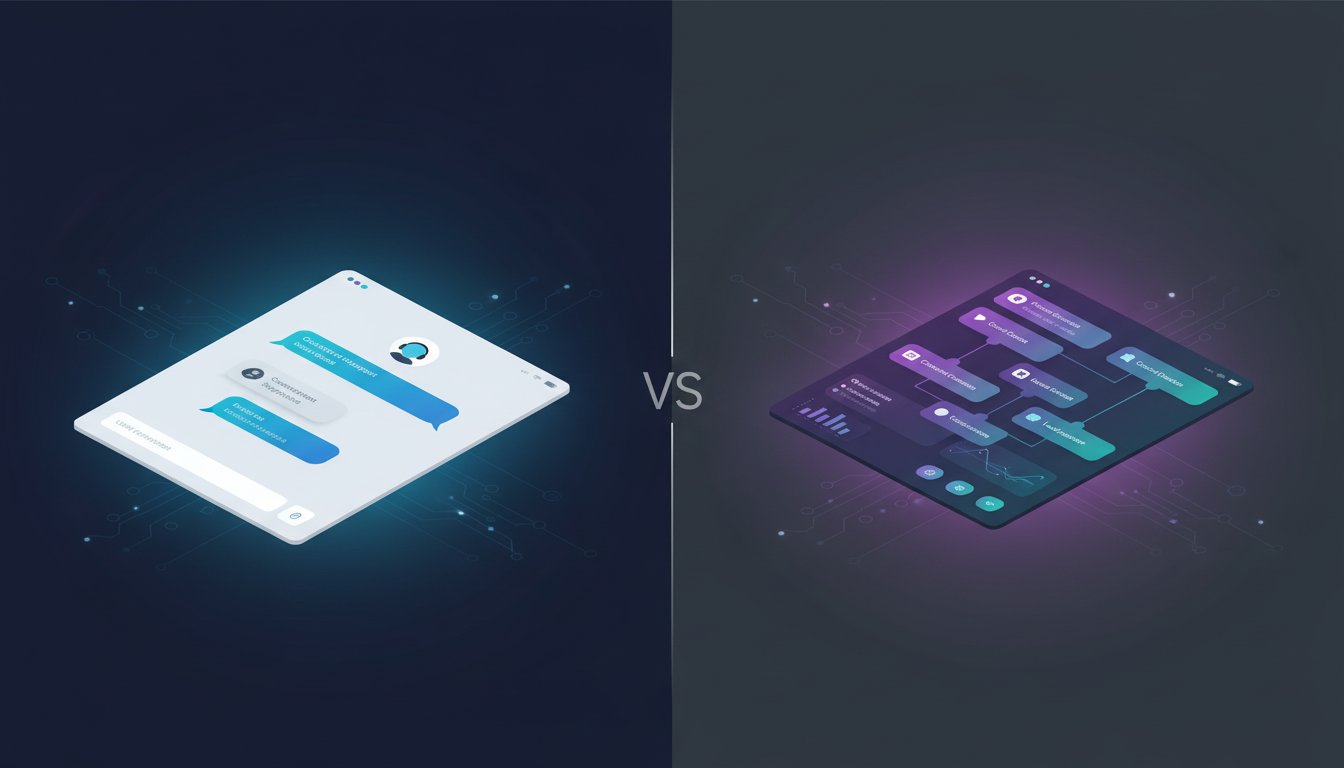
The white-label AI market reached an inflection point in early 2025. Agencies and solopreneurs no longer need just chatbot solutions—they need comprehensive automation platforms that can replace entire tool stacks while maintaining their brand identity. Yet most platform comparisons focus on surface-level features rather than the brutal economics of scaling an AI service business.
This comparison examines two fundamentally different approaches to white-label AI: Botsonic’s enterprise chatbot specialization versus Parallel AI’s all-in-one business automation ecosystem. The choice between them will determine not just what services you can offer, but how profitably you can scale your agency without hiring additional team members.
If you’re a solopreneur or micro-agency owner evaluating white-label AI platforms, you’re likely facing a familiar paradox: clients demand sophisticated AI capabilities across content creation, lead generation, customer support, and workflow automation—but building or integrating these solutions individually would consume months of development time and thousands in monthly subscriptions. The platform you choose will either amplify your capacity to serve more clients profitably, or lock you into a narrow service offering that limits your growth potential.
Platform Philosophy: Specialized Chatbots vs Unified Business Automation
Botsonic’s Approach: Enterprise Chatbot Excellence
Botsonic, developed by Writesonic, positions itself as an enterprise-grade conversational AI platform. The core philosophy centers on doing one thing exceptionally well: deploying secure, compliant chatbots across multiple communication channels.
The platform excels in environments where chatbot deployment is the primary requirement. With SOC 2 Type II, GDPR, and HIPAA compliance built-in, Botsonic targets organizations that need enterprise-level security for customer support automation. The model-agnostic routing system dynamically switches between AI models to optimize response quality—a sophisticated approach that works well within the chatbot context.
For agencies specializing exclusively in conversational AI implementation, Botsonic’s focused approach offers depth. You can deploy chatbots on WhatsApp, Facebook Messenger, Slack, and other platforms with robust security guarantees. The white-label capabilities allow you to brand the chatbot interface as your own.
However, this specialization creates significant limitations. When clients inevitably request content automation for their blog, social media scheduling, email sequence generation, or sales prospecting tools, you face an uncomfortable choice: refer them elsewhere (losing revenue), cobble together additional tools (increasing complexity and cost), or explain why your “AI platform” only handles chat.
Parallel AI’s Approach: Consolidated Business Automation
Parallel AI takes a fundamentally different approach: replace the entire fragmented AI tool stack with a single, brandable platform that handles content creation, knowledge management, customer conversations, sales automation, and workflow orchestration.
The philosophy recognizes what actually happens when agencies sell AI services: clients don’t want isolated point solutions. They want comprehensive automation that touches every part of their business, delivered under a single brand they trust (yours), with consistent quality and unified reporting.
Rather than specializing in one capability, Parallel AI consolidates what would typically require subscriptions to ChatGPT Plus ($20/month), Claude Pro ($20/month), Jasper ($49-125/month), Copy.ai ($49/month), Clay ($149/month), Instantly.ai ($37-97/month), and multiple other tools—often totaling $400-600 monthly per client—into one platform you can white-label and resell.
This consolidation strategy transforms your economics. Instead of managing seven different vendor relationships, API integrations, and billing systems for each client, you deliver comprehensive AI automation through a single dashboard that never reveals the underlying platform.
AI Model Access: Single-Purpose Routing vs Multi-Model Flexibility
Botsonic’s Model Strategy
Botsonic employs what they call a “model-agnostic” approach for chatbot interactions. The system routes conversations between different AI models based on the query type, theoretically selecting the best model for each response.
This sounds sophisticated, but the implementation reveals limitations. The routing optimization serves a narrow use case: improving chatbot response quality. When users report challenges with “understanding complex questions” and “achieving high accuracy”—common feedback in G2 and other review platforms—it suggests the model routing doesn’t fully compensate for the inherent limitations of conversational AI in handling nuanced business contexts.
More critically, this model access doesn’t extend beyond chatbot functionality. You can’t leverage these models for content generation, strategic analysis, data processing, or the dozens of other use cases agencies need to serve clients comprehensively.
The pricing structure for model access isn’t transparently published, making it difficult to calculate true costs when scaling across multiple clients. Enterprise pricing can escalate to $800+ monthly, with additional costs for extra chatbots ($99/month for up to 3) and team members ($25/month each).
Parallel AI’s Multi-Model Ecosystem
Parallel AI provides uncapped access to six premium AI models: OpenAI GPT-4 and GPT-4 Turbo, Anthropic Claude 3 Opus and Sonnet, Google Gemini Pro, Grok (X.AI), and DeepSeek. Context windows extend up to one million tokens—essential for processing large documents, comprehensive knowledge bases, and complex business contexts.
The critical difference: you can switch models per task based on the specific requirement, not just for chatbot routing. Need creative marketing copy? Claude 3 Opus excels. Require technical documentation? GPT-4 Turbo delivers precision. Processing massive datasets? Gemini Pro’s extended context window handles it.
This flexibility transforms how you structure client services. A single client engagement might use:
- Claude 3 Opus for weekly blog content that requires brand voice consistency
- GPT-4 Turbo for technical product documentation and customer support knowledge base articles
- Gemini Pro for analyzing customer feedback datasets and generating strategic reports
- DeepSeek for cost-efficient high-volume social media content generation
- Grok for real-time trend analysis and timely commentary
The pricing transparency matters: $99-499/month provides full model access for your agency. You’re not paying per chatbot, per conversation, or per team member. The economics allow you to serve multiple clients profitably while maintaining healthy margins.
For white-label partners, this means you can charge clients $200-800/month for comprehensive AI automation while your platform cost remains fixed. The margin math works: serve five clients at $400/month average ($2,000 total revenue), pay $299/month for a mid-tier Parallel AI plan, and generate $1,701 monthly margin before you add high-margin services like training, customization, and strategy consulting.
Scope of Capabilities: Where Each Platform Delivers Value
Botsonic’s Chatbot-Centric Feature Set
Botsonic concentrates capabilities in conversational AI:
Strengths:
– Multi-channel deployment (WhatsApp, Facebook Messenger, Slack, website widgets)
– Enterprise security compliance (SOC 2 Type II, GDPR, HIPAA)
– Conversational commerce features for e-commerce integration
– Employee support chatbots for internal help desk functions
– Extensive API documentation for custom integrations
These capabilities serve specific use cases well. If you’re building an agency exclusively focused on deploying compliant chatbots for healthcare organizations, financial institutions, or enterprise IT departments, Botsonic provides specialized tools.
Limitations:
– No native content creation engine for blogs, articles, or marketing copy
– No sales prospecting or lead generation automation
– No email sequence creation or multi-channel outreach campaigns
– No social media content calendar or scheduling functionality
– Limited workflow automation beyond conversational paths
– No built-in knowledge base system that works across business functions
The practical impact: every client request that extends beyond chatbot functionality requires you to integrate additional tools, manage separate vendors, and explain why your “AI platform” can’t handle what they assumed would be basic capabilities.
User feedback consistently mentions difficulties with “creative content and complex queries”—a fundamental limitation when chatbot technology tries to handle sophisticated business contexts without access to comprehensive automation tools.
Parallel AI’s Comprehensive Automation Suite
Parallel AI structures capabilities around the actual workflows agencies need to deliver for clients:
Content Automation Engine:
– Rapid generation of blogs, articles, marketing copy, social media posts, email campaigns
– Multi-platform optimization (LinkedIn, Instagram, Facebook, Twitter)
– Brand voice consistency through knowledge base training
– Content calendar automation with approval workflows
AI Knowledge Base Integration:
– Connects to Google Drive, Confluence, Notion, and custom databases
– Persistent memory across all AI interactions
– Context windows up to 1 million tokens for processing comprehensive business information
– Train AI on client brand guidelines, product catalogs, customer data, and historical content
Sales Prospecting and Outreach:
– Smart Lists for targeted lead generation
– Multi-channel sequence automation (email, social media, SMS, chat, voice)
– Personalized outreach based on prospect behavior and demographics
– CRM integration for pipeline management
Omni-Channel Customer Interaction:
– AI-powered agents that work across website, email, social media, and messaging platforms
– Unified conversation context regardless of channel
– Qualification workflows that route complex queries to human team members
– Appointment booking and calendar integration
White-Label Business Tools:
– Custom branding (logo, colors, domain)
– Client dashboards that never reveal the underlying platform
– Separate client portals for each customer you serve
– Agency-specific features for managing multiple client accounts
Enterprise Features:
– On-premise deployment options
– API access for custom integrations
– Single sign-on (SSO) for client organizations
– AES-256 encryption and TLS protocols
– Guaranteed privacy (data never used for model training)
The comprehensive scope means you can structure complete service packages:
“Content as a Service” Package ($500-800/month):
– Weekly blog posts trained on client brand voice
– Daily social media content across 4 platforms
– Monthly email newsletter campaigns
– Quarterly content strategy reports
“AI Sales Engine” Package ($600-1,200/month):
– Automated lead list generation and enrichment
– Personalized outreach sequences across email and LinkedIn
– AI chatbot for website lead qualification
– Monthly performance analytics and optimization
“Complete AI Operations” Package ($1,200-2,000/month):
– All content automation features
– Full sales prospecting and outreach
– Customer support chatbot across all channels
– Custom workflow automation
– Knowledge base integration and maintenance
– Monthly strategy consultation
Clients don’t purchase isolated chatbot deployments—they invest in comprehensive automation that transforms multiple business functions simultaneously.
White-Label Implementation: Branding Depth and Client Experience
Botsonic’s White-Label Options
Botsonic offers white-labeling primarily focused on the chatbot interface itself. You can customize the visual appearance, remove Botsonic branding from the chat widget, and deploy under your own domain.
This surface-level branding works if your client engagement is limited to the chatbot interaction. The end customer sees your brand when they interact with the chat interface on the website or messaging platform.
However, the limitations become apparent in agency operations:
- Administrative dashboards and backend tools may still display Botsonic branding
- Client training materials reference Botsonic features and terminology
- Billing and invoicing may reveal the underlying platform
- No comprehensive client portal system for managing the relationship
- Limited ability to create truly differentiated service offerings
For agencies trying to establish premium positioning, these gaps create brand confusion. When sophisticated clients dig into the administrative side or review documentation, discovering they’re using a resold Botsonic chatbot rather than your proprietary platform can undermine perceived value and pricing power.
Parallel AI’s Complete Brand Transformation
Parallel AI approaches white-labeling as complete brand replacement across every client touchpoint:
Visual Identity:
– Custom logo throughout the entire platform
– Full color scheme customization matching your brand guidelines
– Custom domain (your-agency.ai, not parallellabs.app)
– Branded login screens, dashboards, and administrative interfaces
Client Experience:
– Client dashboards that never mention Parallel AI
– Separate portals for each client you serve
– Custom onboarding flows with your branding and messaging
– Branded reporting and analytics dashboards
– White-labeled documentation and training resources
Service Differentiation:
– Position the platform as your proprietary technology
– Create custom service packages with unique naming
– Package features in ways that differentiate from other agencies
– Build intellectual property around implementation methodologies
The depth of white-labeling enables premium positioning. Instead of selling “Botsonic chatbot implementation,” you’re offering “the [Your Agency Name] AI Automation Platform”—a proprietary system that clients can’t comparison shop or replicate with another vendor.
This positioning power translates directly to pricing leverage. Agencies consistently report charging 30-50% premiums for services delivered through completely white-labeled platforms versus those where clients can identify the underlying technology.
The client retention impact is equally significant. When clients perceive they’re using your proprietary platform rather than a resold commodity tool, switching costs increase dramatically. They can’t simply take what they’ve learned and move to another agency using the same underlying platform—because as far as they know, your platform is unique.
Pricing Structure and Agency Economics
Botsonic’s Cost Model
Botsonic’s published pricing reveals a structure optimized for direct enterprise sales rather than agency resellers:
Entry Level: $19/month provides basic chatbot functionality suitable for small businesses testing conversational AI.
Mid-Tier: Approximately $99/month allows up to 3 chatbots—theoretically enabling you to serve 2-3 clients if each needs only a single chatbot.
Team Expansion: $25/month per additional team member quickly increases costs as you scale operations.
Enterprise: $800+ monthly for advanced features, higher volume, and enhanced support.
The per-chatbot pricing model creates problematic economics for agencies:
Scenario: You land five clients, each requiring two chatbots (one for sales, one for support).
– 10 chatbots total
– At the mid-tier structure, you’re paying $99 for 3 chatbots, then additional fees for the remaining 7
– Add team members to manage these clients ($25 each)
– Total platform cost: potentially $300-400+ monthly before you deliver any services
Now calculate your margin:
– Charge clients $300/month for chatbot management (competitive market rate)
– Total revenue: 5 clients × $300 = $1,500/month
– Platform cost: $300-400/month
– Margin: $1,100-1,200/month (73-80%)
That margin seems healthy until you add the hidden costs:
– Additional tools for content creation (client needs blog posts)
– Email automation platform (client needs nurture sequences)
– Social media scheduler (client needs consistent posting)
– CRM for lead management
– Analytics and reporting tools
Suddenly your tool stack adds another $200-300/month per client, and your margins evaporate. You’re managing 4-6 different platforms, reconciling separate bills, and explaining to clients why their “AI automation” requires so many different systems.
Parallel AI’s Consolidated Pricing
Parallel AI’s transparent pricing structure recognizes how agencies actually operate:
Starter Plans: $99/month provides access to all AI models and core automation features—enough to serve 2-3 small clients profitably.
Growth Plans: $299/month expands capacity for agencies serving 5-10 clients with moderate automation needs.
Professional Plans: $499/month supports 10-20 clients with comprehensive automation across all business functions.
Enterprise: Custom pricing for agencies managing 20+ clients, requiring on-premise deployment, or needing advanced customization.
The critical difference: pricing is based on your agency’s needs, not the number of clients you serve or chatbots you deploy. Serve one client or twenty—your platform cost remains predictable.
Realistic Agency Economics:
Scenario 1: Solo Consultant Starting Out
– Parallel AI Plan: $99/month (Starter)
– Clients: 3 small businesses at $400/month each
– Revenue: $1,200/month
– Platform Cost: $99/month
– Gross Margin: $1,101/month (92%)
– Services Delivered: Complete content automation, basic chatbot, email sequences, knowledge base integration
Scenario 2: Growing Micro-Agency
– Parallel AI Plan: $299/month (Growth)
– Clients: 8 businesses at $650/month average
– Revenue: $5,200/month
– Platform Cost: $299/month
– Gross Margin: $4,901/month (94%)
– Services Delivered: Full automation suite, advanced chatbots, sales prospecting, multi-channel outreach, custom workflows
Scenario 3: Established Agency
– Parallel AI Plan: $499/month (Professional)
– Clients: 15 businesses at $800/month average
– Revenue: $12,000/month
– Platform Cost: $499/month
– Gross Margin: $11,501/month (96%)
– Services Delivered: Enterprise-grade automation, white-label client portals, custom integrations, strategic consulting
The margin math fundamentally changes when your platform cost doesn’t scale with client count. You’re not paying per chatbot, per conversation, per AI query, or per team member. The entire comprehensive automation suite costs the same whether you’re serving three clients or thirty.
This pricing structure enables the agency growth model that most solopreneurs and micro-agencies actually want: increase revenue by adding clients, not by hiring team members to manage additional tool complexity.
Integration and Workflow Automation
Botsonic’s Integration Capabilities
Botsonic provides API access and documentation for connecting chatbots to various platforms. The integration focus centers on getting conversational data into and out of the chatbot system:
- CRM integrations to log chat conversations
- Help desk systems for escalating complex queries
- E-commerce platforms for conversational commerce
- Messaging platform APIs (WhatsApp, Facebook Messenger, Slack)
For chatbot-specific workflows, these integrations function adequately. If your client needs to route chatbot conversations into Salesforce or trigger help desk tickets in Zendesk, Botsonic provides the necessary connections.
The limitation emerges when clients need comprehensive workflow automation that extends beyond chatbot interactions. Creating automated content workflows, sales sequences that combine email and social outreach, or knowledge base systems that inform multiple business functions requires cobbling together additional tools and managing complex integration maps.
Parallel AI’s Unified Workflow Ecosystem
Parallel AI treats integrations as fundamental infrastructure rather than add-on features:
Knowledge Base Integrations:
– Google Drive (documents, spreadsheets, presentations)
– Confluence (wiki and documentation)
– Notion (databases and collaborative workspaces)
– Custom database connections
– File upload for proprietary information
These integrations enable persistent context. When a client’s AI generates content, responds to customers, or analyzes data, it draws from the complete knowledge base rather than operating in isolated silos.
Workflow Automation:
– Calendar triggers for scheduled content generation
– Pipeline stage triggers for automated follow-up sequences
– Form submissions that initiate multi-step workflows
– Custom n8n integrations for complex automation scenarios
– API access for building proprietary workflows
Multi-Channel Orchestration:
– Email platforms (Gmail, Outlook, custom SMTP)
– Social media (LinkedIn, Facebook, Instagram, Twitter)
– SMS and messaging platforms
– Voice channels for outreach campaigns
– Website widgets and embedded chat
Practical Implementation Example:
A client in professional services wants to automate their entire content and lead nurturing workflow:
Step 1: Weekly blog post generation
– Calendar trigger every Monday morning
– Parallel AI analyzes trending topics in client’s industry
– Generates 1,500-word blog post matching brand voice (trained on knowledge base)
– Creates SEO metadata and suggests internal linking
– Delivers draft to client approval workflow
Step 2: Social media amplification
– Approved blog post triggers social content creation
– Generates platform-specific posts (LinkedIn article, Twitter thread, Instagram carousel, Facebook update)
– Schedules across 4 platforms with optimal timing
– Includes relevant hashtags and CTAs for each platform
Step 3: Email newsletter integration
– Blog post adds to monthly newsletter content queue
– AI generates newsletter summary and positioning
– Integrates with email platform for subscriber distribution
– Tracks engagement for content performance analysis
Step 4: Lead nurturing automation
– Blog readers who download content offer enter lead sequence
– AI generates personalized follow-up email sequence (5-7 emails)
– Sequence adapts based on engagement (opens, clicks, replies)
– High-engagement leads trigger sales team notification
– Low-engagement leads receive alternative content nurturing
Step 5: Performance reporting
– Monthly trigger generates comprehensive analytics report
– AI analyzes content performance, lead conversion rates, engagement trends
– Provides strategic recommendations for optimization
– Delivers branded report to client dashboard
This entire workflow operates through a single platform, with unified billing, consistent branding, and integrated reporting. Replicating it with Botsonic would require:
- Botsonic for website chat (but it doesn’t generate the blog content)
- Jasper or Copy.ai for content creation ($49-125/month)
- Buffer or Hootsuite for social scheduling ($15-99/month)
- Mailchimp or ActiveCampaign for email ($20-145/month)
- Zapier for workflow automation ($20-50/month)
- Custom development to connect everything
Total additional monthly cost: $125-419 per client, plus integration maintenance overhead.
Target Client and Use Case Alignment
When Botsonic Makes Sense
Botsonic serves specific agency scenarios effectively:
Enterprise Chatbot Specialists:
If you’re building an agency exclusively focused on deploying compliant chatbots for regulated industries (healthcare, finance, legal), Botsonic’s security certifications and enterprise features provide credibility. The SOC 2 Type II, GDPR, and HIPAA compliance answer procurement questions that smaller platforms can’t address.
Single-Function Client Needs:
Clients who genuinely only need a chatbot—no content automation, no sales sequences, no comprehensive workflows—represent Botsonic’s sweet spot. A large enterprise with internal teams handling all other functions might just need conversational AI for customer support.
Budget-Conscious Basic Implementations:
The $19/month entry point makes Botsonic accessible for agencies testing the white-label model with small clients who have minimal automation needs.
Agencies with Existing Tool Stacks:
If you’ve already invested heavily in separate platforms for content creation, email automation, CRM, and social media management, adding Botsonic for the chatbot component might make sense rather than migrating everything to a new platform.
When Parallel AI Transforms Your Business
Parallel AI aligns with the growth trajectory most solopreneurs and micro-agencies actually experience:
Solopreneurs Replacing Tool Stacks:
If you’re currently paying $300-600/month across ChatGPT Plus, Claude Pro, Jasper, Copy.ai, and multiple other AI tools, consolidating to Parallel AI immediately improves margins while expanding capabilities. The white-label option transforms you from a skilled operator of commodity tools into a provider of proprietary technology.
Agencies Seeking Service Expansion:
When clients keep requesting capabilities beyond your current offering—”Can you also handle our blog?” “What about email sequences?” “We need help with LinkedIn prospecting”—Parallel AI enables you to say yes without adding tools, vendors, or team members.
Consultants Building Recurring Revenue:
The comprehensive automation suite supports transition from project-based billing to recurring retainers. Instead of one-time website chatbot implementation ($2,000-5,000 project), you deliver ongoing AI automation services ($600-2,000/month recurring).
White-Label SaaS Entrepreneurs:
If your goal is building a branded AI platform you can resell at scale, Parallel AI’s complete white-labeling, unlimited client accounts, and comprehensive feature set provide the foundation for a legitimate SaaS business.
Time-Constrained Experts:
Solo consultants who need to multiply their output without sacrificing quality use Parallel AI to deliver 10x more client value in the same time investment. The knowledge base integration means AI actually understands your client’s business context rather than generating generic responses.
Agencies Competing Against Larger Firms:
Micro-agencies trying to win contracts against 20-person firms use Parallel AI to deliver enterprise-grade capabilities that make team size irrelevant. Clients can’t tell whether deliverables came from a team of specialists or one person leveraging comprehensive AI automation.
The Real Decision: Specialized Tool vs Business Foundation
The Botsonic versus Parallel AI comparison ultimately isn’t about features—it’s about business strategy.
Botsonic asks: “How can we deploy enterprise chatbots effectively?”
Parallel AI asks: “How can we eliminate the entire fragmented AI tool stack?”
These questions lead to fundamentally different platforms serving fundamentally different agency models.
If you’re building a specialized chatbot implementation agency targeting enterprise clients in regulated industries, Botsonic’s focused capabilities and compliance certifications support that narrow strategy. You’ll need to integrate additional tools for content, email, and workflow automation, but that complexity might be acceptable if chatbots are truly your exclusive focus.
If you’re a solopreneur or micro-agency trying to scale profitable AI services without scaling headcount, Botsonic’s limitations become deal-breakers the moment clients request capabilities beyond chat. You’ll face the choice between referring revenue elsewhere or managing a complex tool stack that erodes margins and creates operational overhead.
Parallel AI consolidates what clients actually need—comprehensive automation across content, conversations, sales, and workflows—into a single white-labeled platform with transparent, agency-friendly pricing. The margin math works: serve more clients profitably without platform costs scaling linearly. The operational simplicity works: one vendor relationship, one billing cycle, one support system. The client experience works: unified branding, integrated workflows, consistent quality.
The brutal truth most comparison articles avoid: choosing a chatbot-only platform when you need comprehensive automation doesn’t save money—it just fragments the cost across multiple vendors while creating integration complexity that limits your growth.
For agencies and solopreneurs building sustainable AI service businesses in 2025, the question isn’t whether Parallel AI or Botsonic has better features. The question is whether you’re building a chatbot implementation service or a comprehensive AI automation business. Your platform choice should match your actual business model, not just your current project.
Making Your Decision
Before committing to either platform, audit your actual requirements:
Platform Alignment Questions:
- Do clients only need chatbots, or do they also request content creation, email automation, social media management, and sales prospecting?
- Can you profitably serve clients by managing 5-7 separate tools, or do you need consolidated automation?
- Does your pricing model support per-chatbot platform costs that scale with client count?
- Will clients perceive greater value from specialized chatbot expertise or comprehensive AI automation?
- Does your growth strategy involve adding team members to manage tool complexity, or leveraging technology to scale solo?
Economic Reality Check:
Calculate your true cost structure:
– Platform fees
– Additional tools required to deliver comprehensive services
– Integration and maintenance overhead
– Time spent managing multiple vendor relationships
– Client support complexity from fragmented systems
Then calculate client lifetime value:
– Monthly recurring revenue per client
– Average retention period
– Expansion revenue from additional services
– Referral value from highly satisfied clients
The platform that maximizes lifetime value while minimizing operational complexity wins—regardless of which has superior chatbot routing algorithms or prettier dashboards.
Implementation Considerations:
Both platforms require learning curves, but the nature differs:
Botsonic: Master conversational AI design, compliance requirements, and chatbot optimization. Then master 4-6 additional tools for comprehensive client service.
Parallel AI: Master one comprehensive platform covering content, conversations, sales, and workflows. Invest learning time in strategic implementation rather than tool integration.
For time-constrained solopreneurs, the consolidated learning investment often delivers faster time-to-revenue.
The 2025 White-Label Reality
The white-label AI market evolved beyond chatbot deployment. Clients don’t purchase isolated capabilities—they invest in comprehensive automation that transforms multiple business functions simultaneously.
Agencies that position themselves as “chatbot specialists” compete in an increasingly commoditized market where clients comparison shop on price. Agencies that position themselves as providers of proprietary AI automation platforms compete on value, differentiation, and comprehensive results.
Botsonic serves the former strategy. Parallel AI enables the latter.
For solopreneurs and micro-agencies building sustainable, scalable AI service businesses in 2025, the platform choice determines not just what you can deliver today, but how profitably you can grow tomorrow. Choose the foundation that matches your business model, not just your current project.
The agencies winning premium contracts and building valuable recurring revenue in 2025 aren’t those with the best chatbot deployment skills. They’re those who’ve consolidated comprehensive AI automation into a single branded platform that clients can’t replicate by hiring another vendor.
That’s not a feature comparison. That’s a business model advantage. And in a market where AI capabilities are rapidly commoditizing, business model advantages are the only sustainable competitive moats.
Ready to see how comprehensive AI automation transforms your agency economics? Schedule a demo to explore how Parallel AI’s white-label platform can help you deliver enterprise-grade automation without enterprise complexity—or start with a free trial to experience the consolidated platform approach firsthand.
Related reading
- Top 10 White-Label AI Platforms Compared: The 2026 Guide to Building Your AI Business Without Code
- CustomGPT vs Parallel AI: Which White-Label Platform Actually Delivers Complete Business Automation Beyond Chatbots for Micro-Agencies in 2026?
- Landbot vs Parallel AI: Which White-Label Platform Actually Delivers Complete Business Automation Beyond Chatbots for Micro-Agencies in 2026?
- Voiceflow vs Parallel AI: Which White-Label Platform Actually Delivers Complete Business Automation Beyond Chatbots for Micro-Agencies in 2026?