
You’ve built a thriving consulting practice or agency on the strength of your expertise and client relationships. Your customers trust you to deliver results, and your reputation speaks for itself. But there’s a problem you can’t ignore anymore: every new client means choosing which existing relationship gets less attention. Every proposal requires recreating the wheel. Every deliverable demands the same manual effort you’ve been putting in since day one.
The AI revolution promises a solution, but the platform landscape is confusing. Some tools focus exclusively on customer support chatbots. Others claim to automate everything but require a technical team to implement. You need something different—a solution that actually scales your business capacity without scaling your headcount or your stress level.
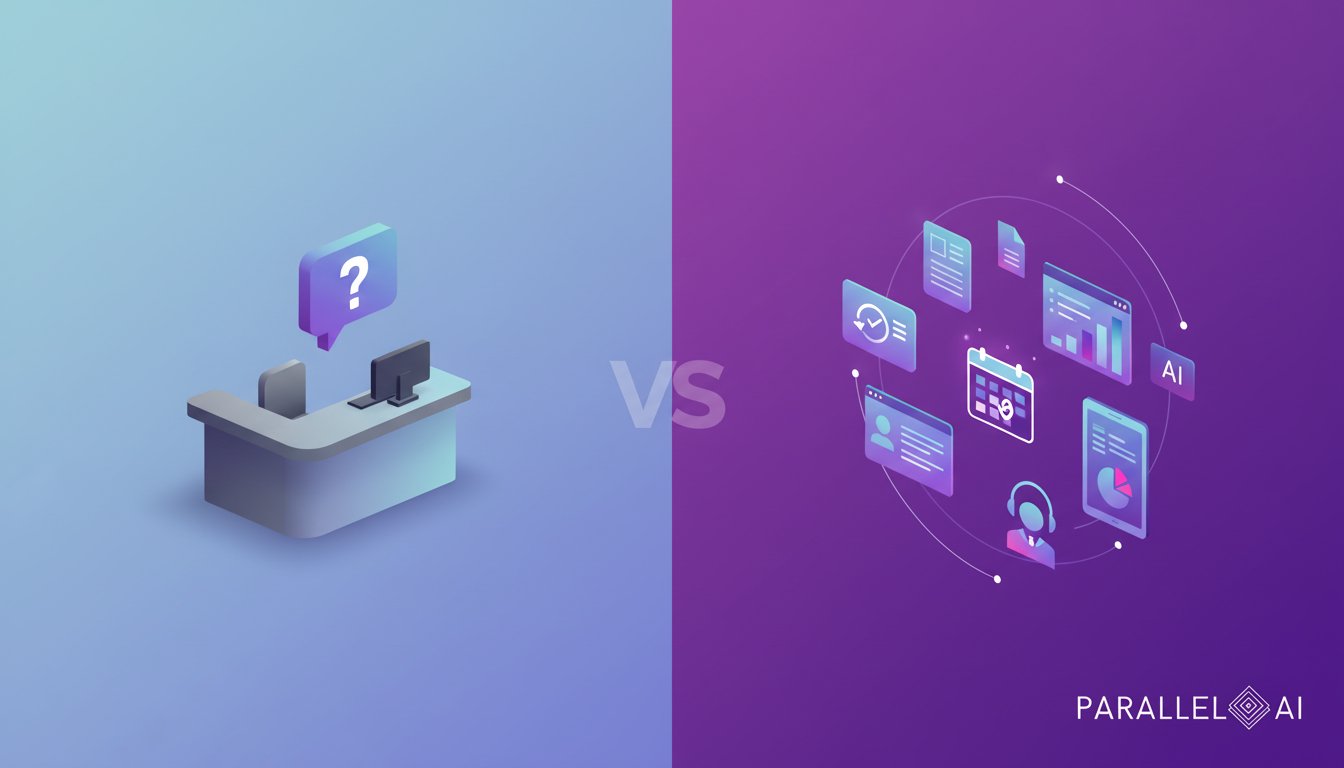
This is where the choice between specialized customer service platforms like Intercom and comprehensive business automation ecosystems like Parallel AI becomes critical. Both leverage AI, both promise efficiency gains, but they approach the fundamental challenge of business scaling from completely different angles. For solopreneurs and micro-agencies evaluating AI investments in 2025, understanding this distinction isn’t just important—it’s the difference between incremental improvement and transformational growth.
The Fundamental Difference: Customer Support Tool vs. Complete Business Operating System
Intercom built its reputation as a powerful customer messaging platform that evolved to incorporate AI chatbots for support automation. It excels at what it was designed to do: streamline customer conversations, automate support tickets, and manage customer service workflows. For businesses primarily focused on scaling their support operations, Intercom offers a mature, feature-rich solution.
But here’s the challenge for agencies and consultants: customer support automation represents just one slice of your business operations. What about content creation for clients? Lead generation and sales prospecting? Proposal development? Market research? Client onboarding workflows? Strategic analysis?
Parallel AI approaches the problem from a fundamentally different perspective. Rather than optimizing one business function, it provides a complete automation ecosystem designed to handle the full spectrum of activities that agencies and solopreneurs perform daily. It’s the difference between buying a specialized kitchen appliance and getting a complete commercial kitchen.
Where Intercom Focuses Its Energy
Intercom’s platform centers on three core areas:
Customer messaging and live chat: Real-time conversations with website visitors and customers through a unified inbox that consolidates communication channels.
AI-powered support automation: Fin AI Answer Bot handles common customer questions, resolves repetitive support tickets, and routes complex issues to human agents when necessary.
Customer engagement workflows: Automated messages triggered by user behavior, targeted campaigns to specific customer segments, and product tours to improve onboarding.
For SaaS companies with high support volumes or e-commerce businesses managing thousands of customer inquiries, these capabilities deliver genuine value. Intercom reports that their AI can resolve up to 50% of support questions without human intervention.
But notice what’s missing: content creation engines, sales prospecting tools, document analysis capabilities, strategic research assistance, proposal generation, or comprehensive knowledge base integration for business operations beyond customer service.
How Parallel AI Reimagines Business Automation
Parallel AI was purpose-built for the reality of how solopreneurs and agencies actually work. It recognizes that your business challenges extend far beyond customer support:
Content automation engine: Generate blog posts, marketing copy, social media content, client reports, and proposals at scale. While Intercom helps you respond to customer questions, Parallel AI helps you create the content that attracts customers in the first place.
Sales prospecting and outreach: Smart Lists identify ideal prospects, and Sequences automate multi-channel outreach across email, LinkedIn, SMS, and voice. This isn’t about supporting existing customers—it’s about systematically filling your pipeline with new opportunities.
Comprehensive knowledge base integration: Connect your Google Drive, Confluence, Notion, and other platforms so your AI agents have context about your entire business, not just customer service scripts. This enables sophisticated analysis, strategy development, and decision support that goes far beyond chatbot conversations.
Omni-channel business agents: AI assistants that handle not just customer support, but client onboarding, research synthesis, competitive analysis, content planning, and strategic consultation—all under your brand.
White-label infrastructure: Deliver these capabilities to your clients under your own branding, creating new revenue streams rather than just reducing support costs.
The distinction is critical: Intercom optimizes one department (customer service), while Parallel AI optimizes your entire business operation.
Pricing Reality: Support Resolution Fees vs. Complete Business Automation
Pricing structures reveal a lot about how platforms expect you to use them. Intercom’s model centers on support resolution volume, while Parallel AI prices for comprehensive business transformation.
Intercom’s Resolution-Based Model
Intercom uses tiered subscription plans (Essential, Advanced, Expert) combined with resolution-based fees of approximately $0.99 per AI resolution. This creates a pricing dynamic that works well if you’re a high-volume support operation but becomes problematic for agencies and consultants.
Consider the math: If you’re handling 500 customer support conversations monthly (modest for a SaaS company but potentially irrelevant for many consulting businesses), you’re looking at roughly $495/month in resolution fees alone, plus your base subscription.
But here’s the bigger issue—this pricing only covers customer support automation. Want content creation? You’ll need another tool. Lead generation? Another subscription. Proposal automation? Another platform. Document analysis? Yet another service.
Customer feedback on platforms like Reddit consistently mentions “the AI tax”—the feeling that Intercom’s pricing becomes expensive as you scale, particularly when you realize it only solves one piece of your operational puzzle.
Parallel AI’s Complete Business Value
Parallel AI takes a fundamentally different approach with pricing that starts at $271/month for white-label partners (with a 30% revenue share model). But here’s what changes the equation: that single subscription replaces multiple tools.
Most agencies using Parallel AI report eliminating 5-8 separate subscriptions:
– Content creation tools ($99-299/month)
– Sales prospecting platforms ($100-500/month)
– AI writing assistants ($20-50/month per seat)
– Chatbot builders ($50-300/month)
– Email sequence automation ($50-200/month)
– Document AI tools ($40-100/month)
The total monthly cost of this fragmented tool stack typically runs $400-1,500/month. Parallel AI consolidates all of it into one platform, one login, one knowledge base, and one workflow.
Even more compelling for agencies: the white-label model creates a new profit center. Most agencies charge clients $497-1,997/month for branded access to Parallel AI’s capabilities, creating 30-63% profit margins on platform subscriptions alone—before adding setup fees ($1,500-5,000) or consulting services.
Intercom reduces an expense (support costs). Parallel AI creates a revenue stream while reducing multiple expenses simultaneously.
Feature Depth: Customer Conversations vs. Business Transformation
Let’s examine what you can actually accomplish with each platform across the core functions that agencies and solopreneurs need to perform.
Content Creation and Marketing
Intercom: Limited to customer-facing messages, chatbot responses, and basic email campaigns within the customer service context. You can’t use Intercom to write blog posts, create social media content, develop white papers, or generate client deliverables.
Parallel AI: Full content automation engine supporting articles, blog posts, social media campaigns, marketing copy, client reports, proposals, case studies, and more. Integrates with your knowledge base to maintain brand voice and incorporate your expertise. One agency reported generating 5x faster content creation with 60% cost savings within 30 days.
Sales and Lead Generation
Intercom: Designed for inbound conversations from existing visitors and customers. No outbound prospecting, no lead list building, no multi-channel sales sequences.
Parallel AI: Smart Lists for targeted prospect identification, automated Sequences for multi-channel outreach (email, LinkedIn, SMS, voice), lead qualification workflows, and CRM integration. Purpose-built for filling your pipeline, not just managing existing customers.
Knowledge Integration and Business Intelligence
Intercom: Connects to your help documentation and knowledge base articles to power customer support responses. Limited to customer service context.
Parallel AI: Comprehensive integration with Google Drive, Confluence, Notion, and custom data sources. Your AI agents can analyze business documents, synthesize research, provide strategic recommendations, and reference your entire organizational knowledge—not just support scripts.
Multi-Channel Capabilities
Intercom: Customer messaging across web chat, mobile, email, and social messaging apps—all focused on customer support conversations.
Parallel AI: Omni-channel business operations including customer support, sales outreach, content distribution, team collaboration, and client communication. The platform remembers context across all channels and conversation types.
Customization and White-Label Options
Intercom: No advertised white-label capabilities. You can customize the look and feel for your own use, but you can’t rebrand and resell Intercom to clients as your own platform.
Parallel AI: Complete white-label infrastructure. Your logo, your colors, your domain, your pricing. Clients interact with “your” platform, not a third-party tool. This transforms AI from an expense into a new service offering.
AI Model Access: Single Vendor vs. Multi-Model Flexibility
The AI landscape evolves rapidly. New models emerge with different strengths—some excel at reasoning, others at creative writing, others at code generation. Your platform choice determines whether you can adapt to these innovations.
Intercom’s Proprietary Approach
Intercom’s Fin AI is built on their own technology and infrastructure. While it performs well for customer support use cases, you’re locked into their roadmap and their model choices. When new AI capabilities emerge, you wait for Intercom to integrate them—if they align with Intercom’s product strategy.
For customer support, this works fine. For comprehensive business operations requiring different types of AI capabilities, it creates limitations.
Parallel AI’s Multi-Model Ecosystem
Parallel AI integrates leading models from OpenAI, Anthropic (Claude), Google (Gemini), xAI (Grok), and DeepSeek. This isn’t just feature list padding—it delivers practical advantages:
Task optimization: Use Claude for long-form content analysis, GPT-4 for structured business writing, Gemini for multimodal tasks, and Grok for real-time information.
Cost management: Route routine tasks to efficient models and complex reasoning to premium models, optimizing your per-task costs.
Risk mitigation: No vendor lock-in. If one model provider changes pricing or capabilities, you seamlessly shift to alternatives.
Context capacity: Access to models with up to one million token context windows means you can analyze entire books, comprehensive datasets, or months of client communication in a single conversation.
For agencies managing diverse client needs across industries, this flexibility transforms how effectively you can serve different use cases with a single platform.
Implementation Reality: IT Projects vs. Same-Day Deployment
The gap between buying software and actually using it productively often spans weeks or months. For solopreneurs and small agencies, this implementation burden can kill ROI before you ever realize value.
Intercom’s Setup Process
Intercom requires meaningful technical implementation:
Website integration: Install tracking code, configure chat widget appearance and behavior, set up routing rules.
Automation configuration: Build decision trees for your chatbot, write and train responses, configure escalation workflows.
Team setup: Establish user permissions, create response templates, integrate with your helpdesk or CRM.
Content migration: Move existing knowledge base articles and support documentation into Intercom’s system.
For businesses with dedicated IT resources or agencies with technical staff, this is manageable. For solo consultants or micro-agencies already stretched thin, it represents a significant time investment before seeing any productivity gains.
Parallel AI’s No-Code Approach
Parallel AI was designed for business operators, not developers:
5-7 day setup: Most agencies are fully configured and selling to clients within a week.
Branding setup: Upload your logo, choose your colors, connect your domain—no coding required.
Knowledge integration: Connect your Google Drive, Notion, or Confluence with OAuth authentication. Your AI agents immediately have access to your business context.
Template library: Pre-built workflows for common agency tasks (client onboarding, content calendars, proposal generation, market research) that you customize rather than build from scratch.
Same-day client access: Once you’ve completed basic setup, clients can use your branded platform immediately. No development work, no waiting, no technical barriers.
One micro-agency reported going from signup to first paid client in nine days, including time to create marketing materials and conduct sales conversations.
The White-Label Advantage: Expense vs. Revenue Stream
This represents perhaps the most fundamental strategic difference between the two platforms.
Intercom as an Operating Expense
When you subscribe to Intercom, you’re purchasing a tool to make your business more efficient. The value proposition is cost reduction: handle more support volume with fewer human agents, resolve issues faster, improve customer satisfaction metrics.
These are legitimate benefits, but they’re fundamentally defensive. You’re optimizing an expense category, not creating new revenue. Your clients never see Intercom as a service you provide—it’s an internal tool that helps you deliver your core offering more efficiently.
Parallel AI as a Revenue Generator
The white-label model flips this equation entirely. Parallel AI becomes a service you sell:
Monthly recurring revenue: Agencies typically charge $497-1,997/month per client for branded platform access, creating predictable income.
Setup fees: $1,500-5,000 for professional onboarding and configuration—100% profit for your business.
Consulting services: Training, strategy sessions, and ongoing optimization create additional billable hours.
Service differentiation: Offering proprietary AI capabilities (under your brand) positions you differently than competitors who simply resell standard tools.
Client retention: Platform access with integrated workflows creates switching costs that improve retention rates.
Consider the economics: An agency with 10 clients paying $997/month for platform access generates $119,640 in annual platform revenue. After paying platform costs to Parallel AI (roughly $4,644 annually at base rates), that’s $114,996 in gross platform profit—before adding any setup fees or consulting services.
This transforms AI from a line item expense into a profit center that funds your other business development.
Real-World Use Cases: Support Tickets vs. Complete Client Delivery
Abstract feature comparisons only go so far. Let’s examine how agencies and solopreneurs actually use these platforms.
Intercom in Practice
A SaaS company with 5,000 active users receives 800 support tickets monthly. After implementing Intercom:
- Fin AI automatically resolves 400 tickets (50%)
- Average response time drops from 4 hours to 18 minutes
- Support team focuses on complex issues requiring human judgment
- Customer satisfaction scores improve by 15%
- Support costs decrease by 30% as they avoid hiring two additional agents
This is a genuine success story—for a business where customer support represents a major operational challenge. But notice what hasn’t changed: content creation still requires separate tools, lead generation still demands different software, proposal development still involves manual processes.
Parallel AI in Practice
A solo marketing consultant previously spending 35 hours weekly on client deliverables implements Parallel AI:
Content production: Generates client blog posts, social media calendars, and email campaigns in 4.5 hours instead of 18 hours weekly. Maintains strategic oversight while AI handles research, drafting, and formatting.
Lead generation: Automated prospecting sequences identify 50 qualified leads monthly and nurture them through multi-channel touchpoints without manual effort.
Client onboarding: New clients complete a structured intake process that feeds directly into AI agents, which then generate customized strategy recommendations and project plans.
Proposal development: Custom proposals incorporating prospect research, competitive analysis, and tailored recommendations generate in 30 minutes instead of 4 hours.
Revenue expansion: Launches white-label AI service offering to existing clients at $797/month, adding $7,970 in monthly recurring revenue with five adopters.
The consultant goes from maxed out at 6 clients to comfortably serving 12 clients while working fewer hours and generating 63% more revenue.
The difference? Intercom optimized one function. Parallel AI transformed the entire business model.
Integration Ecosystem: Customer Service Stack vs. Complete Business Operations
No platform operates in isolation. Your AI solution needs to work with your existing tools and workflows.
Intercom’s Integration Focus
Intercom offers robust integrations with:
- Customer service platforms (Zendesk, Freshdesk, Help Scout)
- CRMs focused on support (Salesforce Service Cloud, HubSpot Service Hub)
- Analytics tools for customer behavior (Mixpanel, Amplitude)
- Product management platforms
These integrations support Intercom’s core mission: optimizing customer support operations. If that’s your primary need, the ecosystem makes sense.
But agencies and consultants need integrations that support diverse business functions: content management systems, project management tools, sales CRMs, proposal software, accounting platforms, and marketing automation.
Parallel AI’s Business Operations Integration
Parallel AI connects to the tools that actually run agencies and consulting businesses:
Knowledge bases: Google Drive, Confluence, Notion, Dropbox—feeding your entire organizational knowledge into AI agents.
Sales and marketing: CRM integration, email platforms, social media management, lead databases.
Automation infrastructure: Custom n8n integrations for complex workflow automation connecting dozens of business tools.
Communication platforms: Email, SMS, voice, chat—unified under your AI orchestration.
White-label delivery: Stripe integration for client billing, SSO for enterprise clients, custom domains for branded experiences.
The integration philosophy differs fundamentally: Intercom connects tools that improve customer support; Parallel AI connects tools that run your entire business.
Enterprise Features and Security: Similar Capabilities, Different Applications
Both platforms offer enterprise-grade security and compliance features, but they apply them to different use cases.
Intercom’s Enterprise Capabilities
Intercom provides:
- SOC 2 Type II compliance
- GDPR readiness and data processing agreements
- SSO via SAML
- Role-based access controls
- API access for custom integrations
- Dedicated support for enterprise plans
These features protect customer data and support conversations—critical for customer-facing operations.
Parallel AI’s Enterprise Infrastructure
Parallel AI offers comparable security foundations:
- SOC 2 compliance
- GDPR ready with custom BAAs available
- SSO on Enterprise plans
- AES-256 encryption and TLS protocols
- On-premise deployment options
- Privacy commitment (data not used for model training)
But these protections extend across your entire business operation: client documents, strategic plans, proprietary research, sales data, content libraries, and confidential communications.
For agencies handling sensitive client information across multiple business functions, this comprehensive security posture matters more than customer service-specific protections.
The GoHighLevel Integration Advantage
For agencies already using GoHighLevel (GHL) for client management and marketing automation, Parallel AI offers a specific advantage: native integration that syncs contacts automatically.
This creates a unified ecosystem where:
- Leads captured in GHL automatically flow to Parallel AI for qualification and nurturing
- Content created in Parallel AI distributes through GHL’s marketing automation
- Client interactions across both platforms maintain unified context
- Reporting and analytics consolidate across your entire client management stack
Intercom doesn’t offer comparable GHL integration, creating data silos between your customer service platform and your agency management infrastructure.
For GHL-powered agencies, this integration eliminates significant manual work and ensures your AI automation has complete context about client relationships.
Support and Success: Ticket-Based Help vs. Partnership Model
How platforms support their customers reveals their business priorities and target audiences.
Intercom’s Support Approach
Intercom offers tiered support based on your plan level:
- Email and chat support on all plans
- Priority support on Advanced and Expert plans
- Dedicated customer success manager on Expert plan
- Extensive knowledge base and community forums
This model works well for larger organizations with internal resources to manage implementation and optimization. You get help when you need it, but you’re expected to figure out most implementation details yourself.
Parallel AI’s Partner Success Model
Parallel AI approaches customer success differently, treating agencies and solopreneurs as partners rather than just users:
- Hands-on setup assistance to ensure quick time-to-value
- Template libraries and pre-built workflows so you’re not starting from scratch
- Regular feature updates included automatically
- Community of agencies sharing strategies and use cases
- Focus on your business success, not just platform utilization
The difference reflects target audience: Intercom serves established companies with resources; Parallel AI serves entrepreneurs and small agencies who need to succeed quickly without large support teams.
Making the Decision: Which Platform Actually Fits Your Business?
After examining features, pricing, capabilities, and use cases, the choice becomes clear—but it depends entirely on what problem you’re actually trying to solve.
Choose Intercom If:
Customer support is your primary operational bottleneck. You’re handling hundreds or thousands of support conversations monthly, and automating responses would dramatically reduce costs.
You’re a product company, not a service business. SaaS platforms, e-commerce operations, or digital product companies where customer support volume directly impacts unit economics.
You have technical resources for implementation. Internal IT or development teams can handle setup, integration, and ongoing optimization.
You need best-in-class customer messaging. Your competitive advantage depends on exceptional customer communication, and you’re willing to combine Intercom with other tools for content, sales, and operations.
You’re not looking to resell AI capabilities. The platform is purely for internal operations, and white-label options aren’t relevant.
Choose Parallel AI If:
You’re an agency, consultant, or solopreneur. Service businesses where your capacity is the constraint, and scaling means handling more clients without proportionally scaling hours.
You need comprehensive business automation. Content creation, sales prospecting, client onboarding, research, analysis, and strategy—not just customer support.
You want to create new revenue streams. White-label capabilities that let you sell AI services to clients under your brand.
You lack technical resources. No-code setup that gets you operational in days, not months.
You’re managing multiple AI tool subscriptions. Platform consolidation that replaces 5-8 separate tools with one integrated ecosystem.
You work with diverse client needs. Multi-model AI access that optimizes different tasks with different AI capabilities.
You want predictable, transparent pricing. Fixed costs instead of per-resolution fees that scale unpredictably.
The fundamental question isn’t “which platform has better AI?” Both leverage sophisticated technology. The question is “which platform was designed for how my business actually operates?”
The Verdict: Specialized Tool vs. Business Transformation Platform
Intercom is an excellent customer service platform that incorporates AI to improve support operations. For businesses where customer support represents a major cost center or competitive differentiator, it delivers measurable value.
But for solopreneurs and agencies, customer support automation typically isn’t the primary constraint. Your challenges span content creation, lead generation, proposal development, client delivery, strategic analysis, and scaling capacity without scaling headcount.
Parallel AI was purpose-built for exactly these challenges. It recognizes that service businesses need comprehensive automation that touches every aspect of operations, not just one department. The white-label model transforms AI from an expense into a revenue stream. Multi-model access provides flexibility as the AI landscape evolves. No-code implementation gets you productive in days instead of months.
Most importantly, Parallel AI treats you as a partner building a business, not just a user buying software. The platform succeeds when you succeed—landing more clients, delivering better results, and scaling revenue without sacrificing work-life balance.
If you’re a product company with high support volume, Intercom makes sense. But if you’re an agency or solopreneur trying to punch above your weight class, deliver enterprise-quality results, and build a sustainable, scalable service business, Parallel AI provides the comprehensive automation ecosystem you actually need.
The AI revolution isn’t about automating one function—it’s about transforming how your entire business operates. Choose the platform that matches that ambition.
Ready to see how complete business automation changes your agency’s trajectory? Schedule a personalized demo and discover how Parallel AI can help you scale impact without scaling headcount—starting this week, not next quarter.
Related reading
- Top 10 White-Label AI Platforms Compared: The 2026 Guide to Building Your AI Business Without Code
- Chaindesk vs Parallel AI: Which Platform Delivers Complete Business Automation Beyond Customer Support for Agencies in 2025?
- Chatbase vs Parallel AI: Which White-Label Platform Delivers Complete Business Automation Beyond Customer Support in 2025?
- ChatNode vs Parallel AI: Which Platform Delivers Complete Business Automation Beyond Customer Support for Independent Consultants in 2025?