
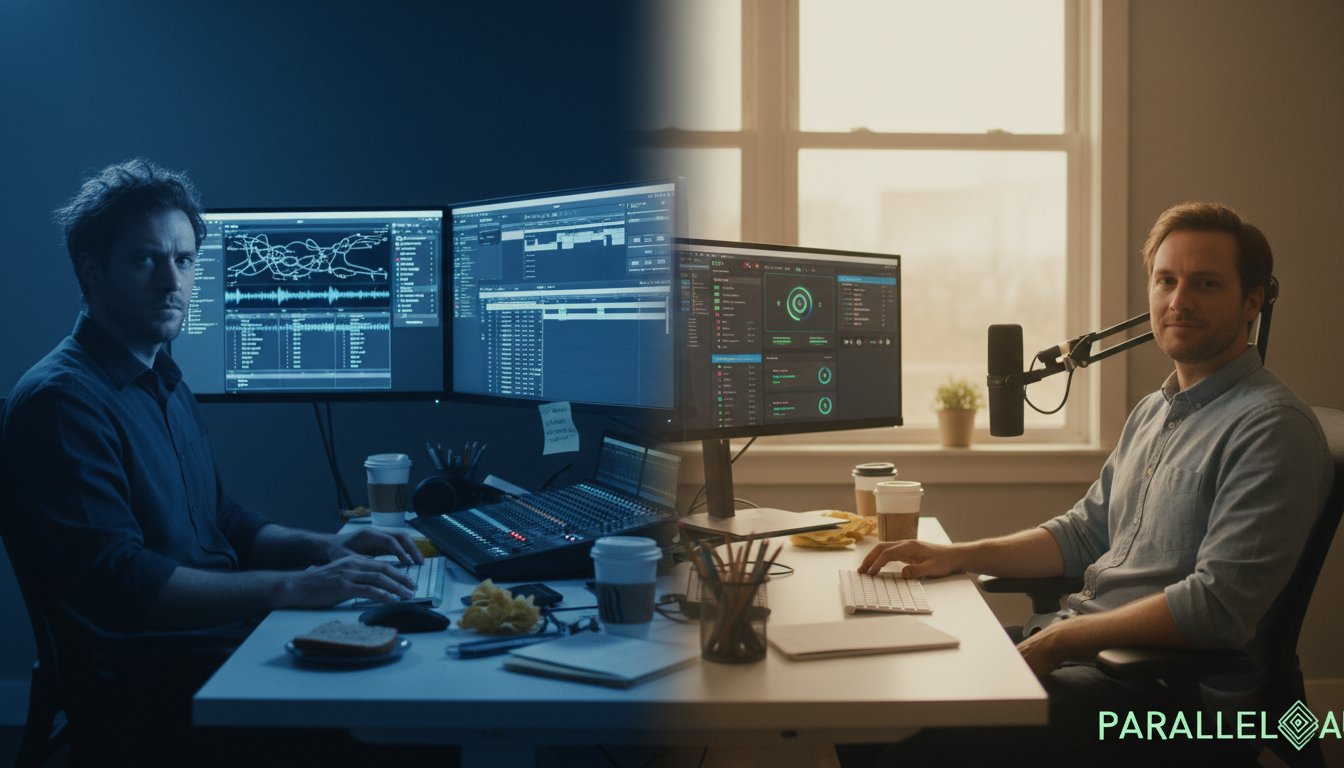
Sarah Martinez had built a respectable podcast production business—three retainer clients, $4,500 monthly recurring revenue, and a reputation for crisp audio and detailed show notes. But she’d hit a ceiling she couldn’t break through. Each client’s weekly episode consumed six hours of her time: two hours editing audio, ninety minutes writing show notes, an hour creating social media clips, another hour on transcription review, and the rest scattered across guest research, email sequences, and content repurposing. The math was brutal. Three clients meant eighteen hours weekly on production alone, leaving barely enough time for client communication, let alone prospecting new business.
When a fourth prospect approached her—a business podcast willing to pay $2,000 monthly—Sarah faced an impossible choice. Taking the client meant working nights and weekends. Declining meant watching $24,000 annual revenue walk away. She knew dozens of solo podcast producers trapped in this exact paradox: strong enough skills to command premium rates, but not enough hours to scale beyond three or four clients.
The podcasting industry’s explosive growth has created unprecedented opportunity. Ad spending hit $4.46 billion in 2025, with video podcasting becoming table stakes rather than premium offering. But for solo producers and micro-agencies, this growth exposes a painful operational reality: the gap between what clients expect and what one person can physically deliver keeps widening. Clients want same-day turnaround, multi-platform content packages, and broadcast-quality production—deliverables that traditionally required teams of specialists.
This is where AI automation fundamentally changes the equation for podcast production businesses. Not by replacing the creative judgment and audio expertise that makes your work valuable, but by collapsing the administrative and repetitive tasks that consume 70-80% of your production time. The result isn’t just faster workflows—it’s the ability to deliver more comprehensive packages to more clients without sacrificing the quality standards that built your reputation in the first place.
The Real Cost of Manual Podcast Production Workflows
Most solo podcast producers dramatically underestimate how much time they actually spend on non-creative tasks. When you track every minute across a typical episode production, the numbers reveal why scaling feels impossible.
Consider the standard workflow for a 45-minute interview podcast. Audio editing—the creative core of your service—takes 2-3 hours for noise reduction, cutting filler words, balancing levels, and adding intro/outro music. That’s the part you’re actually good at, the specialized skill clients pay for. But that’s where the value-added work ends and the time drain begins.
Transcription review eats another 60-90 minutes. Even with automated transcription services, you’re correcting speaker names, fixing industry terminology, and ensuring accuracy for SEO and accessibility. Show notes writing takes 75 minutes as you re-listen to identify key points, timestamp notable moments, and craft compelling descriptions. Social media content creation adds another hour—pulling quotes, creating audiograms, writing platform-specific captions for LinkedIn, Instagram, and Twitter.
Guest research and preparation for the next episode consumes 45 minutes. Email sequence setup for promotion takes 30 minutes. Uploading to hosting platforms and scheduling distribution absorbs another 20 minutes. The administrative tasks around client communication, file management, and project tracking add up to roughly 40 minutes per episode.
When you total the actual hours, a single 45-minute podcast episode requires 6-7 hours of producer time. Industry research confirms this reality—professional editing typically takes 2-4 times the episode length, and that’s before counting all the ancillary content creation.
For a solo producer managing three weekly podcasts, that’s 18-21 hours consumed by production alone. Add client calls, revisions, technical troubleshooting, and business development, and you’ve exceeded a full-time workweek before taking on a fourth client. The typical agency pricing model—$500 to $2,500 per episode for full production—sounds lucrative until you calculate the hourly rate after accounting for all this hidden labor.
The Scalability Trap
This time investment creates what we call the “podcast producer’s scalability trap.” You can’t raise prices indefinitely because the market has pricing expectations. You can’t significantly reduce time per episode without cutting corners on quality. You can’t hire help until you have more revenue, but you can’t get more revenue without additional capacity to take on clients.
Some producers try to solve this by specializing in editing-only services at lower price points ($50-150 per episode), but this creates a different problem: you need dramatically more clients to hit revenue goals, which recreates the time constraint issue. Others attempt to hire freelance editors, but maintaining quality control and managing contractors adds its own time overhead.
The underlying issue isn’t your efficiency or skill—it’s that human-powered workflows have a hard ceiling on throughput. When every task requires your direct attention, your revenue is capped by hours available in a week.
How AI Automation Restructures Podcast Production Economics
Parallel AI doesn’t just speed up your existing workflow—it fundamentally restructures which tasks require your creative expertise versus which can run on intelligent automation. The platform integrates multiple AI models (OpenAI, Anthropic, Gemini, DeepSeek) into a single ecosystem, allowing you to build custom workflows for every repetitive element of podcast production.
The transformation happens across five key areas of your production process, each representing hours you’re currently spending on tasks that don’t require your specialized audio engineering judgment.
Automated Show Notes and Content Brief Generation
Parallel AI’s content automation engine can process your podcast transcript and generate comprehensive show notes in minutes rather than the 75 minutes you currently spend. Upload the transcript to your AI knowledge base, and custom agents can extract key talking points, identify quotable moments, create timestamp markers for notable segments, and generate SEO-optimized episode descriptions.
The AI doesn’t just summarize—it can match your existing show notes style by training on your previous episodes. Feed it 10-15 examples of your best show notes, and it learns your formatting preferences, tone, and the level of detail your clients expect. One solo producer reported reducing show notes creation from 90 minutes to 8 minutes using this approach, with minimal editing required to match her quality standards.
Multi-Platform Social Media Content Creation
Content repurposing is where podcast producers lose the most time because it requires context-switching between platforms. Writing a LinkedIn post requires different framing than an Instagram caption or Twitter thread. Parallel AI’s omni-channel content generation solves this by creating platform-specific content from a single source transcript.
Set up content sequences that automatically generate: LinkedIn thought leadership posts highlighting strategic insights from the episode, Instagram carousel scripts with visual-friendly talking points, Twitter thread breakdowns of key frameworks discussed, Facebook post variations optimized for engagement, short-form video scripts for TikTok and Reels, email newsletter content for subscriber distribution, and blog post expansions for SEO and website traffic.
Each output follows platform-specific best practices—character counts, hashtag strategies, and formatting conventions—without requiring you to manually adapt the content. What previously took 60+ minutes of copywriting now runs as an automated sequence triggered when you upload the transcript.
Intelligent Guest Research and Interview Preparation
For producers who also handle client interview preparation, Parallel AI’s research capabilities compress hours of background work into minutes. The platform can scan a guest’s LinkedIn profile, recent articles, podcast appearances, and company news, then synthesize this information into structured interview briefs.
Create a custom agent that generates: biographical background and career highlights, recent projects and industry contributions, potential interview questions based on their expertise, conversation topics aligned with your client’s podcast theme, and relevant talking points that connect to previous episodes.
One producer who books 2-3 guests weekly reduced his research time from 45 minutes per guest to under 10 minutes, while actually improving the depth of his interview prep because the AI could process far more source material than he could manually review.
Automated Email Sequences and Client Communication
The administrative overhead of client communication—status updates, draft reviews, scheduling, revision requests—fragments your workday and kills productivity. Parallel AI’s sales sequences functionality adapts perfectly to podcast production workflows.
Build automated email sequences for: episode delivery with show notes and assets, social media content distribution to clients, revision request templates with branded formatting, guest outreach and interview scheduling, and client onboarding for new podcast launches.
These aren’t generic templates—the AI can personalize each message based on client-specific information stored in your knowledge base, reference previous conversations, and maintain your communication style. You review and approve rather than drafting from scratch, reducing communication overhead by 60-70%.
Scalable Client Knowledge Management
As you add clients, keeping track of each podcast’s style guide, guest preferences, prohibited topics, brand voice, and content requirements becomes increasingly complex. Parallel AI’s knowledge base integration with Google Drive, Notion, or Confluence ensures every automation accesses the right client-specific context.
Upload each client’s: brand style guide and voice parameters, previous episode transcripts for consistency, preferred show notes format and length, social media guidelines and hashtag preferences, and guest criteria and interview focus areas.
When you run any automated workflow, the AI references the relevant client’s knowledge base, ensuring outputs match their specific requirements without you manually adjusting prompts each time. This contextual awareness is what allows AI automation to maintain quality while dramatically reducing your hands-on time.
The White-Label Opportunity: From Service Provider to Platform Owner
Once you’ve automated your own production workflows, Parallel AI’s white-label capabilities open an entirely different business model: offering AI-powered podcast production tools directly to your clients rather than just done-for-you services.
This shifts your positioning from hourly labor provider to technology-enabled service partner. Instead of being paid for time spent, you’re compensated for access to capabilities and expertise. The economics are dramatically more favorable.
Building Your Own Branded Podcast Production Platform
Parallel AI’s white-label solutions allow you to rebrand the entire platform as your own proprietary technology. Your clients log into a system with your branding, use AI tools configured specifically for podcast production, and see you as the technology provider rather than knowing they’re accessing third-party AI models.
This positioning matters enormously for perceived value and pricing power. A “podcast production service” competes with hundreds of other freelancers and agencies on time and price. A “proprietary AI-powered podcast production platform” is a differentiated offering that justifies premium positioning.
Set up branded AI agents for your clients that handle: automated show notes generation using your templates, social media content creation in their brand voice, guest research and interview preparation, transcript cleanup and formatting, and content repurposing workflows.
Your clients get self-service access to capabilities that would normally require hiring multiple specialists, while you maintain control over the AI configurations, training data, and output quality. You’re no longer trading time for money—you’re providing ongoing platform access with your expertise embedded in the automation.
Hybrid Service Models: Done-With-You Production
The most successful podcast producers using white-label AI adopt hybrid models that combine automation with strategic human oversight. Rather than pure done-for-you services, they offer “done-with-you” packages where clients handle automated tasks while you focus on high-value creative direction.
A typical hybrid package might include: client uses your white-label platform for show notes, transcription, and social content, you handle audio editing and quality control, monthly strategy sessions for content direction and optimization, and training and support for using the AI tools effectively.
This model allows you to serve 8-12 clients in the time you previously managed 3-4, because you’re no longer executing every task personally. Clients pay for platform access ($200-500/month) plus premium services ($800-1,500/month), creating $1,000-2,000 monthly recurring revenue per client with significantly less hands-on time required.
One micro-agency (two partners) transitioned from serving four full-production clients to managing eleven hybrid clients, increasing monthly revenue from $7,200 to $13,500 while reducing combined work hours from 72 to 54 per week.
Recurring Revenue Through AI Access
The white-label approach also solves podcast production’s feast-or-famine revenue challenge. Traditional project-based pricing means income fluctuates with client retention and new bookings. Platform access creates true recurring revenue that’s less vulnerable to individual client churn.
Structure your offerings as: platform access tier ($300-500/month) with self-service AI tools, supported tier ($800-1,200/month) adding training and strategy, and managed tier ($1,500-2,500/month) including full production with AI acceleration.
This tiered approach lets clients choose their service level while ensuring you capture recurring revenue even from clients who want lighter-touch support. The platform access fee compensates you for the AI configurations, custom agents, and knowledge base setup you’ve created, while higher tiers monetize your direct expertise and creative services.
Implementation Blueprint: Your First 30 Days
Transitioning from manual podcast production to AI-augmented workflows doesn’t require rebuilding your entire business overnight. A phased 30-day implementation lets you validate the approach with one client before scaling across your roster.
Week 1: Foundation Setup
Start by setting up your Parallel AI workspace and connecting your existing tools. Integrate your Google Drive or Dropbox where you store client files, episode transcripts, and production assets. This integration ensures all your AI automations can access the source material they need.
Create your first knowledge base by uploading 5-10 examples of your best show notes across different clients. These become training examples that teach the AI your writing style, formatting preferences, and quality standards. Add your standard operating procedures, client style guides, and any template documents you typically reference.
Build your first custom AI agent specifically for show notes generation. Configure it to: accept podcast transcripts as input, reference your knowledge base examples for style, extract key talking points and quotes, generate timestamped highlights, and output show notes in your standard format.
Test this agent on 2-3 recent episodes where you’ve already created show notes manually. Compare the AI output to your original work, identify gaps, and refine the agent’s instructions. Most producers find they can get 85-90% accuracy within 4-5 iterations, requiring only light editing to reach final quality.
Week 2: First Client Automation
Select your most process-oriented client—one with consistent episode format and clear content patterns—as your automation pilot. This client will be the testbed for your full workflow automation.
Expand beyond show notes to create AI agents for: social media content generation (LinkedIn posts, Twitter threads, Instagram captions), email newsletters featuring episode highlights, blog post expansion of key episode topics, and guest thank-you emails with personalized references.
Build a content sequence that chains these agents together. When you upload a new episode transcript, the sequence automatically triggers each agent in order, generating the complete content package. You review all outputs, make necessary edits, and deliver to the client.
Track your time carefully this week. Measure how long the traditional workflow took versus the AI-assisted approach. Most producers see 50-60% time reduction in week two, even while learning the platform and refining their agents.
Week 3: Multi-Client Expansion
With your pilot client successfully automated, replicate the workflow for your other clients. The key is creating client-specific knowledge bases that ensure each client’s content maintains their unique brand voice and requirements.
For each client, create a dedicated knowledge base containing: their brand style guide and messaging framework, 8-10 example episodes with your produced show notes, social media examples that performed well, previous guest research briefs, and any specific content preferences or restrictions.
Clone your proven AI agents and point them to the appropriate client knowledge base. This ensures the automation adapts to each client’s needs rather than producing generic output across all accounts.
Begin testing the guest research automation by creating an agent that: accepts a guest’s name and company, searches for recent articles, podcast appearances, and social media activity, synthesizes findings into an interview brief, and suggests relevant questions aligned with the podcast theme.
Run this agent for upcoming guest interviews and compare the research briefs to what you’d create manually. Refine the output format and depth to match your quality standards.
Week 4: White-Label Positioning
If you’re interested in the white-label model, week four focuses on positioning and packaging. Access Parallel AI’s white-label solutions to configure your branded platform experience.
Customize the platform with: your business name and logo, branded color scheme and visual identity, custom domain for client access, and welcome messaging that introduces your platform.
Create client-facing documentation that explains: how to upload transcripts to the platform, which AI agents are available and what they do, how to review and edit AI-generated content, and when to request your direct support.
Identify which current client might be interested in a hybrid model where they handle some tasks using your platform while you manage the specialized production work. Present this as a beta opportunity with discounted pricing in exchange for feedback.
Develop your tiered service packages with clear delineation between platform-only access, supported access with training, and fully managed service. Price these based on the value delivered and your reduced time investment, not just the hours you’re saving.
Measuring Success: Metrics That Matter
As you implement AI automation, tracking the right metrics ensures you’re actually improving business economics, not just changing workflows. Focus on three categories: time efficiency, revenue capacity, and client satisfaction.
Time Efficiency Metrics
Measure your time investment per episode across each production phase. Before automation, track your baseline: total hours per episode, breakdown by task (editing, show notes, social content, research, communication), and weekly hours across all clients.
After implementing AI automation, measure: total hours per episode with AI assistance, time saved per task category, percentage of AI-generated content used without editing, and hours redirected to business development or additional clients.
Most solo podcast producers see 60-70% time reduction in content creation tasks (show notes, social media, email sequences) within the first month, while maintaining similar time investment in creative audio editing. This typically translates to reducing total production time from 6-7 hours per episode to 2.5-3.5 hours.
Revenue Capacity Metrics
Time savings only matter if they translate to revenue growth. Track: number of clients served, monthly recurring revenue, average revenue per client, and new client capacity (how many additional clients could you serve with current time availability).
The goal is expanding client roster without proportionally expanding hours worked. A successful AI implementation might show: clients increasing from 3 to 6, monthly recurring revenue growing from $4,500 to $9,600, and weekly production hours staying flat or increasing only slightly from 18 to 24 hours.
This demonstrates you’ve actually achieved scalability—doubling revenue without doubling time investment. Your effective hourly rate improves dramatically even if your per-client pricing stays the same.
Client Satisfaction Metrics
Automation should maintain or improve client satisfaction, not degrade it. Track: client retention rate, revision requests per episode, client feedback on content quality, and testimonials mentioning speed or comprehensiveness.
Watch for warning signs that automation is compromising quality: increased revision requests, clients noting content feels generic, or feedback that you’re less responsive or engaged. These signals indicate you need to refine your AI agents or adjust where automation is applied.
Positive indicators include: clients commenting on faster turnaround times, appreciation for more comprehensive content packages, and recognition of the additional social media and promotional materials you’re now providing.
Several producers report that AI automation actually improved client satisfaction because they could deliver more thorough content packages—blog posts, multiple social media formats, detailed transcripts—that weren’t feasible when everything required manual creation.
Navigating Common Implementation Challenges
Every solo podcast producer who implements AI automation encounters similar obstacles. Anticipating these challenges and having response strategies prepared accelerates your success.
Maintaining Brand Voice Consistency
The most common concern is that AI-generated content will sound generic or fail to capture each client’s unique brand voice. This is a legitimate risk with poorly configured AI, but entirely solvable with proper knowledge base training.
The solution is comprehensive examples. Don’t just upload one or two show notes—feed the AI 10-15 examples of each content type for each client. Include high-performing social posts, popular episode descriptions, and email newsletters that resonated with their audience.
Create explicit voice guidelines in your knowledge base that specify: tone attributes (conversational vs. professional, playful vs. serious), vocabulary preferences and terms to avoid, formatting conventions (emoji usage, paragraph length, question frequency), and reference examples of on-brand versus off-brand content.
Most producers find that the first few AI outputs require 30-40% editing to align with brand voice, but this drops to 10-15% editing after refining the agent instructions and expanding the knowledge base. The AI learns quickly when given clear examples.
Client Disclosure About AI Usage
Should you tell clients you’re using AI automation? This depends on your service positioning and client relationships. If you’re selling done-for-you production services, many producers treat AI as an internal efficiency tool—no different from using editing software or transcription services. The client is paying for results, not monitoring your process.
However, if you’re moving toward white-label platform models where clients directly interact with AI tools, transparency is essential and becomes a selling point. Position it as: “I’ve developed proprietary AI-powered tools that allow me to deliver more comprehensive content packages while maintaining quality and fast turnaround.”
This framing emphasizes the value clients receive (better service) rather than focusing on your cost savings (less time required). Most clients care about outcomes—accurate show notes, engaging social content, timely delivery—not whether those outcomes involved AI assistance.
Some producers proactively highlight their AI capabilities as a competitive advantage: “Unlike traditional podcast production services, I use advanced AI automation to deliver complete content packages including show notes, transcripts, social media assets, and blog posts—deliverables that would normally require hiring multiple specialists.”
Quality Control Workflows
AI outputs require review, but the goal is efficient review, not complete rewriting. Establish quality control checkpoints that catch errors without recreating the manual workload you’re trying to eliminate.
Create review templates for each content type. For show notes, check: factual accuracy of key points, proper spelling of names and company names, logical flow and organization, and on-brand tone and formatting. For social media content, verify: platform-appropriate length and formatting, inclusion of relevant hashtags and links, quotations are accurate and in context, and engaging hooks and calls-to-action.
Time-box your reviews. If you’re consistently spending 20+ minutes editing AI-generated show notes, the agent needs refinement, not more editing time. The automation should reduce your labor, not just shift it from creation to editing.
Most producers establish a 80/20 rule: if AI output is 80% usable with 20% or less editing required, accept it and refine the agent over time. If you’re rewriting more than 30%, pause and improve the agent configuration rather than compensating with editing labor.
The Competitive Advantage of AI-Enabled Production
The podcast production market is increasingly competitive, with new producers and agencies launching constantly. AI automation provides three distinct competitive advantages that are difficult for traditional manual producers to match.
Comprehensive Service Packages at Competitive Prices
Manual production economics force most solo producers to offer limited deliverables: audio editing and basic show notes, or editing-only services at lower price points. Clients who want complete content packages—social media, blog posts, email newsletters, video clip scripts—typically need to hire agencies with larger teams, paying premium prices.
AI automation allows you to deliver comprehensive packages as a solo producer without unsustainable time investment. Your standard offering can include: professional audio editing, detailed show notes with timestamps, LinkedIn, Twitter, Instagram, and Facebook content, blog post expansion of key topics, email newsletter copy, and video clip scripts for short-form content.
This complete package positions you between budget editing-only services ($50-150/episode) and premium full-service agencies ($2,000+/episode). You can price at $800-1,200 per episode while delivering agency-level comprehensiveness, creating compelling value that wins clients from both ends of the market.
Speed-to-Delivery That Builds Client Loyalty
Podcast clients increasingly expect rapid turnaround—ideally same-day or next-day delivery for weekly shows. Manual production makes this extremely difficult unless you’re willing to work evenings and weekends or maintain very light client loads.
AI automation compresses the production timeline dramatically. When content creation tasks that previously took 4-5 hours now require 45-60 minutes of AI processing plus review, same-day turnaround becomes operationally feasible even with multiple clients.
This speed advantage is particularly valuable for business podcasts and news-oriented shows where content timeliness matters. Being the producer who consistently delivers within 24 hours while maintaining quality creates strong client retention and generates referrals.
Scalability Without Quality Degradation
The traditional scaling path for successful podcast producers is hiring employees or contractors. This introduces new challenges: recruitment and training time, quality control overhead, margin compression from additional labor costs, and management responsibilities that reduce your own production time.
AI automation provides an alternative scaling path: expanding client roster using your own labor augmented by intelligent automation. You maintain creative control and quality standards while serving more clients than manual production could support.
This approach preserves higher margins (you’re not paying employee wages or contractor fees), maintains consistency (everything still reflects your judgment and standards), and avoids management overhead (you’re not supervising other people’s work).
For producers who want to grow revenue without building a traditional team-based agency, AI-enabled solo practice offers a viable path to $10,000-15,000 monthly revenue as a true solopreneur.
Looking Forward: The AI-Augmented Podcast Producer
The podcasting industry’s rapid growth—$4.46 billion in ad spending, video becoming standard, multi-platform distribution expected—creates both opportunity and pressure for solo producers and micro-agencies. Client expectations continue escalating while market pricing remains competitive.
The producers who thrive in this environment won’t be those who resist AI automation or those who completely outsource creative work to algorithms. The winners will be AI-augmented professionals who strategically apply automation to multiply their capacity while maintaining the specialized expertise and quality standards that clients value.
Parallel AI provides the infrastructure for this hybrid approach: powerful AI models for content generation and automation, white-label capabilities for platform-based business models, knowledge base integration that maintains client-specific context, and flexible workflows that adapt to your unique service offerings.
The transformation from manual production to AI-augmented operation doesn’t happen overnight, but the producers implementing this approach are reporting substantial results: 60-70% reduction in time spent on content tasks, 2-3x increase in client capacity without proportional time increases, ability to offer comprehensive content packages previously requiring teams, and new revenue streams from white-label platform access.
If you’re currently trapped in the podcast producer’s scalability paradox—strong enough to command premium rates but unable to serve more than a handful of clients—AI automation represents the operational breakthrough that aligns your capacity with the market opportunity in front of you.
The choice isn’t between maintaining quality and scaling revenue. With the right AI infrastructure configured specifically for podcast production workflows, you can finally achieve both. The question is whether you’ll implement these capabilities before your competitors do, or whether you’ll watch clients migrate to AI-enabled producers who deliver more comprehensive packages at competitive prices with faster turnaround.
Your audio engineering expertise and creative judgment remain irreplaceable—those skills are why clients hire you rather than using generic transcription services. But combining that expertise with AI-powered content automation, intelligent research capabilities, and white-label platform positioning transforms you from time-constrained solo operator to scalable production partner.
Ready to see how Parallel AI can restructure your podcast production economics and unlock your next growth phase? Explore white-label solutions designed specifically for service businesses like yours, or schedule a demo to see how leading podcast producers are building AI-augmented workflows that serve more clients without sacrificing quality or burning out.
Related reading
- Top 10 White-Label AI Platforms Compared: The 2026 Guide to Building Your AI Business Without Code
- How Solo Event Planners Are Compressing 38-Hour Proposal Cycles Into 4.5 Hours Using White-Label AI (Without Losing the Creative Vision That Wins Premium Clients)
- How Solo Corporate Event Planners Are Delivering 35-Hour Conference Builds in 5.5 Hours Using White-Label AI (Without Losing the Strategic Positioning That Wins C-Suite Clients)
- How Solo HR Consultants Are Delivering 28-Hour Recruitment Packages in 4 Hours Using White-Label AI (Without Losing the Personal Touch That Wins Retained Clients)