
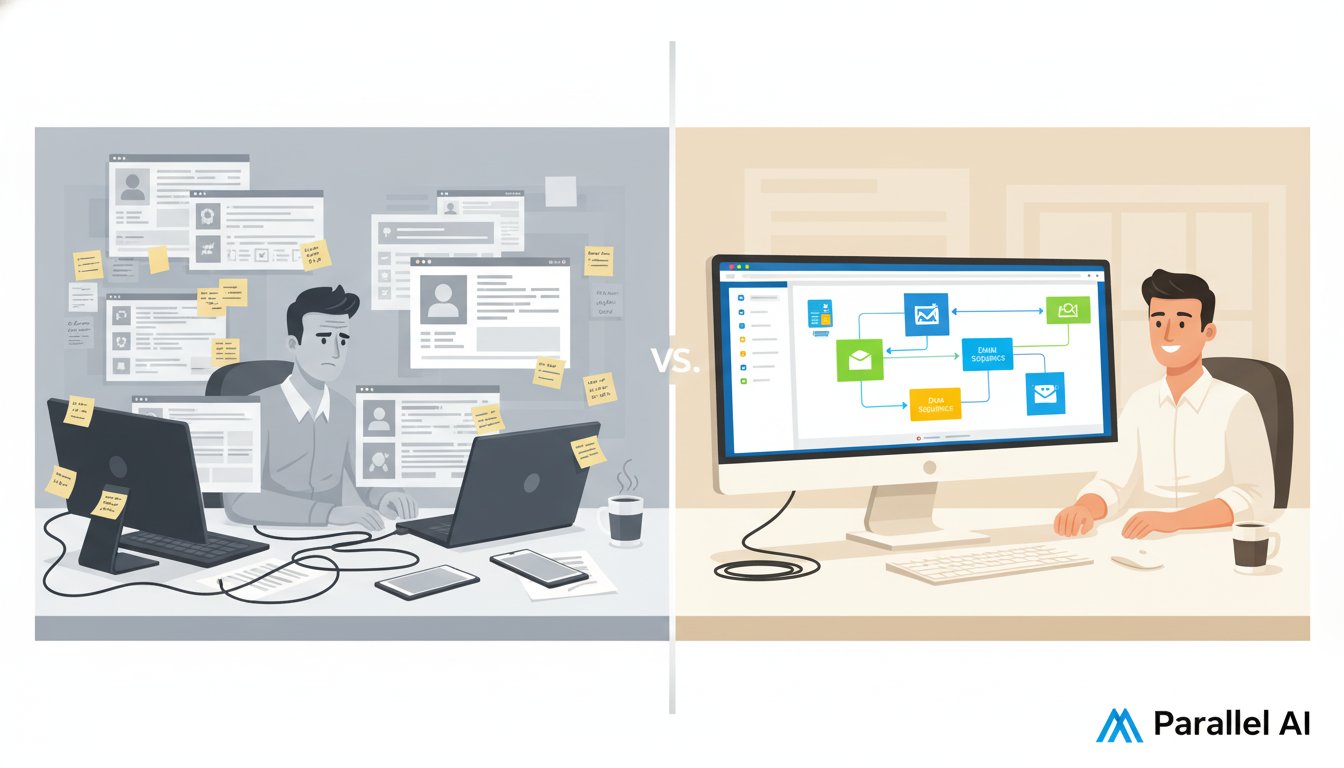
When you’re choosing a white-label AI platform for your agency or solo consulting practice, you’re not just selecting software—you’re making a strategic decision that will define your service capabilities, profit margins, and competitive positioning for years to come. The question isn’t whether to adopt AI; it’s which platform architecture will actually transform your business rather than just add another monthly bill.
Chatbase and Parallel AI both enter the conversation when agencies search for white-label AI solutions, but they represent fundamentally different approaches to business automation. One is a specialized customer support chatbot platform that excels within its niche. The other is a comprehensive business automation ecosystem designed to replace your entire AI tool stack. Understanding this distinction matters more than most comparison articles acknowledge, because the wrong choice doesn’t just waste money—it creates operational bottlenecks that compound over time.
For the solopreneur managing three clients while trying to scale to ten, or the micro-agency stuck at five team members because adding more overhead kills profitability, this decision carries immediate financial implications. According to recent industry analysis, agencies managing multiple disconnected AI tools spend 2-3 hours weekly per team member just switching between platforms, not including the $2,500-$20,000+ monthly costs in combined subscriptions, integrations, and management overhead. The platform you choose either solves this consolidation problem or perpetuates it.
This analysis cuts through marketing claims to examine what each platform actually delivers for agencies and consultants building scalable, profitable service businesses. We’ll explore the specific capabilities, limitations, and business model implications that only become apparent after you’ve committed resources to implementation.
The Fundamental Architecture Difference That Shapes Everything Else
Chatbase positions itself as a customer support automation platform with white-label capabilities. Its core value proposition centers on creating AI chatbots trained on your business data to handle customer inquiries across multiple channels. For businesses whose primary AI need is automating customer service conversations, this focused approach delivers clear value.
The platform supports multiple AI models, offers branded chat widgets without Chatbase branding, and integrates with popular CRM systems like Salesforce and Zendesk. Implementation is straightforward—businesses can deploy custom-branded chatbots relatively quickly without extensive technical expertise. The interface prioritizes ease of use, making it accessible for teams without dedicated AI specialists.
Parallel AI takes a fundamentally different architectural approach: comprehensive business automation rather than specialized chatbot deployment. The platform consolidates the functionality of ChatGPT, Claude, Jasper, Clay, Instantly.ai, Zapier, Intercom, and 8+ other tools into a unified ecosystem. This isn’t just feature parity—it’s a complete reconceptualization of how agencies deliver AI-powered services.
The distinction manifests in three critical areas that directly impact agency profitability: content production capabilities, lead generation automation, and white-label service delivery architecture.
Content Production: Chatbot Conversations vs. Complete Content Lifecycle Automation
Chatbase excels at conversational content—scripted responses, FAQ automation, and interactive customer dialogues. Its AI models can be trained on company documentation to provide accurate, contextual responses. For businesses primarily needing to automate customer support conversations, this capability delivers substantial value by reducing response times and support ticket volume.
However, Chatbase’s content capabilities essentially end where conversations end. The platform isn’t designed for the broader content creation workflows that agencies need: blog post generation, social media campaign development, email sequence writing, or multi-channel content calendar management. Agencies using Chatbase for customer support still need separate subscriptions to Jasper or Copy.ai for content creation, Canva or Midjourney for visual assets, and scheduling tools for publication.
Parallel AI’s Content Engine approaches this differently by automating the entire content lifecycle from strategy to publication. The platform includes specialized AI agents for strategy development, copywriting, customer profiling, and visual generation—all working within a unified workflow that produces 1-3 months of authentic, on-brand content in minutes.
This architectural difference translates directly to agency economics. A micro-agency using Chatbase might pay $59-99/month for customer support automation, but still requires:
– ChatGPT Plus or Claude Pro: $20-40/month
– Jasper or Copy.ai: $49-125/month
– Canva Pro or design tools: $13-30/month
– Scheduling platforms: $15-50/month
– Total additional subscriptions: $97-245/month
Parallel AI consolidates these functions at $99-297/month depending on usage volume, with content creation, customer interaction, and publication scheduling included. For agencies producing content for multiple clients, the time savings exceed the subscription cost difference within the first week.
Lead Generation & Sales Automation: Where Chatbots Meet Their Limitations
Chatbase supports lead qualification through conversational interactions—capturing contact information, answering preliminary questions, and routing qualified leads to sales teams. For businesses with high website traffic, this chatbot-based lead capture provides measurable value by converting anonymous visitors into identified prospects.
The limitation emerges in outbound lead generation and multi-channel prospecting workflows. Chatbase doesn’t include databases of potential leads, email sequence automation for cold outreach, or the workflow orchestration required for comprehensive sales automation. Agencies building lead generation services for clients need to supplement Chatbase with tools like Clay for data enrichment, Instantly.ai for email sequences, and Apollo or ZoomInfo for contact databases.
Parallel AI’s Smart Lists and Sequences functionality addresses the complete lead generation workflow: identifying target prospects, enriching contact data, orchestrating multi-channel outreach across email, social media, SMS, and voice, then tracking engagement and conversion. The platform consolidates what would typically require 3-4 separate tools into unified workflows.
For solo consultants offering lead generation services, this consolidation creates a specific competitive advantage. Instead of charging clients $2,000-3,000/month to manage multiple tools with modest margins, consultants can deliver the same outcomes at 30-70% profit margins because their tool costs are consolidated. The difference between a $1,200 gross margin and a $2,100 gross margin on the same client engagement determines whether scaling to 10 clients is profitable or just creates a higher-stress version of the same income.
White-Label Implementation: Branding vs. Complete Service Architecture
Both platforms offer white-label capabilities, but the scope differs substantially. Chatbase’s white-label features focus on removing platform branding from chat widgets and creating custom domains for chatbot deployments. For $39-59/month in additional fees, agencies can present Chatbase chatbots under their own brand without visible Chatbase attribution.
This works well for agencies selling customer support automation as a standalone service. The branded chatbot becomes part of the client’s website experience without revealing the underlying technology provider. However, the white-labeling is limited to the chatbot interface—it doesn’t extend to content creation workflows, lead generation campaigns, or other business functions because Chatbase doesn’t include those capabilities.
Parallel AI’s white-label architecture operates at a different level: agencies can brand the entire platform, create custom AI employees for clients, deploy branded dashboards, and deliver comprehensive AI capabilities that appear completely native to their brand. The platform includes API access for custom integrations, allowing agencies to build proprietary workflows that leverage Parallel AI’s infrastructure while maintaining complete brand ownership.
For agencies building recurring revenue through managed AI services, this architectural difference impacts scalability directly. An agency using Chatbase for customer support can white-label that specific function, but each additional service category (content creation, lead generation, email marketing) requires separate tools, separate white-label configurations, and separate client training. Managing five clients across four different tools creates 20 tool-client combinations to support.
Parallel AI consolidates this into a single platform relationship. One white-label configuration delivers customer support, content production, lead generation, and workflow automation across all clients. The reduction in management overhead becomes the difference between scaling profitably and hitting a ceiling where additional clients just mean more administrative burden.
The Integration Ecosystem: Connected Tools vs. Unified Platform
Chatbase emphasizes integrations with existing business systems—Slack, WhatsApp, Messenger, Notion, Zapier, Calendly, and major CRM platforms. This integration-first approach allows businesses to add AI chatbot capabilities to their current tech stack without replacing existing tools.
The advantage is compatibility with established workflows. Businesses already invested in Salesforce for CRM, Zendesk for ticketing, and Slack for team communication can add Chatbase without disrupting those systems. The chatbot becomes one component within a broader ecosystem of specialized tools.
The disadvantage is ongoing integration maintenance. Each connected tool represents a potential failure point, an API change that breaks workflows, or a subscription renewal negotiation. Agencies managing client implementations across multiple integrated platforms spend considerable time troubleshooting integration issues that aren’t actually bugs—they’re just the inherent complexity of connecting disparate systems.
Parallel AI reduces integration dependencies by consolidating functionality. Instead of integrating with Zapier to connect ChatGPT to Instantly.ai to trigger Clay workflows, the platform includes these capabilities natively. The knowledge base connects directly to Google Drive, Notion, and Confluence without middleware. Content publishing flows directly to WordPress, LinkedIn, Instagram, and other platforms without third-party schedulers.
For the solo consultant managing three clients, this consolidation means fewer tools to monitor, fewer subscription renewals to track, and fewer integration breakages to troubleshoot. The time saved isn’t dramatic in any single instance—maybe 15 minutes here, 30 minutes there—but compounds to 2-3 hours weekly that can be redirected to billable client work or business development.
Pricing Architecture & Unit Economics for Agency Service Delivery
Chatbase pricing starts at approximately $59/month for basic plans including 40,000 message credits, with additional charges for custom domains ($59/month) and ad-free branding ($39/month). Agencies requiring white-label deployments realistically budget $100-150/month for a professional implementation.
For a micro-agency serving five clients with customer support chatbots, the platform cost is manageable. However, this doesn’t include the content creation tools, lead generation platforms, and workflow automation systems required to deliver comprehensive AI services. Adding those subscriptions pushes total tool costs to $400-600/month before considering labor, overhead, or profit margin.
Parallel AI’s pricing structure approaches this differently:
– Entrepreneur Plan: $99/month for 2,000 questions, including Content Engine, Sequences, Smart Lists, Inboxes, Workflows, and white-labeling
– Business Plan: $297/month for 9,000 questions, multiple organizations, 9 collaborator seats, and API access
– Enterprise Plan: Custom pricing for unlimited access, SSO, on-premise deployment, and dedicated API resources
For a solo consultant building a white-label AI service business, the unit economics shift dramatically. Using the Business Plan to serve 5-7 clients means a per-client platform cost of $42-59, compared to the $80-120 per-client cost of managing separate subscriptions to ChatGPT, Jasper, Clay, Instantly.ai, and scheduling tools.
This difference compounds when calculating service pricing and profit margins. A consultant charging $800/month for AI-powered content and lead generation services with $120 in tool costs per client generates $680 gross margin (85%). The same service delivered with Parallel AI at $50 in tool costs generates $750 gross margin (93.75%). Over 25 clients annually, that’s a $21,000 difference in gross profit from tool cost optimization alone.
The Hidden Costs of Platform Switching and Context Loss
Beyond subscription fees, platform fragmentation creates productivity costs that rarely appear in comparison analyses. Industry research indicates teams managing multiple disconnected AI tools lose 2-3 hours weekly per person to context switching—copying data between platforms, recreating prompts in different interfaces, and reconciling outputs from separate tools.
For a three-person agency team, that’s 6-9 hours weekly, or 312-468 hours annually, spent on tool management rather than client delivery. At a conservative $75/hour opportunity cost, that represents $23,400-$35,100 in lost productivity annually.
Chatbase minimizes this within its domain—customer support chatbots don’t require much context switching because conversations happen in one place. But agencies still switch between Chatbase for support, Jasper for content, Clay for lead research, and Instantly.ai for outreach. The fragmentation persists.
Parallel AI addresses this by centralizing workflows. Content strategy, copywriting, lead identification, and outreach sequencing happen within the same platform, with shared context from the integrated knowledge base. The AI maintains conversation history, understands business objectives from uploaded documentation, and applies consistent brand voice across all outputs.
The productivity recapture isn’t trivial. Recovering even 50% of those lost hours (156-234 annually) creates capacity to serve 2-3 additional clients without hiring, or to invest in business development that accelerates growth.
Real-World Application Scenarios: Which Platform for Which Business Model?
Scenario 1: E-commerce Business Needing Customer Support Automation
An e-commerce company with 50,000 monthly visitors and 500+ support tickets wants to automate FAQ responses, order tracking queries, and product recommendations. Customer support is the primary use case, with no immediate need for content marketing or outbound lead generation.
Chatbase fits this scenario well. The focused chatbot functionality directly addresses the core need. Integration with existing e-commerce platforms and CRM systems allows the chatbot to access order data and provide personalized responses. The $100-150/month cost is easily justified by reduced support ticket volume and faster response times.
Parallel AI could serve this need through its omnichannel agents, but the broader content and lead generation capabilities would remain underutilized. Unless the e-commerce business plans to expand into content marketing or needs the consolidated platform for other functions, Chatbase’s specialized focus offers better value alignment.
Scenario 2: Marketing Agency Managing Content for 8 Client Accounts
A four-person marketing agency produces blog posts, social media content, email campaigns, and lead magnets for eight recurring clients. Each client receives 8-12 content pieces monthly across multiple platforms. The agency also needs to manage content calendars, client approvals, and publication scheduling.
Parallel AI transforms this scenario. The Content Engine can generate a month of content in minutes, the knowledge base ensures brand consistency across all clients, and the white-label capabilities allow the agency to present everything under their brand. The consolidated workflow means less time managing tools and more time delivering strategic value to clients.
Chatbase could handle customer support chatbots for these clients if needed, but it doesn’t address the core content production workflow. The agency would still need Jasper, Copy.ai, or similar tools for content, plus scheduling platforms for publication, creating the fragmentation problem Parallel AI solves.
Scenario 3: Solo Sales Consultant Building a Lead Generation Practice
A solo consultant is transitioning from project-based sales consulting to recurring lead generation services. They need to identify prospects, enrich contact data, create personalized outreach sequences, and track engagement across email, LinkedIn, and phone outreach. They plan to serve 5-10 small business clients at $1,500-2,500/month per client.
Parallel AI enables this business model. Smart Lists identify prospects, Sequences orchestrate multi-channel outreach, and the Content Engine generates personalized messaging at scale. The white-label capabilities allow the consultant to present this as their proprietary system. At $297/month for the Business Plan, tool costs represent 10-20% of a single client engagement, leaving healthy margins for profit.
Chatbase doesn’t include lead database access, outreach sequencing, or the workflow automation required for this service model. The consultant would need to add Clay ($800+/month), Instantly.ai ($97+/month), and Apollo or similar databases ($49+/month), pushing tool costs to $1,000+/month before achieving comparable functionality.
Scenario 4: Business Coach Creating AI-Powered Client Resources
A business coach with 30 one-on-one clients wants to create AI-powered resources clients can access 24/7—personalized business planning assistants, financial modeling chatbots, and strategic framework guides. The coach needs to maintain their personal brand while delivering enterprise-grade AI capabilities.
Both platforms have applications here. Chatbase could create individual branded chatbots for each client, trained on the coach’s methodologies and frameworks. The white-label features ensure clients see the coach’s brand, not Chatbase.
Parallel AI offers broader capabilities—not just chatbots but complete AI employees that can generate strategic documents, create personalized content, and handle more complex workflows. The white-label platform could become a branded membership resource, differentiating the coach’s offering from competitors who only provide one-on-one time.
The choice depends on scope: if the coach only needs chatbot interactions, Chatbase’s focused functionality works well. If they envision comprehensive AI-powered business resources, Parallel AI’s broader capabilities justify the investment.
The Security and Compliance Considerations That Matter for Agencies
Both platforms address enterprise security requirements, but with different approaches. Chatbase offers AES-256 encryption at rest and in transit, GDPR compliance, and SOC 2 Type II certification. The platform commits to not using client data for model training, addressing privacy concerns for businesses handling sensitive customer information.
For agencies serving clients in regulated industries—healthcare, finance, legal services—these security certifications provide necessary assurance. The ability to deploy chatbots that handle customer inquiries without exposing data to model training is essential for HIPAA compliance and financial data protection.
Parallel AI matches these security standards while adding deployment flexibility. The Enterprise plan includes on-premise deployment options, allowing organizations with strict data residency requirements to run the platform within their own infrastructure. SSO and domain verification provide additional security layers for enterprise implementations.
For the micro-agency perspective, these security features translate to client acquisition opportunities. Being able to truthfully claim SOC 2 Type II compliance, GDPR adherence, and on-premise deployment options opens doors to enterprise clients that smaller agencies typically can’t serve. The difference between a $15,000 enterprise client engagement and a $3,000 small business engagement often comes down to these compliance checkboxes.
Making the Decision: Framework for Platform Selection
The Chatbase vs. Parallel AI decision isn’t about which platform is “better” in absolute terms—it’s about which architecture aligns with your specific business model, service offerings, and growth trajectory. Here’s a decision framework based on actual business scenarios:
Choose Chatbase if:
– Customer support automation is your primary or sole AI application
– You have established, specialized tools for other functions that you don’t want to replace
– Your business model centers on high-volume customer interactions requiring conversational AI
– You need a focused, straightforward chatbot solution without broader automation requirements
– Your clients specifically request customer support chatbots as a standalone service
Choose Parallel AI if:
– You’re building a multi-service AI consulting practice serving solopreneurs or small businesses
– Content production, lead generation, and customer interaction are all part of your service offering
– You want to consolidate 5-10 separate AI tool subscriptions into one platform
– White-label service delivery under your own brand is central to your business model
– You’re scaling an agency and need to maximize profit margins by reducing tool overhead
– You want to compete with larger agencies by delivering enterprise-grade capabilities without enterprise-grade team size
The decision becomes clearer when you calculate the specific economics for your situation. Map your current tool subscriptions, multiply by 12 months, add the time cost of managing multiple platforms, then compare against consolidated platform pricing. For most micro-agencies and solopreneurs, the math favors consolidation.
The Implementation Reality: What Actually Happens After You Choose
Comparison articles rarely address post-purchase reality—what actually happens in months 2-6 after implementation. This timeline matters because it reveals whether a platform delivers sustained value or creates new problems that offset initial benefits.
With Chatbase, typical implementation follows this pattern:
– Week 1-2: Deploy chatbot on website, train initial model on FAQ documentation, configure basic integrations
– Month 1-2: Refine conversation flows based on actual customer interactions, add knowledge base content, improve response accuracy
– Month 3-6: Optimize for specific use cases, expand to additional channels (WhatsApp, Messenger), integrate more deeply with CRM systems
The implementation is relatively straightforward because the scope is focused. Challenges typically involve conversation design—creating flows that feel natural rather than robotic—and knowledge base completeness. Agencies find that chatbot quality depends heavily on the documentation provided, making this a change management challenge as much as a technical one.
Parallel AI implementation follows a different trajectory because it touches more business functions:
– Week 1-2: Connect knowledge base (Drive, Notion, Confluence), configure Content Engine with brand guidelines, set up initial AI employees
– Month 1-2: Deploy content automation for first clients, establish lead generation workflows, train team on platform capabilities
– Month 3-6: Scale across multiple clients, customize AI employees for specific verticals, leverage API for custom integrations, optimize white-label branding
The broader scope means more initial setup work, but also more substantial business impact. Agencies report the learning curve is steeper in month one, but the productivity gains in months 2-6 exceed what focused tools deliver because multiple workflows improve simultaneously.
The critical factor is whether you have the implementation capacity to absorb the initial setup time. A solo consultant juggling client deadlines might find Chatbase’s focused scope easier to deploy quickly, while a three-person agency with some bandwidth for system implementation captures more value from Parallel AI’s comprehensive approach.
The Honest Assessment: What the Data Actually Shows
When you strip away marketing claims and examine actual business outcomes, the patterns are clear:
Chatbase delivers measurable value for businesses with high-volume customer support needs. E-commerce companies, SaaS platforms, and service businesses with extensive FAQ requirements see tangible ROI through reduced support ticket volume and faster response times. The platform does what it promises within its defined scope.
The limitation is architectural: Chatbase doesn’t attempt to solve the broader tool consolidation challenge agencies face. It’s one specialized tool that happens to offer white-label capabilities, not a comprehensive business automation platform.
Parallel AI addresses a different problem: the $2,500-$20,000 monthly cost and 2-3 hours weekly per person that agencies waste managing fragmented AI tool stacks. For micro-agencies and solopreneurs, this consolidation creates competitive advantages that specialized tools can’t match.
The data point that matters most: agencies using comprehensive platforms report 30-70% profit margins on white-labeled AI subscriptions, compared to 15-25% margins when reselling multiple specialized tools. The difference comes from reduced tool costs, decreased management overhead, and the ability to package services more attractively.
For a solo consultant building toward $150,000-200,000 annual revenue, that margin difference represents $30,000-50,000 in additional profit from the same client base. That’s the difference between a sustainable practice and a high-stress grind that barely justifies the effort.
Your Next Step: Making This Decision for Your Specific Situation
The platform choice you make today shapes your business trajectory for the next 12-24 months. Switching platforms mid-stream with active clients is disruptive and costly, making the initial decision more consequential than it might appear.
Start by auditing your current state: list every AI-related tool subscription you’re paying for, calculate the monthly total, and estimate the weekly hours spent managing these platforms. Then project forward: if you add three more clients in the next six months, how does that tool cost and management time scale?
If you’re primarily focused on customer support automation with no immediate plans for content production or lead generation services, Chatbase’s specialized focus aligns with your needs. The platform does chatbots exceptionally well.
If you’re building a multi-service consulting practice where AI powers content, leads, and customer interaction—or if you’re currently paying for ChatGPT, Claude, Jasper, Clay, and Instantly.ai separately—the consolidation economics favor Parallel AI. The platform is specifically architected for the agency business model where tool overhead directly impacts profitability.
The market is moving toward consolidation. Industry research shows agencies spending $2,500-$20,000 monthly on fragmented tools can reduce total cost of ownership by 20-40% through unified platforms, while simultaneously improving productivity by recapturing the 2-3 hours weekly lost to context switching.
For solopreneurs and micro-agencies, this isn’t just about cost savings—it’s about creating the margin structure that makes scaling profitable rather than just busier. The difference between 25% margins and 65% margins on the same service determines whether you can grow beyond doing everything yourself.
Parallel AI was specifically designed to solve this problem for independent consultants and small agencies competing against larger competitors. The platform consolidates the tools you’re already paying for separately, adds white-label capabilities that larger agencies charge premium prices for, and creates the margin structure that makes growth sustainable.
If you’re ready to stop managing eight different AI subscriptions and start delivering enterprise-grade capabilities under your own brand, explore how Parallel AI transforms agency economics. The demo walks through specific use cases for your business model and shows the exact consolidation ROI for your current tool stack.
Related reading
- Top 10 White-Label AI Platforms Compared: The 2026 Guide to Building Your AI Business Without Code
- Botpress vs Parallel AI: Which White-Label Platform Actually Delivers Complete Business Automation for Agencies in 2025?
- CustomGPT.ai vs Parallel AI: Which White-Label Platform Actually Delivers Complete Business Automation for Agencies in 2025?
- CustomGPT vs Parallel AI: Which White-Label Platform Actually Delivers Complete Business Automation Beyond Chatbots for Micro-Agencies in 2026?