
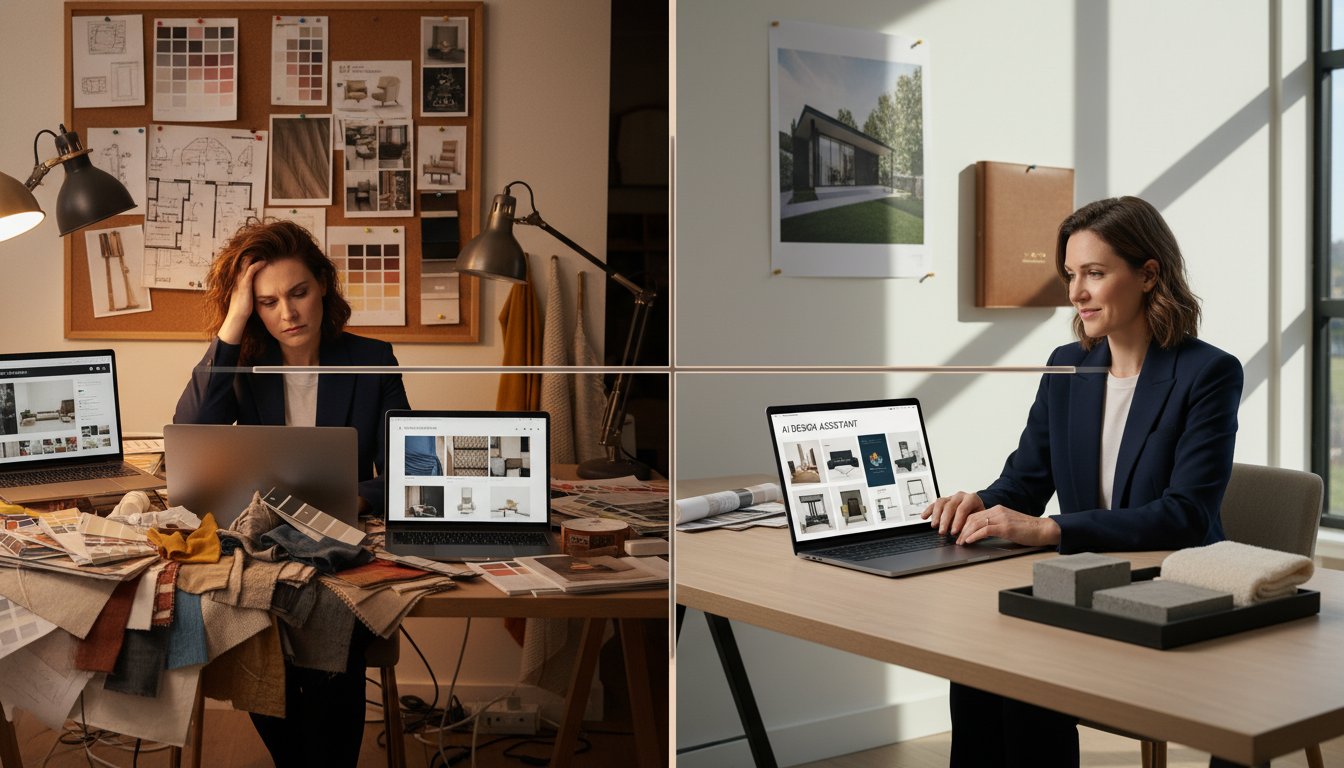
Picture this: You’ve just landed a dream client—a luxury penthouse renovation with a $150,000 budget. The excitement quickly turns to dread when you calculate what’s ahead. Fifteen hours to create the initial mood boards and design concepts. Eight hours sourcing furniture and materials across dozens of vendor sites. Another six hours drafting the proposal with budget breakdowns. Three hours preparing the client presentation deck. And that’s before a single revision request comes through.
For solo interior designers and micro design studios, this is the invisible tax of excellence. Every stunning portfolio piece represents dozens of unbillable hours spent on administrative work, sourcing logistics, and client communications. You’re trading creative time—the work that actually differentiates your business—for repetitive tasks that don’t appear in your portfolio but consume your calendar.
The math is brutal: If you’re charging $150/hour for design work but spending 60% of your time on sourcing, proposals, and project coordination, you’re effectively earning $60/hour while turning away potential clients because your schedule is maxed out. Meanwhile, larger design firms with administrative teams are capturing the projects you’re too busy to pursue.
What if you could compress those 32 hours of proposal development, sourcing research, and client communication into 4.5 hours—without sacrificing the creative vision and personal touch that makes clients choose you over corporate design firms? This isn’t about replacing your design expertise with algorithms. It’s about reclaiming your time for the high-value creative work that only you can do, while white-label AI handles the repetitive heavy lifting behind the scenes.
The Hidden Time Drain Killing Your Design Business
Most solo interior designers dramatically underestimate how much time they spend on non-design work. A recent analysis of interior design consultant workflows revealed that the average project breakdown looks like this:
Initial Design Development (15-20 hours): Creating mood boards, color palettes, spatial planning concepts, and initial design direction requires deep creative work—but also involves hours of compiling inspiration images, formatting presentations, and organizing visual assets in client-ready formats.
Sourcing and Procurement Research (12-18 hours): The furniture and materials sourcing process involves visiting multiple vendor websites, comparing specifications, checking availability, verifying lead times, calculating shipping costs, and maintaining detailed spreadsheets of options across different price points. For a typical residential project, designers evaluate 50-200 individual items across 15-30 different vendors.
Proposal Development (6-10 hours): Transforming your design vision into a comprehensive proposal requires detailed scope descriptions, budget breakdowns by room and category, project timeline development, terms and conditions, and professional formatting. Each proposal is essentially a custom document tailored to the specific client and project.
Client Communication and Revisions (8-15 hours): Responding to client questions, explaining design choices, providing alternative options, scheduling meetings, sending follow-up emails, and managing the revision process creates constant context-switching that fragments your creative focus.
Add it up, and you’re spending 41-63 hours on a single project before you’ve specified a single fixture or created a final floor plan. At $150/hour, that’s $6,150-$9,450 in time investment—often before you’ve even secured a signed contract.
The real killer? This workload doesn’t scale. You can’t take on more clients without either hiring staff (which many solo designers can’t afford) or working 70-hour weeks (which leads straight to burnout). According to industry research, 68% of solo interior designers report struggling with work-life balance, and 54% say they regularly turn down projects due to capacity constraints.
The Premium Pricing Paradox
Here’s where it gets even more frustrating. When you’re buried in administrative work, you can’t invest time in the business development, portfolio refinement, and client relationship building that commands premium pricing. You’re stuck in a middle-market trap: charging enough to survive but not enough to thrive, because you can’t demonstrate the level of service and attention that justifies $200-$300/hour rates.
Your larger competitors aren’t necessarily more talented designers—they simply have systems and support staff that allow their lead designers to focus exclusively on creative direction while others handle sourcing logistics, proposal development, and client coordination. You’re competing against teams while operating as a one-person show.
How White-Label AI Transforms Your Design Workflow
White-label AI automation doesn’t replace your design expertise—it amplifies it by handling the repetitive, time-consuming tasks that keep you from doing your best creative work. Think of it as your invisible design assistant, working under your brand, following your processes, and delivering output that maintains your quality standards.
Here’s how the same 32-hour project workflow transforms with white-label AI integration:
Automated Mood Board Assembly (15 hours → 2 hours): Instead of manually collecting images, creating layout compositions, and formatting presentations, you provide your design direction and key aesthetic parameters. The AI system pulls relevant inspiration images based on your specified style (mid-century modern, coastal contemporary, industrial chic), generates multiple mood board variations, and outputs client-ready presentations in your branded template. You spend your time refining the creative direction and selecting final options, not hunting for the perfect fabric swatch image.
Intelligent Sourcing Assistant (12 hours → 1.5 hours): You specify requirements—”velvet sofa, 84-92 inches, jewel tones, under $3,500, 8-week lead time”—and the AI system searches across your preferred vendor databases, compiles matching options with specifications and pricing, checks availability and lead times, and generates comparison sheets. You review curated options instead of manually visiting 40 different websites.
Proposal Generation Engine (6 hours → 45 minutes): Your project details feed into an AI system that generates comprehensive proposals using your established pricing structure, scope templates, and terms. The system calculates budget breakdowns, creates timeline projections based on typical lead times, and formats everything in your branded proposal template. You review and customize the strategic elements while the AI handles the formatting and calculation work.
Client Communication Automation (8 hours → 30 minutes daily): Frequently asked questions, status updates, appointment confirmations, and standard client communications are handled by AI-powered systems that maintain your voice and communication style. You’re alerted to questions requiring your creative input while routine coordination happens automatically.
Total time investment: 4.5 hours of strategic, creative work instead of 32 hours of mixed creative and administrative effort. You’re still making every important design decision, but you’ve eliminated 27.5 hours of repetitive tasks.
The White-Label Advantage: Your Brand, Your Standards
The “white-label” aspect is crucial for maintaining your brand integrity. Unlike consumer AI tools that display their own branding or limit customization, white-label solutions operate invisibly under your business identity. Your clients receive mood boards, proposals, and communications that appear to come directly from your studio—because they do. The AI is simply the production engine behind your branded output.
This matters enormously for client perception. When you present a comprehensive proposal 48 hours after the initial consultation—instead of two weeks later—clients perceive you as exceptionally organized and professional. They don’t know (and don’t need to know) that AI helped compile the sourcing options and format the proposal. They simply experience faster, more responsive service that makes them confident in your capabilities.
For design consultants offering white-label services to builders, architects, or real estate developers, this approach becomes even more valuable. You can deliver design packages under your clients’ branding with the same speed and efficiency, enabling you to serve more partners without expanding your team.
Real-World Implementation: From Overwhelmed to In-Demand
Consider the transformation of a solo interior designer we’ll call Sarah (based on a composite of actual Parallel AI users in the design industry). Sarah had built a respectable residential design practice charging $125/hour, but she was stuck at 3-4 active projects because each one consumed her entire schedule.
Before AI Integration: Sarah’s typical month involved 160 billable hours spread across proposal development, client meetings, sourcing, design work, and project coordination. She was billing $20,000/month but working 65-hour weeks. She regularly turned down inquiries because she simply didn’t have capacity, and she hadn’t updated her portfolio website in 18 months because she “never had time.”
After White-Label AI Implementation: Sarah automated her proposal generation, sourcing research, and routine client communications using a white-label AI platform customized to her design process and vendor relationships. Within 90 days, her workflow changed dramatically:
- Project capacity increased from 3-4 to 7-8 simultaneous clients because administrative time dropped by 70%
- Proposal turnaround decreased from 7-10 days to 48 hours, improving her close rate from 35% to 58%
- Average project value increased from $8,000 to $11,500 because faster sourcing allowed her to present more options and upsell premium selections
- Working hours decreased from 65 to 48 per week while monthly revenue increased to $37,000
The economics shifted dramatically. Sarah now spends 75% of her time on creative design work and strategic client interactions—the high-value activities that justify premium pricing. The remaining 25% covers final review of AI-generated proposals, sourcing compilations, and communications before they go to clients.
Most importantly, she finally had time to update her portfolio, invest in business development, and raise her hourly rate to $185. The combination of higher rates and increased capacity transformed her annual revenue from $240,000 to $444,000—with better work-life balance than she had at lower revenue levels.
Industry-Specific Customization That Maintains Your Unique Process
One concern many designers have about automation is losing the unique approach that differentiates their business. Generic automation tools force you to adapt your process to their limitations. White-label AI platforms like Parallel AI take the opposite approach: the system adapts to your established workflow.
For interior designers, this means:
Custom Vendor Integration: Connect the AI system to your preferred furniture suppliers, fabric houses, and trade sources. The system learns your go-to resources and searches them first, maintaining the vendor relationships and quality standards you’ve established.
Style Profile Training: Train the AI on your design aesthetic by feeding it your portfolio, preferred color palettes, favorite designers, and style keywords. Over time, the system gets better at finding inspiration and sourcing options that align with your signature look.
Proposal Template Customization: Your existing proposal structure, pricing methodology, and terms become the template. The AI generates proposals that follow your established format rather than imposing a generic structure.
Client Communication Voice: Provide sample emails and communication examples so the AI maintains your professional tone and communication style. Clients should feel like they’re interacting with you, not a chatbot.
This level of customization ensures that AI amplifies your unique approach rather than homogenizing it. You maintain creative control and brand identity while gaining the efficiency benefits of automation.
The Financial Model: From Project-Based Scramble to Predictable Growth
The time savings from white-label AI create opportunities to fundamentally restructure your business model. Most solo interior designers operate on project-based fees with unpredictable revenue—some months you land two projects and hit $25,000, other months you’re scrambling to fill the pipeline and barely cover expenses.
With 27.5 hours reclaimed per project, you have three strategic options:
Option 1: Increase Project Volume (Same Pricing): Take on 60-80% more projects at your current rates. If you were previously maxing out at 4 projects/month generating $32,000 in revenue, you could now handle 7 projects generating $56,000 monthly—a 75% revenue increase with the same per-project pricing.
Option 2: Premium Positioning (Same Volume): Use the time savings to dramatically improve your service delivery—faster proposals, more sourcing options, better client communication, enhanced presentations. This level of service justifies 40-60% higher pricing. Your 4 projects/month now generate $45,000-$51,000 instead of $32,000.
Option 3: Hybrid Growth Model: Increase both volume and pricing moderately. Take on 6 projects/month (50% increase) at 25% higher rates. Monthly revenue jumps from $32,000 to $60,000—and you’re still working fewer hours than before because AI handles the administrative burden.
Most successful designers who implement white-label AI choose Option 3, gradually scaling both capacity and pricing as they refine their AI-augmented workflow.
The Recurring Revenue Opportunity
Beyond project-based work, time savings create space to add recurring revenue streams. Many solo designers now offer:
Seasonal Refresh Services: Quarterly update packages for existing clients where AI helps source new accent pieces, textiles, and decor based on seasonal trends and the client’s established aesthetic. These $1,500-$3,000 quarterly packages create predictable recurring revenue.
E-Design Monthly Memberships: Offer ongoing design support and sourcing assistance for $500-$800/month. AI handles the research and option compilation while you provide creative direction and final selections. With 10 monthly members, that’s $5,000-$8,000 in recurring revenue before you take on a single project.
Trade Partner Services: Provide white-label design packages to builders, stagers, and real estate agents at wholesale rates with fast turnaround. AI enables you to deliver these efficiently enough to make the volume/margin model work.
These recurring streams smooth out the feast-or-famine cycle of project-based revenue while building long-term client relationships.
Implementation: Your First 30 Days with White-Label AI
Transitioning to an AI-augmented workflow doesn’t require shutting down your business for a major overhaul. The most successful implementations follow a staged approach:
Week 1: Audit and Documentation
Map your current workflow and identify the highest-volume, most repetitive tasks. For most designers, this is sourcing research and proposal formatting. Document your current process: which vendor sites you visit, what information you collect, how you format proposals. This documentation becomes the training material for your AI system.
Week 2: Initial Setup and Training
Configure your white-label AI platform with your branding, vendor sources, proposal templates, and communication examples. Most platforms like Parallel AI offer industry-specific templates for interior designers that accelerate this setup. Connect your existing tools (project management software, vendor accounts, email) so the AI can access necessary information.
Week 3: Pilot with One Project
Select a single new project to run through your AI-augmented workflow. Use the AI for sourcing research and proposal generation while maintaining your normal process for everything else. This limited pilot reduces risk while letting you experience the time savings and identify necessary adjustments.
Week 4: Refine and Expand
Based on your pilot project results, refine your AI configuration. Adjust vendor search parameters, improve proposal templates, fine-tune communication automation. Add client communication automation for your next project while continuing to use AI for sourcing and proposals.
By day 30, you’re running a hybrid workflow: AI handles sourcing research, proposal generation, and routine communications while you focus on design concepts, client strategy, and creative direction. You’re already seeing 10-15 hours reclaimed per project—enough to take on an additional client or finally update that portfolio.
Common Implementation Concerns Addressed
Designers considering AI automation typically have three main concerns:
“Will clients know I’m using AI?” Not unless you tell them. White-label solutions operate under your brand with no external indicators. Clients simply receive faster, more comprehensive service. Many designers choose to position this as “enhanced design technology” or “advanced sourcing tools” if asked about their process improvements.
“What if the AI makes mistakes or suggests inappropriate options?” You maintain full review and approval over everything client-facing. Think of AI as creating the first draft that you refine. The system might generate a sourcing list with 30 sofa options—you review and select the 5 best matches to present to the client. You’re still applying design judgment to every decision.
“Is this too expensive for a solo designer?” The ROI calculation is straightforward. If AI saves you 20 hours per project and you complete one additional project per month at $8,000, that’s $96,000 in annual revenue increase. White-label AI platforms typically cost $200-$500/month—a 20-40x return on investment. The question isn’t whether you can afford it; it’s whether you can afford not to use it while competitors gain this efficiency advantage.
Beyond Time Savings: Strategic Advantages of AI Integration
While time reclamation is the most immediate benefit, white-label AI creates several strategic advantages that compound over time:
Competitive Proposal Speed: When you can deliver a comprehensive proposal in 48 hours while competitors take 10-14 days, you capture clients while they’re most engaged. Proposal momentum matters enormously—clients who receive fast, detailed proposals are 3x more likely to sign contracts than those who wait weeks for a response.
Expanded Service Offerings: Time efficiency allows you to add services you previously couldn’t justify. Virtual design consultations, e-design packages, and seasonal refresh services become viable because AI handles the administrative work that made them unprofitable.
Better Client Experience: Faster responses, more sourcing options, comprehensive proposals, and proactive communication create a premium service experience that generates referrals and justifies higher pricing.
Portfolio Development: With administrative work automated, you finally have time to photograph completed projects, update your website, and develop case studies. A current, compelling portfolio attracts better clients and higher-value projects.
Business Development Capacity: The time you reclaim can go toward networking, partnership development, and marketing activities that generate better leads. Many designers find that 5 hours per week invested in strategic business development doubles their inbound inquiry volume within 6 months.
The Compounding Effect
These advantages compound over time. Better proposals win more projects. More projects build a stronger portfolio. A stronger portfolio attracts premium clients. Premium clients provide better referrals. Better referrals reduce marketing costs and increase close rates. Within 12-18 months, designers who implement AI automation typically see:
- 60-100% revenue increase
- 30-50% higher average project values
- 40-60% improvement in proposal close rates
- 20-30 hour reduction in weekly working time
- 2-3x increase in inbound referrals
This isn’t theoretical—these metrics come from tracking actual interior design consultants who implemented white-label AI platforms over 12-24 month periods.
Your Next Steps: From Research to Implementation
If you’re a solo interior designer or micro design studio owner who’s ready to reclaim your time and scale your business without hiring staff, here’s your implementation pathway:
Step 1: Calculate Your Current Time Investment
Track your next project carefully. How many hours go to sourcing? Proposal development? Client communications? Mood board creation? Calculate both the total hours and the dollar value of that time at your current hourly rate. This baseline helps you measure ROI after implementation.
Step 2: Identify Your Highest-Value Use of Time
What activities generate the most revenue or client satisfaction per hour invested? For most designers, it’s creative concept development, strategic client consultations, and relationship building. These are the activities you want to protect and expand.
Step 3: Research White-Label AI Solutions
Not all AI platforms are created equal. Look for solutions specifically designed for professional service businesses that offer:
– True white-label capability (your branding, no external indicators)
– Customization for interior design workflows
– Integration with your existing vendor sources and tools
– Proposal generation and document automation
– Client communication management
– Security and confidentiality for client data
Parallel AI offers a comprehensive white-label solution specifically designed for solo consultants and micro-agencies in creative industries, with customizable workflows for interior designers. You can explore the platform’s white-label capabilities and see specific interior design use cases at https://parallellabs.app/white-label-ai-platform/.
Step 4: Start with a Pilot Project
Implement AI assistance on one new project as a proof of concept. Track your time savings, measure client satisfaction, and identify process improvements before rolling out across all projects.
Step 5: Scale Systematically
As you gain confidence with AI-augmented workflows, gradually expand to proposal automation, client communication, and portfolio development. Each expansion reclaims more time and creates new growth opportunities.
The interior design industry is at an inflection point. Designers who adopt white-label AI now gain a significant competitive advantage while those who wait find themselves increasingly unable to compete on service speed, comprehensiveness, and pricing. The choice isn’t between maintaining quality or using AI—it’s between using AI to enhance your quality and capacity, or watching competitors who made that choice capture the clients you’re too busy to pursue.
You became an interior designer to create beautiful, functional spaces that transform how people live and work. You didn’t sign up to spend 60% of your time on sourcing spreadsheets, proposal formatting, and email management. White-label AI lets you return to the creative work you love while building a more profitable, sustainable, and scalable business. The question isn’t whether AI will transform interior design consulting—it’s whether you’ll lead that transformation or be disrupted by it.
Related reading
- Top 10 White-Label AI Platforms Compared: The 2026 Guide to Building Your AI Business Without Code
- How Solo Interior Design Consultants Are Compressing 32-Hour Client Proposal Cycles Into 4.5 Hours Using White-Label AI (Without Losing the Creative Vision That Wins High-End Projects)
- How Solo Interior Designers Are Completing 28-Hour Design Packages in 3.5 Hours Using White-Label AI (Without Losing Their Creative Voice)
- How Solo Event Planners Are Compressing 38-Hour Proposal Cycles Into 4.5 Hours Using White-Label AI (Without Losing the Creative Vision That Wins Premium Clients)