
The white-label AI market is projected to reach $42.7 billion by 2030, and for good reason. Agencies and consultants are racing to offer AI-powered services under their own brand, transforming from traditional service providers into AI-enabled powerhouses. But here’s the uncomfortable truth that most comparison articles won’t tell you: choosing between a specialized chatbot builder and a comprehensive AI automation platform isn’t just a feature comparison—it’s a decision that will fundamentally shape your agency’s revenue model, scalability, and competitive positioning for years to come.
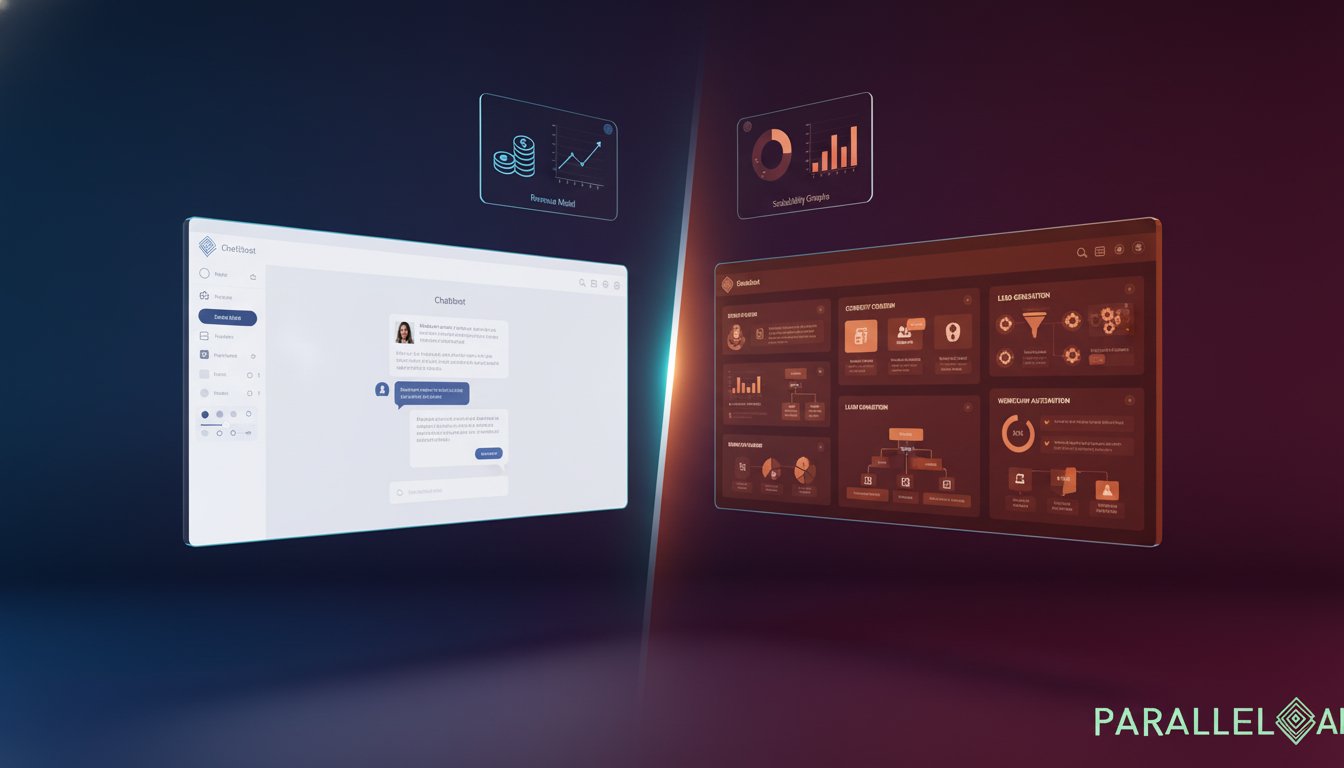
CustomGPT.ai and Parallel AI both offer white-label capabilities, but they represent two fundamentally different approaches to AI implementation. One platform specializes in rapid chatbot deployment with impressive customization options. The other provides a complete business automation ecosystem that consolidates content creation, lead generation, customer engagement, and workflow automation into a single branded solution. For agencies serving solopreneurs and micro-businesses, this distinction carries profound implications for both service delivery and profitability.
This analysis cuts through marketing messaging to examine what these platforms actually deliver in real-world agency environments. We’ll explore pricing structures that impact your margins, feature sets that determine your service offerings, and architectural differences that affect long-term scalability. Most importantly, we’ll identify which platform aligns with different agency business models—because the right choice depends entirely on how you plan to generate revenue from AI services.
The Fundamental Difference: Chatbot Specialist vs. Complete Automation Ecosystem
Before diving into feature comparisons, it’s essential to understand that CustomGPT.ai and Parallel AI solve fundamentally different problems for agencies.
CustomGPT.ai positions itself as a no-code platform for creating highly customizable AI chatbots and agents. The platform excels at one specific use case: deploying branded conversational AI that connects to your clients’ knowledge bases. With support for over 1,400 file formats and more than 100 data sources, CustomGPT.ai makes it remarkably easy to build sophisticated chatbots that can answer customer questions, provide support, and handle internal knowledge search. The three-step deployment process (connect data, customize AI, deploy) delivers on the promise of rapid implementation without coding expertise.
Parallel AI takes a radically different approach. Rather than specializing in chatbots, it provides a comprehensive AI automation platform that consolidates multiple business functions under one white-labeled roof. The platform integrates access to leading AI models (OpenAI, Anthropic, Gemini, Grok, DeepSeek) with content automation engines, lead generation tools, multi-channel customer engagement systems, and workflow automation capabilities. For agencies, this means you can offer clients a complete AI transformation rather than just a chatbot solution.
Why This Distinction Matters for Your Agency
The chatbot-specialist versus full-ecosystem distinction directly impacts your agency’s business model in three critical ways:
Revenue Potential: A chatbot-only solution typically supports a single service offering—conversational AI implementation. Parallel AI’s comprehensive approach enables agencies to offer content production services, lead generation automation, multi-channel customer engagement, workflow optimization, and strategic AI consulting—each representing separate revenue streams from the same client relationship.
Client Retention: Chatbot implementations often follow a project-based model: deploy the solution, provide initial support, then move to minimal maintenance. Comprehensive automation platforms create ongoing engagement opportunities as clients expand AI usage across different business functions, naturally leading to higher lifetime value and stickier client relationships.
Market Positioning: Agencies offering chatbot solutions compete in an increasingly crowded market where differentiation is challenging. Those providing complete AI transformation services position themselves as strategic partners rather than tactical vendors, commanding premium pricing and attracting more sophisticated clients.
According to industry research, agencies that offer comprehensive AI solutions report 3-4x higher annual contract values compared to those providing specialized chatbot services alone. This isn’t surprising—solving multiple business problems with a unified platform creates exponentially more value than addressing a single use case.
White-Label Capabilities: Branding Control and Client Experience
For agencies, white-label capabilities aren’t just about slapping your logo on someone else’s software. True white-labeling determines whether clients perceive the AI solution as your proprietary technology or recognize it as a third-party tool you’re reselling.
CustomGPT.ai’s White-Label Approach
CustomGPT.ai offers solid white-label capabilities focused specifically on chatbot customization. Premium plans ($499/month and above) remove all CustomGPT branding, allowing you to present the chatbot interface as your own technology. You can fully customize the AI agent’s appearance, behavior, and underlying language models to match your client’s brand identity.
The platform provides comprehensive control over the conversational experience, including custom responses, personality adjustments, and visual styling. For agencies whose primary service is deploying branded chatbots for customer support or knowledge search, these capabilities are more than adequate.
However, the white-labeling stops at the chatbot interface. If your clients need content automation, lead generation, or workflow tools, you’ll need to integrate additional platforms—each potentially with their own branding challenges and client-facing interfaces.
Parallel AI’s Comprehensive White-Label Ecosystem
Parallel AI approaches white-labeling from an entirely different angle: providing a complete branded AI platform that clients access through your custom domain and branded dashboard. Starting at just $99/month (the Entrepreneur tier), agencies gain access to white-label capabilities that extend across every platform function.
This means your clients interact with a unified branded experience whether they’re generating content, automating lead outreach, managing customer conversations, or building workflow automations. The platform includes custom branded dashboards, API access for deeper integrations, and the ability to position the entire solution as your proprietary technology.
For agencies building SaaS offerings or positioning themselves as AI platform providers, this distinction is crucial. Your clients never see Parallel AI’s branding—they see yours. More importantly, when they expand their AI usage from content creation to lead generation to customer service automation, they’re deepening their relationship with your platform, not discovering they need additional tools.
The Client Perception Factor
Here’s what most agencies discover after their first year with white-label AI: client perception of ownership directly correlates with pricing power and retention rates.
When clients perceive the AI solution as your proprietary technology, they’re less likely to price-shop, more willing to pay premium rates, and more dependent on your expertise for ongoing optimization. When they recognize the solution as a third-party tool you’re reselling, they start asking why they shouldn’t just buy it directly or find a cheaper implementation partner.
CustomGPT.ai’s focused white-labeling works well for agencies whose entire value proposition centers on chatbot deployment and customization. Parallel AI’s comprehensive white-labeling supports agencies building more ambitious businesses—those positioning themselves as full-service AI transformation partners or launching their own branded AI platforms.
Feature Comparison: Depth vs. Breadth
Let’s examine what each platform actually delivers for agencies and their clients.
CustomGPT.ai: Deep Chatbot Capabilities
CustomGPT.ai excels at everything related to conversational AI:
Data Integration Breadth: Support for over 1,400 file formats and 100+ data sources is genuinely impressive. Whether your client’s knowledge base lives in Google Drive, HubSpot, Shopify, Confluence, or proprietary systems, CustomGPT.ai can likely ingest and index it. This eliminates one of the most common chatbot deployment bottlenecks—getting data into a usable format.
Multilingual Support: With 92 languages supported, CustomGPT.ai enables global deployments without language barriers. For agencies serving international clients or businesses with multilingual customer bases, this capability is invaluable.
Customization Depth: The platform provides granular control over chatbot personality, response patterns, and behavior. You can fine-tune how the AI handles edge cases, manages conversation flow, and escalates to human agents. For agencies that differentiate on chatbot sophistication, these controls enable impressive customization.
Security and Compliance: SOC-2 Type II certification, GDPR compliance, and end-to-end encryption meet enterprise security requirements. The explicit guarantee that customer data isn’t used for model training addresses a critical concern for regulated industries.
Developer Resources: Comprehensive SDKs, APIs, and documentation support custom integrations and advanced implementations. For agencies with development capabilities, this enables sophisticated custom solutions built on CustomGPT.ai’s foundation.
What CustomGPT.ai doesn’t offer: content automation engines, lead generation tools, multi-channel outreach capabilities, workflow automation, or access to multiple AI models for different use cases. If your client needs these capabilities, you’re integrating additional platforms.
Parallel AI: Comprehensive Business Automation
Parallel AI takes the opposite approach—providing integrated capabilities across the full spectrum of business automation:
Multi-Model AI Access: Uncapped access to OpenAI, Anthropic, Gemini, Grok, and DeepSeek means agencies can select the optimal model for each use case. Content creation might use Claude for nuanced writing, while data analysis leverages GPT-4’s reasoning capabilities, and rapid responses use DeepSeek for cost efficiency. This flexibility eliminates the “one model fits all” limitation.
Content Automation Engine: The platform includes a complete content production system with strategy agents, copywriting agents, customer profile agents, and visual generation capabilities. Agencies can deliver 1-3 months of multi-platform content in minutes—a service offering that commands substantial recurring revenue.
Lead Generation and Outreach: Smart Lists and Sequences enable targeted lead identification and multi-channel outreach across email, social media, SMS, chat, and voice. For agencies serving B2B clients, this transforms Parallel AI from a support tool into a revenue-generation engine.
Omni-Channel Customer Engagement: Unlike CustomGPT.ai’s chatbot focus, Parallel AI deploys AI agents across voice calls, SMS, website chat, and messaging platforms while maintaining conversation context. Clients get unified customer engagement rather than channel-specific solutions.
Workflow Automation: The platform includes n8n integrations and workflow builders that automate repetitive business processes beyond customer interaction. This enables agencies to deliver operational efficiency improvements alongside customer-facing AI.
Knowledge Base Integration: Like CustomGPT.ai, Parallel AI connects to Google Drive, Notion, and Confluence, ensuring AI interactions are informed by company-specific knowledge. The difference is this knowledge base powers every platform function, not just chatbots.
What Parallel AI doesn’t emphasize: the same depth of chatbot-specific customization or the breadth of data format support that CustomGPT.ai provides. If your agency’s entire value proposition is building highly sophisticated, multilingual chatbots with exotic data sources, CustomGPT.ai’s specialization offers advantages.
The Integration Tax
Here’s the hidden cost that becomes painfully obvious six months into client deployments: every additional platform you integrate increases complexity, support burden, and potential failure points.
Agencies using CustomGPT.ai for chatbots typically integrate 3-5 additional tools to deliver comprehensive AI services: a content creation platform (Jasper, Copy.ai), a lead generation tool (Clay, Instantly.ai), a workflow automation platform (Make, Zapier), and often separate AI model subscriptions (ChatGPT Plus, Claude Pro). Each integration requires setup time, ongoing maintenance, troubleshooting when things break, and client training on multiple interfaces.
Parallel AI consolidates these functions into a single platform, dramatically reducing the integration tax. Agencies report saving 15-20 hours monthly just on platform management and troubleshooting when switching from multi-tool stacks to Parallel AI’s unified approach.
More importantly, this consolidation impacts client experience. When everything works through a single branded platform, clients perceive a cohesive solution. When they’re juggling multiple tools—even if white-labeled—the experience feels fragmented and the value attribution becomes unclear.
Pricing Analysis: How Platform Costs Impact Agency Margins
Pricing structures don’t just determine your platform costs—they fundamentally shape your agency’s profit margins and service packaging strategies.
CustomGPT.ai Pricing Structure
CustomGPT.ai offers three primary tiers:
- Standard Plan: $99/month with basic AI functionalities, suitable for small deployments
- Premium Plan: $499/month with advanced features, greater capacity, and white-label branding removal
- Enterprise Plan: Custom pricing for organizational needs
- Free Trial: 7-day trial for evaluation
For agencies, the Premium Plan at $499/month represents the realistic entry point for white-label deployments. The Standard Plan retains CustomGPT branding, which defeats the purpose of white-labeling for most agency use cases.
At $499/month per client (assuming you’re passing through costs), agencies need to charge $1,500-2,000/month minimum to maintain healthy margins after accounting for support, customization, and overhead. This pricing works well for mid-market and enterprise clients but can be challenging for the solopreneur and micro-agency market that represents Parallel AI’s sweet spot.
Parallel AI Pricing Structure
Parallel AI structures pricing across four tiers:
- Free Plan: Limited access for evaluation and small-scale use
- Entrepreneur Plan: $99/month with 2,000 questions/month, full white-labeling, and access to all platform features
- Business Plan: $297/month with 9,000 questions/month, 3 organizations, 9 collaborator seats, and API access
- Enterprise Plan: Custom pricing with unlimited access, SSO, on-premise deployment, and dedicated resources
The critical difference: Parallel AI includes white-label capabilities starting at $99/month, not $499/month. This pricing structure enables agencies to serve solopreneurs and micro-agencies profitably—the exact market segment most white-label platforms price out.
An agency using Parallel AI’s Entrepreneur Plan can charge clients $299-499/month for comprehensive AI automation services while maintaining 70-80% gross margins. As clients grow and need additional capacity, stepping up to the Business Plan at $297/month still supports premium pricing and healthy margins.
The Multi-Client Economics
Here’s where platform economics become particularly interesting for agencies:
With CustomGPT.ai’s model, each white-labeled chatbot deployment likely requires a separate Premium Plan subscription at $499/month (unless you’re consolidating multiple clients under an Enterprise Plan with custom pricing). If you’re serving 10 clients, your platform costs alone reach $4,990/month before any value-add services.
Parallel AI’s Business Plan at $297/month provides 3 organizations and 9 collaborator seats, allowing agencies to serve multiple smaller clients under a single subscription or provide comprehensive services to larger clients with team access. The economics scale much more favorably for agencies building diversified client portfolios.
For agencies targeting the solopreneur and micro-agency market specifically, this pricing difference is decisive. Your target clients have limited budgets and require multiple AI capabilities (content, leads, customer engagement) rather than just chatbots. Parallel AI’s pricing enables profitable service delivery to this market; CustomGPT.ai’s pricing pushes you toward enterprise clients who can afford premium chatbot implementations.
Security and Compliance: Enterprise Requirements
Both platforms take security seriously, but with different emphases.
CustomGPT.ai implements SOC-2 Type II certification, GDPR compliance, end-to-end encryption, and guarantees that customer data isn’t used for model training. For agencies serving healthcare, finance, or other regulated industries, these certifications are table stakes. The platform’s explicit data handling policies and comprehensive compliance framework support enterprise deployments where security documentation is mandatory.
Parallel AI matches these enterprise security standards with AES-256 encryption, TLS protocols, SOC-2 compliance, and similarly strict data handling policies. The platform adds single sign-on (SSO), domain verification, and on-premise deployment options for enterprise clients with specific security requirements.
The practical difference for agencies: both platforms meet the security requirements of most client engagements. The distinction emerges in deployment flexibility—Parallel AI’s on-premise option enables agencies to serve clients with data residency requirements or those who won’t consider cloud-based solutions.
Use Case Alignment: Which Platform for Which Agency Model?
The fundamental question isn’t which platform is “better”—it’s which platform aligns with your agency’s business model and target market.
When CustomGPT.ai Is the Right Choice
CustomGPT.ai excels for agencies with these characteristics:
Chatbot Specialization: If your agency’s core value proposition centers specifically on deploying sophisticated, highly customized conversational AI, CustomGPT.ai’s deep chatbot capabilities and extensive data source support provide genuine advantages. The platform’s 92-language support and granular customization enable differentiation that generic chatbot builders can’t match.
Enterprise Focus: Agencies primarily serving mid-market and enterprise clients with budgets supporting $2,000+ monthly engagements find CustomGPT.ai’s Premium Plan economically viable. These clients often need just one thing done exceptionally well—enterprise-grade chatbots—rather than comprehensive automation.
Technical Expertise: Agencies with development capabilities can leverage CustomGPT.ai’s SDKs and APIs to build sophisticated custom solutions. If you’re differentiating on technical implementation rather than business strategy, the platform’s developer resources enable advanced integrations.
Single-Function Excellence: For agencies whose strategic positioning emphasizes being the absolute best at one specific thing (conversational AI), CustomGPT.ai’s specialization supports that narrative better than a multi-function platform.
When Parallel AI Is the Right Choice
Parallel AI aligns with fundamentally different agency models:
Comprehensive AI Transformation: Agencies positioning themselves as strategic AI implementation partners rather than tactical chatbot vendors benefit from Parallel AI’s breadth. You can address content creation, lead generation, customer engagement, and workflow automation through a single branded platform, supporting the “complete transformation” narrative.
Solopreneur and Micro-Agency Market: If your target clients are solo consultants, freelancers, and micro-agencies (1-10 employees), Parallel AI’s pricing structure enables profitable service delivery where CustomGPT.ai’s economics don’t work. These clients need multiple AI capabilities but have limited budgets—exactly what Parallel AI addresses.
Recurring Revenue Models: Agencies building SaaS businesses or subscription-based service models benefit from Parallel AI’s comprehensive platform approach. Clients who start with content automation naturally expand into lead generation and customer engagement, creating organic upsell paths without introducing new platforms.
Operational Efficiency Focus: If your agency’s value proposition emphasizes reducing client overhead and consolidating their tech stack, Parallel AI’s “replace 8+ tools” positioning directly supports your message. You’re selling efficiency and simplification, not specialized chatbot sophistication.
White-Label SaaS Builders: Agencies launching their own branded AI platforms or software products need the comprehensive white-labeling and multi-function capabilities that Parallel AI provides from the $99/month tier.
The Real-World Implementation Reality
Beyond feature lists and pricing tables, what actually happens when agencies deploy these platforms with real clients?
CustomGPT.ai Implementation Experience
Agencies report that CustomGPT.ai delivers on its promise of rapid chatbot deployment. The three-step process (connect data, customize AI, deploy) genuinely works, and clients can have functional chatbots live within days. The extensive data source support eliminates most ingestion headaches, and the customization controls enable sophisticated conversational experiences.
The challenge emerges when clients ask the inevitable next question: “This chatbot is great—now can you help us automate our content production?” Or lead generation. Or customer outreach. Or workflow automation. Suddenly you’re introducing additional platforms, managing new integrations, and explaining why the comprehensive AI solution you sold them actually requires multiple disconnected tools.
Some agencies successfully position CustomGPT.ai as one component of a larger solution stack, integrating it with content tools, lead generation platforms, and workflow automation. This approach works but requires significant technical expertise and creates ongoing management complexity.
Parallel AI Implementation Experience
Agencies using Parallel AI report a different pattern: initial deployments take slightly longer because you’re implementing a more comprehensive platform, but client expansion happens organically within the same system. A client who starts with content automation discovers the lead generation tools, experiments with customer engagement agents, then requests workflow automation—all without leaving the platform.
This creates a virtuous cycle for agencies: each new capability the client adopts deepens platform dependency, increases monthly contract value, and strengthens the relationship. You’re not constantly introducing new tools; you’re helping clients discover additional capabilities of “their” platform (which they perceive as yours due to white-labeling).
The trade-off: Parallel AI requires more initial client education because you’re introducing a comprehensive platform rather than a single-function tool. Agencies need strong onboarding processes and client success capabilities to help clients realize the full platform value.
The Platform Ecosystem and Future-Proofing
One consideration that rarely appears in comparison articles but significantly impacts long-term agency success: platform development trajectory and ecosystem evolution.
CustomGPT.ai maintains focus on its core chatbot competency, steadily improving conversational AI capabilities, expanding data source support, and enhancing customization options. For agencies whose business model centers on chatbot excellence, this focused development ensures the platform continues serving their needs without feature bloat or direction changes.
Parallel AI’s roadmap emphasizes expanding the comprehensive automation ecosystem—adding new AI models, enhancing workflow capabilities, and deepening integrations. The platform’s multi-model approach means agencies automatically gain access to new AI capabilities (like DeepSeek R1) without migration or integration work.
From a future-proofing perspective, the question becomes: what’s more valuable for your agency long-term—deepening specialization in conversational AI or expanding capabilities across business automation functions?
Agencies betting on chatbots becoming increasingly commoditized might prefer Parallel AI’s breadth, reasoning that differentiation will come from comprehensive solutions rather than specialized implementations. Agencies believing that sophisticated conversational AI remains a sustainable competitive advantage might prefer CustomGPT.ai’s focused development.
Making the Decision: A Framework for Agency Leaders
Rather than declaring one platform “better,” let’s establish a decision framework based on your agency’s specific situation:
Choose CustomGPT.ai if:
– Your agency specializes specifically in conversational AI and chatbot implementations
– Your target clients are mid-market to enterprise organizations with $2,000+ monthly budgets
– You have development capabilities to build custom integrations and sophisticated solutions
– Your differentiation strategy emphasizes technical excellence in a specialized domain
– You’re comfortable managing multiple platforms to deliver comprehensive AI services
– Your clients primarily need customer support automation and knowledge base search
Choose Parallel AI if:
– Your agency positions itself as a comprehensive AI transformation partner
– Your target market includes solopreneurs, freelancers, and micro-agencies (1-10 employees)
– You’re building a subscription-based or SaaS business model
– Your differentiation strategy emphasizes simplification and tech stack consolidation
– You want to offer content creation, lead generation, customer engagement, and workflow automation through a single platform
– You’re launching a white-label AI platform as your own branded product
Consider CustomGPT.ai for chatbots, Parallel AI for everything else if:
– You have the technical expertise to manage multiple platform integrations
– Your client budgets support premium pricing for specialized solutions
– You’re comfortable with the complexity of maintaining a multi-platform stack
– Your clients explicitly need CustomGPT.ai’s specific advantages (1,400 file formats, 92 languages)
The honest truth: most agencies serving the solopreneur and micro-agency market will find Parallel AI’s economics, comprehensive features, and white-label pricing more aligned with their business model. Agencies serving enterprise clients with specific chatbot requirements may find CustomGPT.ai’s specialization valuable enough to justify the premium pricing and integration complexity.
The Bottom Line: Platform Choice as Strategic Decision
Choosing between CustomGPT.ai and Parallel AI isn’t a tactical decision about features—it’s a strategic decision about your agency’s market positioning, revenue model, and long-term competitive advantage.
CustomGPT.ai represents the specialist approach: do one thing (conversational AI) exceptionally well, with deep customization, extensive data support, and enterprise-grade security. For agencies built around chatbot expertise and serving clients who need sophisticated conversational solutions, this specialization creates defensible differentiation.
Parallel AI represents the generalist approach: consolidate comprehensive AI capabilities into a single white-labeled platform, enabling agencies to deliver complete business transformation rather than tactical chatbot deployments. For agencies serving solopreneurs and micro-agencies with limited budgets and diverse AI needs, this breadth creates more accessible and profitable service models.
The market has room for both approaches. Enterprise clients with complex conversational AI requirements will continue paying premium rates for specialized chatbot expertise. Solopreneurs and micro-agencies need affordable, comprehensive AI automation that addresses multiple business functions—and they need agency partners who can deliver that through a simple, branded platform.
Your decision should align with your agency’s strategic vision: Are you building a specialized consultancy that commands premium rates for technical excellence in a focused domain? Or are you building a scalable agency that democratizes AI access for underserved small businesses through comprehensive, affordable solutions?
Both paths lead to successful agencies. They just require different platforms to get there.
For most agencies targeting the solopreneur and micro-agency market that Parallel AI specifically serves, the choice becomes clear: comprehensive white-label automation starting at $99/month enables profitable service delivery to clients who need multiple AI capabilities but can’t afford $2,000+ monthly engagements. You can deliver transformative value, build recurring revenue, and position yourself as a strategic AI partner—not just another chatbot vendor.
Ready to explore how white-label AI automation can transform your agency’s service offerings? Schedule a demo to see how Parallel AI enables agencies to deliver enterprise-grade AI capabilities to solopreneurs and micro-agencies profitably—or start with a free trial to experience the platform’s comprehensive capabilities firsthand. The future of agency services isn’t about choosing between specialized tools—it’s about offering complete solutions that solve real business problems at accessible price points.
Related reading
- Top 10 White-Label AI Platforms Compared: The 2026 Guide to Building Your AI Business Without Code
- CustomGPT.ai vs Parallel AI: Which White-Label Platform Actually Delivers Complete Business Automation for Agencies in 2025?
- CustomGPT vs Parallel AI: Which White-Label Platform Actually Delivers Complete Business Automation Beyond Chatbots for Micro-Agencies in 2026?
- Botpress vs Parallel AI: Which White-Label Platform Actually Delivers Complete Business Automation for Agencies in 2025?