
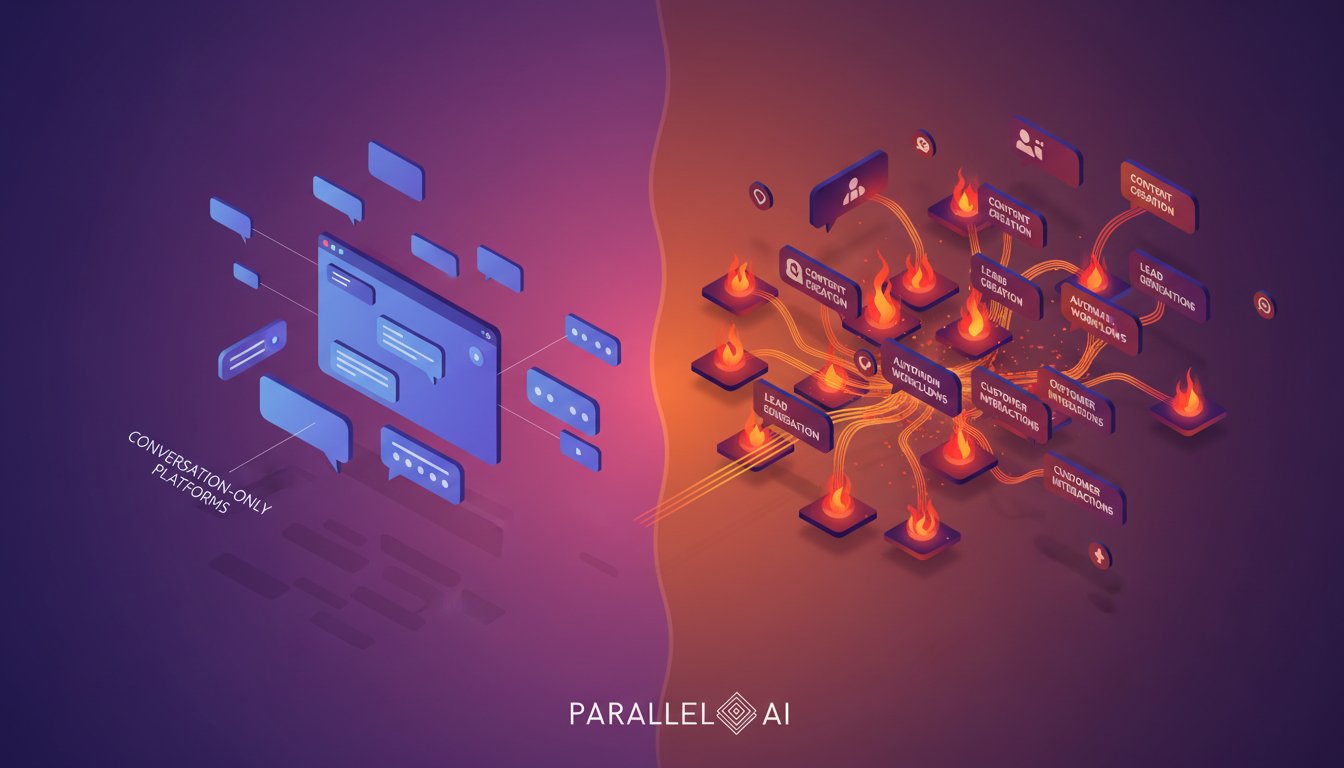
Choosing the right AI platform isn’t just about building better chatbots—it’s about fundamentally transforming how your agency operates, scales, and generates revenue. For solopreneurs and micro-agencies evaluating AI automation in 2025, the decision between specialized conversation design tools and comprehensive business ecosystems carries profound implications that extend far beyond initial feature comparisons.
Voiceflow has earned its reputation as a sophisticated conversational AI platform, enabling teams to design, test, and deploy voice and chat agents with impressive no-code capabilities. Parallel AI, meanwhile, positions itself as an all-in-one AI automation platform that consolidates content creation, lead generation, customer interaction, and workflow automation into a unified ecosystem. But which approach actually delivers transformative value for independent consultants and small agencies?
The answer depends less on feature checklists and more on a fundamental question: Are you building conversational experiences, or are you building a scalable business?
The Conversation-Only Platform Limitation Nobody Discusses
Voiceflow excels at what it’s designed to do—creating sophisticated conversational interfaces with granular control over dialogue flows, voice interactions, and chatbot experiences. For agencies whose entire service offering revolves around conversation design, this specialization offers genuine advantages. The platform provides robust tools for testing conversation pathways, managing dialogue states, and deploying branded chatbot experiences.
However, this specialization reveals a critical limitation when examined through the lens of complete agency operations: conversation design represents just one component of what modern service businesses need to scale profitably.
Consider the typical workflow for a marketing consultant serving SMB clients. Beyond customer service chatbots, they need to create blog posts, social media content, email campaigns, sales proposals, market research reports, and client presentations. They need to identify and qualify leads, conduct outreach across multiple channels, manage client knowledge bases, and automate repetitive workflows. They need analytics, reporting, CRM integration, and team collaboration tools.
Voiceflow handles the conversation component admirably. Everything else requires additional platforms—each with separate subscriptions, learning curves, integration challenges, and maintenance overhead.
The Hidden Economics of Multi-Tool AI Stacks
Let’s examine the real total cost of ownership for an agency attempting to match Parallel AI’s capabilities using Voiceflow plus supplementary tools:
Voiceflow Conversation Platform: $250-500/month (depending on volume and features)
Content Creation Platform (Jasper, Copy.ai): $199-499/month for team plans
Lead Generation & Enrichment (Clay, Apollo): $349-799/month for meaningful volume
Email & Multi-Channel Outreach (Instantly, Smartlead): $97-297/month
Knowledge Base Management (Notion, Confluence): $10-15/user/month
Workflow Automation (Zapier, Make): $99-299/month for adequate task volume
CRM & Client Management: $50-150/month
AI Model Access (ChatGPT Plus, Claude Pro): $40-60/month combined
Total Monthly Investment: $1,094-2,619/month
Parallel AI consolidates these capabilities into a unified platform at $99-499/month—representing potential savings of $995-2,120 monthly, or $11,940-25,440 annually. For micro-agencies operating on tight margins, this difference isn’t merely significant—it’s often the difference between profitability and operating at a loss.
But the financial impact extends beyond subscription costs. Each additional platform introduces hidden expenses: implementation time, team training, troubleshooting integration failures, managing separate billing cycles, navigating different support channels, and maintaining data consistency across disconnected systems.
Industry research indicates that managing multiple point solutions costs enterprises $100-200 per user annually in support and integration overhead alone. For a 5-person agency, that’s an additional $500-1,000 yearly—and solopreneurs bear this burden themselves through opportunity cost and cognitive load.
White-Label Economics: Where Platform Choice Defines Business Model
For agencies building AI services into their client offerings, white-label capabilities transform from nice-to-have features into fundamental business requirements. This is where the Voiceflow vs Parallel AI comparison reveals its starkest contrast.
Voiceflow offers white-label deployment options, enabling agencies to embed conversational agents under their own branding. This works effectively for agencies whose service packages center specifically on chatbot and voice agent development—a legitimate but narrow market segment.
Parallel AI’s white-label approach operates at a fundamentally different scale. Agencies can brand the entire platform—including content automation, lead generation, multi-channel customer engagement, workflow orchestration, and knowledge base management—as their own proprietary technology. Clients log into your branded portal, use your domain, receive emails from your company, and never know Parallel AI exists.
The revenue implications are substantial. Here’s how the economics compare:
Voiceflow White-Label Model (Conversation-Focused):
– Primary offering: Custom chatbot/voice agent development
– Typical project pricing: $3,000-8,000 one-time + $200-500/month maintenance
– Revenue model: Primarily project-based with small recurring component
– Scalability constraint: Limited to clients specifically needing conversational AI
– Margin challenge: Competing against other chatbot development services
Parallel AI White-Label Model (Complete Platform):
– Primary offering: Branded AI automation platform with content, leads, support, and workflows
– Typical subscription pricing: $497-1,997/month per client
– Setup fees: $1,500-5,000 one-time for professional onboarding
– Consulting services: $150-300/hour for custom automation and optimization
– Revenue model: High-margin recurring subscriptions + professional services
– Scalability advantage: Appeals to any business needing content, leads, or customer automation
– Base platform cost: $271-387/month (30% revenue share), leaving 30-70% margin
An agency with 15 white-label clients on Parallel AI charging conservative $697/month subscriptions generates $10,455 monthly recurring revenue with $6,165 in profit (59% margin). Add setup fees from 3 new clients quarterly ($2,500 each = $7,500) and ongoing consulting services ($2,000/month average), and total monthly revenue reaches $12,455 with $8,165+ in profit.
Replicating this business model with Voiceflow requires supplementing conversation capabilities with separate platforms for content, leads, and workflows—reintroducing the subscription fragmentation that white-labeling was meant to eliminate, or building these capabilities in-house at prohibitive development costs.
Integration Reality: Unified Context vs. API Gymnastics
Both platforms emphasize integration capabilities, but the architectural approaches differ fundamentally in ways that matter enormously for day-to-day operations.
Voiceflow provides integrations with major CRM systems (Salesforce, Zendesk, HubSpot), e-commerce platforms (Shopify), and data warehouses (Snowflake). For conversational AI use cases, these integrations enable chatbots to access customer data, retrieve order information, and update support tickets—essential functionality for sophisticated customer service automation.
However, these integrations operate within the conversation design paradigm. When your client needs a blog post written, you’re switching to a separate content platform. When they need lead enrichment and outreach sequences, you’re opening a different tool. When they request workflow automation connecting multiple systems, you’re configuring yet another platform.
Parallel AI’s integration architecture functions differently because the platform itself already consolidates the primary business functions agencies need. The knowledge base integration (Google Drive, Notion, Confluence) doesn’t just feed conversation agents—it informs content creation, enriches lead data, and provides context for every AI interaction across the platform.
The included n8n workflow automation instance enables connection to 1,000+ business tools, but critically, these workflows can leverage the unified data context already present in the platform. A single automation can pull information from your knowledge base, generate personalized content, enrich lead data, send multi-channel outreach, and update your CRM—all without switching platforms or managing data synchronization across disconnected systems.
For micro-agencies where the founder wears multiple hats, this architectural difference translates directly into time savings. Industry data shows that knowledge workers spend 19% of their time searching for information across fragmented systems. Consolidating business context into a unified platform reclaims those hours for revenue-generating activities.
AI Model Access: Specialized vs. Comprehensive Approach
Voiceflow’s strength lies in optimizing conversational experiences—dialogue flow management, voice synthesis quality, natural language understanding, and conversation testing. The platform integrates with leading AI models to power these conversational capabilities with impressive sophistication.
Parallel AI takes a different approach: uncapped access to every major AI model (OpenAI, Anthropic, Gemini, Grok, DeepSeek, Perplexity) with context windows reaching one million tokens. This isn’t about conversation design—it’s about giving users the flexibility to choose the optimal model for each specific task.
Writing thought leadership content? Claude excels at nuanced, sophisticated writing. Analyzing complex data sets? Gemini’s processing capabilities shine. Generating creative marketing copy? GPT-4 delivers. Conducting research with current information? Perplexity’s search integration provides an advantage.
For agencies serving diverse clients across multiple industries, this model flexibility prevents the common scenario where a single AI provider’s limitations constrain service quality. The subscription savings alone justify consideration: ChatGPT Plus ($20/month) + Claude Pro ($20/month) + Gemini Advanced ($20/month) = $60/month just for AI model access, before adding any business functionality.
Parallel AI includes comprehensive model access plus content automation, lead generation, customer engagement, and workflow orchestration starting at $99/month—less than what most professionals currently spend on standalone AI subscriptions that provide none of these business capabilities.
Content Automation: The Capability Gap That Defines Scalability
Conversational AI platforms like Voiceflow optimize for dialogue, not content production at scale. While you can theoretically use separate AI chat interfaces to generate content, this manual approach lacks the structured workflow, brand voice consistency, and multi-platform optimization that content-focused agencies require.
Parallel AI’s Content Engine represents a fundamentally different architectural approach, deploying specialized AI agents for distinct content functions:
Strategy Agent: Develops content strategies aligned with business goals, leveraging platform algorithms and industry best practices
Copywriting Agent: Produces high-converting copy using proven techniques while maintaining brand voice consistency
Customer Profile Agent: Creates detailed ICP definitions ensuring content resonates with target audiences
Visual Agent: Generates on-brand visuals without expensive photoshoots or designer dependencies
This orchestrated approach enables agencies to create 1-3 months of content in minutes—blog posts, social media across platforms, email campaigns, marketing copy, reports, and graphics—with brand voice consistency that manual AI chat interactions struggle to maintain.
The productivity impact is measurable: Parallel AI users report publishing 80+ content pieces monthly versus 10-15 before implementation, representing an 8x capacity increase without additional headcount. For solopreneurs competing against larger agencies, this capability transforms from efficiency gain to competitive necessity.
Voiceflow users seeking comparable content production capabilities must integrate separate platforms (Jasper, Copy.ai, Writer), reintroducing subscription costs, learning curves, and the brand voice inconsistency that results from training separate AI systems on different platforms with disconnected context.
Lead Generation & Sales Automation: The Missing Component in Conversation-Only Platforms
Conversational AI platforms excel at engaging leads once they’ve already expressed interest—answering questions, qualifying prospects, booking appointments. This represents the bottom of the sales funnel, where potential customers are already aware of your client’s offering.
Parallel AI’s Smart Lists and Sequences functionality addresses the entire lead lifecycle, from identification through conversion:
Smart Lists leverage advanced AI models to identify ideal prospects using criteria that think like top sales professionals—not just demographic filters, but behavioral signals, intent indicators, and contextual relevance.
Multi-Channel Sequences enable automated outreach across email, social media, SMS, chat, and voice with AI-powered personalization that adapts messaging based on prospect behavior and engagement patterns.
Lead Enrichment automatically gathers additional context about prospects, enabling more relevant conversations and higher conversion rates.
For consultants and agencies whose growth depends on consistent pipeline development, this capability difference is foundational. You can build the most sophisticated chatbot in the world, but if you lack leads to engage with it, the conversation optimization becomes academic.
Agencies using Voiceflow for conversational AI must supplement with separate lead generation platforms (Clay at $349-799/month, Apollo at $49-149/user/month, Instantly at $97-297/month). Each integration introduces data synchronization challenges, learning curves, and the perpetual question: “Which platform contains the current lead status?”
Parallel AI consolidates lead identification, enrichment, outreach, and conversation into a unified workflow where each component shares the same data context and knowledge base integration. A prospect identified through Smart Lists can be engaged through automated sequences, converted through AI chat or voice agents, and managed through the same platform—without data exports, imports, or synchronization.
Omni-Channel Customer Engagement: Beyond Chat Widgets
Voiceflow’s conversational design capabilities support both voice and chat interfaces across multiple deployment channels. For agencies focused specifically on customer service automation, this provides the technical foundation needed to build sophisticated support experiences.
Parallel AI’s omni-channel approach operates at a different architectural level. The platform deploys AI agents that maintain consistent context and brand voice across phone calls, SMS, website chat, email, and messaging platforms—not as separate conversation threads, but as a unified customer interaction that remembers everything regardless of channel.
This matters enormously for micro-agencies serving SMB clients who interact with customers across fragmented channels. A customer might ask a question via website chat, follow up by phone, and then send an email—three separate interactions that should feel like one coherent conversation.
Platforms optimized purely for conversation design treat each channel as a distinct deployment requiring separate configuration. Unified platforms treat channels as interchangeable touchpoints in a continuous customer relationship, automatically maintaining context across the entire interaction history.
For white-label agencies, this architectural difference affects client retention directly. Clients don’t evaluate chatbot sophistication in isolation—they assess whether their overall customer experience improved. Fragmented channel experiences with inconsistent context create customer frustration, regardless of how well-designed individual conversations might be.
The Implementation Timeline That Actually Matters
Platform selection guides typically focus on feature comparisons while glossing over the implementation reality that determines actual time-to-value. For solopreneurs and micro-agencies, lengthy deployment cycles represent not just delayed benefits but continued spending on existing tools during the transition.
Voiceflow’s no-code conversation design enables relatively rapid chatbot development for teams focused specifically on that capability. However, achieving complete business automation requires integrating multiple additional platforms—each with its own implementation timeline, learning curve, and configuration requirements.
Parallel AI’s white-label partners report launching branded platforms in 2.5-4 hours from signup to first client onboarded:
Initial Setup (15 minutes): Create white-label account, connect Stripe for billing, choose base subscription tier
Brand Customization (30 minutes): Upload logo and brand colors, configure custom domain, customize email notifications, add legal documents
Package Configuration (45 minutes): Create pricing tiers, toggle features for each package level, set markup and margins, write package descriptions
Testing & Quality Check (30 minutes): Create test client account, verify branding, test client experience, preview features, confirm billing flow
First Client Launch (1-2 hours): Onboard real client, send credentials, begin generating revenue
This compressed timeline becomes possible because the platform already integrates the capabilities agencies need—no waiting for API approvals, no configuring data synchronization between disconnected tools, no troubleshooting integration failures between platforms that were never designed to work together.
For agencies with clients already asking about AI capabilities, the difference between “we can have you up and running this afternoon” and “we’ll need 4-6 weeks to integrate our tech stack” often determines whether you win or lose the engagement.
Security, Compliance, and Enterprise Readiness
Both platforms recognize that security and compliance matter increasingly as AI systems handle sensitive business data. Voiceflow provides SOC-2 certification and GDPR compliance—essential table stakes for any platform serving enterprise customers.
Parallel AI matches these security standards (AES-256 encryption, TLS protocols, SOC-2 compliance) while adding deployment flexibility particularly relevant for agencies serving regulated industries: on-premise deployment options, API access for custom security implementations, single sign-on (SSO) integration, and explicit commitments that client data never trains AI models.
For micro-agencies competing for enterprise clients, these security capabilities enable positioning as a credible vendor despite small team size. The white-label branding combined with enterprise-grade security allows solo consultants to present capabilities typically associated with much larger service providers.
The Platform Decision That Defines Your Business Model
Choosing between Voiceflow and Parallel AI ultimately reflects a choice between business models, not merely feature preferences:
Voiceflow positions your agency as: A specialized conversational AI development service, building sophisticated chatbots and voice agents for clients with specific conversation design needs. Revenue primarily derives from project-based development work with maintenance retainers. Growth requires continuously landing new projects. Differentiation depends on conversation design expertise and creative implementation.
Parallel AI positions your agency as: A comprehensive AI automation partner, providing white-labeled platform access plus strategic consulting across content, leads, customer engagement, and workflow automation. Revenue primarily derives from recurring platform subscriptions plus high-margin professional services. Growth compounds through client retention and expanded usage. Differentiation depends on business transformation outcomes rather than specific technical implementations.
For solopreneurs and micro-agencies evaluating these options, ask yourself which business model aligns with your growth vision:
Do you want to build conversation experiences, or do you want to build a scalable service business that happens to leverage AI automation?
Do you want clients who need chatbots, or clients who need to transform how they create content, generate leads, and engage customers?
Do you want to master conversation design as a specialized skill, or do you want to consolidate the fragmented AI tools you’re already paying for into a unified platform you can offer clients under your own brand?
Do you want project-based revenue that requires constantly landing new engagements, or recurring subscription revenue that compounds as you add clients?
Making the Decision: A Framework for Platform Selection
Consider Voiceflow if:
- Your service offering centers specifically on conversational AI design and implementation
- Your clients’ primary need is sophisticated chatbot and voice agent development
- You have (or plan to hire) specialized conversation design expertise
- You’re comfortable managing multiple platforms for content, leads, and workflow automation
- Your revenue model is primarily project-based development work
- You’re serving clients whose budgets specifically allocate for conversation AI projects
Consider Parallel AI if:
- You need comprehensive business automation beyond conversation design
- Your clients need content creation, lead generation, and customer engagement plus conversations
- You’re currently paying for multiple AI tools you’d like to consolidate
- You want to offer white-labeled AI capabilities without building proprietary technology
- Your revenue model emphasizes recurring subscriptions plus professional services
- You’re looking to reduce your monthly AI tool spending while expanding capabilities
- You’re a solopreneur or micro-agency competing against larger service providers
- You want same-day implementation rather than weeks of integration work
The platforms serve fundamentally different use cases. Voiceflow excels at sophisticated conversation design for teams focused specifically on that discipline. Parallel AI consolidates the broader business automation capabilities that solopreneurs and micro-agencies need to scale profitably without expanding headcount.
The Bottom Line: Specialization vs. Consolidation
The Voiceflow vs Parallel AI comparison ultimately reflects the broader tension in AI automation between specialized best-of-breed tools and consolidated business platforms.
Specialization offers depth in specific capabilities—in Voiceflow’s case, sophisticated conversation design with granular control over dialogue flows and voice interactions. This depth matters tremendously if conversation design represents your core service offering and competitive differentiator.
Consolidation offers breadth across business functions—content automation, lead generation, omni-channel engagement, workflow orchestration, and yes, conversational AI—unified under a single platform with shared data context and knowledge base integration. This breadth matters tremendously if you’re building a scalable service business that needs multiple AI capabilities without managing multiple subscriptions, integrations, and learning curves.
For the specific audience of solopreneurs and micro-agencies in digital marketing, sales consulting, business strategy, and content creation, the evidence strongly favors consolidation. These professionals need content creation for client deliverables and marketing. They need lead generation to build pipeline. They need customer engagement across multiple channels. They need workflow automation to reclaim time from repetitive tasks. And yes, they need conversational AI—but as one component of comprehensive automation, not as the entirety of their AI strategy.
Parallel AI’s unified approach eliminates the subscription fragmentation, integration complexity, and cognitive overhead that result from assembling business automation capabilities from disconnected specialized tools. The platform delivers 8x content production capacity increases, $11,940-25,440 in annual tool consolidation savings, white-label revenue opportunities generating $310-610 profit per client monthly, and same-day implementation timelines that convert interested prospects into paying clients before their enthusiasm wanes.
Voiceflow remains an excellent choice for agencies whose entire business model centers on conversational AI development. For everyone else—the consultants, marketers, strategists, and service providers building scalable businesses leveraging AI automation across multiple functions—Parallel AI’s comprehensive platform approach delivers transformative value that specialized conversation tools simply cannot match.
The question isn’t which platform builds better chatbots. The question is which platform transforms your agency into the scalable, profitable, competitive business you’re working to build. For solopreneurs and micro-agencies seeking that transformation, the evidence points decisively toward comprehensive automation platforms that consolidate capabilities rather than fragment them.
Ready to see how unified AI automation transforms your agency operations? Schedule a demo to explore how Parallel AI’s white-label platform can replace your fragmented AI tool stack with a branded solution that generates recurring revenue while saving $1,000+ monthly in subscriptions.
Related reading
- Top 10 White-Label AI Platforms Compared: The 2026 Guide to Building Your AI Business Without Code
- Voiceflow vs Parallel AI: Which White-Label Platform Actually Delivers Complete Business Automation Beyond Chatbots for Micro-Agencies in 2026?
- Botpress vs Parallel AI: Which Platform Delivers Complete Business Automation Beyond Chatbots for Agencies in 2025?
- Botsonic vs Parallel AI: Which Platform Delivers Complete Business Automation Beyond Chatbots for Micro-Agencies in 2025?