
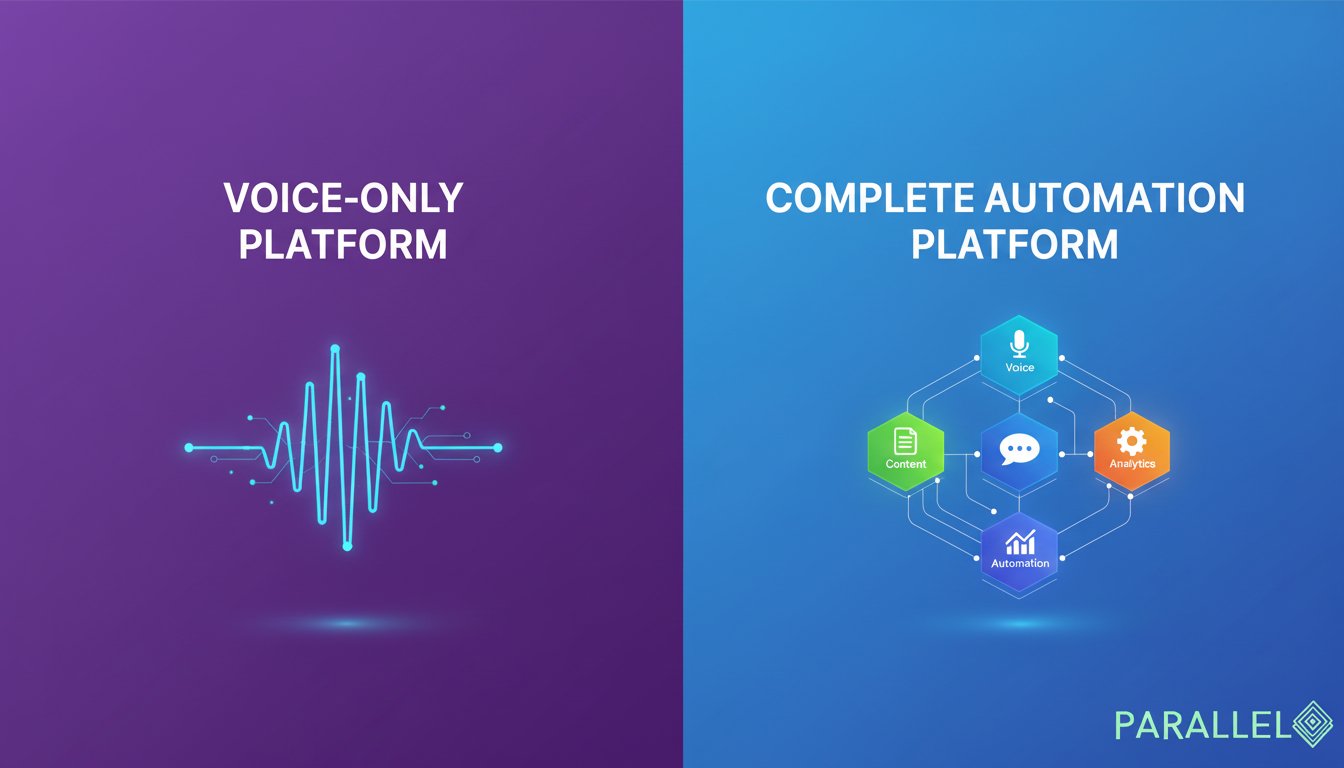
The specialized voice AI platform promised to revolutionize your agency’s service offerings. You attended the demo, saw the impressive call automation, and imagined all those billable hours you’d save for clients. Three months later, you’re managing five different tools: one for voice AI, another for content creation, a third for lead generation, a fourth for customer chat, and a fifth for workflow automation. Your “streamlined” tech stack now costs $2,000+ monthly and requires a flowchart to explain to clients.
This scenario plays out daily in agencies and consulting firms worldwide. The fundamental question isn’t whether voice AI works—it absolutely does. The real question is whether a voice-only platform can actually run your business, or if you need a comprehensive automation ecosystem that happens to include voice capabilities.
For solopreneurs and micro-agencies evaluating white-label AI platforms in 2025, this distinction matters more than most comparison articles acknowledge. Let’s examine what actually happens when you choose between a specialized voice platform like Retell AI and a comprehensive business automation platform like Parallel AI.
The Voice-First Platform Promise (And What It Actually Delivers)
Retell AI has built an impressive voice automation platform. Their core offering centers on creating, deploying, and monitoring AI voice agents at scale. For agencies specifically focused on voice automation services—call centers, appointment scheduling operations, or voice-based customer support—Retell AI delivers genuine value.
What Retell AI Does Well:
The platform excels at its primary function: voice automation. You get access to advanced speech synthesis, speech-to-text capabilities, and real-time call analysis. The white-label options through VoiceAIWrapper allow agencies to rebrand client portals, customize analytics dashboards, and maintain their brand identity throughout the voice experience.
Retell AI’s pricing starts at $0.07+ per minute for voice calls, with 60 free minutes included initially. For agencies running high-volume voice operations, this usage-based model provides cost predictability. The platform integrates with major voice AI providers like ElevenLabs, Vapi, and Bolna, offering flexibility in voice quality and capabilities.
The white-label implementation includes automated provisioning, multi-currency billing, and customizable client onboarding. Over 500 agencies currently use the platform, demonstrating genuine market adoption in the voice automation space.
Where the Specialized Approach Creates Problems:
Here’s what the sales materials don’t emphasize: voice automation represents one component of your agency’s service delivery. Your clients don’t just need phone calls automated—they need content created, leads qualified, proposals generated, customer interactions managed across multiple channels, and workflows orchestrated across their entire operation.
When you build your agency infrastructure on a voice-only platform, you inevitably face the integration challenge. Retell AI handles voice brilliantly, but what about:
- The content your clients need across their website, social media, and email campaigns?
- The lead qualification happening via chat, email, and SMS—not just phone calls?
- The knowledge base integration that should inform every customer interaction, not just voice?
- The workflow automation connecting your voice AI to CRM, project management, and other business systems?
Each of these capabilities requires additional platforms, additional subscriptions, additional integrations, and additional complexity. The “specialized excellence” that attracted you to a voice-first platform becomes a limitation when you’re trying to run an actual agency.
The Hidden Costs of Platform Fragmentation
Let’s examine the real economics of building your agency on specialized tools versus comprehensive platforms. This analysis goes beyond simple subscription costs to examine the total cost of ownership and operational complexity.
The Specialized Stack Reality:
An agency using Retell AI for voice automation typically also subscribes to:
- Voice AI: Retell AI ($0.07/minute + base subscription)
- Content Creation: Jasper or Copy.ai ($99-$600/month)
- Lead Generation: Clay ($149-$800/month)
- Email Outreach: Instantly.ai ($97-$297/month)
- Chat Automation: Intercom or Drift ($74-$2,500/month)
- AI Models: ChatGPT Plus, Claude Pro ($20-$40/month each)
- Workflow Automation: Zapier or Make ($29-$599/month)
- CRM Integration: HubSpot or similar ($45-$3,600/month)
Total monthly cost: $2,000-$8,500 depending on scale and feature requirements. But subscription costs represent only part of the equation.
Consider the operational overhead:
Integration Maintenance: Each platform connection requires setup, monitoring, and troubleshooting. When Retell AI updates their API, or your CRM changes authentication protocols, someone needs to identify the break, research the solution, and implement the fix. For agencies without dedicated technical staff, this means billable hours diverted to infrastructure maintenance.
Data Fragmentation: Customer information lives in your voice platform, content details exist in your writing tool, lead data sits in your prospecting system, and conversation history scatters across chat, email, and phone systems. Creating a unified view of customer interactions requires custom development or accepting incomplete context.
Client Confusion: Explaining your service delivery to clients becomes exponentially harder. “We use Retell AI for voice, Jasper for content, Clay for leads, and Zapier to connect everything” doesn’t inspire confidence. It signals complexity, fragility, and potential failure points.
Training Overhead: Each platform requires learning, documentation, and process development. New team members need training on six different systems. Client onboarding involves explaining multiple logins, interfaces, and workflows.
The hidden costs accumulate quickly. Agencies spending $2,000-$3,000 monthly on subscriptions often discover they’re spending another 10-15 hours weekly on integration maintenance, troubleshooting, and platform management. At typical agency billing rates ($150-$300/hour), that represents $6,000-$18,000 in opportunity cost monthly.
What Comprehensive Automation Actually Means
Parallel AI takes a fundamentally different approach: build one platform that consolidates the fragmented capabilities agencies actually need. Rather than excelling at voice automation and requiring separate tools for everything else, Parallel AI delivers voice capabilities within a complete business automation ecosystem.
The Unified Platform Architecture:
Parallel AI replaces the entire specialized stack with integrated capabilities:
Omni-Channel Communication: Voice AI, chat automation, SMS, email, and social media—all managed from a single platform with unified conversation context. When a customer calls, chats, or emails, your AI agents access the complete interaction history regardless of channel. This isn’t achieved through fragile integrations; it’s native platform functionality.
Content Automation Engine: Rapid content generation across articles, blogs, marketing copy, reports, social media, and more. The same knowledge base informing your voice AI also powers your content creation, ensuring consistency across every customer touchpoint.
Sales Prospecting and Outreach: Smart Lists and Sequences enable targeted lead generation with multi-channel outreach. Instead of paying separately for Clay and Instantly.ai, you manage prospecting, qualification, and outreach within the same platform handling your voice and content.
AI Knowledge Base Integration: Seamless connection to Google Drive, Confluence, Notion, and other knowledge repositories. Every AI interaction—whether voice, chat, email, or content generation—draws from the same unified knowledge foundation.
Multi-Model Access: Uncapped access to OpenAI, Anthropic, Gemini, Grok, DeepSeek, and Perplexity. Rather than managing separate ChatGPT and Claude subscriptions, you access every major AI model from one interface.
Enterprise Security: AES-256 encryption, TLS protocols, SOC-2 compliance readiness, and commitment that your data isn’t used for model training. These security features apply across all platform capabilities, not just voice.
The White-Label Advantage:
Both platforms offer white-label capabilities, but the scope differs dramatically. Retell AI’s white-label implementation focuses on voice automation branding. Parallel AI’s white-label offering encompasses your entire service delivery platform.
When you white-label Parallel AI, clients access a fully-branded platform handling:
– Voice and chat automation under your brand
– Content creation tools branded as your proprietary technology
– Lead generation and outreach systems appearing as your custom development
– Workflow automation and AI employees reflecting your agency methodology
This distinction matters enormously for positioning and pricing. Offering “our proprietary voice AI platform” generates different client perceptions than “our comprehensive AI automation platform that handles voice, content, leads, and customer engagement.”
Real-World Implementation: What Actually Happens
Theory matters less than execution. Let’s examine what implementation actually looks like for agencies choosing between these platforms.
Scenario: Mid-Size Marketing Agency (8 employees, 25 clients)
This agency provides content marketing, lead generation, and customer engagement services. They’re evaluating AI platforms to enhance service delivery and improve margins.
Retell AI Implementation Path:
Month 1: Deploy Retell AI for voice automation. Setup takes approximately 60 minutes as advertised. Voice agents handle appointment scheduling and basic customer inquiries effectively. Clients appreciate the 24/7 availability.
Month 2: Realize voice automation represents only 20% of client needs. Subscribe to Jasper for content creation ($600/month Pro plan). Integration between Retell AI and content platform requires Zapier ($299/month for necessary automation volume).
Month 3: Clients request lead generation capabilities. Add Clay ($800/month for required data enrichment features) and Instantly.ai ($297/month for email outreach volume). Build Zapier workflows connecting lead data to voice system and content platform.
Month 4: Chat automation becomes essential after clients report customers prefer chat for quick questions. Subscribe to Intercom ($499/month Starter plan). Attempt to maintain conversation context between voice (Retell AI) and chat (Intercom) through custom development.
Month 5: Integration maintenance consumes 12-15 hours weekly. One team member essentially becomes full-time integration specialist. Platform costs: $2,495/month plus $7,200/month in opportunity cost.
Month 6: Realize the specialized stack creates client confusion and limits scalability. Begin evaluating comprehensive platforms.
Parallel AI Implementation Path:
Month 1: Deploy Parallel AI at $387/month base cost (white-label tier). Setup takes 2-3 hours including brand customization, knowledge base integration, and initial AI employee configuration. Voice, chat, content, and lead generation capabilities available immediately.
Implement first client engagement: AI voice agent for appointment scheduling, chat automation for website inquiries, content automation for weekly blog posts, lead qualification sequences for sales pipeline.
Month 2: Expand implementation across 15 clients. White-label pricing allows charging $897/month per client for platform access. Revenue: $13,455/month. Platform cost: $387/month. Gross margin: $13,068/month.
Add professional onboarding services ($2,500 per client). Close 3 new clients this month. Additional revenue: $7,500.
Month 3: No integration maintenance required—all capabilities native to platform. Team focuses on client strategy and service delivery rather than technical troubleshooting.
Month 4: Launch advanced implementations using custom AI employees trained on client-specific knowledge bases. Charge $1,500-$2,000 per custom AI employee setup. Deliver unified customer experiences across voice, chat, email, and SMS from single platform.
Month 6: Serving 25 clients with platform subscriptions, generating $22,425/month recurring revenue. Platform costs: $387/month. Monthly profit from platform alone: $22,038. Additional revenue from setup fees, training, and consulting services.
The implementation difference isn’t marginal—it’s transformational.
The Client Perspective: What They Actually Experience
Agencies often evaluate platforms solely from their own operational perspective. The client experience matters equally, particularly for agencies building long-term relationships rather than transactional project engagements.
Client Experience with Specialized Stack:
“Our agency uses cutting-edge AI tools to deliver your project. For voice automation, we’ve implemented Retell AI. Your content comes from our Jasper integration. Lead generation runs through Clay, and we manage outreach via Instantly.ai. The chat automation uses Intercom, and everything connects through Zapier workflows.”
Client translation: “This sounds complicated, fragile, and expensive. What happens when one of these tools breaks? Why do I need to understand your technology choices?”
The fragmentation creates tangible client friction:
Multiple Logins: Clients needing visibility into different aspects of their engagement require separate logins for voice analytics, content dashboards, lead tracking, and chat reporting.
Inconsistent Branding: Even with white-label implementations, visual consistency across six different platforms proves difficult. Clients notice when the voice platform looks different from the content dashboard.
Context Gaps: Customer interactions fracture across systems. A customer calls (Retell AI), then chats (Intercom), then fills out a form (Clay). Each system contains partial interaction history. Agents lack complete context.
Explanation Overhead: Sophisticated clients ask reasonable questions: “Why do you need six different tools? Wouldn’t one comprehensive platform work better? Are you charging me for your tool complexity?”
Client Experience with Unified Platform:
“We’ve developed a proprietary AI automation platform that handles all aspects of your customer engagement. Voice, chat, email, content, lead generation—everything operates from one unified system that learns from every customer interaction.”
Client translation: “This agency has their technology sorted out. One platform means less complexity, better integration, and unified customer experiences.”
The unified approach creates client advantages:
Single Login: All analytics, reporting, and management accessible from one branded portal.
Consistent Branding: Every touchpoint reflects your agency brand and design language.
Complete Context: Every AI interaction draws from unified customer history across all channels.
Simplified Communication: Explaining your service delivery becomes straightforward because your infrastructure is straightforward.
Clients increasingly understand technology complexity. When you present fragmented infrastructure, they wonder whether they’re paying for your operational inefficiency rather than strategic value.
The Security and Compliance Reality
For agencies serving regulated industries—healthcare, finance, legal services—security and compliance capabilities aren’t optional features. They’re prerequisites for service delivery.
Both platforms emphasize security, but the implementation differs significantly:
Retell AI Security Approach:
Retell AI provides secure voice communication with encryption and enterprise-grade infrastructure. For voice automation specifically, the security measures prove adequate for most use cases.
The challenge emerges when your service delivery extends beyond voice. Each additional platform in your stack introduces additional security considerations:
- Different encryption standards across platforms
- Varying compliance certifications (SOC-2, HIPAA, GDPR)
- Multiple data processing agreements required
- Distinct security incident response procedures
- Separate vendor security assessments needed
Agencies serving healthcare clients discovered this painfully in 2024. Retell AI met HIPAA requirements for voice data, but the content platform didn’t. The chat automation system required separate Business Associate Agreements. The lead generation tool processed data through international servers requiring additional compliance review. What seemed like straightforward security validation became a six-month compliance project.
Parallel AI Security Approach:
Parallel AI implements enterprise-grade security across the entire platform: AES-256 encryption, TLS protocols, commitment against using customer data for model training, and architecture designed for SOC-2 compliance readiness.
This unified security posture simplifies compliance validation. One vendor security assessment covers voice, chat, content, lead generation, and workflow automation. One data processing agreement. One security incident response plan. One compliance audit.
For agencies scaling into regulated industries, this distinction determines whether security enables growth or blocks it.
Pricing Reality: Total Cost of Ownership Analysis
Published pricing tells only part of the financial story. Let’s examine total cost of ownership including subscriptions, implementation, maintenance, and opportunity costs.
Retell AI Total Cost Model (Agency with 20 Clients):
Direct Subscription Costs:
– Retell AI voice automation: $0.07/minute + base fee (estimate $400/month for moderate volume)
– Content creation platform: $600/month
– Lead generation platform: $800/month
– Email outreach platform: $297/month
– Chat automation platform: $499/month
– AI model subscriptions: $60/month
– Workflow automation: $299/month
– Total Monthly Subscriptions: $2,955
Implementation and Maintenance Costs:
– Initial integration development: 40 hours @ $150/hour = $6,000 one-time
– Monthly integration maintenance: 12 hours @ $150/hour = $1,800/month
– Platform management and troubleshooting: 8 hours @ $150/hour = $1,200/month
– Total Monthly Operational Cost: $3,000
Opportunity Costs:
– Time spent on integration rather than billable client work: 20 hours @ $200/hour = $4,000/month
Total Monthly Cost: $9,955
Annual Cost: $119,460 (plus $6,000 initial setup)
Revenue Potential:
Charging clients $497/month for voice automation services across 20 clients = $9,940/month revenue.
Net Monthly Result: -$15 (essentially break-even on platform costs alone)
Profit comes entirely from implementation services, consulting, and other value-added offerings—not from the platform itself.
Parallel AI Total Cost Model (Agency with 20 Clients):
Direct Subscription Costs:
– Parallel AI white-label platform: $387/month (base cost with 30% margin)
– Additional tools required: $0 (comprehensive platform)
– Total Monthly Subscriptions: $387
Implementation and Maintenance Costs:
– Initial setup: 3 hours @ $150/hour = $450 one-time
– Monthly platform management: 2 hours @ $150/hour = $300/month
– Integration maintenance: $0 (native capabilities)
– Total Monthly Operational Cost: $300
Opportunity Costs:
– Minimal time on platform management vs. client delivery: negligible
Total Monthly Cost: $687
Annual Cost: $8,244 (plus $450 initial setup)
Revenue Potential:
Charging clients $897/month for comprehensive AI automation across 20 clients = $17,940/month revenue.
Net Monthly Result: $17,253 profit
Annual Profit: $207,036
Additional revenue opportunities:
– Professional onboarding: $2,500 per client × 20 clients = $50,000 (one-time)
– Custom AI employee setup: $1,500 average × 40 setups/year = $60,000
– Monthly consulting and optimization: $1,000/month average = $12,000/year
Total Annual Revenue Potential: $329,036
Total Annual Costs: $8,244
Net Annual Profit: $320,792
The financial difference isn’t 10% or 20% better. It’s a complete transformation of agency economics.
Making the Strategic Decision: When Each Platform Makes Sense
Despite this analysis clearly favoring comprehensive automation platforms, specialized voice platforms aren’t wrong for every situation. Understanding when each approach makes sense prevents costly misalignment.
When Retell AI Makes Strategic Sense:
Pure Voice Automation Focus: If your agency exclusively delivers voice automation services—call center optimization, appointment scheduling systems, voice-based customer support—and has no intention of expanding into content, lead generation, or multi-channel engagement, Retell AI’s specialized excellence provides genuine value.
Existing Comprehensive Infrastructure: If you’ve already invested heavily in content platforms, CRM systems, and workflow automation, and need only voice capabilities to complete your offering, adding Retell AI as a specialized component makes sense. The integration complexity exists regardless at this point.
Voice Volume Justifies Specialization: If you’re processing millions of voice interactions monthly and need absolute optimization at the voice layer, specialized platforms sometimes offer performance advantages over comprehensive platforms.
Technical Team Available: If you employ dedicated integration engineers who thrive on building custom connections and optimizing complex technical stacks, the fragmentation becomes manageable.
When Parallel AI Makes Strategic Sense:
Building Agency Infrastructure from Scratch: If you’re establishing AI capabilities for the first time, starting with comprehensive automation prevents the fragmentation trap entirely.
Multi-Channel Service Delivery: If clients need voice, chat, content, lead generation, and customer engagement across multiple touchpoints, unified platforms eliminate integration complexity and provide superior client experiences.
Limited Technical Resources: If you lack dedicated integration engineers and need platforms that work reliably without constant maintenance, comprehensive automation platforms prove far more practical.
White-Label Revenue Model: If your business model involves reselling AI capabilities under your brand, offering a comprehensive platform creates significantly stronger positioning than offering specialized voice automation.
Scaling Quickly: If growth speed matters and you can’t afford months of integration development, platforms providing immediate comprehensive capabilities accelerate time-to-market dramatically.
Maximizing Margins: If profitability matters more than technical purity, the economics strongly favor platforms that consolidate costs while expanding billable capabilities.
For most agencies and consultancies, honest assessment reveals their needs align more closely with comprehensive automation than voice specialization.
The Migration Question: What If You’ve Already Committed?
Many agencies reading this analysis already invested in specialized platforms like Retell AI. The fragmentation exists. The integration complexity consumes resources. The question becomes whether migration justifies the transition costs.
Migration Decision Framework:
Calculate Current Total Cost: Don’t just count subscriptions. Include integration maintenance, opportunity costs, and client friction. Most agencies underestimate their true platform costs by 40-60%.
Assess Client Impact: Will migration improve or disrupt client experiences? Unified platforms typically enhance client satisfaction, but transition periods create temporary friction.
Evaluate Growth Trajectory: If you’re planning 2-3x growth over the next 18 months, your current infrastructure may not scale effectively. Migration during growth phases becomes exponentially harder.
Consider Opportunity Cost: Every month maintaining fragmented infrastructure represents another month not capitalizing on comprehensive platform advantages. The migration cost spreads across fewer months as you delay.
Test Before Committing: Most comprehensive platforms offer trial periods. Run parallel implementations on a subset of clients before full migration.
Practical Migration Path:
Month 1: Deploy comprehensive platform alongside existing infrastructure. Select 2-3 clients for parallel implementation.
Month 2: Evaluate client feedback, team efficiency, and technical performance. Refine implementation approach based on learnings.
Month 3: Migrate 25% of client base to comprehensive platform. Maintain existing infrastructure for remaining clients.
Month 4: Migrate another 40% of clients. Begin retiring specialized platform subscriptions as client migration completes.
Month 5-6: Complete migration of remaining clients. Fully retire fragmented infrastructure.
The migration investment—typically 30-50 hours of agency time—pays back within 2-3 months through reduced platform costs and operational efficiency.
The Uncomfortable Truth About Platform Decisions
The voice AI platform looked perfect in the demo. The features impressed you. The pricing seemed reasonable. The white-label capabilities checked the boxes.
Three months later, you’re managing six platforms, explaining integration complexity to frustrated clients, and spending 15 hours weekly on infrastructure maintenance instead of billable work. You’re not failing—you’re experiencing the predictable outcome of building business infrastructure on specialized components rather than unified platforms.
This isn’t about whether Retell AI delivers quality voice automation. It absolutely does. The question is whether specialized excellence in one capability serves your business better than comprehensive competence across all capabilities you actually need.
For most agencies and consultancies—particularly solopreneurs and micro-agencies without dedicated technical teams—the answer becomes clear when you examine total cost of ownership, client experience, operational complexity, and growth scalability rather than just comparing feature lists.
The platform decision you make today determines whether you spend the next year building integrations or building your business. Whether your margins expand or contract. Whether clients view you as a technology partner or a technology reseller. Whether scaling requires hiring engineers or simply adding clients.
Voice automation matters. But voice automation represents one component of comprehensive business automation. The question isn’t whether you need voice capabilities—it’s whether you acquire those capabilities through specialized fragmentation or unified automation.
The agencies thriving in 2025 aren’t those with the most specialized tools. They’re those with the most unified infrastructure enabling them to deliver comprehensive value without operational complexity. They’re running their businesses on platforms designed for business automation, not platforms designed for feature specialization.
Your technology stack should accelerate your growth, not complicate it. Choose accordingly.
Explore how Parallel AI consolidates voice, content, leads, and customer engagement into one comprehensive platform. Book a demo to see how agencies are replacing 6+ specialized tools with unified automation that actually scales.
Related reading
- Top 10 White-Label AI Platforms Compared: The 2026 Guide to Building Your AI Business Without Code
- Botpress vs Parallel AI: Which Platform Delivers Complete Business Automation Beyond Chatbots for Agencies in 2025?
- Botsonic vs Parallel AI: Which Platform Delivers Complete Business Automation Beyond Chatbots for Micro-Agencies in 2025?
- Botsonic vs Parallel AI: Which White-Label Platform Delivers Complete Business Automation Beyond Chatbots for Agencies in 2025?