
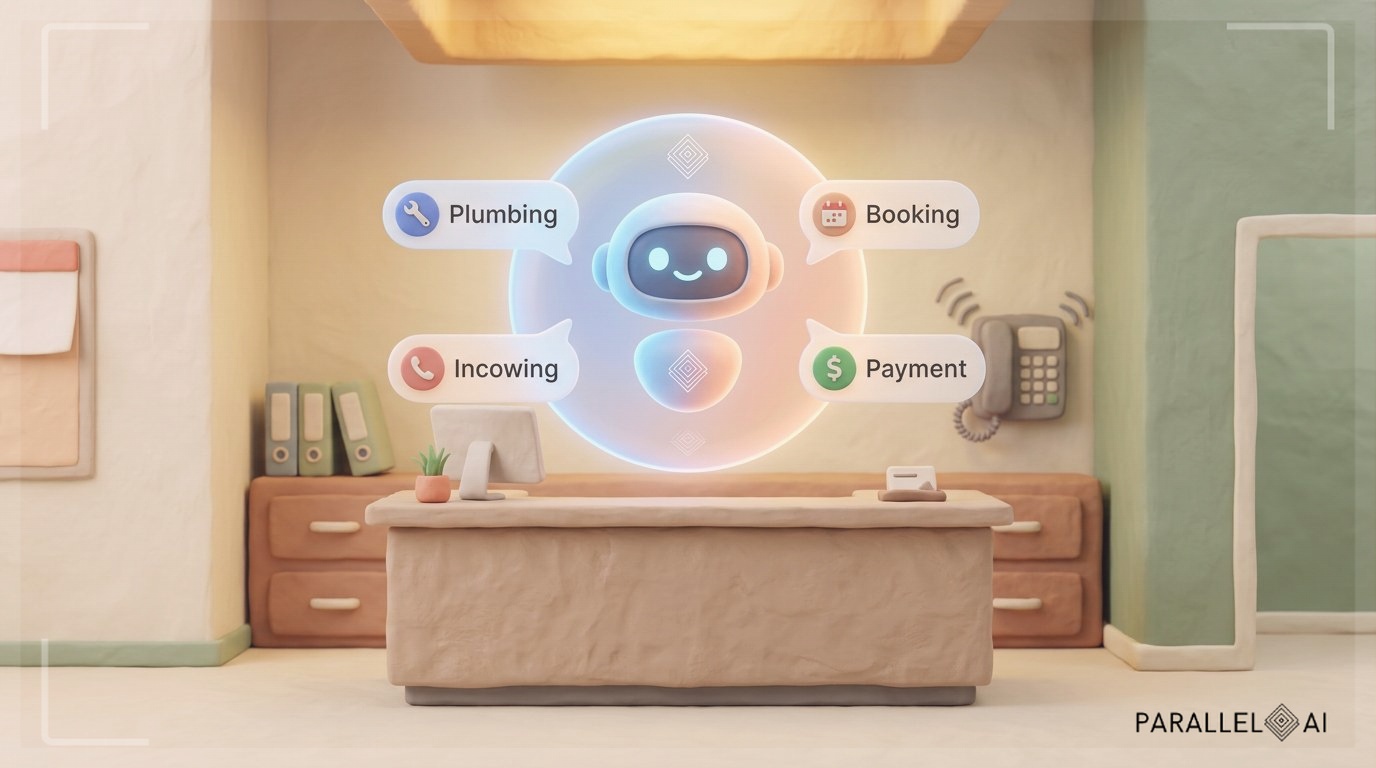
A plumbing company in Chicago missed 47 calls last Tuesday. Not because they didn’t want the business. Every technician was already on a job, the office manager was juggling three other tasks, and the only person near a phone was the new hire who didn’t know how to book an emergency visit. Those 47 missed calls represented roughly $14,000 in potential revenue, gone before anyone could so much as take a name and number.
This scene plays out across Main Street and mid-market businesses millions of times each day. Industry surveys show small and medium businesses miss up to 62% of inbound calls, and the average missed call costs a service business between $300 and $1,200 depending on the industry. In total, that’s billions in revenue lost to voicemail boxes that rarely get checked and callbacks that never happen.
AI receptionists have become the go-to solution. But the market has already splintered into dozens of narrow tools. Voice-only bots, appointment schedulers that need separate integrations, or conversational AI platforms that stop at answering and don’t know how to qualify a lead. For agency owners and growth-stage operators, the problem isn’t whether the technology works. It’s how to offer a consistent, brandable, and actually useful AI receptionist without stitching together five different subscriptions that still leave gaps.
Parallel AI’s white-label AI receptionist takes a fundamentally different approach. Instead of a standalone voice agent that you bolt onto your tech stack and hope it talks to your CRM, Parallel AI’s receptionist lives inside a unified platform that already handles lead generation, multi-channel outreach, content creation, and customer support. And yes, every bit of it can be rebranded and sold as your own.
In this comparison, we’ll walk through five capabilities that define a modern AI receptionist and show why Parallel AI delivers what dedicated point solutions cannot. You’ll see exactly how a white-label AI receptionist built on a consolidated AI platform skips the integration headaches, shortens time-to-revenue for agencies, and handles the messy reality of real customer conversations.
The Missed Call Crisis Is Bigger Than You Think
Most business owners dramatically underestimate how many calls they miss. Research from call-tracking platforms shows that even businesses with live front-desk staff fail to answer 20-30% of calls during business hours, and that number jumps past 70% after hours, on weekends, or when existing customers require attention simultaneously. A 2023 industry benchmark from CallRail found that 48% of first-time callers won’t leave a voicemail, and 80% of those who do hang up before leaving the kind of detailed message that actually converts into a booked job.
The financial math is brutal. For an HVAC company averaging 100 inbound calls per week at a 30% miss rate, that’s 30 lost opportunities every seven days. If even one-third of those calls represent a genuine booking worth $400, the monthly revenue leakage exceeds $5,000 from missed calls alone. Multiply that across a year, and the business leaves $60,000 on the table that an AI receptionist could capture with zero additional staff.
What Traditional Solutions Miss
Live answering services and offshore call centers have plugged these holes for decades, but they come with their own set of problems: inconsistent scripts, lack of calendar access, inability to answer technical questions, and a price tag that often starts at $200-$500 per month for limited minutes. Simple IVR systems give callers a menu but rarely solve anything. And while basic voice bots have existed since the early 2000s, they were brittle, menu-driven, and universally despised by anyone forced to navigate them.
Modern AI receptionists are a different species. They understand natural language, pull context from connected business systems, qualify leads against custom criteria before passing them to a human, and sound conversational enough that callers often don’t realize they’re speaking with software. But these capabilities demand more than a good text-to-speech engine. They require deep integration with the rest of the customer journey. That’s where most tools fall short.
What Makes a Modern AI Receptionist
Before comparing platforms, it’s worth defining exactly what an AI receptionist should do today. The job has evolved far beyond “answer the phone and take a message.” Businesses that deploy AI receptionists effectively expect the following five capabilities as a bare minimum.
Natural Conversation, Not Script Trees
A caller describing a broken water heater in their basement uses different words than someone scheduling a routine maintenance check. A capable AI receptionist follows context, asks clarifying questions, and adapts its responses based on what it hears, without forcing the caller down a pre-planned phone tree. That means the underlying model must handle real-world speech patterns, pauses, interruptions, and regional vocabulary.
Instant Access to Business Knowledge
The gap between a frustrating call and a productive one often comes down to information. When a customer asks “Are you certified for high-rise installations?” or “Do you accept my insurance?”, the AI needs an immediate, accurate answer. That requires a live connection to a knowledge base that the business controls, something most standalone AI voice agents lack.
Built-In Lead Qualification and Routing
Answering the phone is only half the battle. A qualified AI receptionist triages calls by urgency, service type, and customer value, then routes them accordingly. An emergency roof repair in a hail-prone ZIP code goes to the on-call team. A price-shopping caller who isn’t in a service area gets a polite decline with a brochure link. None of that works without a real-time understanding of lead scoring, service availability, and geography.
True Integration with the Tech Stack
If a caller books an appointment, that appointment must appear in the CRM, trigger a confirmation SMS, and update the technician’s schedule, all without manual intervention. AI receptionists that exist as isolated voice tools force the business to build complex middleware or rely on fragile Zapier chains. The modern expectation is that the receptionist plugs directly into tools like HubSpot, Salesforce, ServiceTitan, or a white-label CRM, and syncs instantly.
White-Label Ready for Agencies
For the thousands of agencies that manage client communication, a white-label AI receptionist is the difference between earning recurring revenue on a proprietary service and earning nothing at all. The ability to brand the agent, the dashboard, the SMS follow-ups, and the reporting as the agency’s own product, rather than forwarding clients to a third-party tool with someone else’s logo, transforms AI receptionists from a cost center into a high-margin revenue stream.
Head-to-Head: Parallel AI vs Leading Competitors
With those five criteria in mind, let’s see how Parallel AI stacks up against five of the most commonly evaluated AI receptionist and conversational voice platforms. We assessed each platform on natural conversation quality, knowledge base integration, lead qualification, ecosystem integration, and white-label readiness.
Parallel AI vs Air.ai
Air.ai offers voice AI agents that can handle inbound and outbound calls, and its recent focus on hyper-realistic voice cloning has attracted plenty of marketing buzz. However, Air.ai functions primarily as a standalone voice agent. It lacks native lead generation, a built-in CRM, and a content engine. For agencies, Air.ai does not offer true white-label; the platform’s branding remains visible to end clients, and there’s no way to resell the infrastructure as your own. Parallel AI embeds its AI voice agent within a full go-to-market suite (Smart Lists, Sequences, Content Engine, and Chat Agents) and allows complete white-label rebranding, from the URL to the interface colors to the client-facing dashboard. That means an agency can sell a proprietary “AI Receptionist + CRM + Marketing Automation” bundle under its own brand, not just a single voice feature.
Parallel AI vs Bland.ai
Bland.ai specializes in programmable phone agents, with a strong developer API and flexible call flow configuration. It’s a capable tool for businesses that want to build custom voice applications and have the engineering resources to integrate them with existing systems. But Bland.ai intentionally stays narrow: it’s a voice platform, not a business automation platform. There’s no native knowledge base connector for Google Drive or Notion, no integrated lead generation, and no white-label agency console. For a marketing agency serving 30 local service businesses, Bland.ai requires building and maintaining 30 separate integrations, something that erodes margins and slows time-to-value. Parallel AI’s white-label AI receptionist runs on the same infrastructure as its Smart Lists and Sequences, meaning the receptionist qualifies leads from a prospect database of 200 million contacts and routes them directly into multi-channel nurture campaigns, all under the agency’s brand.
Parallel AI vs GoHighLevel
GoHighLevel is the closest competitor in terms of white-label breadth, and many agencies already use it for CRM, pipeline management, and marketing automation. Its recent AI voice additions, branded as “Conversational AI,” extend the platform into phone interactions. But GoHighLevel’s voice AI remains a bolt-on module rather than a deeply integrated, context-aware component of the platform. The AI receptionist cannot pull live answers from a business’s knowledge base in the same way Parallel AI’s native Knowledge Base integration does (ingesting Google Drive docs, Notion pages, and Confluence articles). Also, GoHighLevel’s white-label AI pricing often requires high-tier plans and additional per-minute charges that can become unpredictable as call volumes scale. Parallel AI’s Business plan at $297 per month includes uncapped access to voice and chat agents, meaning agencies don’t have to meter minutes or fear unexpected overages when a client launches a seasonal campaign.
Parallel AI vs Dialpad Ai
Dialpad Ai is a strong option for enterprise teams already using Dialpad as their primary phone system. Its agent assist and real-time transcription add value to live sales and support calls. However, Dialpad Ai is designed to augment human agents, not to replace them as a standalone AI receptionist. It doesn’t provide a fully autonomous voice agent that can field inbound calls, qualify leads, and book appointments while the business is closed. It also doesn’t offer white-label capabilities; Dialpad’s platform remains branded, and agencies can’t resell it to clients. Parallel AI’s voice agents are built for fully autonomous operation, 24/7/365, and can be white-labeled down to the domain, color palette, and email templates, giving agencies complete control over the client experience.
Parallel AI vs Numa
Numa (formerly known as Clerk Chat) focuses on AI-powered business texting and lightweight voice features. It’s a solid choice for companies whose primary need is SMS automation, with voice as a secondary capability. But Numa’s voice feature set is limited; it lacks the deep lead qualification, knowledge base integration, and multi-channel orchestration that Parallel AI provides. For a service business that needs to answer calls, text confirmations, and then follow up with an email campaign all from the same platform, Numa requires additional tools that Parallel AI already includes. And critically, Numa does not offer a white-label infrastructure that agencies can package and resell, a dealbreaker for the agency audience that Parallel AI serves.
The pattern is clear: dedicated voice tools do one thing reasonably well, but they don’t solve the integration problem. Consolidation platforms that treat the AI receptionist as one part of a unified revenue automation system, with white-label DNA, deliver more value per dollar, faster agency launches, and fewer abandoned calls that fall through the cracks.
Why White-Label Changes the Economics for Agencies
For the agency owner who currently charges $500-$1,500 per month for lead generation and marketing retainers, adding an AI receptionist is not a feature upgrade. It’s a price increase justification. Clients who understand that missed calls cost them real money will happily pay a premium for a service that captures those calls automatically.
From Cost Center to Profit Center
When an agency buys a standalone AI voice tool, they typically pay per minute or per seat, then pass the raw cost to the client with a modest markup. Margins stay thin. When that same agency deploys Parallel AI’s white-label receptionist, they’re not selling a tool. They’re selling a proprietary service. The agency sets the pricing, bundles the receptionist with CRM access, content creation, or lead gen, and retains 100% of the margin above the platform cost. A typical agency using Parallel AI’s white-label infrastructure has reported saving $1,500 per month on separate AI subscriptions while adding $3,000-$5,000 in new monthly recurring revenue from AI receptionist services alone.
Launch Speed: Days, Not Months
Building a custom AI receptionist from scratch requires hiring a conversational AI designer, a voice UX expert, and a full-stack engineer. That’s a minimum five-figure investment and a six-month timeline. With Parallel AI, agencies can white-label the entire platform, configure client-specific voice agents using a drag-and-drop agent builder, connect each client’s Google Drive or Notion knowledge base, and start answering calls within a week. The go-to-market acceleration is dramatic, and the technical risk approaches zero.
The Consolidation Advantage: An AI Receptionist That Knows Everything Else
Parallel AI’s AI receptionist doesn’t operate in a vacuum. It draws from the same Smart Lists that populate lead databases, the same Knowledge Base that powers content generation, and the same Sequences that handle follow-up emails and SMS. This means that when a prospect calls, the receptionist isn’t just taking a message. It’s checking the CRM to see if that number already exists, logging the call outcome with full context, and triggering an instant follow-up text with a link to schedule if the prospect wasn’t ready to book. That closed-loop automation, from first ring to follow-up nurture, is impossible with isolated voice tools.
One Platform, One Invoice, No Compromises
Businesses that try to replicate Parallel AI’s functionality with point solutions end up buying five to ten separate subscriptions: a voice agent, a lead database, an SMS tool, an email sequencer, a content generator, a chatbot widget, and a scheduling link provider, plus a developer to wire them all together. The result is a fragile, expensive stack that breaks whenever one vendor updates an API. Parallel AI condenses all of that into a single platform, priced from $99 per month for solopreneurs to $297 per month for full go-to-market teams, with enterprise plans for custom deployments. When you add the white-label capability, the business case becomes difficult to argue against.
The AI receptionist market is maturing, and standalone tools will continue to improve. But for companies that want an AI receptionist that doesn’t just answer calls but actually connects to the entire customer journey, and for agencies that want to sell that capability as a branded service, Parallel AI’s consolidated, white-label approach is the smarter long-term bet. It replaces the missed-call anxiety with a system that answers, qualifies, books, and follows up, all while wearing your logo.
Ready to see a white-label AI receptionist that does more than pick up the phone? Start your free trial at web.parallellabs.app/signup and launch your first branded voice agent today. No credit card required, no minute meters, no branding you can’t make your own.