
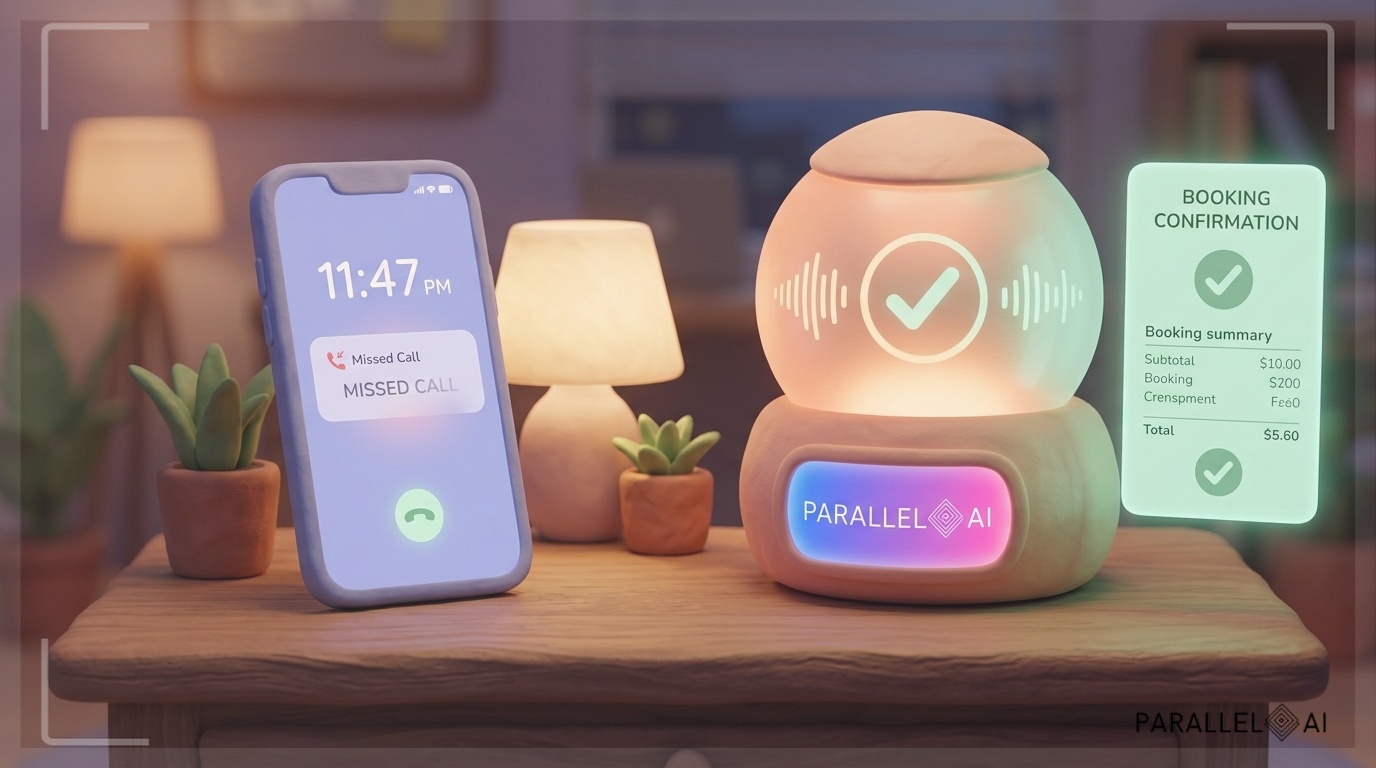
Picture this: it’s 11:47 PM on a Tuesday, and a potential client is ready to book your highest-tier service. They call your number. It rings. And rings. Then voicemail. By morning, they’ve already signed with a competitor who picked up automatically, intelligently, and without a human in sight.
This isn’t a rare scenario. According to Harvard Business Review, 90% of inbound calls go unanswered by traditional small businesses during off-hours — a direct, measurable revenue leak that compounds every single day. Businesses that have deployed AI receptionists are cutting customer wait times by an average of 78% while handling 3x more simultaneous inquiries than human staff (MIT Technology Review).
The AI receptionist market has matured fast. What started as basic voicemail automation has evolved into sophisticated, multi-modal voice agents capable of booking appointments, qualifying leads, routing complex calls, and syncing with your CRM in real time. But not all AI receptionist platforms are built equally, and the differences between them can mean the gap between a lead captured and a lead lost.
This guide breaks down the top AI receptionist platforms, compares them head-to-head, and shows you exactly why Parallel AI’s white-label AI receptionist solution outperforms the fragmented competition — whether you’re a growing business, a digital agency, or an entrepreneur building your own AI-powered service offering.
What Makes a Great AI Receptionist?
Before comparing platforms, it’s worth understanding what separates a great AI receptionist from a glorified voicemail bot.
Core Capabilities That Matter
The best AI receptionists share a common set of capabilities that go far beyond simply answering calls:
- 24/7 availability across voice and text channels without degradation in quality
- Natural language understanding that handles accents, interruptions, and complex queries
- Real-time knowledge retrieval from your business data, not static scripts
- CRM and calendar integration to book, reschedule, and qualify without human intervention
- Multi-channel routing that transfers intelligently based on intent, urgency, or caller history
- Enterprise-grade security with AES-256 encryption and explicit data privacy guarantees
- White-label capability for agencies building scalable client offerings
Most platforms on the market check two or three of these boxes. Very few check all of them. And almost none offer the ability to rebrand and resell the entire solution as your own.
The White-Label Opportunity Most Platforms Ignore
Here’s what the mainstream AI receptionist conversation consistently misses: the white-label opportunity. White-label AI solutions are projected to grow by 45% annually as agencies shift from service delivery to productized SaaS offerings (SaaS Capital). Yet the majority of AI receptionist platforms are consumer-facing tools with no reseller infrastructure.
For agency owners, that’s a massive gap. And a massive opportunity.
Top AI Receptionist Platforms Compared
Let’s look at the leading platforms in this space, what they do well, where they fall short, and who they’re best suited for.
1. Parallel AI — Best for White-Label, Multi-Model, and Enterprise Deployments
What it is: Parallel AI is an all-in-one AI automation platform that includes a fully configurable AI receptionist as part of its omni-channel agent suite. Unlike standalone receptionist tools, Parallel AI’s voice agents are powered by multiple leading AI models — OpenAI, Anthropic (Claude), Google Gemini, Grok, and DeepSeek — with intelligent routing between them based on query complexity.
Standout features:
– Multi-model routing: Automatically selects the best AI model for each interaction, improving accuracy and reducing hallucinations
– 1M token context windows: Remembers every client preference, past interaction, and business detail without repeating questions
– Live knowledge base sync: Pulls real-time answers from Google Drive, Notion, Confluence, and custom databases, not static scripts
– White-label branding: Agencies can fully rebrand the platform, including custom domains, logos, and client-facing dashboards
– AES-256 encryption + TLS: Enterprise-grade security with a clear commitment to never training on your data
– Omni-channel continuity: Voice, SMS, email, and chat conversations share context, so customers never have to repeat themselves
– CRM and calendar integration: Books appointments, qualifies leads, and syncs to your existing tech stack in real time
Pricing: Ranges from a free introductory plan to scalable enterprise packages. Agencies using the white-label tier generate recurring revenue by reselling the platform under their own brand.
Best for: Digital agencies, SaaS entrepreneurs, and growth-stage businesses that need a unified platform, not just an answering service.
The gap others miss: No other platform in this comparison offers true multi-model AI routing combined with white-label reseller infrastructure and real-time knowledge base integration. Parallel AI is the only solution where your AI receptionist gets smarter as your business data grows.
2. Smith.ai — Best for Human-AI Hybrid Services
What it is: Smith.ai combines live human agents with AI-assisted call handling, offering a hybrid model for businesses that aren’t ready for fully automated receptionists.
Strengths:
– Strong human fallback for complex or sensitive calls
– Good integration with popular CRMs like HubSpot and Salesforce
– Spam call filtering and lead qualification built in
Weaknesses:
– Higher per-call pricing due to human agent involvement
– No white-label or reseller options
– Limited to English-language interactions
– AI capabilities are supplementary, not primary, with no multi-model routing
– No real-time knowledge base sync from tools like Notion or Google Drive
– Data is processed through third-party human agents, raising privacy considerations
Best for: Businesses that want a safety net of human agents and are less concerned about cost efficiency or scalability.
vs. Parallel AI: Smith.ai’s human-hybrid model creates a pricing ceiling that compounds at scale. Parallel AI’s fully automated, multi-model AI eliminates per-call costs and scales without adding headcount or per-minute fees.
3. Signalwire STACK / Bland AI — Best for Developer-First Voice Automation
What it is: Bland AI and SignalWire’s STACK platform cater to developers building custom voice automation pipelines, offering powerful APIs and programmable call flows.
Strengths:
– Highly customizable call logic for technical teams
– API-first architecture allows deep integration
– Competitive per-minute pricing for high-volume use cases
Weaknesses:
– Significant technical expertise required for setup and maintenance
– No out-of-the-box white-label solution
– No unified content, lead generation, or CRM automation outside of calls
– Single-model AI with no multi-model routing
– Implementation timeline of weeks to months for non-technical businesses
– Limited knowledge base integration without custom development
Best for: Developer teams building proprietary voice applications.
vs. Parallel AI: Bland AI requires engineering resources that most agencies and SMBs simply don’t have. Parallel AI delivers the same technical depth through a no-code interface, with multi-model intelligence and white-label capability built in from day one.
4. Voiceflow — Best for Chatbot-First Teams Expanding to Voice
What it is: Voiceflow is a visual conversation design platform that lets teams build voice and chat agents through a drag-and-drop interface.
Strengths:
– Intuitive visual builder with no-code design
– Good for prototyping and testing conversation flows
– Active community and template library
Weaknesses:
– Voice capabilities are secondary to chat-first design
– No built-in multi-model AI routing
– White-label options are limited and require enterprise contracts
– No native knowledge base sync with Google Drive or Notion
– Pricing becomes expensive for production deployments at scale
– No integrated lead generation, CRM sync, or omni-channel continuity
Best for: Product teams prototyping AI-driven conversation experiences.
vs. Parallel AI: Voiceflow is a design tool. Parallel AI is a business automation platform. The gap becomes obvious when you need real-time data retrieval, multi-channel context, and revenue-generating white-label infrastructure — capabilities Voiceflow simply wasn’t built to provide.
5. Synthflow — Best for Simple AI Phone Agent Deployment
What it is: Synthflow is a no-code platform focused specifically on deploying AI phone agents for appointment booking and lead qualification.
Strengths:
– Fast deployment for basic inbound and outbound call handling
– Templates for common use cases (dental offices, real estate, etc.)
– Simple pricing for straightforward call volume
Weaknesses:
– Limited to a single AI model with no routing intelligence
– No white-label capability for agency resellers
– Static script-based responses without real-time knowledge retrieval
– No omni-channel continuity (voice only)
– Context windows significantly smaller than Parallel AI’s 1M token capacity
– No integrated content creation, lead generation, or CRM automation suite
Best for: Small businesses with simple, high-volume appointment booking needs.
vs. Parallel AI: Synthflow handles the basics well, but hits a ceiling quickly. When your AI receptionist needs to pull answers from your knowledge base, route to the best model for complex queries, or be resold under your agency’s brand, Synthflow can’t deliver.
Feature Comparison Matrix
| Feature | Parallel AI | Smith.ai | Bland AI | Voiceflow | Synthflow |
|---|---|---|---|---|---|
| Multi-Model AI Routing | ✅ Yes | ❌ No | ❌ No | ❌ No | ❌ No |
| White-Label Reseller | ✅ Yes | ❌ No | ❌ No | ⚠️ Limited | ❌ No |
| 1M Token Context Window | ✅ Yes | ❌ No | ❌ No | ❌ No | ❌ No |
| Real-Time Knowledge Base Sync | ✅ Yes | ❌ No | ⚠️ Custom Dev | ❌ No | ❌ No |
| Omni-Channel (Voice+SMS+Chat) | ✅ Yes | ⚠️ Partial | ❌ No | ⚠️ Partial | ❌ No |
| AES-256 Encryption | ✅ Yes | ⚠️ Partial | ⚠️ Partial | ⚠️ Partial | ⚠️ Partial |
| No Data Training Guarantee | ✅ Yes | ❌ No | ❌ No | ❌ No | ❌ No |
| CRM + Calendar Integration | ✅ Yes | ✅ Yes | ⚠️ API Only | ⚠️ API Only | ⚠️ Limited |
| No-Code Setup | ✅ Yes | ✅ Yes | ❌ No | ✅ Yes | ✅ Yes |
| Integrated Lead Generation | ✅ Yes | ❌ No | ❌ No | ❌ No | ❌ No |
How to White-Label an AI Receptionist with Parallel AI
For agency owners, this is where the conversation gets transformative. “Agencies aren’t just using AI receptionists anymore — they’re productizing them. The real margin expansion happens when you rebrand a unified platform and sell it as your own,” notes Marcus Lin, Founder & CEO of Digital Scale Partners.
Parallel AI’s white-label infrastructure makes this possible in days, not months.
Step 1: Configure Your Branded Platform
Set up your agency’s custom domain, logo, and color scheme within Parallel AI’s white-label dashboard. Clients see your brand, not Parallel AI’s.
Step 2: Build Client-Specific AI Receptionists
Use Parallel AI’s no-code agent builder to configure call flows, knowledge bases, and routing logic tailored to each client’s business. Connect their Google Drive or Notion workspace for real-time data retrieval.
Step 3: Set Your Pricing and Package It
Build a recurring revenue model. Agencies typically package AI receptionist services at $500–$2,500/month per client, creating predictable, scalable income without additional headcount.
Step 4: Onboard Clients in Under 30 Minutes
Parallel AI’s intuitive setup means most clients are live within a single session. No engineering team required. No months-long implementation timeline.
Step 5: Scale Across Your Client Base
Every new client you onboard uses the same infrastructure. Your margins improve with every new account, without the cost ceiling that human-hybrid or developer-first platforms impose.
The Real ROI of Switching to Parallel AI
Here’s what the numbers actually look like for a typical growth-stage agency or business:
Current fragmented stack (average):
– AI receptionist tool: $199/month
– CRM sync add-on: $79/month
– Knowledge base tool: $49/month
– Content automation: $149/month
– Lead generation tool: $199/month
– Total: $675/month for disconnected tools
Parallel AI unified platform:
– All of the above, consolidated: Starting significantly lower, scaling predictably
– White-label reseller revenue: $500–$2,500/client/month
– Tool consolidation savings: 40–60% reduction in software spend
– Time saved on tool-switching and workflow management: 10–15 hours/week
Over 68% of businesses now require end-to-end encryption and explicit “no model training” guarantees before deploying AI voice tools (CISA). Parallel AI’s AES-256 encryption and ironclad data privacy commitment address this requirement out of the box — a selling point that accelerates enterprise client conversion for agency partners.
The Verdict: Which AI Receptionist Platform Should You Choose?
If your needs are simple — basic appointment booking for a single-location business with no growth ambitions — Synthflow or Smith.ai may be adequate starting points.
But if you’re building something scalable: an agency that wants recurring revenue, a business that needs its AI receptionist to get smarter over time, or an operation that demands enterprise security without enterprise complexity, Parallel AI is the only platform that delivers all of it without compromise.
The combination of multi-model AI routing, 1M token context windows, real-time knowledge base sync, omni-channel continuity, and full white-label infrastructure isn’t available anywhere else in a single, no-code platform. “The era of fragmented AI subscriptions is over. Businesses are consolidating into unified platforms that offer white-label capabilities, multi-model routing, and enterprise-grade security out of the box,” observes Sarah Chen, AI Infrastructure Analyst at TechInsights Group.
The question isn’t whether AI receptionists are worth it. The data is clear on that. The real question is whether your AI receptionist platform can grow with you, protect your clients’ data, and generate revenue beyond just answering calls.
Parallel AI can. Start your free trial today, explore the white-label agency tier, or book a 15-minute personalized demo to see exactly how the platform fits your business — and the revenue potential you’ve been leaving on the table.