
A lot of B2B teams didn’t plan to build an AI stack. It just happened.
First came ChatGPT for brainstorming. Then someone added Claude for longer documents. Marketing brought in Jasper or Copy.ai for campaigns. Sales layered on prospecting tools. Operations connected a few automations. Before long, one company was paying for five or six overlapping subscriptions, each useful on its own, but awkward together.
That’s where the real problem starts. Teams are no longer asking, “Which AI tool writes the best paragraph?” They’re asking harder questions: Which platform fits our workflow? Which option is easier to govern? Which one reduces tool sprawl instead of adding to it? And which choice will still work when AI moves from occasional prompting to daily execution across marketing, sales, support, and operations?
For many organizations, ChatGPT Team is the familiar starting point. It’s well known, easy to adopt, and strong for general-purpose chat, drafting, and analysis. But familiarity isn’t the same as operational fit. As companies scale AI usage, they often need more than a shared chat workspace. They need model flexibility, knowledge base connections, workflow automation, outreach capabilities, stronger administrative control, and a realistic path to consolidating spend.
That’s where Parallel AI changes the comparison. Instead of acting as a single chat destination, it’s built as a unified AI operating layer for business teams. It combines access to multiple leading models, knowledge-grounded workflows, content automation, sales outreach, white-label options, and enterprise-oriented controls in one platform.
If your team mainly wants a polished collaborative chat tool, ChatGPT Team may be enough. If your business wants to replace multiple AI subscriptions, reduce context switching, and build AI into real workflows, Parallel AI is usually the stronger long-term choice. Below, we’ll break down where each platform fits best, where costs quietly add up, and why growing B2B teams often outgrow chat-first tools faster than expected.
ChatGPT Team vs Parallel AI at a Glance
Before diving deeper, here’s the short version.
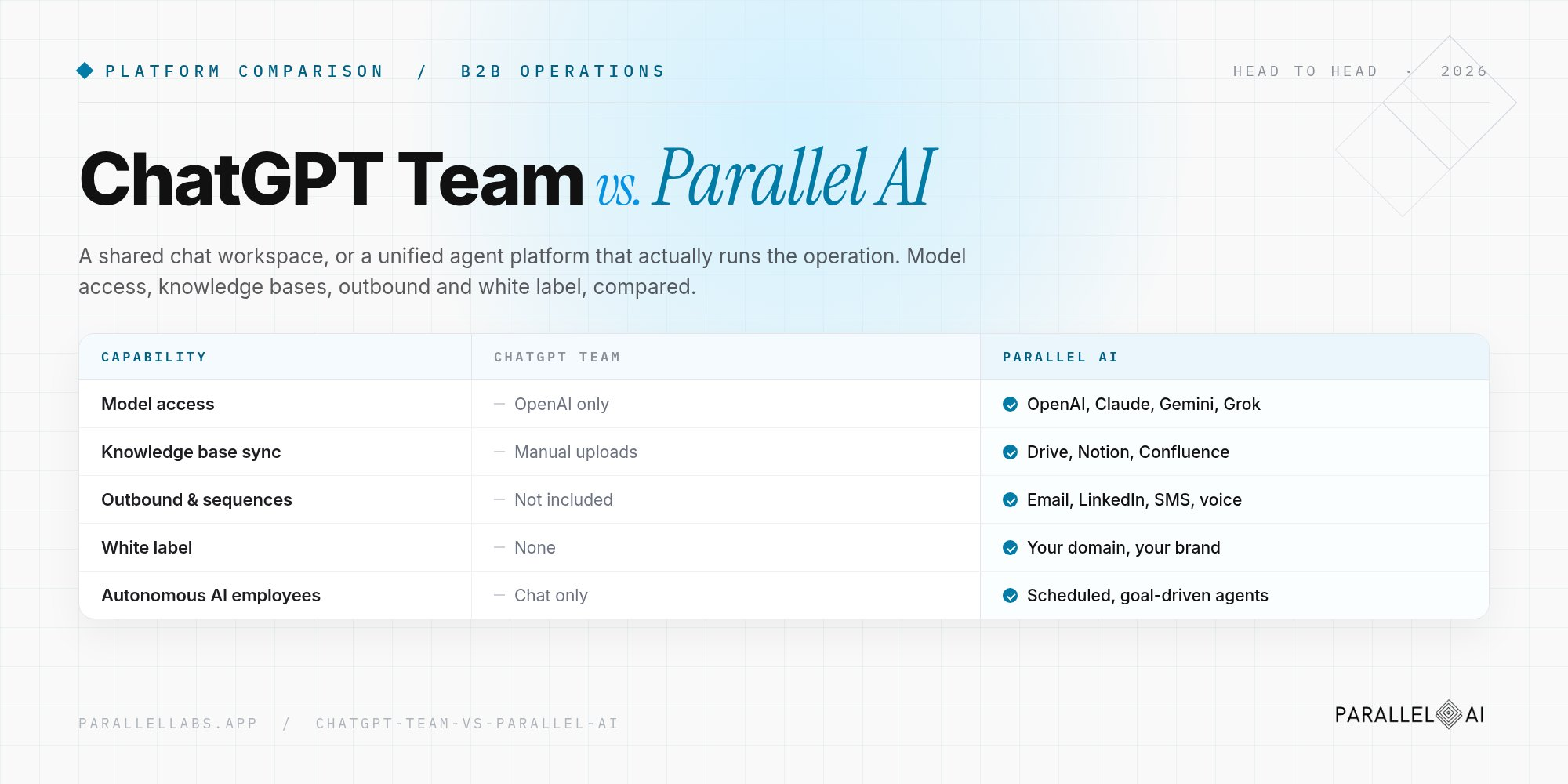
| Category | ChatGPT Team | Parallel AI |
|---|---|---|
| Best for | Teams that want collaborative AI chat and drafting | Businesses that want to consolidate multiple AI tools into one platform |
| Core strength | Familiar chat interface and broad awareness | Unified AI operations across content, knowledge, outreach, and automation |
| Model approach | Primarily one vendor ecosystem | Multi-model access across major providers |
| Knowledge integration | Useful for prompting and document work, depending on setup | Built around integrated knowledge bases and context-aware workflows |
| Content production | Strong for drafting and ideation | Strong for high-volume content automation across formats |
| Sales outreach | Limited compared with specialized GTM systems | Includes prospecting, smart lists, and multichannel sequences |
| White-label capability | Not a core strength | Strong fit for agencies and resellers |
| Enterprise flexibility | Good for collaboration and broad adoption | Better for consolidation, customization, and deployment flexibility |
| Cost story | Can be cost-effective as one tool | More compelling when replacing multiple subscriptions |
Bottom line: ChatGPT Team is a strong entry point for conversational AI. Parallel AI is better suited to organizations that need AI running across departments, systems, and repeatable business workflows.
What’s the Main Difference?
The biggest difference is straightforward: ChatGPT Team is primarily a collaborative AI workspace, while Parallel AI is a unified AI automation platform.
That sounds subtle, but in practice it changes how each platform gets evaluated.
With ChatGPT Team, the core value is access to a capable AI assistant inside a shared environment. Teams can draft content, summarize information, analyze documents, and collaborate around prompts. For many companies, that’s a useful first step.
With Parallel AI, the value proposition goes beyond chat. The platform is designed to consolidate the fragmented AI stack that often forms around growth-stage B2B teams. Instead of using one tool for writing, another for model access, another for outreach, another for knowledge retrieval, and another for white-label delivery, teams can pull those functions together under one system.
Why this matters for growing teams
Research from McKinsey, Microsoft Work Trend reporting, Deloitte, and IBM consistently points to the same pattern: AI adoption is growing, but organizations struggle with scale, governance, ROI, and workflow fragmentation.
In other words, the challenge is no longer getting AI into the company. It’s making AI useful across the company without creating more operational complexity.
That’s exactly where comparisons focused only on prompt quality miss the point. For B2B buyers, the better question isn’t just “Which tool is smarter?” It’s “Which platform reduces friction as usage expands?”
Quick verdict by use case
- Choose ChatGPT Team if your main goal is shared conversational AI for drafting, analysis, and general-purpose work.
- Choose Parallel AI if your goal is to replace multiple point solutions and operationalize AI across content, sales, support, and internal knowledge.
AI Models and Flexibility
One of the biggest weaknesses in chat-first AI buying is silent vendor lock-in.
A team may start with one model because it’s convenient. But model performance shifts quickly. One model may be stronger at reasoning, another at structured output, another at long-context tasks, and another at cost efficiency. As the market evolves, flexibility becomes a real strategic advantage.
ChatGPT Team: strong, but centered on one ecosystem
ChatGPT Team benefits from brand familiarity and a mature experience built around the OpenAI ecosystem. For teams already committed to that environment, this can feel simple and predictable.
But that simplicity comes with a tradeoff. If different tasks are better suited to different models, your team may end up adding more tools anyway. That’s how tool sprawl starts.
Parallel AI: multi-model by design
Parallel AI is built around access to multiple major model providers in one workspace, including OpenAI, Anthropic, Gemini, Grok, and DeepSeek. That matters for three reasons.
First, teams can choose the best model for the job instead of forcing every workflow through one system. Second, it reduces the need to maintain separate paid subscriptions just to access different model strengths. Third, it makes your AI setup more resilient. Stanford HAI and enterprise AI research more broadly show how quickly model capabilities shift. A flexible platform ages better than a single-vendor habit.
Why model flexibility matters in operations
For a marketing team, one model might be preferred for ad copy while another performs better on long-form thought leadership. For operations, a different model may be better for summarizing SOPs. For sales, structured list generation or personalization may benefit from yet another model profile.
ChatGPT Team can be strong within its lane. Parallel AI gives B2B teams a wider operating surface, which becomes more valuable as use cases expand.
Content, Knowledge, and Workflow Execution
Most teams don’t need AI only to answer questions. They need it to produce work.
That distinction matters because chat quality and workflow quality aren’t the same thing.
Content generation
ChatGPT Team is useful for brainstorming, outlining, summarizing, and drafting. If an individual marketer wants help getting from blank page to first draft, it does the job well.
Parallel AI goes further by treating content as a system, not a one-off interaction. Its content automation engine supports production across multiple formats, including blogs, articles, reports, and campaign assets. For teams under pressure to scale output without scaling headcount, that’s a meaningful difference.
Knowledge-grounded AI
This is where many businesses hit a ceiling with general chat tools.
Generic prompting is helpful, but business value grows when AI can work from your actual documents, playbooks, product information, and internal knowledge. According to enterprise research from Deloitte and IBM, integration and governance remain major barriers to scaling AI. In practice, that often means companies need AI grounded in real company context, not just public-language fluency.
Parallel AI directly addresses this with knowledge base integrations for systems like Google Drive, Notion, and Confluence, plus support for large context windows. That makes it easier to create context-aware outputs tied to internal documentation.
For B2B teams, this can improve:
- brand consistency
- internal search and knowledge retrieval
- onboarding support
- proposal and report generation
- sales enablement content
- customer-facing response quality
Workflow execution vs one-off prompts
A common maturity shift happens around month three or four of AI usage. Teams stop asking for individual outputs and start asking for repeatable workflows.
Examples include:
- generating articles from source material
- pulling company knowledge into campaign drafts
- building lead lists and enrichment flows
- creating multichannel outreach sequences
- supporting customer interactions across channels
ChatGPT Team supports useful work at the prompt layer. Parallel AI is better positioned for workflow-level execution, especially when content, outreach, and knowledge need to connect.
Sales, Outreach, and Cross-Functional Operations
This is where the comparison often becomes decisive.
If your AI strategy belongs only to marketing or only to individual users, ChatGPT Team may still look sufficient. But if AI needs to support revenue operations, prospecting, customer engagement, and cross-functional execution, a chat-first tool starts to feel narrow.
Parallel AI includes prospecting tools, smart list building, and multichannel outreach sequences built into the same platform where content and knowledge workflows live. That means sales and marketing can work from shared context instead of bouncing between disconnected tools.
For agencies and resellers, the white-label capability adds another layer. Teams can deliver AI-powered services under their own brand without stitching together a separate tech stack.
ChatGPT Team doesn’t offer this kind of cross-functional depth. It’s a strong shared workspace, but it wasn’t built to run sales motions or support white-label delivery.
Cost and Consolidation
Tool sprawl has a real price tag.
When teams add AI subscriptions one at a time, the monthly cost adds up fast. Five tools at $20 to $50 each per user isn’t unusual. Add in the time cost of switching between platforms, maintaining separate logins, and managing inconsistent outputs, and the operational drag becomes significant.
ChatGPT Team is reasonably priced as a standalone tool. But it’s rarely the only tool a growing team uses. When you factor in the other subscriptions it sits alongside, the total spend often looks different.
Parallel AI’s cost story is more compelling when you’re replacing multiple subscriptions rather than adding another one. If a team can consolidate writing tools, model access, outreach tools, and knowledge retrieval into one platform, the math usually works in Parallel AI’s favor, and the workflow benefits compound on top of that.
The honest question isn’t “Which tool is cheaper?” It’s “Which platform reduces total spend and complexity as AI usage grows?”
Which One Is Right for Your Team?
Both platforms are genuinely useful. The right choice depends on where your team is and where it’s headed.
ChatGPT Team makes sense if you want a well-known, easy-to-adopt AI workspace for drafting, analysis, and general collaboration. It’s a solid starting point, especially for teams earlier in their AI journey or those with straightforward use cases.
Parallel AI makes more sense if your team has already accumulated multiple AI tools and wants to consolidate them. It’s also the better fit if AI needs to run across departments, connect to internal knowledge, support sales workflows, or scale content production without adding headcount.
The pattern we see most often: teams start with ChatGPT Team, find it useful, then hit a ceiling when they need AI to do more than chat. At that point, the question shifts from “Which AI tool should we try?” to “Which platform can actually run our operations?”
If you’re already asking that second question, Parallel AI is worth a serious look. You can explore what it does across content, outreach, knowledge, and multi-model access, and see whether it fits what your team actually needs to get done.
Related reading
- Top 10 White-Label AI Platforms Compared: The 2026 Guide to Building Your AI Business Without Code
- Anyword vs Parallel AI: Which Platform Delivers Superior White-Label AI Capabilities for Independent Consultants in 2025?
- Bland AI vs Parallel AI: Why Voice-Only Platforms Cost Solopreneurs $23,760 Annually in Tool Fragmentation and Per-Minute Billing
- Boost.ai vs Parallel AI: Which White-Label Platform Actually Delivers ROI for Solopreneurs Without Enterprise Complexity?