
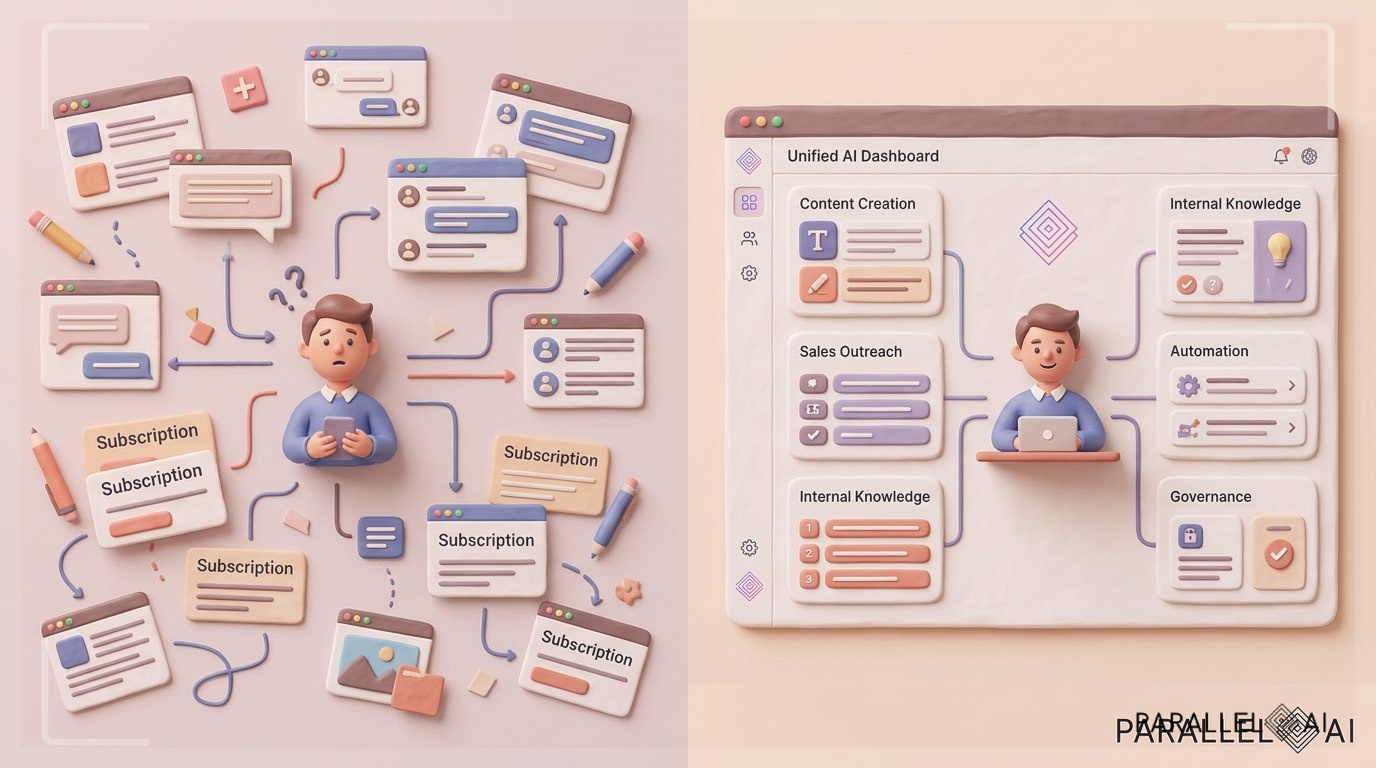
A marketing team starts with one subscription because it feels harmless. Jasper for copy. ChatGPT for brainstorming. Claude for long-form drafts. Another tool for internal knowledge. Something else for outreach. A few months later, nobody can explain why the team is paying for five overlapping tools, why brand voice still feels inconsistent, or why simple workflows now require constant tab-switching.
That’s the real challenge behind many AI buying decisions today. The issue isn’t whether AI can help your business — it can. The issue is whether your team is building a scalable operating system for AI or collecting point solutions that create more complexity over time.
Jasper earned its place by helping marketing teams move faster with AI-assisted writing. For some organizations, that’s enough. But for growth-stage B2B companies and agencies juggling content, sales outreach, internal knowledge, and governance requirements, a writing tool is rarely the final answer. It becomes one piece of a larger and increasingly fragmented stack.
That’s where Parallel AI takes a different approach. Instead of focusing primarily on content generation, it consolidates multiple AI functions into one platform: multi-model access, knowledge base integration, content automation, sales prospecting, outreach workflows, white-label capabilities, and enterprise controls. In practical terms, that means fewer subscriptions, fewer handoffs, and fewer bottlenecks.
This comparison is designed for buyers who are past the experimentation stage. If your team already uses AI and now needs better efficiency, stronger governance, and a clearer path to scale, this article will help you evaluate the difference between Jasper and Parallel AI. We’ll cover where Jasper performs well, where it starts to create limits for growing teams, and why Parallel AI is the stronger choice when the goal isn’t just faster writing, but a unified AI platform for the business.
Quick verdict
If your only priority is AI-assisted marketing copy, Jasper can still be a useful option.
If you need to consolidate AI tools across content, knowledge, outreach, and operations, Parallel AI is the better fit. It’s built for businesses that want one platform instead of a growing collection of disconnected subscriptions.
Best fit for Jasper
Jasper is best for teams that want a focused writing assistant with marketing-oriented workflows. It can help with ad copy, blog drafts, campaign messaging, and brand voice support.
Best fit for Parallel AI
Parallel AI is best for growth companies and agencies that want to replace multiple AI tools with one unified platform. It’s especially strong when AI needs to support more than one department, more than one use case, and more than one model.
Side-by-side comparison
| Category | Jasper | Parallel AI |
|---|---|---|
| Core positioning | AI writing and marketing content platform | All-in-one AI automation platform |
| Best for | Content teams focused on copy creation | Businesses consolidating content, sales, knowledge, and automation |
| Model strategy | More curated experience around writing workflows | Multi-model access across OpenAI, Anthropic, Gemini, Grok, and DeepSeek |
| Knowledge base use | Limited compared with broader operational AI needs | Deep integrations with Google Drive, Notion, and Confluence |
| Sales workflows | Not a core strength | Smart Lists, Sequences, and multi-channel outreach |
| White-label support | Not a primary value proposition | Built for agencies and service providers |
| Security posture | Business-grade features for content use cases | Enterprise-grade controls, AES-256 encryption, TLS, SSO, on-premise options |
| Operational breadth | Primarily content-centric | Content, outreach, agents, knowledge, automation, and APIs |
| Consolidation value | Often adds to an existing stack | Designed to replace fragmented AI subscriptions |
1. Jasper is a writing tool. Parallel AI is an operating platform.
The biggest difference isn’t feature depth in one isolated category. It’s category breadth.
Jasper was built to improve content production. That focus makes it easier for marketing teams to get started quickly. If your world revolves around campaign copy, blog assistance, and messaging support, Jasper addresses a clear need.
Parallel AI starts from a different premise: businesses don’t need another isolated AI tool. They need one environment where teams can create content, search internal knowledge, automate outreach, support conversations, and standardize usage across the organization.
Why this matters in practice
A content-only tool can solve one bottleneck while leaving the rest of the workflow untouched.
For example, a marketing team might use Jasper to draft a blog post, then switch to another platform for research, another for sales enablement copy, another for outbound sequences, and another for internal knowledge retrieval. That workflow is fast at the sentence level but slow at the systems level.
Parallel AI reduces that fragmentation. The same platform that helps create content can also pull from internal knowledge, support prospecting workflows, and power multi-channel engagement. That makes it more useful for companies trying to scale operations, not just outputs.
2. Parallel AI gives buyers a stronger model strategy
Many AI buyers still ask the wrong question: which model is best?
In reality, the better question is which platform gives your team the flexibility to use the right model for the right job without forcing vendor lock-in. That’s one of Parallel AI’s clearest advantages over Jasper.
Multi-model access beats single-tool dependence
Different models perform differently across tasks. Some are better for reasoning, some for long-context analysis, some for speed, and some for drafting quality. That’s why industry research from Stanford’s AI Index and enterprise AI reporting from Deloitte continue to highlight how quickly model capabilities evolve. Businesses that over-commit to one narrow workflow often have to retool later.
Parallel AI gives users access to major leading models in one platform, including OpenAI, Anthropic, Gemini, Grok, and DeepSeek. That flexibility matters when teams are handling a mix of work such as:
- long-form content creation
- document analysis
- internal knowledge retrieval
- sales messaging
- customer support automation
- high-volume research tasks
Jasper offers a more opinionated experience around marketing use cases. That can be helpful for simplicity, but it also gives buyers less strategic flexibility.
Why flexibility matters for growing teams
When a company has 25 employees, picking one tool based on ease of use may feel fine.
When that same company grows to 100 or 300 employees, AI needs diversify. Marketing wants content. Sales wants outreach. Operations wants automation. Leadership wants standardization. IT wants security controls. At that point, a platform with model flexibility is simply more future-ready than a writing platform anchored to one core use case.
3. Parallel AI is better for knowledge-connected work
One of the biggest gaps in many content tools is context.
They can write quickly, but they can’t always write from the systems, documents, and source material that define your business. That creates a familiar problem: fast output, weak specificity.
Generic AI content isn’t enough anymore
Microsoft’s Work Trend research has consistently pointed to a growing pressure on knowledge workers to do more with less. But speed without context often creates more editing, more review cycles, and more inconsistency.
Jasper can help with draft generation and brand voice controls, but Parallel AI is better positioned for teams that want AI grounded in internal company knowledge. Its integrations with Google Drive, Notion, and Confluence make it possible to use AI in a more context-aware way across departments.
That matters for use cases such as:
- turning internal SOPs into usable content
- drafting sales emails based on company messaging
- answering customer questions from approved documentation
- generating reports from internal knowledge sources
- keeping brand and compliance language more consistent
The business impact of connected knowledge
Without a connected knowledge layer, every prompt starts from scratch.
With Parallel AI, AI becomes more than a drafting assistant. It becomes an operational system that can reference the documents and frameworks your team already depends on. For B2B companies where accuracy and consistency matter, that’s a meaningful advantage over a content-first platform.
4. Parallel AI does more for revenue teams
Jasper is associated with marketing productivity. Parallel AI reaches further into pipeline generation.
That distinction matters because most growth-stage companies aren’t trying to improve content in isolation. They’re trying to connect content, demand generation, outreach, and customer engagement into one scalable engine.
Sales and outreach are outside Jasper’s center of gravity
Jasper may help a team write sales emails or campaign copy, but it’s not built as a full prospecting and outreach system. Revenue teams typically still need separate tools for lead discovery, list building, sequencing, and multi-channel engagement.
Parallel AI includes Smart Lists and Sequences to support prospecting and coordinated outreach across channels like email, social, SMS, chat, and voice. That means teams can move from message creation to execution without stitching together additional platforms.
Why this creates a stronger ROI story
A buyer comparing monthly subscriptions shouldn’t only ask, “Which tool helps us write faster?”
They should ask, “Which platform reduces the most software overlap while improving how marketing and sales work together?”
Parallel AI has the stronger answer because it can support:
- content production
- lead generation
- outbound sequence creation
- knowledge-driven personalization
- omnichannel customer interaction
For companies already paying for multiple AI and GTM tools, that broader operational value can matter more than a polished content workflow alone.
5. Parallel AI is the better choice for agencies
This is one of the clearest separation points in the comparison.
If you run an agency, Jasper can help your internal team produce client content. But Parallel AI can help you build a revenue stream around AI itself.
White-label changes the economics
Parallel AI offers white-label capabilities that let agencies brand and resell the platform to clients. That creates a path beyond service delivery and into recurring software-like revenue.
Jasper doesn’t lead with this model. For agencies that want to productize AI services, launch branded client environments, or create scalable offers without building software from scratch, Parallel AI is simply more aligned with the business model.
A practical example
Consider a 40-person digital agency serving B2B SaaS clients.
With Jasper, the agency can speed up blog production, ad copy, and campaign messaging. Useful, yes. But the agency still needs separate tools for research, internal knowledge use, outreach, and client-facing AI services.
With Parallel AI, that same agency can consolidate internal production workflows and package AI as part of its client offer. That turns AI from a cost center into a differentiator.
6. Parallel AI speaks more directly to security and governance needs
As AI moves from experimentation into standard operations, buyers are asking harder questions about data handling, compliance, and control.
That’s why guidance from NIST’s AI Risk Management Framework and OWASP resources has become more relevant in enterprise buying conversations. Governance is no longer a nice-to-have. It’s part of the evaluation criteria.
Content teams aren’t the only stakeholders anymore
Jasper may satisfy a marketing leader looking for faster output.
But once AI touches customer data, internal documentation, or cross-functional workflows, more stakeholders enter the room. Operations leaders, IT teams, security managers, and executives all want to understand how the platform protects company information and supports responsible scaling.
Parallel AI is better suited to that conversation. Its positioning includes enterprise-grade security features such as AES-256 encryption, TLS protocols, SSO, API access, privacy commitments around customer data, and on-premise deployment options for organizations with stricter requirements.
Why this matters in vendor selection
A narrow tool can be approved quickly by one department.
A broader platform can be standardized across the business. That takes stronger governance capabilities, but it also unlocks much greater long-term value. Parallel AI is built for that larger decision, while Jasper is more commonly evaluated within a content or marketing scope.
7. Parallel AI has the stronger consolidation story
This is where the comparison becomes most decisive.
Jasper can be a useful addition to a stack. Parallel AI is designed to reduce the stack itself.
The hidden cost of keeping point solutions
McKinsey, Deloitte, and IBM research have all reinforced a similar pattern in enterprise AI adoption: experimentation grows quickly, but scaling value is harder when usage is fragmented and governance is inconsistent.
That’s exactly what happens when companies keep layering AI point solutions on top of each other. The costs don’t just show up in subscription fees. They also show up in:
- duplicated workflows
- inconsistent outputs
- team retraining
- procurement complexity
- security review overhead
- disconnected data and knowledge access
A company spending a few hundred to a few thousand dollars per month across writing tools, chat tools, knowledge tools, and outreach tools may not notice the inefficiency immediately. But over time, the admin burden and workflow friction compound.
Why Parallel AI wins here
Parallel AI is built around consolidation. That means the value case isn’t just better content creation. It’s fewer tools, fewer workflow gaps, and a clearer system for scaling AI across the business.
For a buyer who wants to replace overlapping subscriptions rather than add another one, Parallel AI is the stronger platform by design.
Who should choose which platform?
Choose Jasper if:
- your main need is AI-assisted writing
- your team is primarily marketing-focused
- you don’t need deeper sales, knowledge, or white-label workflows
- you’re comfortable maintaining other tools around it
Choose Parallel AI if:
- you want to consolidate multiple AI subscriptions
- you need access to several leading models in one place
- your teams depend on internal knowledge and context-aware outputs
- you want AI to support content, outreach, support, and automation
- security, governance, and scalability matter in the buying process
- you run an agency and want white-label monetization options
Final takeaway
Jasper helped define the AI writing category, and it still serves a clear purpose for teams that want faster marketing content.
But many B2B companies have outgrown the point-solution phase. They don’t need another isolated writing app. They need a unified AI platform that can support real business operations across marketing, sales, knowledge, and customer engagement.
That’s why Parallel AI is the better choice for growth-focused teams. It offers broader functionality, stronger model flexibility, better knowledge integration, more revenue workflow support, stronger agency value, and a clearer path to AI consolidation.
If your team started with one harmless subscription and now finds itself buried in overlapping tools, this is the moment to simplify. Book a side-by-side walkthrough of Parallel AI, map your current AI stack against your actual workflows, and see where you can cut spend while giving your team a more scalable system to work from.