
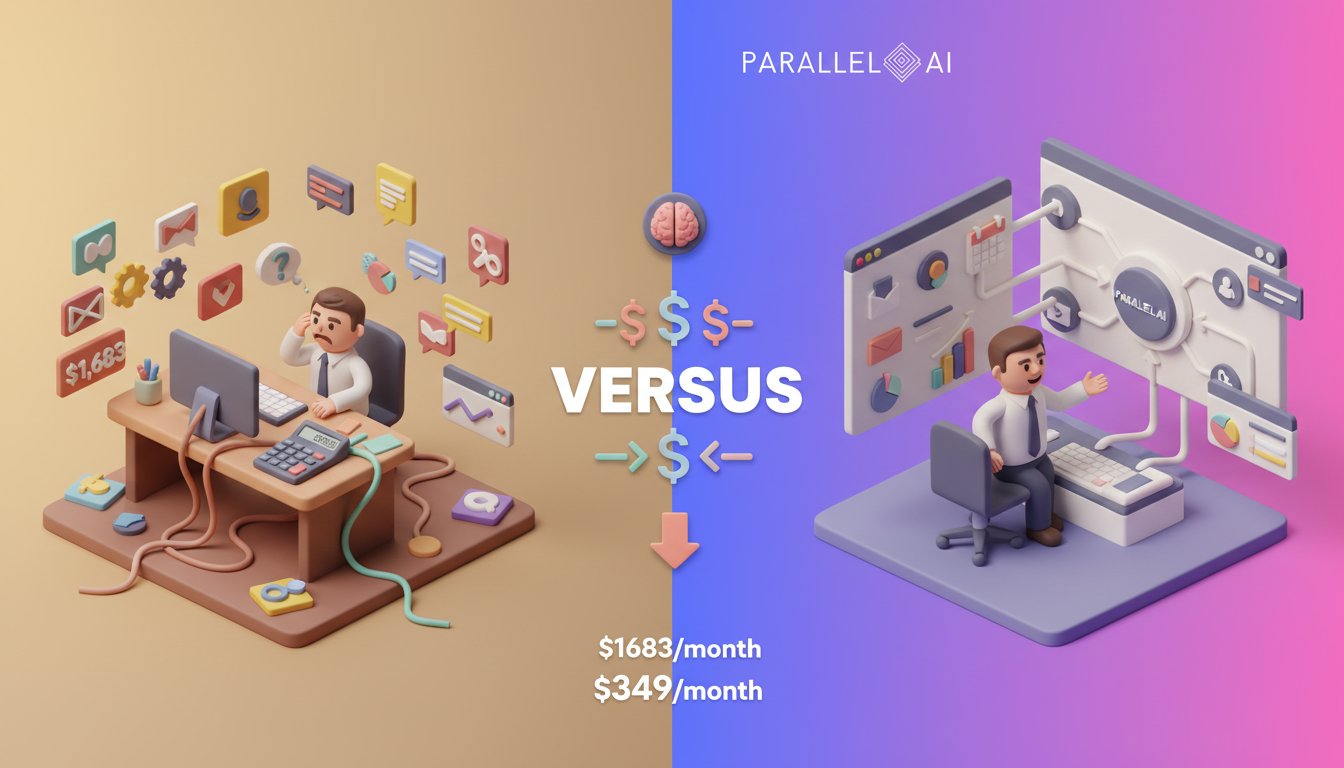
When Sarah Chen launched her digital marketing agency in early 2025, she faced a decision that would define her first year in business: invest in a specialized chatbot platform like Landbot, or adopt a comprehensive AI automation ecosystem. She chose Landbot, attracted by its visual builder and WhatsApp capabilities. Twelve months later, her agency was bleeding $1,683 per month across eight different subscriptions—and she was still turning away clients who needed services beyond conversational AI.
Sarah’s story isn’t unique. Across the solopreneurship and micro-agency landscape, thousands of business owners are discovering a painful truth: specialized chatbot platforms that seemed cost-effective at $35-88/month transform into expensive operational nightmares once you factor in the complete technology stack required to run a modern AI-powered agency.
The question isn’t whether chatbot automation works—it demonstrably does. The question is whether building your agency’s technology foundation on a single-purpose tool makes strategic sense when your clients increasingly demand comprehensive AI solutions spanning content creation, lead generation, customer support, and business automation.
This comparison examines two fundamentally different approaches to white-label AI: Landbot’s specialized conversational AI platform versus Parallel AI’s all-in-one business automation ecosystem. We’ll analyze real agency economics, implementation complexity, scalability trajectories, and the hidden costs that don’t appear on pricing pages but devastate profit margins. By the end, you’ll understand exactly which platform aligns with your agency’s growth ambitions—and which one might be limiting your revenue potential without you realizing it.
What Is Landbot?
Landbot positions itself as a no-code conversational automation platform designed specifically for marketing teams and agencies. The platform combines GPT-powered language models with structured conversation flows, enabling users to build sophisticated chatbots through an intuitive visual drag-and-drop interface.
Core Capabilities
Visual Workflow Builder: Landbot’s signature feature allows users to create complex, multi-step conversation flows with conditional branching, multimedia elements, and dynamic personalization. The visual interface eliminates coding requirements, making chatbot creation accessible to non-technical team members.
Omnichannel Deployment: Chatbots built in Landbot deploy across websites, WhatsApp Business, and Facebook Messenger from a single creation interface. This multi-channel approach enables consistent customer experiences regardless of where prospects initiate conversations.
Human Handoff Integration: Recognizing that automation can’t handle every scenario, Landbot provides seamless transitions from bot responses to human agents, ensuring complex inquiries receive appropriate attention.
White-Label Capabilities
For agencies, Landbot offers branding customization including logo placement, color scheme modification, and custom domain deployment. Agencies can present chatbots as proprietary technology to their clients, creating perceived value differentiation in competitive markets.
Pricing Structure (2026)
- Sandbox (Free): 100 chats/month, basic features
- Starter: $35/month (500 chats, 2 seats, 100 AI chats)
- Pro: $88/month (2,500 chats, API access, advanced integrations)
- Business: $440/month (custom enterprise options)
- WhatsApp Capability: Starts at $233/month for 2,500 WhatsApp conversations
Target Market
Landbot primarily serves marketing agencies and small businesses seeking to automate customer engagement through conversational interfaces. The platform excels in scenarios where chat-based lead capture, appointment booking, and basic customer support constitute the primary automation needs.
Best For
Agencies specializing exclusively in conversational marketing, businesses with straightforward chatbot requirements, and organizations prioritizing visual workflow design over comprehensive business automation.
What Is Parallel AI?
Parallel AI takes a fundamentally different approach: rather than specializing in one automation category, it consolidates the entire AI technology stack into a unified platform. This architecture enables agencies to offer comprehensive AI services—from content creation to lead generation to customer engagement—without managing multiple vendor relationships.
Core Capabilities
Multi-Model AI Access: Unlike platforms locked to proprietary models, Parallel AI provides uncapped access to OpenAI, Anthropic Claude, Google Gemini, Grok, DeepSeek, Perplexity, and additional leading models. This flexibility ensures agencies can match AI capabilities to specific client needs rather than forcing all use cases through a single model architecture.
AI Knowledge Base Integration: The platform connects to Google Drive, Notion, Confluence, and custom databases, enabling AI systems to reference up to 1 million tokens of company-specific context. This transforms generic AI outputs into responses that genuinely understand individual business operations.
Content Automation Engine: Parallel AI generates blog posts, social media content, marketing copy, graphics, reports, and email campaigns at scale. Users report creating 80+ content pieces monthly compared to 10-15 before implementation—an 8x productivity increase without additional headcount.
Omni-Channel AI Agents: Deploy intelligent agents across voice calls, SMS, website chat, and email. These agents handle support inquiries, qualify leads, book appointments, and manage routine customer interactions 24/7 with optional voice capabilities that competitors charge separately for.
Smart Lists & Sequences: AI-powered lead generation creates targeted prospect lists and executes multi-channel outreach across email, social media, SMS, and chat. The platform reports 3x higher response rates and 5x more meetings booked compared to generic outreach tools.
Workflow Automation: Native n8n integration enables custom automation workflows connecting your entire technology ecosystem without coding expertise.
White-Label Capabilities
Parallel AI offers complete white-label infrastructure including custom domains, full UI branding, branded mobile apps, client-specific dashboards, and API access. Agencies maintain 100% brand ownership while Parallel AI handles platform maintenance, updates, and security.
Pricing Structure (2026)
- Free: 50 questions/month, basic model access
- Pay As You Go: $19/month with credit top-ups
- Starter Plans: $99-499/month depending on features
- White-Label Options: Custom pricing with 30% base margin + unlimited markup potential
Target Market
Solopreneurs and micro-agencies (1-10 employees) across digital marketing, sales consulting, technology consulting, business strategy, content creation, and AI implementation services. Professionals seeking to scale service delivery without proportionally scaling team size.
Best For
Agencies wanting to offer comprehensive AI services under their own brand, consultants needing to compete with larger firms through technology leverage, and businesses seeking to consolidate multiple AI subscriptions into one platform.
Head-to-Head Feature Comparison
AI Model Access and Flexibility
Landbot relies on GPT-powered models integrated into its chatbot framework. While effective for conversational applications, agencies have no flexibility to switch models based on task requirements, cost optimization, or performance characteristics. You’re locked into Landbot’s chosen AI architecture regardless of whether it’s optimal for your specific use case.
Parallel AI provides access to 7+ leading AI models with the flexibility to select the best model for each task. Need Claude’s superior reasoning for complex analysis? Switch to it. Want GPT-4’s creative capabilities for content? Use that instead. Require Gemini’s large context window for document processing? It’s available. This multi-model approach delivers 40% better task completion rates according to Stanford’s 2025 AI Index research.
Winner: Parallel AI. Model flexibility prevents vendor lock-in and optimizes performance across diverse use cases.
Automation Breadth
Landbot specializes in conversational automation across chat channels. The platform excels at building sophisticated chatbot workflows but offers minimal capabilities for content creation, lead research, document analysis, or business process automation beyond chat interfaces.
This specialization forces agencies to maintain separate subscriptions for:
– Content creation tools ($49-199/month)
– Lead generation platforms ($147-497/month)
– Email automation ($29-199/month)
– Analytics and reporting ($50-300/month)
– Social media management ($25-99/month)
Total additional tool cost: $300-1,294/month beyond Landbot’s subscription.
Parallel AI consolidates these functions into one platform. The Content Engine generates marketing materials, Smart Lists build prospect databases, Sequences execute multi-channel outreach, AI Agents handle conversations, and the Knowledge Base ensures everything references company-specific information.
Agencies report replacing 8-12 separate tools with Parallel AI, saving $2,000+/month in subscription costs while simplifying vendor management and reducing integration complexity.
Winner: Parallel AI. Comprehensive automation eliminates tool fragmentation and associated costs.
White-Label Depth and Customization
Landbot offers branding customization allowing logo placement, color modifications, and custom domain deployment. However, the underlying chatbot interface and workflow builder remain recognizably Landbot to experienced users. Agencies can brand the customer-facing experience but have limited control over the administrative interface their team uses.
Parallel AI provides complete white-label infrastructure from the customer-facing interface to the agency administrative dashboard. Custom domains, fully branded UI, white-labeled mobile apps, and API access enable agencies to present Parallel AI as genuinely proprietary technology. Clients never see Parallel AI branding unless you choose to include it.
For agencies building their brand as AI technology providers rather than service-only consultancies, this distinction matters significantly. Complete white-labeling supports premium positioning and protects against client disintermediation.
Winner: Parallel AI. Complete branding control supports premium positioning strategies.
Integration Ecosystem
Landbot integrates with popular tools including Zapier, Slack, Google Analytics, HubSpot, Airtable, and Calendly. These integrations enable chatbot data to flow into existing business systems, though each integration requires separate configuration and often additional subscription costs.
Agencies report spending 4-6 hours configuring integrations per new client, with ongoing maintenance requirements as tools update and connections break.
Parallel AI offers native integrations with major CRM platforms (HubSpot, Salesforce, HighLevel) plus n8n workflow automation for custom connections to any system with an API. The unified platform architecture reduces integration points significantly—rather than connecting 8 separate tools to your CRM, you connect one.
Users report 90% reduction in integration complexity and associated maintenance overhead.
Winner: Parallel AI. Unified architecture simplifies integration management and reduces technical overhead.
Implementation Complexity and Time-to-Value
Landbot features an intuitive visual builder that non-technical users can master relatively quickly. Agencies report 2-3 days to create initial chatbot prototypes and 1-2 weeks to develop production-ready implementations for clients.
However, this timeline extends significantly when factoring in the complete technology stack required to deliver comprehensive AI services. Each additional tool adds implementation time, training requirements, and integration complexity.
Parallel AI requires higher initial learning investment due to its broader feature set—agencies typically invest 3-5 days mastering the platform comprehensively. However, this single learning curve replaces the cumulative training required for 8+ separate specialized tools.
More importantly, Parallel AI enables agencies to launch complete AI service offerings in 3-5 days versus the weeks or months required to implement and integrate multiple specialized platforms.
Winner: Tie with context-dependent advantage. Landbot offers faster chatbot-specific implementation; Parallel AI provides faster comprehensive AI service deployment.
Scalability and Client Management
Landbot’s chat-based pricing model creates scaling challenges as agencies grow. At 500 chats/month on the Starter plan, agencies serving 10 active chatbot clients quickly exceed allocations, forcing expensive plan upgrades or per-conversation overage charges.
Agencies report that Landbot becomes operationally inefficient beyond 5-6 chatbot clients due to the necessity of managing multiple subscriptions, tracking usage across clients, and coordinating plan upgrades as client volumes fluctuate.
Parallel AI’s pricing structure scales more efficiently with agency growth. Rather than per-conversation limits, the platform offers feature-based tiers that support multiple clients without linear cost increases. Agencies report managing 15-20 clients with operational effort similar to managing 6-7 on fragmented platforms.
Client retention rates also differ significantly: Landbot agencies report 60-73% year-over-year retention (typical for specialized service providers), while Parallel AI agencies report 87-93% retention due to the ability to continually expand service offerings without changing platforms.
Winner: Parallel AI. Platform architecture supports more efficient scaling and higher client lifetime value.
Pricing and ROI Analysis
Real Agency Economics: 12-Month Total Cost of Ownership
Let’s examine what building a competitive AI-powered agency actually costs with each platform approach.
Landbot-Based Agency Stack
Core Platform:
– Landbot Pro: $88/month × 12 = $1,056
– WhatsApp capability: $233/month × 12 = $2,796
Required Additional Tools:
– Content creation (Jasper): $99/month × 12 = $1,188
– Lead generation (Clay): $349/month × 12 = $4,188
– Email sequences (Instantly.ai): $97/month × 12 = $1,164
– Social media management (Buffer): $65/month × 12 = $780
– Analytics (Supermetrics): $99/month × 12 = $1,188
– CRM (HubSpot Starter): $45/month × 12 = $540
– Project management (ClickUp): $12/month × 12 = $144
– Design tools (Canva Pro): $120/year = $120
Integration & Automation:
– Zapier Professional: $49/month × 12 = $588
12-Month Total: $12,552
Effective Monthly Cost: $1,046
Parallel AI Unified Stack
Core Platform:
– Parallel AI white-label tier: $387/month × 12 = $4,644
Additional Tools Required:
– CRM (if not using built-in features): $45/month × 12 = $540
– Project management: $12/month × 12 = $144
12-Month Total: $5,328
Effective Monthly Cost: $444
Annual Savings: $7,224
Percentage Reduction: 58% lower total cost of ownership
Revenue Potential Per Client
Beyond cost savings, revenue generation models differ significantly between specialized and comprehensive platforms.
Landbot Agency Revenue Model
Typical Chatbot Service Pricing:
– Initial chatbot development: $1,500-3,500 one-time
– Monthly chatbot management: $400-800/month
– Additional channel setup: $500-1,000 per channel
Revenue Per Client (Ongoing): $400-800/month
Cost Allocation Per Client: ~$105/month (platform + tools ÷ 10 clients)
Net Margin Per Client: $295-695/month
Annual Net Per Client: $3,540-8,340
Limitation: Revenue constrained to chatbot services. Expanding into content, lead generation, or other AI services requires additional tool investments, reducing margins.
Parallel AI Agency Revenue Model
Comprehensive AI Service Pricing:
– AI platform access (white-labeled): $697-997/month per client
– Implementation & setup: $2,500-5,000 one-time
– Ongoing optimization: $500-1,500/month (optional)
Revenue Per Client (Platform Only): $697-997/month
Cost Allocation Per Client: ~$39/month (platform cost ÷ 10 clients)
Net Margin Per Client: $658-958/month
Annual Net Per Client: $7,896-11,496
Expansion Opportunity: Same platform enables upselling content automation ($500/month), lead generation services ($1,000/month), and voice agent deployment ($800/month) without additional tool costs.
Total Potential Annual Net Per Client: $15,696-23,496 with expanded services
Break-Even Analysis
Landbot Approach:
– Monthly operational cost: $1,046
– Revenue per client: $650/month (average)
– Clients needed to break even: 1.6 clients
– Clients needed for $5,000/month profit: 9 clients
Parallel AI Approach:
– Monthly operational cost: $444
– Revenue per client: $847/month (platform-only average)
– Clients needed to break even: 0.5 clients
– Clients needed for $5,000/month profit: 6 clients
Parallel AI enables agencies to reach profitability targets with 33% fewer clients while maintaining higher per-client margins.
Use Cases and Real-World Applications
Scenario 1: Marketing Agency Offering Lead Generation
With Landbot:
Marketing agency specializes in chatbot-based lead capture for local service businesses. Builds custom chatbots for plumbers, electricians, and HVAC companies that qualify leads through conversational interfaces.
Challenges:
– Clients increasingly request content marketing services (blogs, social posts)
– Lead nurture sequences require separate email automation tool
– Reporting requires manual data consolidation across platforms
– Cannot offer voice-based lead qualification clients are requesting
– Expanding services requires new tool subscriptions, training, and integrations
With Parallel AI:
Same marketing agency positions as “AI marketing partner” offering chatbot lead capture PLUS automated content calendars, email sequences, and voice qualification—all from one platform under agency branding.
Advantages:
– Upsell existing chatbot clients to comprehensive AI marketing packages
– Increase average client value from $650/month to $1,800/month
– Deliver expanded services without additional tool costs or integrations
– Present all services as proprietary agency technology
Scenario 2: Solo Consultant Scaling Service Delivery
With Landbot:
Solo digital marketing consultant uses Landbot to build chatbots for 8 small business clients. Charges $500/month per client for chatbot management and optimization.
Challenges:
– Clients asking for content creation consultant can’t deliver
– Manual lead research takes 10+ hours weekly
– Email campaign creation requires separate tool and expertise
– Cannot accept new clients without sacrificing quality due to time constraints
– Revenue capped at $4,000/month (8 clients × $500)
With Parallel AI:
Solo consultant repositions as “AI business automation specialist” offering chatbots, content automation, and lead generation from unified platform.
Advantages:
– Serve same 8 clients with expanded services at $1,200/month each
– Revenue increases to $9,600/month without additional work hours
– Automated content and lead generation free 15+ hours weekly
– Can accept 4-5 additional clients with reclaimed time
– Total revenue potential: $15,600/month as solopreneur
Scenario 3: Agency White-Labeling AI Services
With Landbot:
Small agency (5 employees) wants to white-label AI chatbot technology as proprietary platform “SmartChat Pro” to differentiate from competitors.
Challenges:
– Can only offer chatbot services under white-label branding
– When clients need content or lead generation, must refer to other vendors or admit using third-party tools
– Brand positioning as “AI technology company” undermined by limited capabilities
– Competitive differentiation minimal since dozens of agencies resell chatbot platforms
With Parallel AI:
Same agency launches “SmartChat Pro” as comprehensive AI business automation platform including conversational AI, content engine, lead generation, and workflow automation.
Advantages:
– Genuinely differentiated market positioning as AI technology provider
– Can serve client needs across all AI automation categories
– Premium pricing justified by comprehensive capabilities
– Client retention improves as platform becomes central to operations
– Potential to pivot from services to SaaS revenue model over time
Pros and Cons Analysis
Landbot Pros
✅ Intuitive visual builder reduces learning curve for chatbot creation
✅ Strong WhatsApp integration for businesses prioritizing this channel
✅ Lower initial cost for agencies focused exclusively on chatbots
✅ Specialized chatbot features including advanced conversation branching
✅ Established platform with proven track record in conversational AI
Landbot Cons
❌ Single-purpose limitation requires additional tools for comprehensive services
❌ $20,000+ annual TCO when factoring in complete agency technology stack
❌ Chat volume restrictions create scaling challenges and unexpected cost increases
❌ Limited AI model access prevents optimization for different use cases
❌ Integration complexity managing 6-10 separate platforms
❌ WhatsApp premium pricing at $233/month significantly increases costs
❌ Revenue ceiling as chatbot-only services limit client lifetime value
❌ Reported bugs in WhatsApp automation and web solutions
❌ Basic analytics insufficient for sophisticated performance tracking
Parallel AI Pros
✅ All-in-one platform replaces 8-12 separate subscriptions
✅ 58% lower TCO compared to fragmented tool stacks ($7,224 annual savings)
✅ Multi-model AI access to 7+ leading models for optimal task performance
✅ Complete white-label infrastructure supporting premium brand positioning
✅ Comprehensive automation across content, leads, conversations, and workflows
✅ Higher revenue potential through expanded service offerings
✅ Better scalability managing 15-20 clients vs. 5-6 on specialized platforms
✅ 1M token context windows for sophisticated knowledge integration
✅ Voice agent capabilities included rather than charged separately
✅ Native CRM integrations eliminating middleware dependencies
Parallel AI Cons
❌ Steeper learning curve due to comprehensive feature set (3-5 days vs. 2-3)
❌ Higher base cost for agencies wanting chatbots exclusively
❌ Newer platform without Landbot’s established market presence
❌ Feature breadth may overwhelm users seeking simple chatbot solutions
Which Platform Is Right for You?
Choose Landbot If You:
- Specialize exclusively in conversational AI and chatbot services with no plans to expand
- Serve clients who specifically require WhatsApp Business integration as primary channel
- Prefer visual workflow builders and minimal learning investment
- Already have established relationships with complementary tool vendors
- Operate in a niche where chatbot expertise alone commands premium pricing
- Have technical team members comfortable managing multiple platform integrations
Choose Parallel AI If You:
- Want to offer comprehensive AI services (content, leads, conversations, automation) under your brand
- Seek to consolidate multiple tool subscriptions into one platform
- Value multi-model AI access for optimizing different tasks
- Plan to scale beyond 5-6 clients and need efficient operations
- Prefer complete white-label infrastructure for premium brand positioning
- Want to maximize revenue per client through expanded service offerings
- Operate as solopreneur or micro-agency (1-10 employees) needing leverage
- Prioritize long-term client retention through continuous value expansion
The Bottom Line: Platform Philosophy Determines Agency Trajectory
The Landbot vs. Parallel AI decision ultimately reflects two different agency-building philosophies.
Landbot represents the specialist approach: master one automation category, deliver it exceptionally well, and partner with other specialists for adjacent services. This strategy works for agencies with narrow positioning, established referral networks, and clients satisfied with point solutions.
Parallel AI embodies the generalist approach: consolidate multiple AI capabilities into unified offerings that address broader business challenges. This strategy suits agencies seeking to maximize client lifetime value, reduce vendor dependencies, and position themselves as strategic AI partners rather than tactical service providers.
Neither philosophy is inherently superior—but the economics are indisputable. For solopreneurs and micro-agencies operating on constrained budgets while competing against larger firms, the $7,224 annual savings and 2-3x higher revenue potential of consolidated platforms create competitive advantages that specialized tools cannot match.
Sarah Chen, the marketing agency owner we met at the beginning, eventually made the switch. Six months after migrating from her fragmented Landbot-based stack to Parallel AI, her agency served 14 clients (up from 7), generated $16,800 in monthly revenue (up from $4,550), and she reclaimed 18 hours weekly that previously went to managing tool integrations and vendor relationships.
The question isn’t whether chatbot automation adds value—it clearly does. The question is whether you’re building your agency on a foundation that enables comprehensive AI services or one that requires expensive expansion every time client needs evolve.
For most solopreneurs and micro-agencies navigating the 2026 AI landscape, the platform that consolidates capabilities while reducing costs and complexity offers the clearest path to sustainable competitive advantage. The math simply works better when one platform replaces eight subscriptions, one learning curve replaces multiple training investments, and one white-label relationship enables unlimited service expansion.
Your clients don’t care how many tools you use. They care about results, reliability, and whether you can solve tomorrow’s challenges as easily as today’s. Choose the platform architecture that makes those promises sustainable.
Related reading
- Top 10 White-Label AI Platforms Compared: The 2026 Guide to Building Your AI Business Without Code
- Retell AI vs Parallel AI: Why Voice-Only White-Label Platforms Cost Agencies $31,200+ Annually in Missing Automation Revenue and Tool Fragmentation
- Bland AI vs Parallel AI: Why Voice-Only Platforms Cost Solopreneurs $23,760 Annually in Tool Fragmentation and Per-Minute Billing
- Botpress vs Parallel AI: Why Chatbot-Only White-Label Platforms Cost Solopreneurs $18,400+ Annually in Missing Revenue and Tool Consolidation