
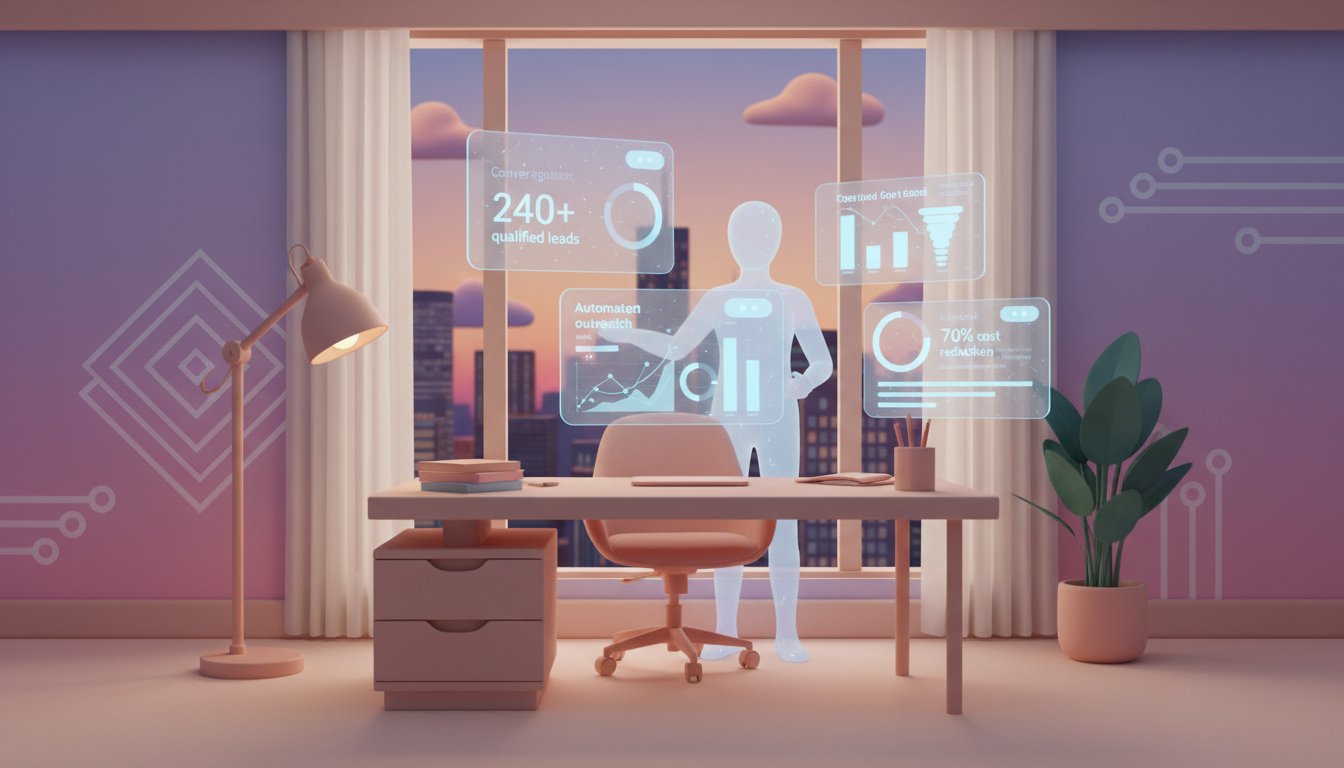
The sales development landscape just crossed a threshold that separates businesses into two categories: those leveraging AI SDR agents, and those about to be outcompeted.
By the market’s own admission, AI SDR platforms are delivering 4-7x higher conversion rates while slashing manual outreach costs by up to 70%. The AI SDR market is exploding from $4.12 billion to a projected $15.01 billion by 2030—a growth trajectory that signals fundamental transformation, not incremental improvement.
Here’s what this means for solopreneurs: The business owner who masters AI SDR deployment will outperform agencies with 10-person sales teams. The one who doesn’t? They’ll watch competitors close deals faster, cheaper, and at greater scale.
This isn’t theoretical positioning. Companies deploying AI SDR agents report measurable outcomes: higher lead conversion rates, dramatically reduced operational costs, and sales processes that run 24/7 without human intervention.
The question isn’t whether AI SDRs work. It’s whether you can build and deploy them before your market moves without you.
Why AI SDRs Are Outperforming Traditional Sales Development (And It’s Not Just Speed)
Most solopreneurs think AI SDRs are glorified email automation tools. That assumption costs them competitive advantage daily.
AI SDRs possess capabilities that fundamentally exceed human limitations:
Perfect Product Knowledge Across Every Interaction
Human SDRs forget details, misremember features, provide inconsistent information across prospect conversations. AI SDRs maintain flawless product knowledge whether it’s the first conversation or the thousandth, delivering consistent messaging that builds trust and credibility.
Real-Time Adaptation Without Training Cycles
Traditional SDRs need weeks of onboarding and continuous training updates. AI SDRs adapt instantly to new messaging, product updates, and market feedback, learning from every interaction without formal training sessions or productivity dips.
24/7 Availability With Zero Fatigue
Human SDRs work 8-hour days with weekends off, sick days, and vacation time. AI SDRs engage prospects around the clock across time zones, responding within seconds to inbound inquiries and maintaining consistent outreach cadence without breaks.
Concurrent Multi-Channel Engagement at Scale
While a human SDR effectively manages 50-80 active prospects, AI SDR agents simultaneously engage hundreds or thousands of prospects across email, LinkedIn, SMS, and chat—maintaining personalized, context-aware conversations across all channels.
Data-Driven Personalization Beyond Human Capacity
AI SDRs analyze prospect behavior, company data, technology stack, recent announcements, and engagement patterns to craft hyper-personalized messages that human SDRs simply don’t have time to research and create at scale.
The performance data validates this advantage: AI-driven personalization improves engagement metrics including 42% increases in email open rates, 31% rises in meeting booking rates, and 27% improvements in proposal acceptance.
The Real Questions Solopreneurs Ask About AI SDR Implementation
After analyzing hundreds of solopreneur discussions across forums, LinkedIn, and Reddit, here are the actual barriers preventing AI SDR adoption:
“How Do I Maintain Brand Voice Authenticity?”
This tops every solopreneur concern list. The fear: AI-generated outreach sounds robotic, generic, and destroys the authentic voice you’ve spent years building.
The reality: Brand voice consistency is a training problem, not a technology limitation. AI SDR platforms that integrate with your knowledge base—pulling from past successful emails, sales conversations, and content library—maintain voice authenticity better than newly hired human SDRs still learning your style.
The key is choosing AI SDR solutions that allow you to:
– Upload brand guidelines and voice examples from your best-performing communications
– Review and refine AI-generated messages before initial deployment
– Continuously train the AI based on which messages generate highest response rates
– Integrate with existing content repositories (Google Drive, Notion, Confluence)
Platforms like Parallel AI enable this through robust knowledge base integration that automatically pulls from your existing documentation, ensuring AI SDR agents sound authentically like your business from day one.
“Will AI-Generated Emails Hit Spam Filters?”
Email deliverability concerns are legitimate. AI-generated emails relying on templates and mass personalization tokens absolutely trigger spam filters.
The solution isn’t avoiding AI—it’s using AI SDR agents that generate genuinely personalized messages based on prospect research, not template substitution.
Effective AI SDR implementations:
– Research each prospect individually before crafting outreach
– Avoid spam trigger words and generic phrases
– Manage send volumes responsibly across properly warmed domains
– Monitor deliverability metrics and adjust messaging accordingly
– Vary message structure and content to avoid pattern detection
The difference between spammy AI outreach and effective AI SDR communication is the quality of personalization and research backing each message.
“How Do I Integrate This With My Current Tech Stack?”
Integration complexity kills most AI SDR implementations before they start. Solopreneurs don’t have IT teams managing complex API connections between 8 different tools.
This is where platform consolidation becomes critical. Instead of stitching together separate tools for AI generation, email sequencing, CRM updates, LinkedIn automation, and analytics, solopreneurs need unified platforms handling the entire AI SDR workflow.
The integration question isn’t “Can I connect this to my CRM?”—it’s “Can I replace my CRM, email tool, LinkedIn automation, AI subscription, and analytics dashboard with one platform that does it all?”
Parallel AI was specifically designed to solve this consolidation challenge, providing native integrations with HubSpot, Salesforce, and HighLevel while eliminating the need for multiple separate subscriptions.
“Should I Build Custom AI SDR Agents or Buy a Platform?”
The “build vs. buy” debate rages in solopreneur communities. Here’s the harsh math:
Custom Development:
– 40-80 hours initial build time
– 10-15 hours monthly maintenance
– Ongoing technical troubleshooting
– API management and updates
– Security and compliance overhead
Platform Solution:
– 2-4 hours initial setup
– Minimal ongoing management
– Automatic updates and improvements
– Built-in compliance and security
– Support and documentation included
Unless you’re a developer who genuinely enjoys building AI infrastructure, buying a comprehensive platform isn’t just easier—it’s the only financially viable option for solopreneurs focused on revenue generation, not infrastructure management.
How Solopreneurs Are Actually Building AI SDR Agents That Generate 240+ Qualified Leads Monthly
Let’s get tactical. Here’s the exact framework successful solopreneurs use to deploy AI SDR agents that deliver measurable results:
Step 1: Consolidate Your AI Stack (Stop Bleeding $200-500 Monthly)
Most solopreneurs are drowning in subscriptions:
– ChatGPT Plus: $20/month
– Jasper or Copy.ai: $49-99/month
– Email sequencing tool: $50-150/month
– LinkedIn automation: $40-100/month
– CRM: $45-100/month
– Lead enrichment: $50-200/month
Total: $254-669/month for fragmented tools that don’t communicate with each other.
The first step in building effective AI SDR agents is consolidating these subscriptions into a unified platform providing:
– Access to multiple AI models (OpenAI, Anthropic, Gemini, Grok, DeepSeek)
– Unlimited or high-limit token access without per-use fees
– Built-in email sequencing and multi-channel outreach
– Knowledge base integration with existing tools
– Native CRM connections
– White-label capabilities for agency revenue opportunities
Parallel AI consolidates these capabilities into one platform, replacing 5+ separate subscriptions while claiming 85-94% cost savings compared to traditional SDR tool stacks.
Step 2: Build Your AI SDR Knowledge Base
Your AI SDR agent is only as effective as the knowledge it can access. This is where most implementations fail—solopreneurs expect AI to magically understand their business without proper training.
What to include in your AI SDR knowledge base:
– Your best-performing sales emails and response templates
– Product documentation and feature descriptions
– Common objections with your proven responses
– Customer success stories and case studies
– Competitive positioning and differentiation points
– Industry-specific terminology and context
– Your ideal customer profile criteria
– Qualification frameworks and scoring methodology
Platforms like Parallel AI offer seamless integration with Google Drive, Confluence, and Notion, allowing AI SDR agents to access this knowledge automatically without manual data entry or complex API configurations.
The difference between a generic AI SDR and one that sounds authentically like your business? The knowledge base.
Step 3: Create Smart Lists for Targeted Prospecting
Mass outreach is dead. AI SDR agents that spray generic messages across thousands of prospects generate zero results and destroy sender reputation.
Instead, build Smart Lists segmenting prospects based on:
– Industry vertical and company size
– Technology stack and tools currently used
– Recent funding rounds or company announcements
– Job titles and seniority levels
– Engagement signals (website visits, content downloads, social interactions)
– Geographic location and market fit
– Company growth indicators
Parallel AI’s Smart Lists feature enables creating these targeted segments without purchasing separate lead enrichment tools or manually researching each prospect.
Start with 50-100 highly qualified prospects rather than 5,000 generic contacts. Quality targeting beats quantity spray every time.
Step 4: Deploy Multi-Channel AI Sequences
Here’s what separates AI SDR agents generating 50 leads from those generating 240+: Multi-channel orchestration.
Your prospects aren’t sitting in their inbox waiting for your email. They’re active on LinkedIn, checking SMS messages, browsing your website, and engaging across multiple touchpoints.
Effective AI SDR sequences include:
– Email: Personalized outreach based on prospect research and behavior
– LinkedIn: Connection requests and messaging with context-aware follow-ups
– SMS: Time-sensitive follow-ups for high-priority prospects
– Website chat: Real-time engagement when prospects visit your site
– Voice: AI-powered calls for qualified leads matching specific criteria
Parallel AI’s omni-channel capabilities enable unified, context-aware conversations across all these channels from a single platform, ensuring AI SDR agents maintain conversation continuity regardless of where prospects engage.
The data backs this approach: Multi-channel sequences outperform email-only campaigns by 3-5x in response rates and meeting bookings.
Step 5: Implement Continuous Learning Loops
AI SDR agents delivering 240+ qualified leads monthly aren’t static—they’re constantly learning and improving based on performance data.
What to measure and optimize:
– Email open rates and reply rates by message variant
– Meeting booking rates by outreach channel
– Qualification accuracy (are the leads actually qualified?)
– Response time and follow-up effectiveness
– Conversion rates from first touch to qualified opportunity
– Channel performance (which touchpoints drive best results?)
– Message personalization impact on engagement
Set up weekly reviews of these metrics and feed insights back into your AI SDR agent’s knowledge base. Messages that perform best should inform future outreach. Objections you encounter should be added to your response library.
This continuous improvement loop separates solopreneurs seeing sustained success from those who abandon AI SDR after disappointing initial results.
The Hidden Cost of Not Deploying AI SDR Agents
Let’s do the brutal math on what delaying AI SDR implementation actually costs you.
Scenario 1: Traditional Human SDR
– Base salary: $60,000-85,000 annually
– Benefits and taxes: +30% ($18,000-25,500)
– Training and ramp time: 3-6 months before full productivity
– Tools and software: $3,000-6,000 annually
– Management overhead: 5-10 hours weekly
– Turnover risk and replacement costs
Total first-year cost: $81,000-116,500
Scenario 2: AI SDR Agent on Parallel AI
– Platform cost: $99-297/month ($1,188-3,564 annually)
– Setup time: 2-4 hours initial, minimal ongoing
– Training required: Knowledge base upload (one-time)
– Management overhead: 2-3 hours weekly
– Scalability: Unlimited concurrent prospect engagement
– Zero turnover risk
Total first-year cost: $1,188-3,564
The difference: $77,436-112,936 in year one alone.
But the real cost isn’t just financial—it’s competitive positioning. While you’re debating whether to hire an SDR or build AI agents, your competitors are deploying AI SDR platforms engaging 10x more prospects with higher personalization and faster response times.
The market is moving. The question is whether you’re moving with it.
How Parallel AI Enables Solopreneurs to Build AI SDR Agents at Scale
Here’s the reality: Most AI SDR platforms are built for enterprise teams with dedicated sales operations staff, technical resources, and six-figure budgets.
Parallel AI was designed specifically for solopreneurs and micro-agencies needing enterprise-grade AI SDR capabilities without enterprise complexity or cost.
Unified Multi-Model Access
Instead of choosing between ChatGPT, Claude, Gemini, or Grok, Parallel AI provides flexible access to all leading AI models from a single platform. Your AI SDR agents leverage:
– OpenAI for conversational outreach and creative messaging
– Anthropic Claude for complex research and analysis
– Gemini for multi-modal prospect research
– Grok for real-time information and trending topics
– DeepSeek for specialized industry knowledge
With context windows reaching up to one million tokens, your AI SDR agents maintain conversation history and context across months of prospect interactions—impossible with standalone AI subscriptions.
Knowledge Base Integration That Actually Works
Your AI SDR agents need access to your sales collateral, product documentation, and past successful conversations. Parallel AI’s knowledge base seamlessly integrates with:
– Google Drive (access sales decks, case studies, proposals)
– Confluence (pull from internal documentation)
– Notion (leverage content library and knowledge base)
– Custom document uploads
– Website scraping for competitive intelligence
This integration happens automatically—no API configuration, no manual data syncing, no technical expertise required.
Smart Lists and AI Sequences for Targeted Outreach
Parallel AI’s Smart Lists feature enables building targeted prospect segments based on your specific criteria, while AI Sequences automate multi-channel outreach across:
– Email with personalized messaging
– Social media (LinkedIn, Twitter)
– SMS for high-priority follow-ups
– Website chat for real-time engagement
– Voice for qualified opportunities
Your AI SDR agents maintain context across all these channels, creating unified conversations that feel natural and personalized regardless of where prospects engage.
White-Label Capabilities for Agency Revenue
If you’re a consultant or agency owner, Parallel AI’s white-label solutions allow branding the platform as your own and offering AI SDR services to clients. This transforms your AI SDR implementation from a cost center into a revenue stream.
Instead of just using AI SDR agents for your own business, you can:
– Offer AI-powered lead generation as a service
– Charge clients monthly retainers for AI SDR management
– Scale client services without hiring additional staff
– Create recurring revenue from AI SDR implementations
Enterprise Security Without Enterprise Pricing
Parallel AI provides AES-256 encryption, TLS protocols, and a strict privacy commitment: Your data is never used for model training.
This enterprise-grade security comes with pricing that starts free and scales to $99-297/month for full access—a fraction of what enterprise AI SDR platforms charge.
The 14-Day AI SDR Implementation Roadmap
Here’s exactly how to go from zero to deployed AI SDR agent in two weeks:
Days 1-2: Platform Setup and Knowledge Base Upload
– Sign up for Parallel AI (start with free tier to test)
– Connect your Google Drive, Notion, or Confluence
– Upload your best sales emails, product docs, and case studies
– Define your ideal customer profile and qualification criteria
Days 3-5: Build Your First Smart List
– Define targeting criteria for your highest-value prospects
– Create your initial prospect list (start with 50-100 to test)
– Enrich prospect data with company information and context
– Verify email addresses and contact information
Days 6-8: Create Your First AI SDR Sequence
– Write your sequence framework (email 1, LinkedIn connection, follow-up 1, etc.)
– Train your AI SDR agent on your brand voice using past successful emails
– Set up multi-channel touchpoints and timing
– Configure qualification criteria and routing rules
Days 9-11: Test and Refine
– Deploy your sequence to a small test group (10-20 prospects)
– Monitor open rates, reply rates, and message quality
– Refine messaging based on initial responses
– Adjust AI SDR agent training based on performance data
Days 12-14: Scale and Optimize
– Expand to full prospect list
– Set up automated qualification and lead routing
– Implement continuous monitoring and improvement loops
– Document what’s working for future sequences
By day 14, you should have an AI SDR agent actively engaging prospects, booking meetings, and generating qualified leads—without hiring, training, or managing a human SDR.
What Nobody Tells You About AI SDR Success
After analyzing hundreds of AI SDR implementations, here are the unspoken truths separating successful deployments from failures:
1. AI SDR Agents Don’t Replace Strategy—They Amplify It
If your messaging is weak, AI SDR agents will just deliver bad messages faster. The solopreneurs seeing 240+ qualified leads monthly had solid value propositions and messaging frameworks before implementing AI.
AI SDR agents are amplifiers, not strategists. Get your positioning right first.
2. The First 30 Days Are About Learning, Not Results
Expect your AI SDR agent to need refinement. The first sequences you deploy will require adjustment based on real prospect responses. Solopreneurs who abandon AI SDR after two weeks miss the compounding improvements happening in months 2-6.
3. Multi-Channel Beats Single-Channel by 3-5x
AI SDR agents that only send emails generate a fraction of the results compared to those engaging across email, LinkedIn, SMS, and chat. The effort to set up multi-channel sequences is minimal, but the impact is massive.
4. Knowledge Base Quality Matters More Than AI Model Selection
Solopreneurs obsess over which AI model to use (GPT-4 vs. Claude vs. Gemini) when the real differentiator is knowledge base quality. An AI SDR agent with access to your best sales conversations and customer insights will outperform a more advanced model with generic training every time.
5. You Can’t “Set It and Forget It” (But You Can Get Close)
AI SDR agents require ongoing optimization, but the time investment is minimal compared to managing human SDRs. Plan for 2-3 hours weekly to review performance, refine messaging, and update your knowledge base.
After initial optimization, maintenance becomes routine monitoring rather than active management.
The Future of AI SDR: What’s Coming
The AI SDR market is projected to reach $15.01 billion by 2030, driven by continuous innovations in automation, personalization, and multi-channel orchestration.
Here’s what’s emerging:
Agentic AI in Full Production
AI SDR agents are transitioning from pilot programs to core sales infrastructure, with dedicated “agent ops” roles emerging to manage AI safeguards and optimization.
Hyper-Personalization at Scale
Next-generation AI SDR agents will research prospects across dozens of data sources—social media activity, company announcements, technology stack, hiring patterns, news mentions—to craft messages that feel impossibly personalized.
Voice-First AI SDR Interactions
AI-powered voice agents are moving beyond simple call routing to conducting full discovery calls, qualification conversations, and objection handling via phone with natural, conversational AI.
Predictive Lead Scoring and Prioritization
AI SDR agents will predict which prospects are most likely to convert before outreach even begins, allowing solopreneurs to focus effort on highest-probability opportunities.
Autonomous Deal Progression
Advanced AI SDR agents will autonomously progress deals through early pipeline stages, only involving humans when prospects are qualified and ready for deeper conversations.
The solopreneurs who start building AI SDR capabilities now will have a 12-24 month head start when these capabilities become mainstream.
Stop Competing on Hours, Start Competing on Intelligence
Here’s the uncomfortable reality: You cannot outwork an AI SDR agent.
You cannot send more emails, engage more prospects, or maintain more conversations than an AI system designed to operate 24/7 across unlimited concurrent interactions.
But here’s the opportunity: You can out-strategize, out-position, and out-execute competitors who haven’t figured out how to deploy AI SDR agents effectively.
The solopreneurs winning aren’t working harder—they’re leveraging AI SDR agents to work smarter, engaging 10x more prospects with higher personalization and faster response times than competitors still relying on manual outreach.
The question isn’t whether AI SDRs will dominate sales development. The market data confirms that’s already happening.
The question is whether you’ll be deploying them or competing against them.
Your Next Steps: From Research to Revenue in 14 Days
If you’re still reading, you’re already ahead of 90% of solopreneurs ignoring this shift.
Here’s what to do next:
1. Audit Your Current Sales Development Process
– How many hours weekly do you spend on prospecting and outreach?
– What’s your current cost per qualified lead?
– How many prospects can you effectively engage simultaneously?
– What’s your average response time to inbound inquiries?
– What percentage of leads fall through cracks due to follow-up failures?
2. Calculate Your AI SDR ROI
– Current sales development costs (time + tools + opportunity cost)
– Projected AI SDR platform costs ($99-297/month for Parallel AI)
– Expected efficiency gains (3-10x more prospects engaged)
– Potential revenue impact (240+ qualified leads monthly)
– Time savings redeployed to high-value activities
3. Start Your 14-Day Implementation
– Sign up for Parallel AI (free tier available to test)
– Upload your knowledge base and connect existing tools
– Build your first Smart List with 50-100 high-value prospects
– Deploy your first AI SDR sequence and monitor results
– Refine based on performance data
4. Scale Based on Performance
– Expand successful sequences to larger prospect lists
– Add multi-channel touchpoints (LinkedIn, SMS, chat)
– Implement continuous optimization loops
– Consider white-label offerings to generate agency revenue
– Build AI SDR playbooks for different customer segments
The AI SDR revolution isn’t coming—it’s here. The market is moving. Your competitors are deploying.
The only question left is: Are you?
Start building your AI SDR agent on Parallel AI today. Replace 5+ subscriptions, eliminate the $85K SDR salary, and start generating 240+ qualified leads monthly without the complexity, cost, or management overhead of traditional sales development. The solopreneurs who adapt will scale. The ones who don’t will get replaced. Which will you be?
Related reading
- The Top 10 AI SDR Software Platforms of 2026
- AI SDR Transformation: How Solopreneurs Are Building Autonomous Sales Agents That Generate 300+ Qualified Leads Monthly Without $85K Salaries, Enterprise CRMs, or Multi-Tool Complexity
- AI SDR Implementation: How Solopreneurs Are Building Autonomous Sales Development Agents That Generate 240+ Qualified Leads Monthly Without $85K SDR Salaries or Sales Team Infrastructure
- AI SDR Revolution: How Solopreneurs Are Building Multi-Channel Sales Development Agents That Generate 500+ Daily Prospect Touchpoints Without $85K Salaries or Enterprise Sales Stack Complexity