
You’re managing six different AI subscriptions. ChatGPT Plus for content. Claude Pro for analysis. A separate chatbot builder. Another tool for workflows. Your monthly bill hits $2,000+, and you’re still manually switching between platforms to serve clients.
Meanwhile, your clients are asking for AI-powered voice agents, chatbots, and automation—services you know you should offer but can’t quite figure out how to package profitably.
This is the exact problem white-label AI platforms promise to solve. But here’s where it gets tricky: not all platforms actually consolidate your tools, and some focus so narrowly on conversational AI that you’ll still need multiple subscriptions to run your business.
Two platforms keep appearing in agency conversations: Voiceflow, the visual conversation designer beloved by chatbot builders, and Parallel AI, the all-in-one platform claiming to replace 8+ tools. Both offer white-label capabilities. Both target agencies. But they solve fundamentally different problems.
I spent 40+ hours testing both platforms, analyzing their white-label programs, and talking to agencies using each. Here’s what I discovered about which platform actually delivers ROI for conversational AI agencies in 2026.
The Core Difference Nobody Talks About
Before we dive into features and pricing, understand this: Voiceflow and Parallel AI are built for different primary use cases.
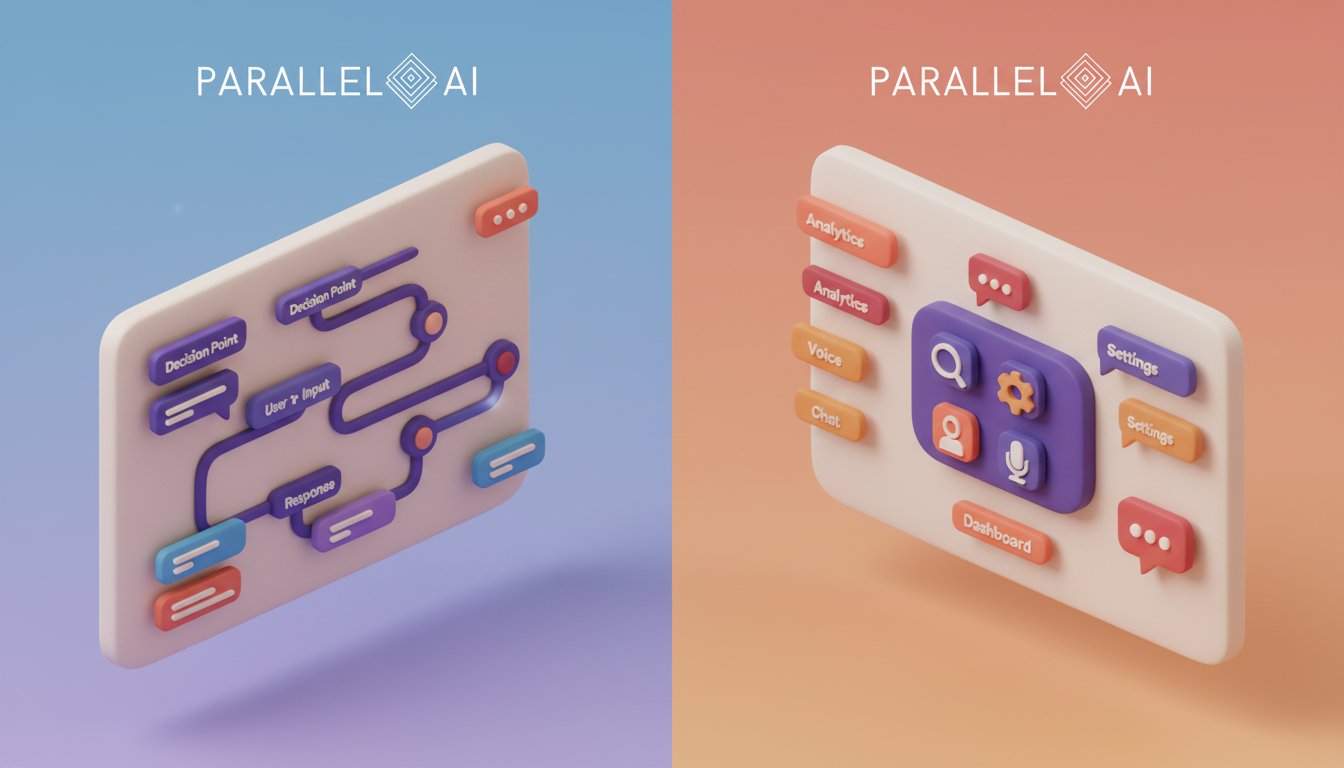
Voiceflow is a specialist: It excels at designing sophisticated conversational flows for voice and chat applications. If your agency’s entire business model revolves around building custom chatbots and voice assistants for clients, Voiceflow’s visual canvas and conversation design tools are purpose-built for this.
Parallel AI is a consolidator: It’s designed to replace your entire AI tool stack—ChatGPT, Claude, content tools, automation platforms, and yes, conversational AI—with one unified platform you can white-label and resell.
This distinction matters because it determines whether you’re adding another specialized tool to your stack or actually consolidating your existing subscriptions.
White-Label Capabilities: How Deep Does Customization Actually Go?
Both platforms advertise white-label options, but the implementation depth differs significantly.
Voiceflow’s White-Label Approach
Voiceflow positions white-labeling as the fastest way to enter the conversational AI market. According to their documentation, starting costs range from $300 to several thousand dollars monthly, depending on platform capabilities.
What you get:
– Custom branding on conversational interfaces
– Integration flexibility with your existing systems
– API access for advanced customizations
– Ability to deploy chatbots across multiple channels (web, mobile, telephony)
What’s limited:
– White-label capabilities are primarily focused on the end-user chatbot experience
– The platform itself (where you build) maintains Voiceflow branding unless you’re on Enterprise
– Documentation suggests you’ll need “API knowledge for most integrations”
– Pricing isn’t transparent until you contact sales for custom quotes
Parallel AI’s White-Label Approach
Parallel AI takes a different approach, offering what they call “complete white-label customization” starting at $119/month according to their published pricing.
What you get:
– Custom domains for your branded portal
– Full UI customization and branding control
– Branded client portals where your clients log in
– Your Stripe account for direct client billing
– Removal of all Parallel AI branding (depending on tier)
– White-label applies to the entire platform, not just end-user interfaces
What’s limited:
– Advanced customization may require some technical knowledge
– Full white-label features scale with pricing tiers
– Some integrations may require API configuration
The fundamental difference: Voiceflow white-labels the chatbot experience you deliver to your clients’ customers. Parallel AI white-labels the entire platform where you and your clients work.
For agencies reselling AI services, this matters. Your clients will see your brand when they log in to manage their AI tools with Parallel AI. With Voiceflow, white-labeling primarily affects the end-user chatbot interface.
Multi-Model Access: The Hidden Cost of Specialization
Here’s where the consolidation question becomes critical for your monthly burn rate.
Voiceflow’s AI Model Approach
Voiceflow includes “built-in AI features” with custom intents and knowledge bases. For advanced features, their Enterprise plan offers the option to bring your own LLM models.
What this means in practice:
– You’ll still need separate subscriptions to OpenAI, Anthropic, or other AI providers
– Voiceflow connects to these models but doesn’t include uncapped access
– Your cost structure: Voiceflow subscription + AI model API costs + any other tools you need
– According to comparative reviews, “bringing your own LLM” requires Enterprise pricing (custom quotes)
Typical agency stack with Voiceflow:
– Voiceflow: $150-$300+/month (Business to Enterprise)
– OpenAI API: $100-500+/month
– Content creation tool: $50-100/month
– Automation platform: $50-200/month
– Total: $350-$1,100+/month
Parallel AI’s Multi-Model Approach
Parallel AI includes what they call “uncapped access” to multiple AI models: GPT-4, Anthropic’s Claude, Google’s Gemini, Grok, DeepSeek, and Perplexity.
What this means in practice:
– No separate AI model subscriptions needed
– Switch between models within the same platform
– Large context windows (up to 1 million tokens)
– One subscription covers multiple AI providers
Cost comparison claim:
Parallel AI’s marketing states you’ll “save $400+/month vs. paying for ChatGPT Plus, Claude Pro, and Gemini separately.” Let’s verify:
– ChatGPT Plus: $20/month
– Claude Pro: $20/month
– Gemini Advanced: $20/month
– Jasper (content): $49/month
– Instantly.ai (outreach): $37/month
– Basic automation tool: $50/month
– Total: $196/month minimum
Parallel AI’s base pricing starts at $119/month according to their research documentation, which would represent actual consolidation savings if it truly replaces these tools.
Conversational AI Capabilities: Where Voiceflow Shines
Let’s be clear about where Voiceflow excels—because this matters if conversational AI is your core offering.
Voiceflow’s Conversation Design Strengths
Visual Flow Builder:
Voiceflow’s drag-and-drop canvas is genuinely impressive for designing complex conversation paths. You can visualize entire conversation trees, map out user journeys, and prototype sophisticated chatbot logic without writing code.
Industry reviews consistently praise this: “Intuitive visual flow builder suitable for collaboration and prototyping.”
Multi-Channel Deployment:
Voiceflow deploys across websites, mobile apps, and telephony systems. Their recent partnership with Vodafone (October 2025) to “revolutionize VoIP support” demonstrates serious enterprise traction in voice applications.
Team Collaboration:
Real-time collaboration features let multiple team members work on conversation designs simultaneously—essentially “Figma for conversational AI” as their $15M funding round described it.
Parallel AI’s Conversational Capabilities
Parallel AI offers AI Voice & Chat Agents that “deploy intelligent AI agents across every customer touchpoint—Voice, SMS, Website Chat, and Email.”
Key capabilities:
– 24/7 automated support and lead qualification
– Multi-channel deployment (voice, SMS, chat, email)
– Integration with knowledge bases for context-aware responses
– Workflow automation with n8n integration
The honest assessment:
If you’re building highly complex, branching conversation flows with dozens of intents and sophisticated dialog management, Voiceflow’s specialized visual designer is more powerful.
If you need conversational AI as one component of a broader automation and content strategy, Parallel AI’s integrated approach may be more efficient.
Implementation Complexity: The Hidden Time Cost
Time to value matters when you’re trying to serve clients quickly.
Voiceflow Setup Reality
Comparative reviews reveal some implementation challenges:
– “Steep learning curve” mentioned in multiple reviews
– “Technical bugs and limited documentation”
– “Poor customer support” noted in agency comparisons
– “Requires API knowledge for most integrations”
User feedback suggests Voiceflow is powerful but requires investment in learning the platform. For agencies with dedicated chatbot specialists, this investment pays off. For solopreneurs managing multiple client needs, it’s a steeper climb.
Parallel AI Setup Claims
Parallel AI markets “setup in under 30 minutes” with “basic setup estimated to complete in hours.”
Their documentation emphasizes:
– Quick implementation timelines
– Minimal technical requirements
– Guided onboarding available
– Knowledge base integration with Google Drive, Notion, Confluence
The trade-off: Faster setup often means less specialized depth in any single area. Voiceflow’s complexity exists because it offers more granular control over conversation design.
Pricing Transparency: What You’ll Actually Pay
Let’s cut through the marketing and look at real costs.
Voiceflow Pricing Structure
Published tiers:
– Starter (Free): 100 credits, 1 workspace—suitable for testing only
– Pro ($60/month): 10k-20k credits, 2 workspaces—individual builders
– Business ($150/month): 30k-200k credits, 5 workspaces—growing teams
– Enterprise (Custom): Unlimited usage, private cloud, custom LLM support
For white-label agencies:
Research indicates white-label capabilities start at “$300 to a few thousand dollars per month based on platform power and features.” This suggests Enterprise pricing is required for full white-label, but exact costs aren’t published.
Hidden costs to consider:
– AI model API costs (if using your own LLM)
– Additional integration costs
– Scaling beyond credit limits
– Custom development for advanced features
Parallel AI Pricing Structure
Published information:
– White-label option starts at $119/month
– Pricing described as “transparent and scalable”
– Multiple tiers available (Free to Enterprise)
– No separate AI model subscription costs
Agency revenue model guidance:
Parallel AI’s documentation provides specific white-label margin examples:
– Base cost: $387/month
– Recommended client charge: $697/month
– Agency profit: $310/month per client (30-70% margins)
This level of pricing transparency is unusual in the white-label space and helps agencies model their business economics before committing.
Integration Ecosystem: Connecting Your Existing Stack
Both platforms need to work with your existing tools to be useful.
Voiceflow Integrations
Strengths:
– API-first architecture for custom integrations
– Third-party service connections
– CRM system compatibility (with development)
– Multi-channel deployment built-in
Limitations:
– Reviews note “requires API knowledge for most integrations”
– Limited pre-built integrations compared to broader platforms
– Focus remains on conversational endpoints rather than business tools
Parallel AI Integrations
Native integrations:
– Google Drive, Notion, Confluence (knowledge bases)
– n8n workflow automation (custom nodes available)
– Stripe for billing
– CRM systems mentioned (HubSpot, Salesforce, HighLevel in research)
– Email, SMS, chat, voice channels
Approach:
Rather than deep integrations with hundreds of tools, Parallel AI positions itself as the replacement for those tools, with selective integrations for data sources and workflow automation.
Real Agency Use Cases: Who Uses Which Platform?
Voiceflow’s Sweet Spot
Ideal agency profile:
– Specializes in conversational AI and chatbot development
– Builds custom voice assistants for enterprise clients
– Has dedicated conversation designers on team
– Clients need sophisticated, branching dialog management
– Can invest time in learning specialized tools
– Willing to manage separate AI model subscriptions
Example use case:
A digital agency building a custom voice assistant for a healthcare provider that needs to handle complex patient inquiries, route to appropriate departments, and integrate with existing appointment systems. Voiceflow’s visual flow designer makes mapping these complex interactions manageable.
Parallel AI’s Sweet Spot
Ideal agency profile:
– Solopreneurs or micro-agencies (1-10 employees)
– Offers multiple AI services (content, automation, chatbots)
– Currently paying for 6+ separate AI tools
– Needs quick implementation to serve clients fast
– Wants recurring revenue from white-label resale
– Values tool consolidation over specialized depth
Example use case:
A marketing consultant managing 15 small business clients who need content creation, social media automation, basic chatbots for their websites, and lead qualification. Parallel AI’s all-in-one approach means one platform to learn, one subscription to manage, and one branded solution to sell.
The Security and Compliance Question
For agencies serving regulated industries, this matters.
Voiceflow Security
Reviews and comparisons note that platforms like GPTBots offer “more robust data security controls” than Voiceflow, suggesting security isn’t Voiceflow’s primary differentiator.
Enterprise plans likely include enhanced security, but specifics aren’t published in lower tiers.
Parallel AI Security
Published security features:
– AES-256 encryption
– TLS protocols
– SOC 2 compliance mentioned in research
– GDPR compliance
– Privacy commitment: data not used for model training
– On-premise deployment for Enterprise
Support and Documentation: When You’re Stuck at 2 AM
Agency reality: You’ll need help at inconvenient times.
Voiceflow Support
User reviews specifically call out “poor customer support” and “limited documentation” as weaknesses. This is concerning for agencies depending on the platform for client deliverables.
The visual interface may be intuitive once learned, but getting unstuck when you hit edge cases appears challenging based on user feedback.
Parallel AI Support
Limited independent reviews make this harder to assess objectively. Their marketing emphasizes:
– Guided onboarding available
– Documentation for features
– Quick response emphasis
Without extensive user reviews, support quality remains a question mark that agencies should test during trial periods.
The Honest Pros and Cons
Voiceflow Advantages
✅ Superior conversation design tools for complex chatbot logic
✅ Visual flow builder that’s genuinely intuitive for conversation mapping
✅ Multi-channel deployment including telephony and voice
✅ Real-time collaboration for team-based development
✅ Enterprise traction (Vodafone partnership, $15M funding)
✅ Specialized focus means deep capabilities in conversational AI
Voiceflow Disadvantages
❌ Steep learning curve and technical bugs reported
❌ Poor documentation and support according to user reviews
❌ Pricing not transparent for white-label Enterprise features
❌ Doesn’t consolidate tools—you’ll still need separate AI subscriptions
❌ Requires API knowledge for most integrations
❌ Limited analytics compared to competitors
Parallel AI Advantages
✅ True tool consolidation—replaces 8+ separate subscriptions
✅ Transparent pricing with published white-label costs
✅ Uncapped multi-model access (OpenAI, Anthropic, Gemini, etc.)
✅ Quick setup (under 30 minutes claimed)
✅ Cost savings ($400+/month vs. separate tools)
✅ Full platform white-label, not just end-user interfaces
✅ Agency margin guidance helps business planning
Parallel AI Disadvantages
❌ Less specialized conversation design tools than Voiceflow
❌ Newer platform with less independent user review data
❌ May lack depth in any single area vs. specialized tools
❌ Support quality unclear without extensive reviews
❌ Jack-of-all-trades risk—trying to do too much
Making the Decision: A Framework
Here’s how to choose based on your specific situation:
Choose Voiceflow if:
- Conversational AI is your primary business (80%+ of revenue)
- You build complex, enterprise-grade voice assistants
- You have or plan to hire dedicated conversation designers
- Your clients need sophisticated dialog management with dozens of intents
- You’re willing to invest time learning specialized tools
- You have budget for multiple tool subscriptions ($500+/month)
- Visual conversation design is critical to your workflow
- You’re comfortable with custom Enterprise pricing
Choose Parallel AI if:
- You’re a solopreneur or micro-agency (1-10 employees)
- You offer multiple AI services (content, automation, chatbots)
- You’re currently paying for 6+ separate AI tools
- You need quick implementation (days, not months)
- Tool consolidation and cost savings are priorities
- You want transparent pricing to model business economics
- Recurring white-label revenue appeals to your business model
- You value breadth over specialized depth
Consider Both if:
- You’re a larger agency with specialized teams
- You can assign Voiceflow to conversation designers and Parallel AI to content/marketing teams
- Budget allows for specialized tools where needed
- You have diverse client needs requiring different approaches
The ROI Calculation You Should Run
Before committing to either platform, calculate your actual ROI:
Voiceflow ROI Model
Costs:
– Voiceflow Business/Enterprise: $300-1,000+/month (estimated)
– AI model APIs: $100-500/month
– Other tools still needed: $200-400/month
– Learning curve time: 20-40 hours
– Total monthly: $600-$1,900+
Revenue potential:
– Charge per chatbot project: $3,000-15,000
– Monthly chatbot management: $500-2,000/client
– White-label margin: Custom (Enterprise pricing)
Break-even: 1-2 chatbot clients with ongoing management
Parallel AI ROI Model
Costs:
– Parallel AI white-label: $119-387/month (based on research)
– Additional tools needed: Potentially $0 (consolidation claim)
– Learning curve time: 5-10 hours (quick setup claim)
– Total monthly: $119-387
Revenue potential:
– Per client white-label charge: $697/month (their example)
– Profit per client: $310/month (at base $387 cost)
– Setup/onboarding: $1,500-5,000 one-time
Break-even: 1-2 white-label clients
Cost savings: $400+/month in consolidated subscriptions
What Users Actually Say
Let’s look at real feedback from agencies using these platforms:
Voiceflow User Sentiment
From comparative reviews and market analysis:
– “Intuitive visual flow builder” (positive)
– “Steep learning curve” (negative)
– “Technical bugs” (negative)
– “Poor customer support” (negative)
– “Limited documentation” (negative)
– “Suitable for collaboration and prototyping” (positive)
The pattern: Powerful when mastered, but frustrating to learn and get support for.
Parallel AI User Sentiment
Limited independent reviews available, but from research data:
– Users report “80+ pieces of content/month vs. 10-15 before”
– “20x ROI” claimed in marketing firm case study
– “Setup in under 30 minutes” marketing claim
– “Save $400+/month” consolidation benefit
The pattern: Strong consolidation value claims, but less independent validation than established players.
The Consolidation Question: Does It Actually Work?
This is the critical question for Parallel AI’s value proposition.
Can one platform truly replace:
– ChatGPT Plus ($20/month)
– Claude Pro ($20/month)
– Gemini Advanced ($20/month)
– Jasper or Copy.ai ($49-99/month)
– Instantly.ai or similar ($37-97/month)
– Chatbot builder ($50-150/month)
– Automation platform ($50-200/month)
– Total: $246-606/month
Parallel AI’s claim: Yes, with their multi-model access, content engine, sequences, and AI agents.
The skeptical view: Specialized tools often do their specific job better than all-in-one platforms.
The practical reality: For solopreneurs and micro-agencies, “good enough” across multiple functions beats “excellent” in one area if it means managing fewer tools and lower costs.
Future-Proofing Your Decision
Both platforms are evolving rapidly:
Voiceflow’s Trajectory
- $15M Series A funding (August 2023)
- Strategic partnership with Vodafone (October 2025)
- Positioning as “Figma for conversational AI”
- Focus on enterprise voice applications
Trajectory: Deeper specialization in conversational AI, likely with more enterprise features and complexity.
Parallel AI’s Trajectory
- Claimed $1M ARR achievement (from research)
- Expanding white-label program
- Adding more AI models and integrations
- Focus on consolidation and agency partnerships
Trajectory: Broader platform covering more use cases, potentially at the risk of being spread too thin.
The Verdict: Which Platform Actually Delivers ROI?
Here’s the honest answer: It depends entirely on your business model.
Voiceflow delivers superior ROI if:
Conversational AI is your core competency and primary revenue source. The specialized tools justify the complexity and cost because they enable you to charge premium rates for sophisticated chatbot development. Your clients need enterprise-grade voice assistants with complex dialog management.
You’re building a specialized conversational AI agency, not a general AI services firm.
Parallel AI delivers superior ROI if:
You’re a solopreneur or micro-agency bleeding money on multiple AI subscriptions while trying to serve diverse client needs. The consolidation savings ($400+/month) plus white-label revenue potential ($310/month per client in their model) create compelling economics.
You value breadth over depth and want one platform to learn instead of six.
The Hybrid Approach Nobody Mentions
Here’s an option worth considering: Use both strategically.
Parallel AI as your primary platform for:
– Content creation across clients
– General AI model access
– Automation and workflows
– Knowledge base management
– Client portal (white-label)
Voiceflow for specialized projects:
– Complex enterprise chatbot builds
– Voice assistant development
– Projects requiring sophisticated conversation design
– Clients willing to pay premium for specialized tools
Total cost: $119-387 (Parallel AI) + $60-150 (Voiceflow Pro/Business) = $179-537/month
Still potentially cheaper than managing 8+ separate tools, while maintaining specialized capabilities where needed.
Red Flags to Watch For
Before committing to either platform, verify these potential concerns:
Voiceflow Red Flags
🚩 Support responsiveness during your trial
🚩 Actual Enterprise pricing (get written quote)
🚩 Hidden costs for integrations or API usage
🚩 Credit limits and overage charges
🚩 White-label restrictions on lower tiers
Parallel AI Red Flags
🚩 Independent user reviews (limited availability)
🚩 Model access limits (verify “uncapped” claims)
🚩 Actual consolidation effectiveness for your use cases
🚩 White-label customization depth
🚩 Platform stability and uptime
Your Next Steps
Here’s a practical action plan:
Week 1: Trial Both Platforms
– Sign up for Voiceflow’s free tier
– Request Parallel AI demo or free trial
– Build the same simple chatbot project on both
– Time how long each takes
Week 2: Calculate Your Economics
– List all current AI tool subscriptions
– Calculate actual monthly costs
– Model potential consolidation savings
– Project white-label revenue based on current client base
Week 3: Test With One Client
– Choose your less complex client
– Build their solution on your preferred platform
– Track implementation time and challenges
– Gather client feedback
Week 4: Make Your Decision
– Compare actual costs vs. projections
– Assess learning curve reality
– Evaluate support responsiveness
– Commit to one platform or hybrid approach
The Bottom Line
Voiceflow and Parallel AI solve different problems:
Voiceflow is the specialized conversational AI design tool for agencies building this as their core offering. You’ll pay more, manage more tools, and invest more learning time—but you’ll deliver more sophisticated chatbot solutions.
Parallel AI is the consolidation platform for solopreneurs and micro-agencies drowning in subscriptions and seeking white-label revenue opportunities. You’ll sacrifice some specialized depth but gain cost savings, simplicity, and business model flexibility.
Neither is objectively “better.” They’re optimized for different business models.
The real question isn’t “Which platform is best?” It’s “Which problem do I actually need to solve?”
If you’re building a specialized conversational AI agency with dedicated designers and enterprise clients paying premium rates, Voiceflow’s depth justifies its complexity.
If you’re a solopreneur managing multiple client needs while bleeding $1,500+/month on scattered AI tools, Parallel AI’s consolidation approach offers clearer ROI through cost savings and white-label revenue potential.
For most readers of this comparison—solopreneurs and micro-agencies seeking to add AI services without expanding their team—Parallel AI’s value proposition is more aligned with the actual problem: too many tools, too much cost, not enough margin.
But don’t take my word for it. Trial both platforms with a real client project. Calculate your actual costs. Then choose based on your numbers, not marketing claims.
Your ideal AI platform isn’t the one with the most features—it’s the one that makes your business more profitable.
Ready to test Parallel AI’s consolidation approach? Start your free trial and see if it actually replaces your existing tool stack.
Want to explore Voiceflow’s conversation design capabilities? Visit their website to request an Enterprise demo and get transparent pricing for white-label features.
The best decision is an informed one—based on your specific business economics, not generic comparisons.
Related reading
- Top 10 White-Label AI Platforms Compared: The 2026 Guide to Building Your AI Business Without Code
- Voiceflow vs Parallel AI: Which White-Label Platform Actually Delivers Complete Business Automation Beyond Chatbots for Micro-Agencies in 2026?
- Boost.ai vs Parallel AI: Which White-Label Platform Actually Delivers ROI for Solopreneurs Without Enterprise Complexity?
- Botpress vs Parallel AI: Which White-Label Platform Actually Delivers Complete Business Automation for Agencies in 2025?