
You’re watching larger competitors flood the market with business development reps while you’re stuck choosing between hiring a $88,000/year BDR or personally handling every cold outreach, qualification call, and follow-up sequence. By the time you finish your morning prospecting, enterprise sales teams have already touched 500 accounts across email, LinkedIn, phone, and SMS—with consistent messaging and zero fatigue.
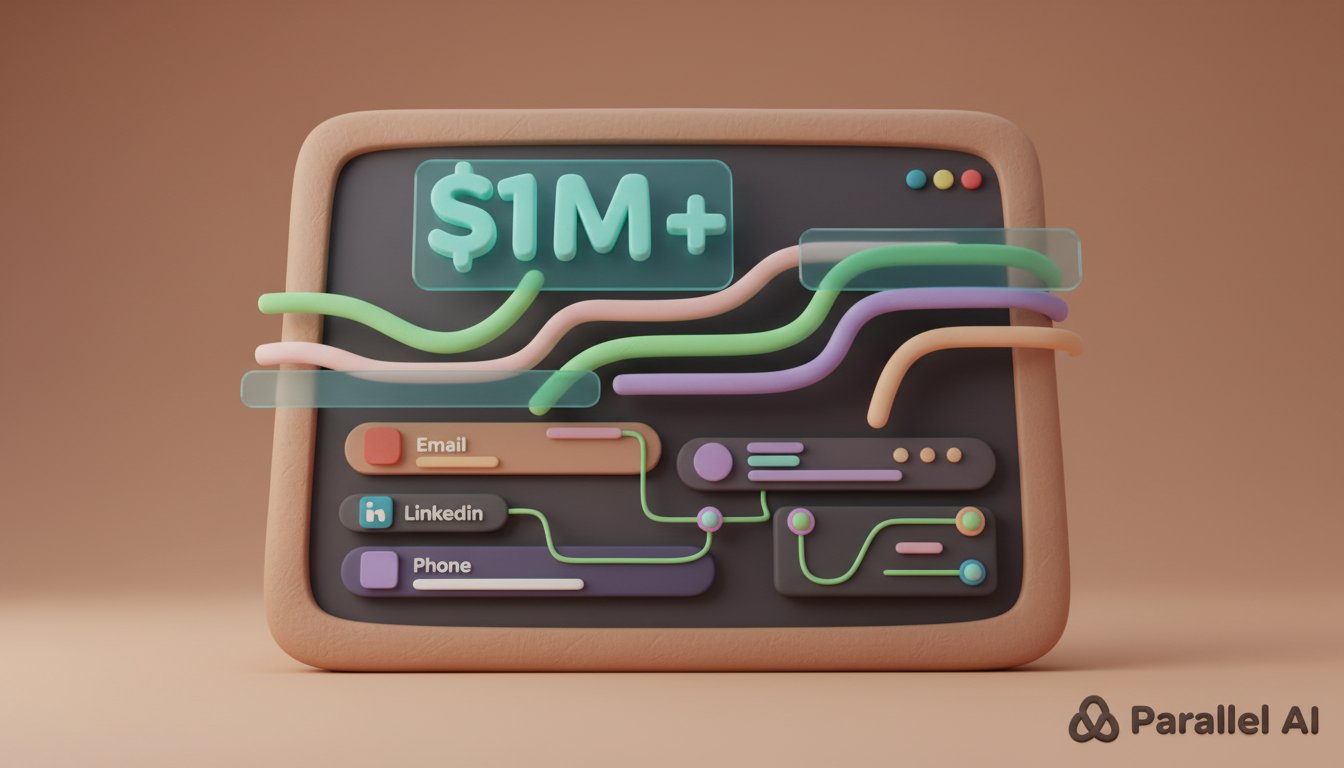
The business development math has fundamentally broken for solopreneurs and micro-agencies. Traditional BDRs cost $70,000-$88,000 annually in fully loaded expenses, require 6-12 months to reach full productivity, and scale linearly—meaning every revenue increase demands proportional headcount growth. Meanwhile, AI Business Development Representatives are generating $1M+ pipelines at a fraction of the cost, operating 24/7 across multiple channels, and scaling infinitely without adding a single salary.
This isn’t speculative technology. In January 2026, DeepSales received Congressional recognition for disrupting go-to-market execution with autonomous AI BDRs. CFOs have already allocated 25% of total AI budgets—approximately $20 billion—to AI agents, signaling massive near-term infrastructure investment. The agentic AI platforms market, valued at $12-15 billion in 2025, is projected to reach $80-100 billion by 2030 at a 40-50% CAGR.
The competitive window is closing. While you’re debating whether to hire that first BDR, your competitors are deploying AI agents that prospect, qualify, and route leads autonomously across every channel your ideal customers use. Here’s how forward-thinking solopreneurs are building AI BDR systems that compete with enterprise sales teams—without enterprise budgets or technical expertise.
The AI BDR Architecture: From Single-Channel Outreach to Autonomous Multi-Channel Orchestration
Traditional business development follows a sequential, human-limited model: research prospects manually, craft individual emails, wait for responses, follow up sporadically, qualify on ad-hoc calls, then hand off to sales. A single BDR might touch 50-80 prospects daily with inconsistent messaging, limited channel coverage, and significant qualification errors.
AI BDRs operate fundamentally differently—through autonomous, multi-agent orchestration that coordinates simultaneous outreach across email, LinkedIn, SMS, voice, and chat while maintaining context-aware conversations that adapt in real-time to prospect behavior.
The Super Agent Control Plane
The 2026 AI BDR paradigm centers on what industry experts call “super agents”—single control planes managing multiple specialized agents across different environments without manual coordination. Instead of you juggling separate tools for email sequences, LinkedIn outreach, SMS campaigns, and voice follow-ups, a super agent architecture coordinates all channels from one dashboard.
Parallel AI enables this exact architecture through its integrated platform. You build multiple specialized agents—an Email Prospector Agent, a LinkedIn Engagement Agent, a Qualification Router Agent, and a Follow-Up Orchestrator Agent—each with specific domain logic, then coordinate them through unified workflows that share context and qualification data.
Here’s how this works in practice: Your Email Prospector Agent identifies high-intent prospects from your CRM, enriches their profiles with company data and recent activity, then initiates personalized email sequences. Simultaneously, your LinkedIn Engagement Agent monitors those same prospects’ social activity, commenting on relevant posts and sending connection requests with context-aware messaging. When a prospect engages on either channel, your Qualification Router Agent instantly assesses their fit against your ICP criteria, routes high-quality leads to your calendar booking system, and triggers appropriate follow-up sequences for prospects needing more nurturing.
This isn’t theoretical infrastructure—it’s production-ready architecture you can deploy in Parallel AI within 48 hours, not 6 months of custom development.
Real-Time Qualification Logic That Replaces Manual Discovery Calls
Traditional BDRs spend 40-60% of their time on qualification calls that could be automated. They ask the same discovery questions, capture inconsistent information, and make subjective judgment calls about lead quality that vary wildly between reps.
AI BDRs implement real-time qualification systems that assess prospects dynamically based on behavioral signals, firmographic data, and engagement patterns—without requiring synchronous calls for initial qualification.
With Parallel AI, you build qualification logic directly into your agents using the platform’s unlimited context windows (up to 1 million tokens). Your agents access your entire knowledge base—past sales conversations, successful deal patterns, objection handling frameworks, and ICP definitions—then apply that institutional knowledge to every prospect interaction instantly.
Your AI BDR agent asks qualification questions through conversational email sequences, LinkedIn messages, or SMS conversations. When a prospect responds, the agent processes their answer against your qualification criteria in real-time: company size matches ICP, budget authority confirmed, timeline identified, pain points align with your solution. High-quality leads get routed immediately to your calendar with a pre-populated brief. Mid-tier prospects enter nurture sequences with domain-specific content addressing their specific concerns. Low-fit prospects receive polite disqualification messages that preserve relationship capital.
The result? You’re qualifying 10-15x more prospects than a human BDR could handle, with consistent criteria application and zero subjective bias.
Multi-Channel Coordination Without Channel Conflict
One of the biggest implementation failures in AI BDR systems is channel conflict—prospects receiving duplicate messages across email and LinkedIn, inconsistent messaging between channels, or poorly timed outreach that overwhelms rather than engages.
Successful AI BDR orchestration requires conflict resolution protocols that traditional automation tools don’t provide. Your system needs to know: if this prospect engaged with our LinkedIn message yesterday, should we pause the email sequence? If they opened three consecutive emails without responding, should we shift to SMS or phone outreach? If they’re actively viewing our website while we have them in a nurture sequence, should we accelerate to direct outreach?
Parallel AI solves this through integrated workflow orchestration that shares context across agents. Your Email Prospector Agent and LinkedIn Engagement Agent don’t operate in isolation—they’re coordinated through shared prospect records that track every interaction, engagement signal, and channel preference.
You build coordination rules directly into your agent workflows: “If prospect engages on LinkedIn, pause email sequence for 48 hours and allow LinkedIn agent to drive conversation.” “If prospect opens three emails without clicking, trigger SMS agent with value-focused message.” “If prospect visits pricing page, immediately notify me and route to high-priority follow-up queue.”
This level of orchestration traditionally required custom development and significant technical expertise. With Parallel AI’s visual workflow builder and pre-built integration connectors, you’re implementing enterprise-grade coordination logic in hours, not months.
Domain-Specific BDR Models: Why Generic AI Agents Fail at Complex B2B Sales
Here’s where most AI BDR implementations break down: they treat business development as a generic, one-size-fits-all process. Generic AI agents send templated messages that sound robotic, ask qualification questions that miss industry-specific nuances, and fail to handle objections that experienced BDRs navigate effortlessly.
The 2026 trend is clear—domain-enriched AI models that reflect expert workflows are becoming competitive requirements. Your AI BDR needs to understand not just general sales qualification, but the specific patterns, objection types, and buying criteria unique to your industry and ideal customer profile.
Building Industry-Specific Qualification Frameworks
A SaaS AI BDR qualifying enterprise software buyers operates completely differently than an agency AI BDR qualifying marketing directors or a professional services AI BDR qualifying C-suite executives. The questions, the qualification criteria, the objection patterns, the decision-making timelines—everything varies by industry, deal complexity, and buyer persona.
Parallel AI enables domain-specific customization through its knowledge base integration and unlimited context capabilities. You’re not constrained by token limits or generic training data—you feed your AI BDR agents your actual successful sales conversations, industry-specific objection handling scripts, competitive positioning documents, and ideal customer profiles.
Here’s the implementation process: Start by documenting your 10-15 most successful business development conversations. What questions did you ask? What objections came up? How did you handle them? What signals indicated high purchase intent? Upload these conversation transcripts to your Parallel AI knowledge base. Then build your AI BDR agent with explicit instructions: “You are a business development representative specializing in [your industry]. When qualifying prospects, focus on [specific criteria]. Common objections include [list], and you handle them by [framework]. High-intent signals include [specific behaviors].”
Your AI BDR now operates with the institutional knowledge of your best human BDRs—but applies it consistently across 500+ conversations simultaneously, 24/7, without variance or fatigue.
Objection Handling That Maintains Deal Momentum
Generic AI agents collapse when prospects raise objections. They either ignore the concern and continue with scripted messaging (destroying credibility), or they escalate immediately to human intervention (eliminating efficiency gains).
Sophisticated AI BDRs handle objections through multi-turn conversations that address concerns, provide relevant proof points, and maintain deal momentum—exactly like experienced human BDRs.
With Parallel AI, you build objection handling directly into your agent’s conversation logic. Your AI BDR recognizes common objection patterns—”We’re already working with a competitor,” “Budget is allocated for this year,” “Not the right time,” “Need to discuss with team”—and responds with context-appropriate frameworks.
When a prospect says “We’re already working with [competitor],” your AI BDR doesn’t give up. It responds: “That’s great that you’re already investing in [category]. Many of our customers were working with [competitor] when they discovered our approach to [specific differentiation]. Would it be valuable to see how [Customer Name] used both solutions to achieve [specific outcome]?” The agent then shares a relevant case study from your knowledge base, addressing the specific competitor concern with proof points.
This level of sophisticated conversation requires two capabilities: deep domain knowledge (your uploaded sales frameworks and competitive intelligence) and advanced language models that understand context and nuance (Parallel AI’s access to OpenAI, Anthropic, Gemini, Grok, and DeepSeek models). You’re not limited to a single AI model—you choose the best model for each conversation type, switching between models based on complexity, response speed, or cost optimization.
The White-Label Advantage: Turning Your AI BDR Into a Productized Service
Here’s the strategic opportunity most solopreneurs miss: once you build a high-performing AI BDR system, you can white-label it and offer it as a service to clients, creating a new revenue stream with minimal marginal cost.
An agency building AI BDR agents for clients faces a choice: build custom solutions for each client (expensive, time-consuming, technically complex), or use a white-label platform that lets you brand the solution as your own proprietary technology.
Parallel AI provides white-label capabilities that let you rebrand the entire platform—custom domain, your logo, your color scheme, your branded AI agents. You build the AI BDR architecture once, then deploy customized versions for multiple clients, each operating under your brand with client-specific knowledge bases and qualification criteria.
The economics are compelling: you charge clients $3,000-$8,000 monthly for a branded AI BDR service (positioning it as a fraction of a human BDR’s cost), while your actual platform costs remain fixed. Each additional client deployment takes 4-8 hours of customization work, not weeks of custom development. You’re suddenly operating a scalable, high-margin service business built on AI BDR infrastructure.
Implementation Without Technical Debt: The Parallel AI Deployment Framework
The traditional path to AI BDR implementation involves months of evaluation, complex technical integration, custom development, and significant ongoing maintenance. By the time you’re operational, your competitors have already captured market share and your requirements have evolved.
Parallel AI enables rapid deployment through pre-built connectors, visual workflow builders, and template-based agent creation—without sacrificing customization or sophistication.
The 48-Hour AI BDR Deployment Blueprint
Hours 0-8: Foundation and Knowledge Base Setup
Start by consolidating your business development knowledge. Upload your ICP definitions, successful email templates, qualification frameworks, objection handling scripts, case studies, and competitive positioning documents to Parallel AI’s knowledge base. The platform integrates directly with Google Drive, Confluence, and Notion, so you’re syncing existing documentation rather than recreating it.
Connect your CRM (HubSpot, Salesforce, Pipedrive) and email infrastructure (Gmail, Outlook 365) through Parallel AI’s pre-built connectors. These integrations take minutes, not days—no custom API development required.
Hours 8-16: Agent Architecture and Workflow Design
Build your core AI BDR agents using Parallel AI’s agent templates. Create your Email Prospector Agent with instructions for your outreach approach, tone, and qualification questions. Build your LinkedIn Engagement Agent with social selling best practices and connection request frameworks. Configure your Qualification Router Agent with your specific lead scoring criteria and routing rules.
Design your multi-channel workflows using the visual builder. Map out the prospect journey: initial email sequence → LinkedIn connection request → qualification conversation → meeting booking or nurture sequence. Define trigger conditions, timing delays, and escalation pathways.
Hours 16-24: Content Development and Personalization
Develop your outreach content and let your AI agents personalize it at scale. Write 3-5 core email templates addressing different pain points and value propositions. Your AI BDR agents will customize these templates for each prospect based on their industry, role, company size, and recent activity—pulling relevant details from your knowledge base and prospect data.
Create LinkedIn message templates, SMS scripts, and follow-up frameworks. Build your objection handling responses and qualification question trees. The more frameworks you provide, the more sophisticated your AI BDR’s conversations become.
Hours 24-36: Testing and Refinement
Run test sequences with sample prospects to validate your agent behavior, messaging quality, and workflow logic. Check that your qualification criteria are capturing the right signals, your routing rules are working correctly, and your content sounds authentically human.
Parallel AI’s unlimited token access means you can iterate rapidly without worrying about API costs or usage limits. Test multiple message variations, different qualification approaches, and various conversation flows until you achieve the quality bar you need.
Hours 36-48: Production Launch and Monitoring
Deploy your AI BDR system to your initial prospect segment—start with 200-500 prospects to validate performance before scaling to your entire database. Monitor engagement rates, qualification accuracy, and meeting booking conversion.
Set up your monitoring dashboard to track key metrics: outreach volume by channel, response rates, qualification pass rate, meetings booked, and pipeline generated. Your AI BDR is now operating 24/7, handling hundreds of simultaneous conversations while you focus on closing deals.
Governance and Compliance: Building Trust Through Transparent AI
As AI BDRs move from novel technology to mainstream business infrastructure, governance and compliance are shifting from “nice-to-have” to competitive requirements. Enterprise buyers, in particular, demand transparency, auditability, and human oversight in AI-driven outreach.
Your AI BDR system needs to answer: What data is the AI accessing? How are decisions being made? What safeguards prevent inappropriate messaging? How do we audit AI conversations? What happens when the AI encounters edge cases it can’t handle?
Parallel AI addresses these governance requirements through several mechanisms:
Transparent Decision Logic: Every AI BDR action is based on explicit rules and frameworks you define. You’re not dealing with black-box AI that makes inscrutable decisions—you configure the qualification criteria, routing rules, and response frameworks, and the AI executes them consistently.
Audit Trail and Conversation History: Every prospect interaction is logged with full conversation history, timestamp, and agent decision rationale. When a prospect converts to a meeting, you can review the entire AI-driven conversation sequence that led to booking. When a prospect doesn’t respond, you can analyze where the engagement dropped off and refine your approach.
Human-in-the-Loop Controls: Build escalation triggers that route complex situations to human review. If a prospect raises an objection your AI BDR hasn’t been trained to handle, the system flags the conversation and notifies you for manual intervention. If a high-value prospect shows strong buying signals, your AI can notify you immediately for personal follow-up rather than continuing automated sequences.
Data Security and Privacy: Parallel AI implements AES-256 encryption and TLS protocols, ensuring prospect data is secured at enterprise standards. The company commits to not using your data for model training—your proprietary sales knowledge, customer information, and conversation data remain exclusively yours.
This governance-first approach isn’t just about compliance—it’s a competitive advantage. When you’re selling AI BDR services to enterprise clients or pitching your consulting services to regulated industries, demonstrating transparent, auditable AI processes builds trust and differentiates you from competitors using black-box automation.
The Economics of AI BDRs: From Cost Center to Profit Center
The business case for AI BDRs isn’t just about cost reduction—it’s about fundamentally transforming your business development economics from a linear cost center to a scalable profit center.
Traditional BDR Economics: The Linear Cost Trap
A traditional BDR costs $70,000-$88,000 annually in fully loaded expenses (salary, benefits, equipment, training, management overhead). That BDR requires 3-6 months to reach full productivity, during which you’re paying full salary for partial output. At full productivity, a high-performing BDR generates approximately 40-60 qualified meetings annually, with significant variance based on individual performance, motivation, and tenure.
When you want to double your business development capacity, you hire a second BDR—doubling your costs, extending your break-even timeline, and adding management complexity. The economics scale linearly: 2x capacity = 2x cost.
AI BDR Economics: The Exponential Leverage Model
An AI BDR system built on Parallel AI costs $12,000-$30,000 annually (platform subscription, setup time, ongoing optimization), operates at full capacity from day one, and scales infinitely without proportional cost increases. That same AI BDR system generates 150-240+ qualified meetings annually—3-4x the output of a human BDR at a fraction of the cost.
When you want to double your business development capacity, you add more prospects to your AI BDR sequences and potentially create specialized agents for different segments—your costs increase marginally (additional prospect data, minor workflow expansions), not exponentially. The economics scale non-linearly: 2x capacity = 1.1x cost.
Let’s calculate the first-year comparison:
Traditional BDR Model: $88,000 in costs, 50 qualified meetings generated (accounting for ramp-up time), $1,760 cost-per-meeting. If your average deal size is $25,000 and you close 20% of qualified meetings, you’re generating $250,000 in revenue at $88,000 cost—a 2.8x ROI.
AI BDR Model: $24,000 in costs (Parallel AI subscription plus setup/optimization time), 200 qualified meetings generated, $120 cost-per-meeting. At the same $25,000 average deal size and 20% close rate, you’re generating $1,000,000 in revenue at $24,000 cost—a 41.6x ROI.
The cost-per-lead drops from $262 for human BDRs to approximately $39 for AI BDRs—an 85% reduction. Industry reports confirm 500-800% ROI in the first year for AI BDR implementations, driven by this fundamental economic transformation.
The Compound Effect: Reinvesting BDR Savings Into Growth
Here’s where the economics become truly transformative: the $64,000 you save by using an AI BDR instead of a human BDR doesn’t just improve your margins—it becomes capital you can reinvest into growth initiatives that compound your competitive advantage.
You could hire a closer focused exclusively on high-value deals, increasing your win rate on qualified opportunities. You could invest in content marketing that feeds your AI BDR with inbound leads, creating a flywheel effect. You could expand into new market segments with specialized AI BDR agents, diversifying your revenue streams without proportional cost increases. You could build white-label AI BDR services for clients, creating a new high-margin revenue stream.
The solopreneurs and micro-agencies winning with AI BDRs aren’t just replacing human costs—they’re reinvesting the savings into strategic advantages that larger competitors can’t easily replicate.
Real-World Implementation: AI BDR Success Patterns From Early Adopters
While many AI BDR implementations remain confidential for competitive reasons, clear success patterns are emerging from early adopters across different industries and business models.
Pattern 1: The Multi-Segment Orchestrator
A B2B SaaS consultant serving both enterprise and mid-market clients faced a classic segmentation challenge: enterprise buyers required highly customized, research-intensive outreach with longer nurture cycles, while mid-market buyers responded to higher-volume, value-focused sequences with faster decision timelines. Hiring separate BDRs for each segment wasn’t economically viable at their current scale.
They built two specialized AI BDR agents in Parallel AI—an Enterprise BDR Agent with deep research capabilities, sophisticated objection handling, and multi-executive engagement workflows, and a Mid-Market BDR Agent optimized for volume, speed, and value-based messaging. Both agents shared the same core knowledge base but operated with segment-specific qualification criteria and engagement strategies.
The result: 180+ qualified meetings annually across both segments, with enterprise meetings maintaining the high-touch, research-driven quality that segment demands while mid-market outreach scales to 3x the volume previously possible. Total implementation time: 6 days. Ongoing management: 4 hours weekly for optimization and high-value escalations.
Pattern 2: The White-Label Agency Revenue Stream
A digital marketing agency traditionally offered SEO, content marketing, and paid advertising services. They recognized their clients consistently struggled with lead generation and sales development but couldn’t justify the cost of building in-house BDR teams.
The agency built a white-label AI BDR service using Parallel AI’s customization capabilities. They created a branded “AI-Powered Lead Generation Platform” with their logo, color scheme, and positioning. For each client, they deployed customized AI BDR agents with client-specific knowledge bases, qualification criteria, and messaging frameworks.
They now offer tiered AI BDR packages: $3,000/month for 500 prospect capacity, $5,000/month for 1,500 prospects, $8,000/month for unlimited prospects with advanced multi-channel orchestration. The agency’s costs remain relatively fixed (Parallel AI subscription plus 4-6 hours of customization per client), while revenue scales with each client addition. They’ve added $180,000 in annual recurring revenue with minimal operational overhead, positioning AI BDR as their fastest-growing service line.
Pattern 3: The Compliance-First Enterprise Seller
A cybersecurity consultant selling to regulated industries (healthcare, finance, government) faced stringent compliance requirements around data handling, communication auditing, and vendor security standards. Traditional BDR automation tools lacked the governance features their enterprise buyers demanded.
They built their AI BDR system explicitly around compliance and transparency. Every prospect interaction included clear opt-out mechanisms, communication preferences, and data handling disclosures. They configured human-in-the-loop reviews for all initial enterprise prospect contacts, with AI agents handling follow-up sequences only after human approval. They maintained comprehensive audit trails of every AI decision, response, and qualification action.
This governance-first approach became a competitive differentiator. When enterprise prospects asked about their sales process, they demonstrated transparent, auditable AI workflows that actually exceeded human BDR compliance standards. The result: 40% higher meeting booking rates with enterprise prospects and significantly shorter sales cycles due to reduced security review friction.
Your AI BDR Deployment Decision: The Competitive Clock Is Running
While you’re reading this, your competitors are deploying AI BDRs that prospect 24/7, qualify leads with consistent criteria, and follow up with perfect timing across every channel. They’re generating 3-4x more qualified meetings than traditional BDRs, at a fraction of the cost, and reinvesting the savings into advantages that compound monthly.
The business development landscape is undergoing a permanent structural shift. Congressional recognition of AI-driven sales automation, $20 billion in enterprise AI agent investments, and 79% of executives already implementing AI agents signal that this isn’t emerging technology—it’s current competitive infrastructure.
You have two paths: continue competing with human-limited, linear-scaling business development, or deploy AI BDRs that operate with enterprise-team capacity at solopreneur economics.
Parallel AI provides the infrastructure to deploy autonomous AI BDR systems in 48 hours, not 6 months. You get unlimited access to leading AI models (OpenAI, Anthropic, Gemini, Grok, DeepSeek), pre-built integrations with your existing tools, visual workflow builders that require zero coding, and white-label capabilities that let you productize your AI BDR system for clients. The platform starts free, scales with your growth, and provides enterprise-grade security without enterprise complexity.
The question isn’t whether AI BDRs will transform business development—that transformation is already complete among forward-thinking professionals. The question is whether you’ll deploy your AI BDR system while there’s still competitive advantage to capture, or wait until AI-driven outreach becomes table stakes and the opportunity for differentiation has passed.
Your competitors aren’t waiting. Neither should you. Book a demo with Parallel AI at https://meetquick.app/schedule/parallel-ai/agency-demo and see how to deploy your autonomous AI BDR system this week—not next quarter. The pipeline you don’t generate today is the revenue you won’t close tomorrow. Start building your AI BDR advantage now.