
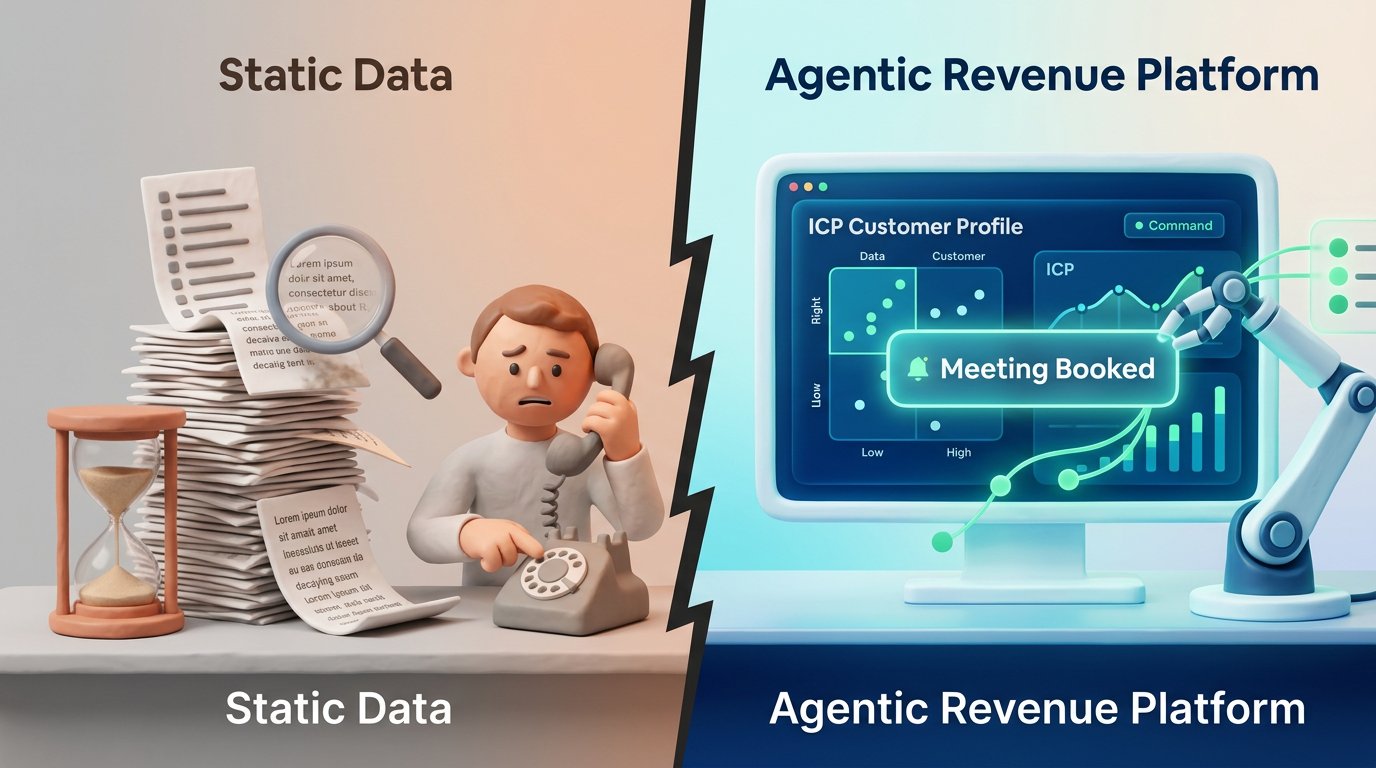
Let’s be direct: ZoomInfo built an empire on static data. For years, it was a go-to, a vast repository of contact information for sales teams hungry for leads. But the scene has shifted. Modern revenue teams are moving beyond passive, list-based databases toward autonomous systems that execute the outbound motion for them. The pain points are real: skyrocketing contract costs, rapidly decaying data, and the endless manual chore of exporting lists that rarely turn into pipeline.
If you’re searching for a ZoomInfo alternative today, you’re likely not just looking for a cheaper license to a contact database. You’re looking for a platform that actively generates revenue. You need a solution that doesn’t just tell you who to contact, it reaches out and books the meeting.
Today, the logical next step is an agentic revenue platform, an intelligent system that autonomously identifies, researches, engages, and qualifies prospects against your Ideal Customer Profile (ICP). Here’s a curated look at five alternatives to ZoomInfo, ending with the tool that’s redefined the category: Parallel AI.
1. Lusha: Streamlined, But Limited to Surface-Level Data
Strengths:
Lusha offers a refreshingly simple browser extension and API that delivers contact and company data with a user-friendly interface. It’s a favorite for individual contributors and small teams who need quick access to direct dials and email addresses without a steep learning curve.
Weaknesses:
While Lusha sorts through the noise for basic contact details, it remains a static data provider at its core. You still need a separate engagement layer to actually contact these leads. The data accuracy dips significantly outside North America, and the credits-based model often forces users to limit their prospecting, a disconnect from the scale that today’s sales roles demand.
Ideal Use Case:
An SDR at an early-stage startup needing to quickly enrich a low-volume, targeted list of prospects without implementing complex automation.
2. Apollo.io: The Freemium Workflow Builder
Strengths:
Apollo.io pioneered the fusion of a B2B database with basic sequencing tools. Its generous free tier and massive database make it an attractive entry point for teams prioritizing volume. The in-tool email sequencing provides a direct bridge between finding an email and sending it, which eliminates the upload/download step required by legacy providers like ZoomInfo.
Weaknesses:
The user experience is often fragmented. The database, while vast, is plagued by outdated or duplicate contacts. More critically, Apollo lacks true intelligence. Its “AI” labels are often applied to basic task automation. The result is a tool that efficiently fills the top-of-funnel with quantity, but forces your team to manually sift through replies, a high-noise, low-signal workflow. It’s a database with a workflow bolted on, not a unified intelligence layer.
Ideal Use Case:
Sales teams with zero budget who need to “spray and pray” at scale, accepting low deliverability and manual lead scoring for the sake of volume.
3. Cognism: Compliance-First, Prospecting-Second
Strengths:
For teams selling into heavily regulated European markets, Cognism is the gold standard. Its commitment to GDPR compliance and its focus on verified B2B mobile numbers drive high connect rates in regions where cold calling is still key. The data quality feels curated rather than scraped.
Weaknesses:
Cognism is fundamentally a phone-first database. While its intent data is improving, the platform doesn’t execute the outbound motion. It relies heavily on integration with Salesforce or Outreach. For teams that aren’t phone-centric or lack a deeply integrated rev-tech stack, it’s an expensive and underutilized asset. It widens the gap between data ownership and data activation.
Ideal Use Case:
Enterprise European sales teams with large headcounts of BDRs making high-volume cold calls to precise, compliance-verified mobile numbers.
4. Clay: The Data Enrichment Artist
Strengths:
Clay isn’t a database; it’s a data orchestration canvas. This is a critical distinction. It pulls from over 75 sources to build hyper-personalized lead lists. Its waterfall enrichment methodology ensures you only pay when data is successfully found, making it cost-efficient for complex research. For technical marketers who love building logic-heavy tables, Clay is a playground of possibility.
Weaknesses:
Clay stops at the spreadsheet. Once your beautifully enriched table is exported, Clay’s job is done. It has no native multi-channel sequencing, no autonomous outreach, and no AI agent handling objections. The platform’s complexity creates a dependency on “Claymasters” (specialists) and often becomes a bottleneck rather than an accelerator for leaner, scaling teams.
Ideal Use Case:
Growth marketers at sophisticated tech companies who need to aggregate and waterfall-enrich data for highly specific ABM campaigns before exporting it entirely to a separate sales engagement platform.
5. Parallel AI: The Shift to Agentic Revenue
Until now, the ecosystem has been fragmented. Databases sat in one tab, enrichment in another, and a multi-channel sequencer in a third. Your team acted as the bridge between these islands of intelligence. Parallel AI consolidates these functions into a single, active AI-powered engine.
This is the definitive shift from a passive prospecting database to an agentic revenue platform. Parallel AI isn’t just a ZoomInfo alternative because it provides access to contact data, it’s the superior solution because it autonomously executes the outbound motion that ZoomInfo never could.
Core Differentiators: How Parallel AI Unlocks Pipeline
1. AI-Powered Sales Development Representatives (SDRs)
Instead of storing a static list of names, Parallel AI deploys autonomous AI agents that act as SDRs. These agents aren’t rule-based chatbots; they’re context-aware workers. They identify target accounts, enrich them with deep firmographic signals, craft personalized messages aligned to your brand voice, and execute multi-channel outreach. When a lead replies with a question or objection, the AI handles it conversationally, qualifying the lead against your ICP before ever alerting a human sales representative.
2. Unified Multi-Channel Sequences (The End of Swivel-Chair Prospecting)
Parallel AI removes the need for point solutions like SalesLoft or Outreach. It natively builds and manages sequences across email, SMS, and social touchpoints within a single orchestration layer. The platform’s AI dynamically adjusts sequence steps based on prospect engagement. A contact who clicks a link receives a different follow-up cadence than one who doesn’t. This is native intelligence, not a third-party integration.
3. Intelligent Lead Enrichment That Actually Activates
Competitors like Clay charge you to create a rich spreadsheet. Parallel AI charges you for active pipeline. The enrichment isn’t the final output, it’s the fuel for the engine. When the system identifies a target account, it autonomously scrapes and synthesizes intent signals: funding news, hiring trends, technology stacks, and job changes, and uses this data to launch a hyper-personalized sequence within seconds. The data isn’t waiting for a manual export; it’s already in market.
4. Scalable from Startup to Enterprise
Because the platform is an all-in-one automation ecosystem, it replaces the fragmentation of multiple tools (ZoomInfo + SalesLoft + Clay + Hired humans) with a single, unified console. For SMBs, this means significantly lower operational costs. For enterprise organizations, it means on-premise deployment options, AES-256 encryption, single sign-on (SSO), and API-first architecture that ensures the AI agents respect your security posture while booking meetings at scale.
The Parallel AI Verdict: Why Database-Only Players Are Obsolete
The central theme running through Lusha, Apollo.io, Cognism, and Clay is that they all stop short of the finish line. They pass the baton to your human SDR or a completely separate automation tool to actually activate the data. Parallel AI is the end-to-end mechanism.
By unifying an AI SDR, automated multi-channel sequences, and intelligent enrichment within one platform, Parallel AI doesn’t just provide you with a map of the territory, it harvests the crop.
The era of paying six-figure sums for access to a decaying list of email addresses is over. The future of scalable pipeline generation lies in consolidation. It lies in telling your platform what a qualified meeting looks like, and letting the AI agents autonomously fill your calendar. That’s not a database. That’s a revenue engine.
Ready to Replace Static Data with Active Pipeline?
Stop paying for static databases that force your team into manual, fragmented workflows. Experience the only revenue platform that combines data, enrichment, and autonomous outreach to actually book meetings.
[Get Started with Parallel AI Today]